Animal Control Officer Resume Examples: read this first
Write an Animal Control Officer Resume That Wins the Interview
By Mustafa Tarabya, founder of CVBooster · Published · Updated
Animal control officer resume example, keyword list and writing guide covering capture technique, bite investigations, ordinance enforcement and cruelty cases.
Sample resumes for a animal control officer
The same animal control officer content laid out in three CVBooster templates, so you can see what the finished document looks like before you write a word.
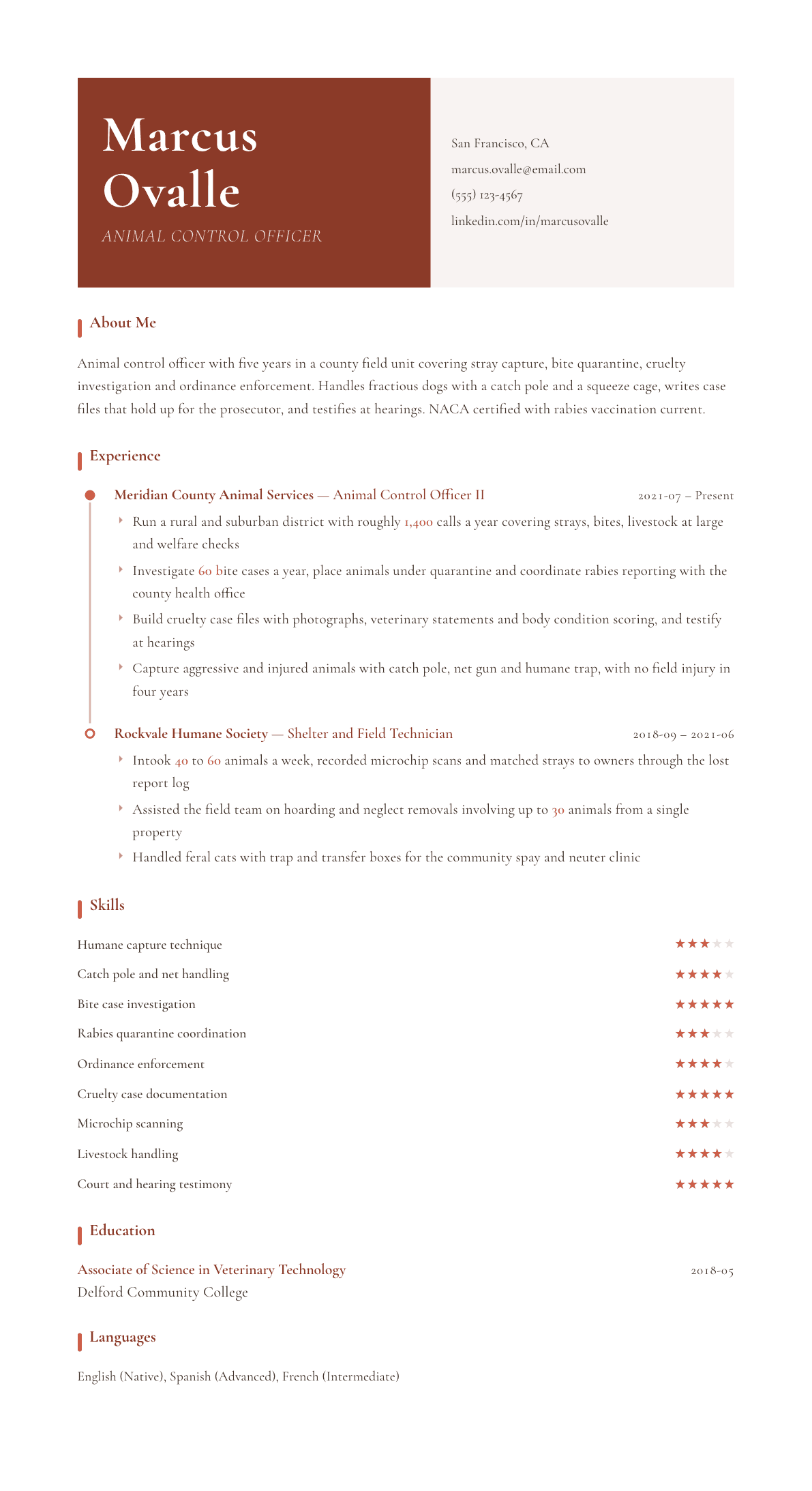
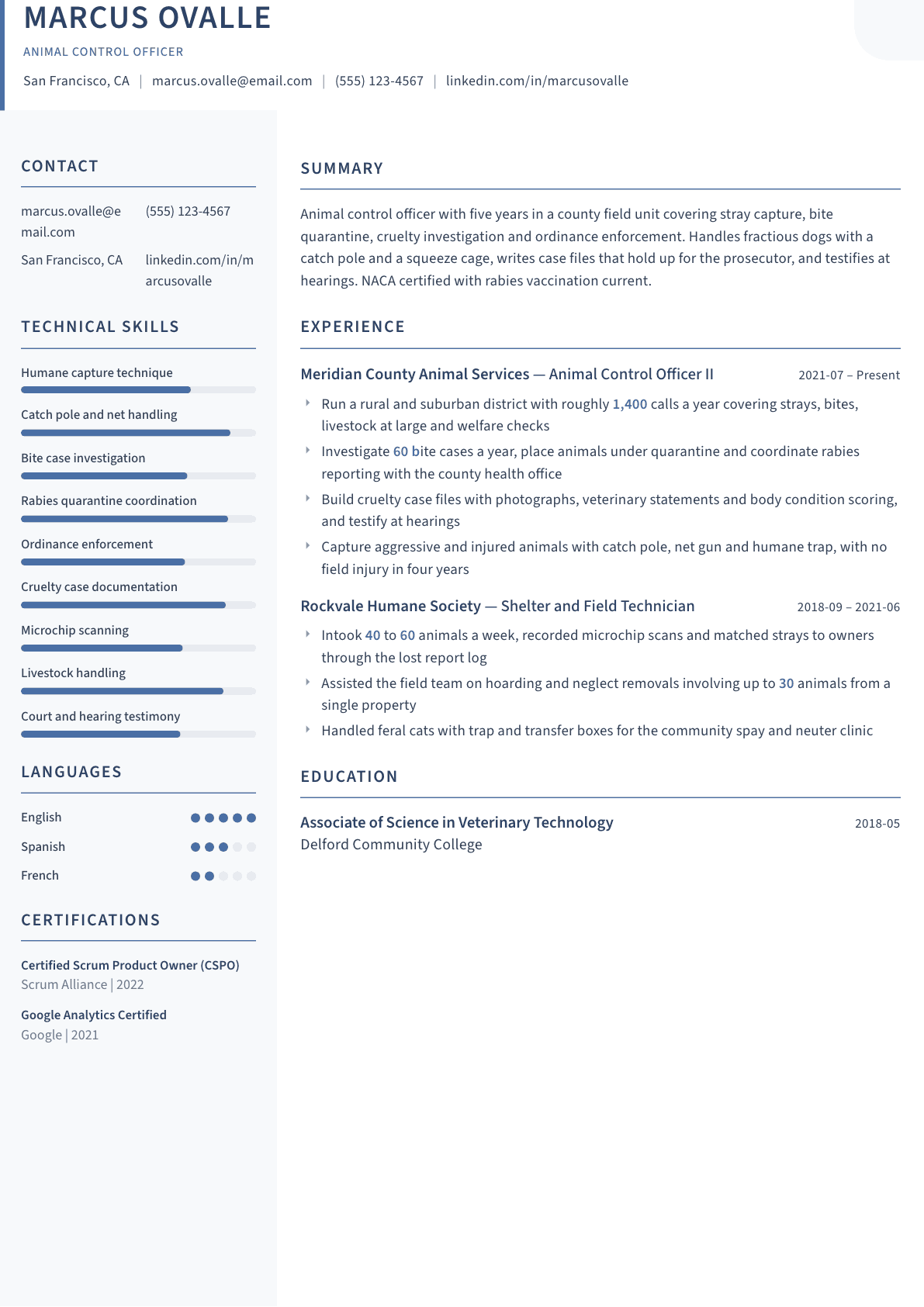
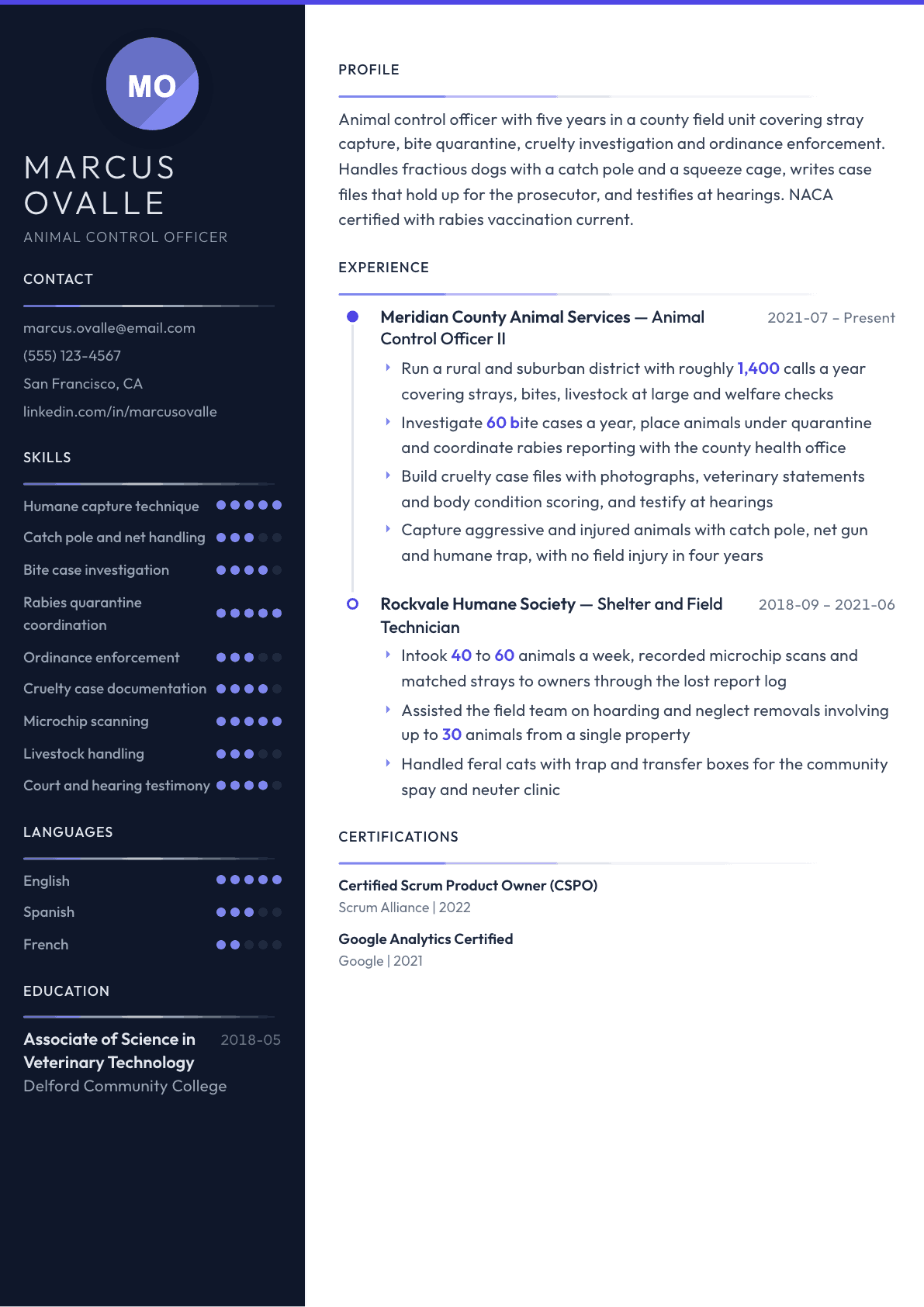
Example Animal Control Officer summary
Animal control officer with five years running a county field district of roughly 1,400 calls a year across strays, bites, livestock at large and welfare checks. Captures fractious and injured animals humanely, manages rabies quarantine with the health office, builds cruelty case files that survive prosecutor review, and testifies at hearings. NACA certified with current rabies preexposure vaccination.
Skills to list on a Animal Control Officer resume
- Humane capture and restraint
- Catch pole, net and trap use
- Fractious dog handling
- Livestock at large response
- Bite investigation
- Rabies quarantine and reporting
- Animal ordinance enforcement
- Cruelty and neglect investigation
- Body condition scoring
- Evidence photography
- Microchip scanning and owner reunification
- Shelter intake procedure
- Court testimony
- Field vehicle and equipment maintenance
What actually gets this resume read
- Give your annual call volume and the mix of stray, bite, welfare and livestock work so a supervisor can size your route.
- Name the capture equipment you are trained on, from catch pole and net gun to chemical immobilization if you hold it.
- Show your bite investigation and quarantine process, since rabies reporting is the part a health department audits.
- Put court testimony on the page, because a cruelty case is only worth what the officer can defend on the stand.
- List your NACA level, euthanasia certification if you hold one, and your current rabies preexposure vaccination status.
- Include the field vehicle and equipment you maintain, since a truck with broken transport boxes takes a district offline.
How to write a animal control officer resume
An animal control officer works three jobs at once. She is a field responder catching a loose dog on a highway shoulder, an investigator building a neglect case that a prosecutor will have to defend, and a public health link who makes sure a bite gets quarantined and reported. A resume that only shows the first of those reads as a shelter helper, and the supervisor hiring for a district needs more than that.
The people who read these applications are usually a field supervisor and a shelter director, sometimes with a county health officer looking over their shoulder. They are screening for two things they cannot train quickly: safe handling under pressure, and case documentation that holds together in a hearing room months after the animal has been placed.
This guide walks through the sections that matter for field animal work, how to write capture, bite and cruelty experience so it can be checked, three summaries pitched at different points in the career, before and after bullets, and the questions shelter staff ask when they try to move into a field truck.
Format: one to two pages, certifications and vaccination status visible
Reverse chronological, one page under five years and two after. These are usually county or city positions, so check whether the posting wants a supplemental application with detailed duty statements. When it does, the resume still has to stand alone because the field supervisor reads it first and the human resources form second.
Put a short block near the top with your training association certification level, your euthanasia certification if your jurisdiction issues one, your rabies preexposure vaccination status and your driver record class. Those four items decide which calls a supervisor can send you to, and burying them costs you interviews.
- Header for field work: name, city and county, phone, email, driver license class, and rabies preexposure vaccination status.
- Sections for this job: summary, certifications and vaccinations, field experience, shelter experience, education and training courses.
- Every field position names the jurisdiction type, the district size and the annual call volume you carried.
- Shelter-only applicants add an animal handling block covering species, temperament levels and restraint equipment used.
Summary: district, call mix, and what you can handle alone
Three lines. Name the jurisdiction type, whether it is urban, suburban, rural or mixed, the annual call volume of your district, and the call mix. Then say what you handle without backup: a fractious dog with a catch pole, a downed horse, a hoarding removal, a bite quarantine placed in the home.
Career changers should name the transferable half plainly. A veterinary technician moving into the field already has restraint, species knowledge and medical vocabulary. A patrol officer already has report writing, testimony and de-escalation with owners. Say which half you bring and which half you are learning.
Field experience: calls, capture and the animals you were not afraid of
Give the district and its call volume, then break the calls into their real categories: stray at large, bite, welfare check, cruelty complaint, livestock at large, wildlife conflict, deceased animal pickup, barking and nuisance complaints, and owner surrender in the field. Supervisors staff routes off that mix, so it is the fastest way to prove you have done the job.
Then write capture as technique. Catch pole use on a fractious dog, a squeeze cage transfer, a humane box trap set for a feral colony, a net for a small animal, a snappy snare, a control pole plus a muzzle for a bite case, and horse or cattle handling with a halter and a trailer. If you are trained in chemical immobilization, say so with the training source, because it is the qualification that separates a district officer from a helper.
Include a safety line. Years in the field with no handler injury and no animal injury during capture is the strongest thing you can write, because both numbers appear in the same incident system that a supervisor already reads every week.
Bites, quarantine and cruelty cases: the documentation half of the job
Bite work is a public health process and should be written as one. The investigation, the victim statement, the animal identification, the vaccination history check, the quarantine placement in the home or at the shelter, the release exam, and the report to the county health office. An officer who lays that sequence out is telling a health officer she never has to chase him.
Cruelty and neglect work is a legal process. Write the file: photographs with scale and date, body condition scoring, veterinary statements, the seizure authority you worked under, the chain of custody and the outcome at hearing. Then add whether you have testified, how often, and whether cases you built were prosecuted. That last detail is rare on these resumes and it moves a candidate to the top.
Say nothing that sounds like you enforce on instinct. The strongest officers describe ordinance sections they apply, warnings before citations, and abatement plans that got an animal into better conditions without a seizure. Supervisors want the officer who solves the problem, not the one who collects animals.
Skills, equipment and the words a county posting scans for
These postings reuse a compact vocabulary: humane capture, restraint, animal at large, bite investigation, rabies quarantine, ordinance enforcement, cruelty investigation, evidence collection, microchip scanning, euthanasia, transport, court testimony and public education. Use them exactly once in the skills list and once in a bullet that shows the work.
Equipment matters more here than in most fields. Name what you maintain and operate: the transport truck and its climate controlled boxes, catch poles, nets, traps, a scanner, a scale, cameras and a tranquilizer projector if you are certified. A truck that goes out with a broken box takes a district offline for a day, and supervisors notice applicants who understand that.
- Call volume and mix per year, broken into stray, bite, welfare, cruelty, livestock and wildlife categories.
- Capture equipment by name plus a safety record for handler and animal injuries.
- Bite process end to end, including quarantine placement and reporting to the health office.
- Case building detail: photographs, body condition scoring, veterinary statements, chain of custody and testimony.
Animal Control Officer resume summary examples
Moving from shelter to field
Shelter technician with two years of intake, restraint and feral cat trapping, moving into field animal control. Handles fractious dogs with a control pole and a squeeze cage, scans and logs microchips, and has assisted the field team on two hoarding removals. Rabies preexposure vaccination current.
Three years in a district
Animal control officer covering a mixed suburban and rural district of roughly 1,400 calls a year. Handles strays, bites, welfare checks and livestock at large, places rabies quarantines with the county health office, and builds neglect files with photographs, body condition scoring and veterinary statements.
Senior officer and trainer
Senior animal control officer with nine years in a county field unit, leading cruelty investigations and training three new officers on humane capture and case documentation. Has testified at eleven hearings, coordinates large seizures with the sheriff, and maintains the trapping and transport equipment program.
Work experience bullets: before and after
Before: Picked up stray animals in the community.
After: Ran a mixed rural and suburban district of about 1,400 calls a year covering strays, bites, livestock at large, welfare checks and wildlife conflicts.
Call volume and category mix tell a supervisor exactly what route you are ready to take over.
Before: Caught aggressive dogs safely.
After: Captured aggressive and injured animals using a control pole, a squeeze cage transfer and a humane box trap, with no handler injury and no capture injury to an animal across four years.
Equipment names plus a two-sided safety record turn a claim into something the incident log can confirm.
Before: Handled dog bite cases.
After: Investigated 60 bite cases a year, confirmed vaccination history, placed home and shelter quarantines and filed each rabies report with the county health office inside the required window.
The public health sequence is the part a health officer needs to see, and volume proves you have done it repeatedly.
Before: Investigated animal cruelty complaints.
After: Built neglect and cruelty files with dated photographs, body condition scoring, veterinary statements and chain of custody records, and testified at hearings on six cases that were prosecuted.
Naming the evidence types and the courtroom outcome shows the case survives after the animal leaves the property.
Before: Worked with the public on animal issues.
After: Resolved 40 barking and nuisance complaints a year through owner education and written abatement plans, escalating to citation only after a documented warning went unmet.
A graduated enforcement process demonstrates judgment, which is what separates a district officer from an animal catcher.
Hard skills
- Humane capture and restraint
- Control pole, net and box trap use
- Fractious and injured animal handling
- Livestock and large animal handling
- Bite investigation
- Rabies quarantine and health reporting
- Animal ordinance enforcement
- Cruelty and neglect investigation
- Body condition scoring
- Evidence photography and chain of custody
- Microchip scanning and owner reunification
- Shelter intake and transport procedure
- Court and administrative hearing testimony
- Field vehicle and equipment maintenance
Soft skills
- Staying steady with an owner who is losing an animal
- Reading an animal before reaching for equipment
- Explaining an ordinance without lecturing
- Carrying difficult calls without hardening toward the public
- Writing a file that a stranger can follow a year later
Certifications worth listing
- NACA Level 1 Training Certification (National Animal Care and Control Association)
- NACA Level 2 Training Certification (National Animal Care and Control Association)
- Cat and Dog First Aid (American Red Cross)
Mistakes that cost animal control officer candidates the interview
- Writing a shelter resume for a field job, so the reader never learns whether you can work a truck and a district alone.
- Leaving out call volume and call mix, which are the two numbers a field supervisor uses to size your experience.
- Describing captures without naming the equipment, when equipment competence is exactly what the safety record depends on.
- Skipping the bite and quarantine process, even though rabies reporting is the part a county health office audits.
- Treating cruelty work as rescue stories rather than as case files with photographs, scoring, statements and testimony.
- Omitting your rabies preexposure vaccination and driver license class, both of which gate the calls you can be assigned.
Animal Control Officer resume questions
How do I move from a shelter job into the field?
Get on ride alongs, take the training association courses, and rewrite your shelter work around handling, restraint and documentation instead of care tasks. Trapping, intake exams, microchip scanning and hoarding assists all translate directly, and a field supervisor will recognize them if you name them.
Do I need a law enforcement background for animal control?
Not usually. Most agencies hire on handling skill, documentation and temperament, then train on the ordinance. Some counties do sworn or commissioned animal control positions with a police academy requirement, so read the posting closely and state your status either way.
How should I write about euthanasia experience?
Factually and briefly. Name the certification if your state issues one, say what you are qualified to perform, and give the setting. Skip any emotional framing. Supervisors read this line to confirm a legal qualification, not to gauge how you feel about it.
What if my only experience is volunteering with rescues?
Present it as work: hours a week, species handled, transport runs, foster intake exams, trapping projects and any case support you gave. Then close the gaps with the training association course and a rabies preexposure vaccination, which together make you far easier to hire.
Should I put photographs of rescues in my application?
No. Case photographs are evidence and belong in a file, not an application, and rescue photographs read as advocacy rather than professional practice. Describe the work in words and bring the outcome numbers instead, which is what a hiring panel can actually evaluate.
Related resume examples
- Veterinary Technician Resume example
- Police Officer Resume example
- Park Ranger Resume example
- Security Officer Resume example
- State Trooper Resume example
- Military Police Resume example