Caregiver Resume Examples: free ATS score and gap list
Build a Caregiver Resume, and the Skills List, Families Trust
By Mustafa Tarabya, founder of CVBooster · Published · Updated
Caregiver resume example with real duties, client counts and the caregiver resume skills to list, plus certification keywords and a section guide.
Sample resumes for a caregiver
The same caregiver content laid out in three CVBooster templates, so you can see what the finished document looks like before you write a word.
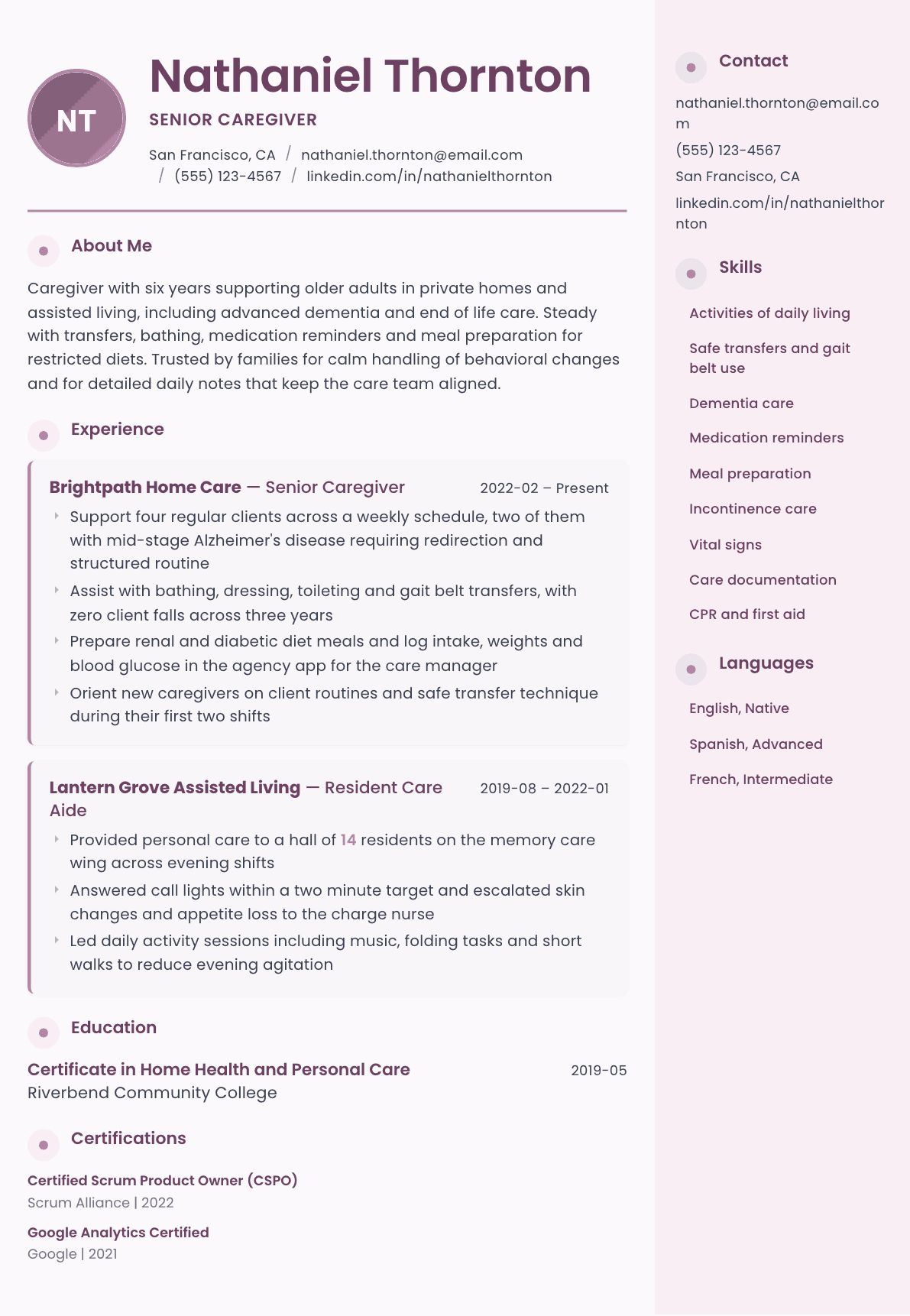
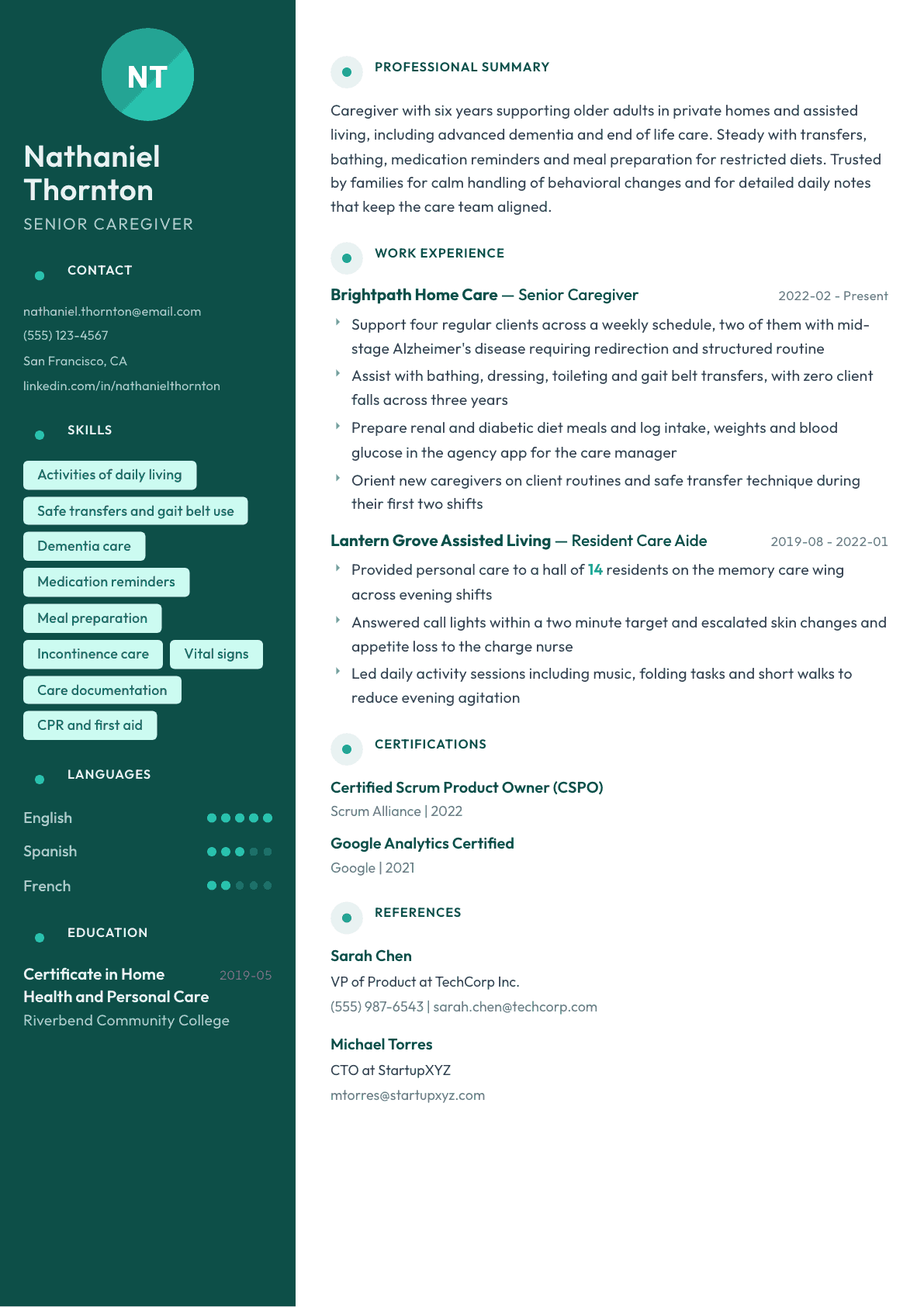
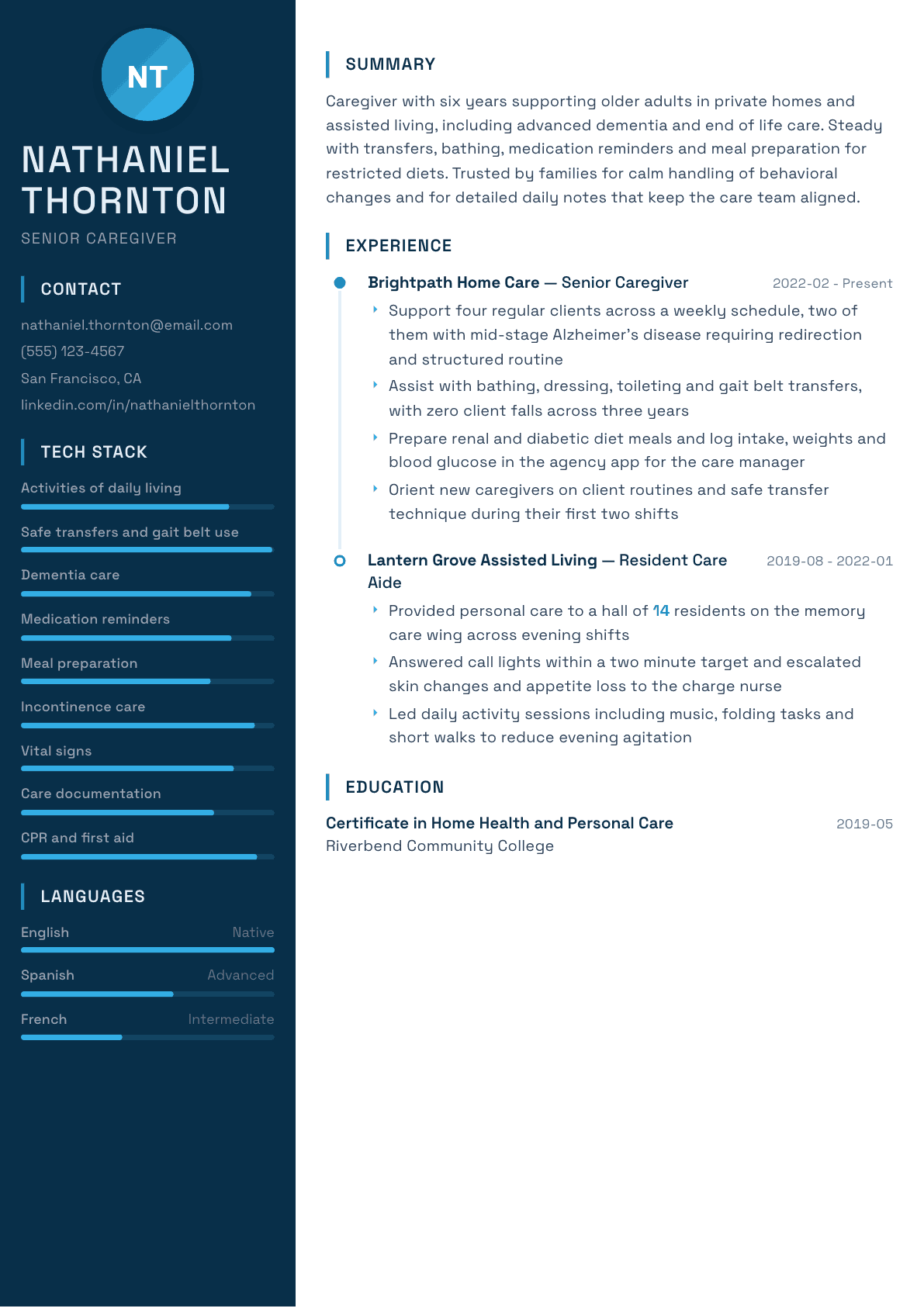
Example Caregiver summary
Compassionate caregiver with six years in private homes and memory care, supporting clients with dementia, limited mobility and complex medication schedules. Experienced with two person transfers, Hoyer lift use, and diet specific meal preparation. Families rely on me for clear daily notes, early reporting of skin and appetite changes, and a calm routine that keeps clients settled through the evening.
Skills to list on a Caregiver resume
- Personal care assistance
- Bathing and grooming
- Safe patient transfers
- Dementia and memory care
- Medication reminders
- Meal planning and preparation
- Light housekeeping
- Companionship
- Mobility and range of motion support
- Hoyer lift operation
- Vital signs monitoring
- Daily care notes
- Hospice and comfort care
- CPR and first aid
What actually gets this resume read
- Say who you cared for and for how long, since continuity with one client reads as reliability to any agency.
- Name the conditions you have handled: dementia, Parkinson's disease, stroke recovery, hospice, or post surgical recovery.
- Put your certification, CPR card and driver license in a short block, because many postings screen on all three.
- Quantify the physical work with transfer types, client weight ranges, hours per shift and overnight or live-in coverage.
- Show your documentation habit, since families and case managers judge caregivers on the quality of daily notes.
- Mention languages spoken and whether you drive, as both decide which clients an agency can assign you.
How to write a caregiver resume
A caregiver resume is read fast, often by a scheduler with twelve shifts to fill this week. She is checking four things: can you do the physical work, have you handled the conditions her clients have, will you show up, and is there anything in the file that would worry a family. Everything you write should answer one of those four.
The common failure is a resume that lists gentle duties in the passive voice and never says how many clients, how many hours, which diagnoses or which equipment. Two caregivers can both write that they assisted with daily living. One of them has done two person Hoyer transfers on a bariatric client through night shifts and the other has driven someone to appointments. The resume has to tell them apart.
What follows is the section order agencies and private families expect, three example summaries at different stages, before and after bullets taken from real home care work, and answers to the questions caregivers ask most when they write the file themselves.
Format: one page, plain layout, availability near the top
Keep it to a single page in reverse chronological order. Agency software and a busy scheduler both prefer plain text with clear headings and no photographs or icon columns. Below your contact details, add two short lines that most caregivers leave out: your availability and your transport situation.
Availability means the shifts you can truly cover, including overnights, weekends, live-in and holidays. Transport means whether you drive, whether you have your own insured vehicle, and how far you will travel. Those two lines decide which open cases you can be matched to, and leaving them out costs interviews.
- Header: name, city, phone, email, availability, driving status.
- Sections: summary, certifications and clearances, care experience, training, skills, languages, references available on request.
- New caregivers move training and clinical placement above paid experience and add family care with honest dates.
Summary: who you cared for, for how long, at what level of need
Three lines. Name the years, the settings, the diagnoses you have supported and the level of physical assistance the clients needed. Level of need is the part candidates skip, and it is the part that matters most: a client who needs standby assistance and a client who is a full mechanical lift transfer are completely different jobs.
Avoid opening with adjectives about your own warmth. Every applicant claims patience. Show it later in a bullet where you handled sundowning at nine in the evening without calling the family in a panic.
Experience: clients, continuity, conditions, equipment
For each position, give the employer or say private family, the setting, how many clients you supported at once, and the shift pattern. Continuity is a selling point in this field. Three years with the same client says more about your reliability than any adjective, so make the length of each placement obvious.
Then write bullets around the four things a care manager cares about. Personal care tasks with the level of assistance. Conditions and their behavior, such as dementia with evening agitation, Parkinson's disease with freezing episodes, or stroke recovery with one sided weakness. Equipment by name: gait belt, Hoyer or ceiling lift, transfer board, shower chair, oxygen concentrator, hospital bed. Household and community work such as cooking to a renal or diabetic diet, laundry, errands and appointment escort.
Add one bullet about noticing and reporting. Caregivers who catch a skin change, a urinary tract infection presenting as confusion, or a sudden weight loss are the ones agencies keep. Write the specific catch, not the word observant.
Certifications, clearances and the paperwork side
Put your certificate, your current CPR and first aid card with the issuing body, and any state registry listing in a block near the top. Add the checks that clients require: background clearance, tuberculosis screening, immunization records and a valid driver license with a clean record. Families and agencies verify all of it, so stating it early removes a round of email.
If you have completed dementia specific or hospice specific training, name the program and the hours. Those courses are how a scheduler decides whether to send you to a memory care case or a comfort care case.
Skills, languages and documentation habits
Keep the skills list concrete: transfers, bathing, toileting and incontinence care, feeding assistance including thickened liquids, medication reminders, range of motion exercises, meal preparation for restricted diets, and vital signs if you take them. List the languages you speak and read, because language matching is a real constraint on case assignment.
Add the care app or paper system you documented in. Agencies live on visit notes and electronic visit verification, and a caregiver whose notes are complete and submitted on time is worth more to them than one who is merely pleasant.
Caregiver resume skills: what to list and how to prove them
Caregiver resume skills fall into three groups, and a scheduler or family looks for all three. Hands on care is what you do with the client. Health and safety skills show you notice changes and keep people safe. People skills show you can work in someone else's home with their family watching. List the skills in a short section, then prove the important ones inside your experience bullets.
Each skill is stronger with a context. Write transfers with a gait belt and a mechanical lift for a client after a stroke rather than just transfers. Write redirection and routine building for a client with dementia rather than just patience.
- Hands on care: bathing, dressing, grooming, toileting and incontinence care, feeding assistance, meal preparation for special diets, light housekeeping and laundry.
- Mobility and safety: gait belt and mechanical lift transfers, fall prevention, range of motion support, wheelchair and walker use, home safety checks.
- Health monitoring: medication reminders, vital signs, blood glucose checks where allowed, skin and pressure area checks, reporting changes to the nurse or family the same day.
- Memory and comfort care: dementia redirection, structured daily routines, hospice and comfort care support.
- People and paperwork skills: patience, clear communication with families, reliability on a set schedule, privacy, visit notes and electronic visit verification.
Caregiver resume summary examples
First caregiving job
Certified caregiver with 75 hours of classroom and supervised practical training in personal care, safe transfers and dementia support, plus two years caring for a grandparent through late stage Parkinson's disease at home. CPR certified, driving, and available for weekends and overnight shifts.
Four years in home care
Home caregiver with four years supporting older adults with dementia, diabetes and limited mobility. Experienced with gait belt and Hoyer transfers, incontinence care, diet specific cooking and medication reminders. Held one client for 26 months without a missed shift, and reports skin and appetite changes promptly to the care manager.
Lead caregiver
Senior caregiver with nine years across private homes, assisted living and hospice cases, including bariatric clients and end of life care. Trains new hires on safe transfer technique and client routines, covers the hardest evening memory care shifts, and has held a clean record on falls and medication errors throughout.
Work experience bullets: before and after
Before: Helped clients with daily living activities.
After: Assisted two clients daily with bathing, dressing, toileting and grooming, one requiring standby assistance and one requiring a two person mechanical lift transfer.
Naming the level of assistance tells a scheduler whether you can be sent to a heavy case tomorrow.
Before: Cared for a client with dementia.
After: Supported a client with mid stage Alzheimer's disease through daily sundowning, using a fixed evening routine, familiar music and redirection instead of argument, which ended the nightly attempts to leave the house.
The technique and the result show real dementia skill rather than exposure to the diagnosis.
Before: Cooked meals for clients.
After: Prepared renal and diabetic diet meals to a dietitian plan, logged food and fluid intake, and adjusted textures to a modified consistency after a swallowing assessment.
Diet type, documentation and texture modification prove you can cook safely for medically complex clients.
Before: Reported changes to the nurse.
After: Flagged a sudden increase in confusion and reduced fluid intake to the care manager the same morning, which led to a urinary tract infection being treated before hospital admission was needed.
A specific catch with an outcome is the strongest evidence a caregiver can put on paper.
Before: Kept notes on each visit.
After: Completed visit notes and electronic verification entries at the end of every shift for three years, covering intake, mood, mobility and any incidents, with no rejected submissions.
Documentation reliability is what agencies get paid on, so make yours measurable.
Hard skills
- Bathing, dressing and grooming assistance
- Gait belt and mechanical lift transfers
- Incontinence and catheter bag care
- Dementia and memory care techniques
- Medication reminders and pill organizers
- Diet specific meal preparation
- Feeding assistance and texture modification
- Range of motion and mobility support
- Vital signs and blood glucose checks
- Skin integrity and pressure area checks
- Hospice and comfort care support
- Visit documentation and verification systems
Soft skills
- Patience with repetitive questions
- Reliability across long placements
- Respect for client privacy and home
- Clear reporting to family and nurse
- Calm response to agitation
- Boundary setting with families
Certifications worth listing
- CPR and First Aid (American Red Cross)
- Basic Life Support (BLS) (American Heart Association)
- Certified Home Health Aide (State health department registry)
- Certified Dementia Practitioner (CDP) (National Council of Certified Dementia Practitioners)
Mistakes that cost caregiver candidates the interview
- Writing duties in the passive voice with no client numbers, hours or level of assistance attached to any of them.
- Leaving availability and driving status off the page, which stops a scheduler from matching you to open cases.
- Naming clients or describing their homes and families in identifying detail, which reads as a privacy risk.
- Listing every soft skill in the summary while never showing one of them in a real situation further down.
- Hiding family caregiving because it was unpaid, when it is often the strongest experience a new caregiver has.
- Skipping the certification and clearance block, so the agency has to email you for documents before booking an interview.
Caregiver resume questions
What skills should I put on a caregiver resume?
List hands on care skills such as bathing, dressing, transfers and meal preparation; safety and health skills such as fall prevention, medication reminders and noticing changes; and people skills such as patience and clear communication with families. Keep it to one page and prove the main skills inside your experience bullets.
Can I put unpaid family caregiving on my resume?
Yes, and you should. List it as a role with honest dates, the relationship, the conditions involved and the tasks you performed. Agencies value it, provided you describe it as family care rather than dressing it up as agency employment.
What do I write if I have gaps between clients?
State the reason plainly in one line, such as a client passing away, a family relocating or a period of your own care responsibilities. Gaps are normal in home care. An unexplained gap raises more questions than a short honest explanation.
Should I list the diagnoses of people I have cared for?
List the conditions but never the people. Saying you have supported clients with vascular dementia, stroke recovery and end stage heart failure is professional information about your skills, and it contains nothing that identifies anyone.
Do I need a certificate to work as a caregiver?
Requirements vary by state and by the type of care. Private companion work often needs none, while agency and Medicaid funded roles usually require a state approved training certificate plus CPR. Listing whatever training you have completed always helps.