Veterinary Assistant Resume Examples: what gets the call
Write a Veterinary Assistant Resume That Gets Interviews
By Mustafa Tarabya, founder of CVBooster · Published · Updated
Veterinary assistant resume examples with restraint, kennel and treatment room keywords, plus a guide to getting hired without a technician credential.
Sample resumes for a veterinary assistant
The same veterinary assistant content laid out in three CVBooster templates, so you can see what the finished document looks like before you write a word.
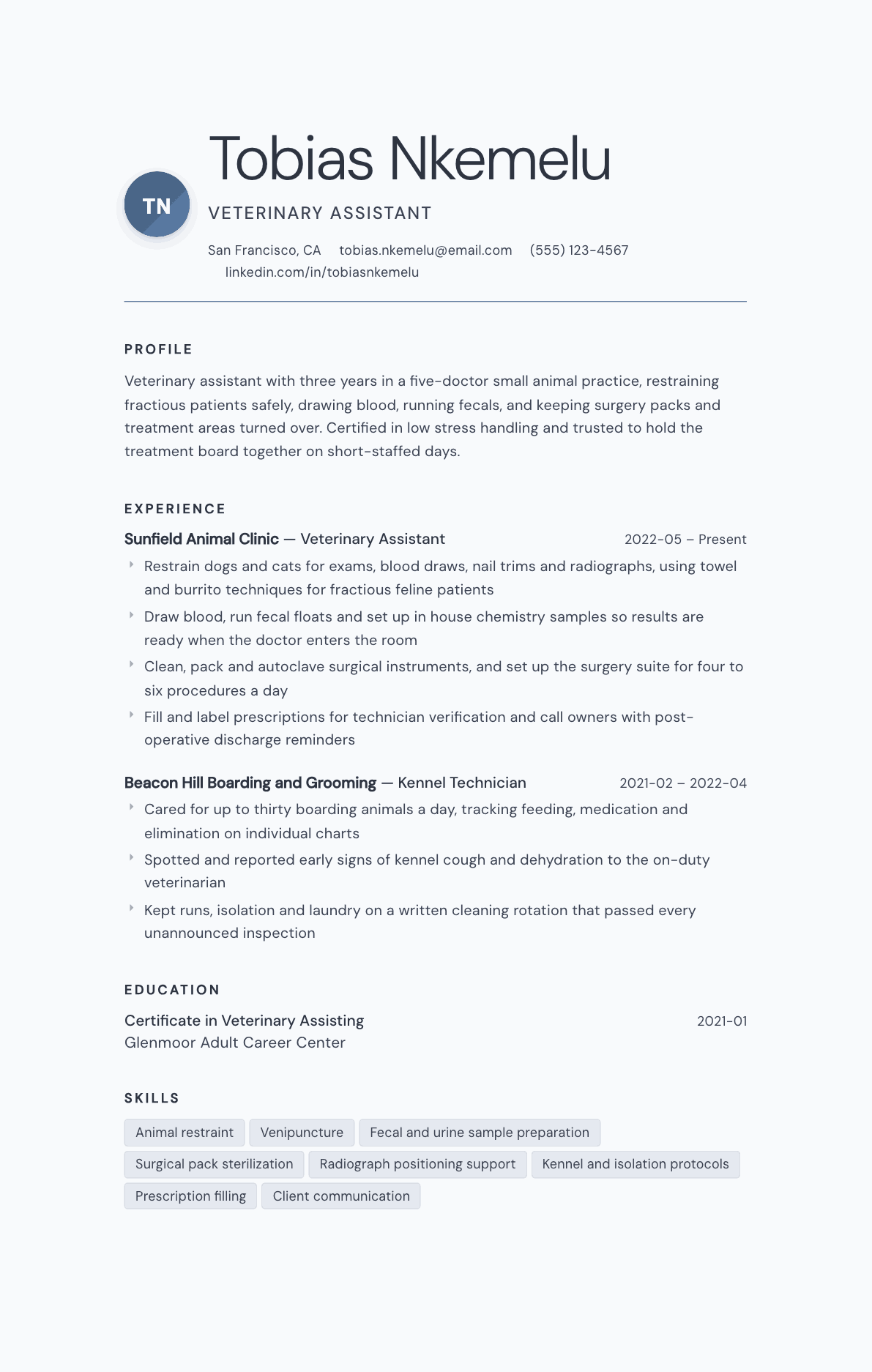
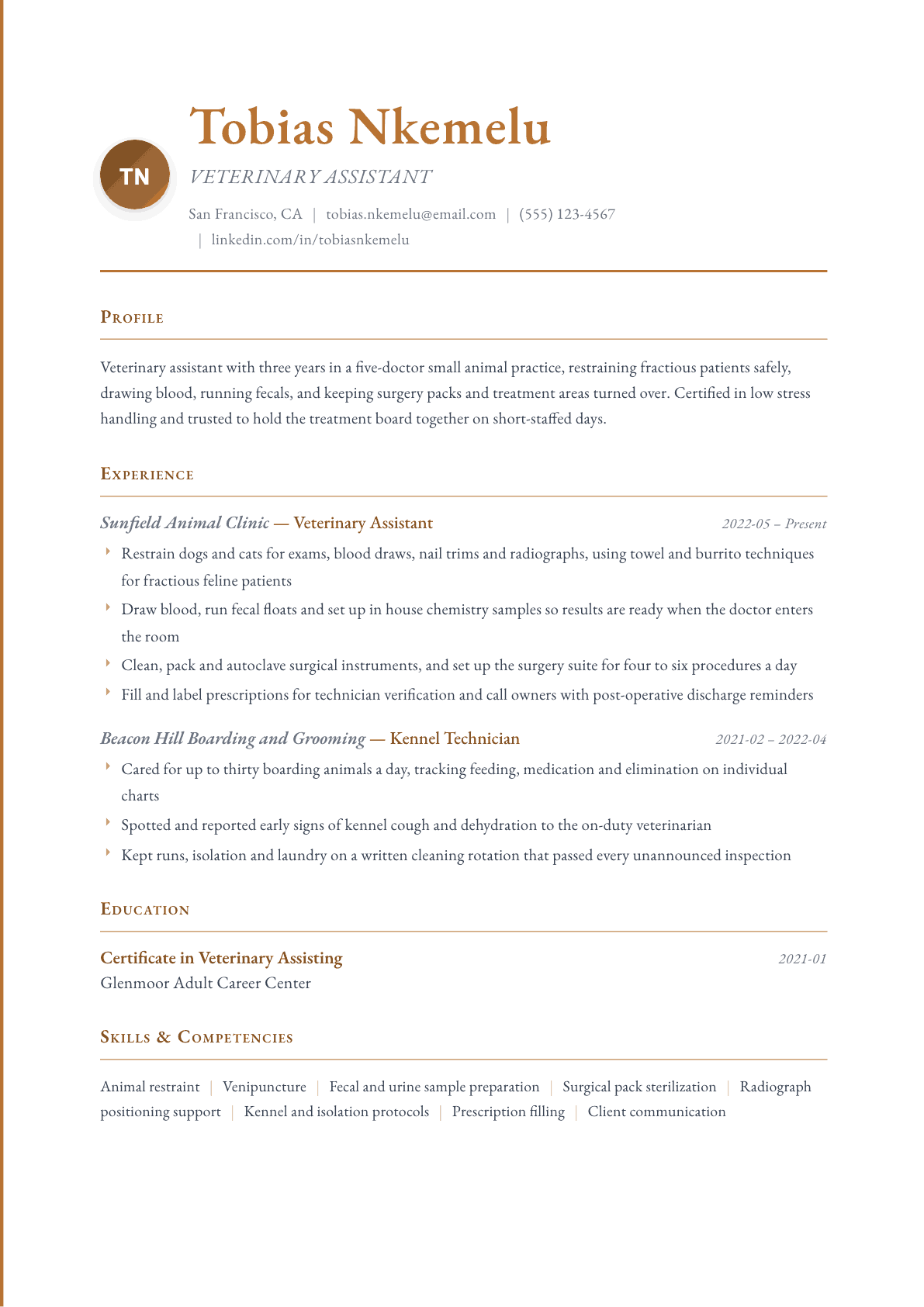
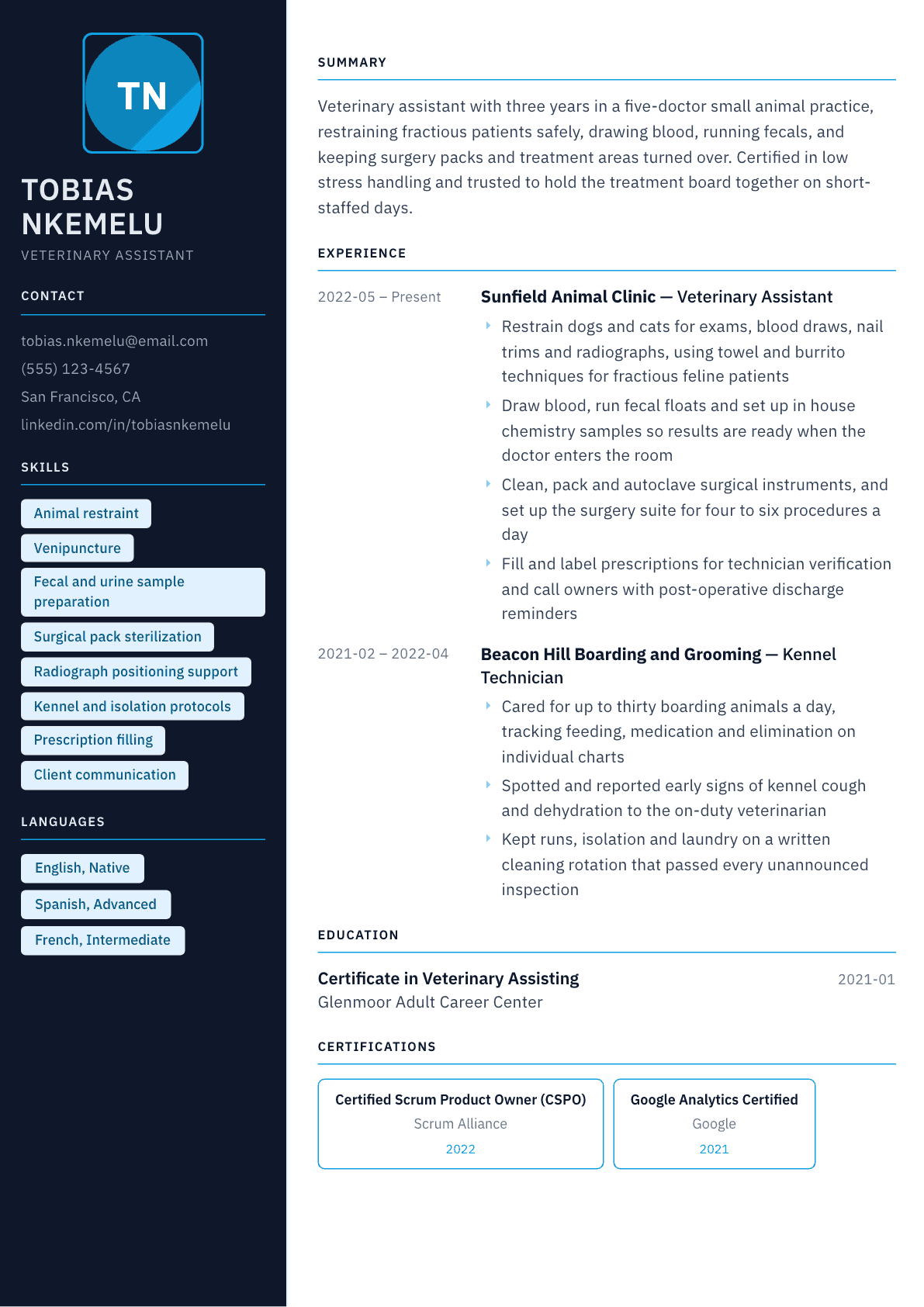
Example Veterinary Assistant summary
Veterinary assistant with three years in small animal general practice, handling restraint for exams and radiographs, drawing samples, prepping surgery, and keeping the treatment area stocked and clean. Comfortable with fractious cats and large breed dogs, and currently enrolled in an accredited veterinary technology program. Reliable on weekends and short-notice coverage.
Skills to list on a Veterinary Assistant resume
- Animal restraint and handling
- Low stress handling techniques
- Venipuncture support
- Sample collection and preparation
- Fecal flotation
- Surgical instrument sterilization
- Surgery suite setup
- Radiograph positioning assistance
- Kennel and isolation sanitation
- Medication administration under supervision
- Prescription labeling
- Treatment board management
- Client check-in and discharge
- Inventory restocking
What actually gets this resume read
- Lead with hands-on animal handling, since restraint is the first skill a practice manager checks in an assistant.
- Separate what you do independently from what you support, because assistants work under a technician or doctor.
- Include the species and case mix you have handled: canine, feline, exotics, livestock or shelter populations.
- Show laboratory prep work such as fecal floats, slide preparation and sample labeling, not just cleaning duties.
- Say whether you are working toward a technician credential, because practices want assistants who grow into technicians.
- Add kennel, boarding or shelter work rather than hiding it; it proves stamina and animal handling under real conditions.
How to write a veterinary assistant resume
Veterinary assistant openings attract two very different piles of applicants: people who love animals and have never worked in a clinic, and people who have already spent a year holding a fractious cat still for a jugular draw. The resume has ten seconds to prove which pile you belong in, and the proof is always specific handling and specific tasks.
Practice managers hire assistants to protect the technicians' time. If your resume shows that you can restrain safely, prep surgery, run a fecal, keep the treatment area stocked and clean cages properly, you free a credentialed technician to place catheters and monitor anesthesia. Write from that angle and the value is obvious.
This guide walks through the format a clinic expects, how to describe restraint and support tasks without sounding like a job description, three summaries covering the shelter volunteer through the assistant studying for a credential, five rewritten bullets, and answers to the questions assistants ask most.
Format: one page, plain, and honest about scope
One page, reverse-chronological, single column. Do not dress an assistant resume up with graphics; clinics print these and pass them around the treatment area. Keep the font readable and leave white space so a manager can annotate it.
Be exact about your title. If you worked as an assistant, write assistant. Claiming technician duties you performed under close supervision is the fastest way to lose credibility in a working interview, where you will be asked to restrain a dog within the first ten minutes.
- Header: name, city and state, phone, email.
- Order: summary, animal care experience, technical and handling skills, education and training.
- Add a certifications line if you hold an assistant credential or a handling certification.
Summary: species, setting, and what you handle alone
Three lines that answer where you have worked, what species and temperaments you handle, and which tasks you complete without being asked twice. A clinic reading "restrains fractious feline patients with towel and burrito techniques" already knows more about you than a paragraph of enthusiasm would convey.
If you are new to clinical work, use the summary to point at transferable animal experience: shelter, boarding, grooming, farm or wildlife rehabilitation. Then say what you want to learn, because clinics that hire green assistants are choosing on attitude and reliability.
Experience: restraint, prep, sanitation, support
Open each job with the setting: number of doctors, appointment volume, whether the practice runs surgery daily, and the species mix. Then group bullets into handling, laboratory and surgical support, sanitation, and client contact.
Handling is your headline. Describe the restraint positions you use for blood draws, radiographs, nail trims and vaccine appointments, and say how you manage fractious or painful patients. Naming low stress or fear free handling techniques signals that you were trained rather than improvising.
Laboratory and surgical support come next: drawing samples, spinning and labeling, setting up fecal floats and slides, cleaning and packing instruments, running the autoclave and setting the surgery suite. Sanitation is not filler on this resume. Kennel rotation, isolation protocol and laundry are what stop a parvovirus case from becoming an outbreak, and a manager knows it.
Close each job with the client-facing piece if you had one: check-in, discharge instructions read back to the owner, medication labeling for technician verification and post-operative follow-up calls.
Skills and training: name what you were taught
Split skills into handling, clinical support, sanitation and software. Under training, list any assistant program, on-the-job training modules, low stress handling coursework or the veterinary technology program you are enrolled in, with the expected completion month rather than a vague "in progress".
Mention the practice software you have entered notes or appointments in. Assistants who can navigate Cornerstone, Avimark or ezyVet without a tutorial save the clinic real training time.
Availability: the detail that closes the gap
Clinics lose assistants to burnout on weekends and holidays. If you can work weekends, overnights, holidays or on-call surgery days, say it plainly near the top. It is one of the few pieces of information on this resume that can move you ahead of a more experienced applicant.
Veterinary Assistant resume summary examples
Coming from shelter work
Animal care worker with two years in a municipal shelter, handling intake exams, vaccination clinics and daily care for up to forty animals. Comfortable restraining anxious dogs and cats, recognizing early illness, and following isolation protocol. Seeking a veterinary assistant role in general practice.
Three years in general practice
Veterinary assistant with three years in a five-doctor small animal clinic, restraining for exams, blood draws and radiographs, drawing samples, running fecal floats, and prepping four to six surgeries a day. Trained in low stress handling and trusted to run the treatment area on short-staffed shifts.
Senior assistant in training for credential
Senior veterinary assistant with six years in general and emergency practice, handling surgical prep, sample collection, patient monitoring under technician supervision and inventory. Trains new assistants on restraint and sanitation, and is enrolled in an accredited veterinary technology program with graduation next spring.
Work experience bullets: before and after
Before: Restrained animals for the doctor.
After: Restrained dogs and cats for exams, blood draws, radiographs and nail trims, using towel wraps and low stress positioning for fractious feline patients.
Naming the appointments and the actual technique proves trained handling rather than brute strength.
Before: Cleaned kennels and the clinic.
After: Ran the kennel and isolation cleaning rotation on a written schedule, including parvovirus disinfection protocol, laundry and daily surface logs.
Sanitation described as a protocol reads as infection control, which is exactly what it is.
Before: Helped with lab samples.
After: Drew blood samples, spun and labeled tubes, set up fecal flotations and prepared ear cytology slides so results were ready before the doctor finished the exam.
The task chain and the timing show you understand why the sample matters, not just how to collect it.
Before: Set up for surgery.
After: Cleaned, packed and autoclaved instrument sets and set the surgery suite for four to six procedures a day, including clipping and initial surgical scrub.
Volume and the specific prep steps let a manager picture your morning without asking.
Before: Talked to clients about their pets.
After: Reviewed discharge instructions with owners, confirmed understanding of medication timing, and made next-day post-operative calls flagged for the technician when appetite was poor.
It shows client contact with a clinical purpose and a clear escalation path.
Hard skills
- Animal restraint and positioning
- Low stress and fear free handling
- Blood sample collection support
- Fecal flotation and slide preparation
- Surgical instrument cleaning and autoclaving
- Surgery suite setup and patient clipping
- Radiograph positioning assistance
- Kennel and isolation disinfection protocol
- Medication labeling and refill preparation
- Treatment board and inventory upkeep
- Patient check-in and discharge support
Soft skills
- Reading animal body language
- Physical stamina across long shifts
- Following protocol under pressure
- Comforting anxious owners
- Taking correction from technicians well
Certifications worth listing
- Approved Veterinary Assistant (AVA) (National Association of Veterinary Technicians in America)
- Fear Free Certified Professional (Fear Free)
- Pet First Aid and CPR (American Red Cross)
Mistakes that cost veterinary assistant candidates the interview
- Leading with a love of animals instead of the handling and support tasks a clinic is paying for.
- Claiming technician-level procedures that you performed under direct supervision, which collapses in a working interview.
- Leaving out shelter, boarding, grooming or farm work, which is the strongest evidence a new assistant has.
- Describing cleaning as cleaning rather than as the isolation and disinfection protocol it actually follows.
- Failing to state weekend, holiday or overnight availability, which is often the deciding factor between two applicants.
- Writing "in progress" about a technology program with no expected completion date attached.
Veterinary Assistant resume questions
Can I get a veterinary assistant job with no clinic experience?
Yes, and most assistants start that way. Lead with animal handling from shelter, boarding, grooming, farm or rescue work, show that you follow protocol, and state your availability. Clinics train assistants; they cannot train reliability.
What is the difference between a veterinary assistant and a technician resume?
A technician resume centers on credentialed procedures such as anesthesia, catheters and dental radiographs. An assistant resume centers on restraint, sample and surgical prep, sanitation and treatment area support. Keep the boundary clear and the hiring manager will trust the rest.
Should I list the animals I have worked with?
List the species you can handle unsupervised, such as canine, feline, pocket pets, reptiles or livestock. A clinic that sees exotics will move an applicant with rabbit and reptile handling straight up the pile, so be specific rather than broad.
How do I show I want to become a veterinary technician?
Name the accredited program, whether you are enrolled or applying, and the expected completion date. Practices that offer tuition support or flexible schedules look for this, because an assistant heading toward a credential is a technician they do not have to recruit.
Does a veterinary assistant resume need a certification?
It is not required in most states, but an approved assistant credential or a recognized handling certification gives a hiring manager evidence that your training was structured. Only list credentials you actually hold, with the issuing organization named.