Dog Walker Resume Examples: free ATS score and gap list
A Dog Walker Resume Built on Routes, Leashes and Trust
By Mustafa Tarabya, founder of CVBooster · Published · Updated
Dog walker resume example and guide covering daily route volume, leash handling, reactive dogs, GPS check ins and client retention.
Sample resumes for a dog walker
The same dog walker content laid out in three CVBooster templates, so you can see what the finished document looks like before you write a word.
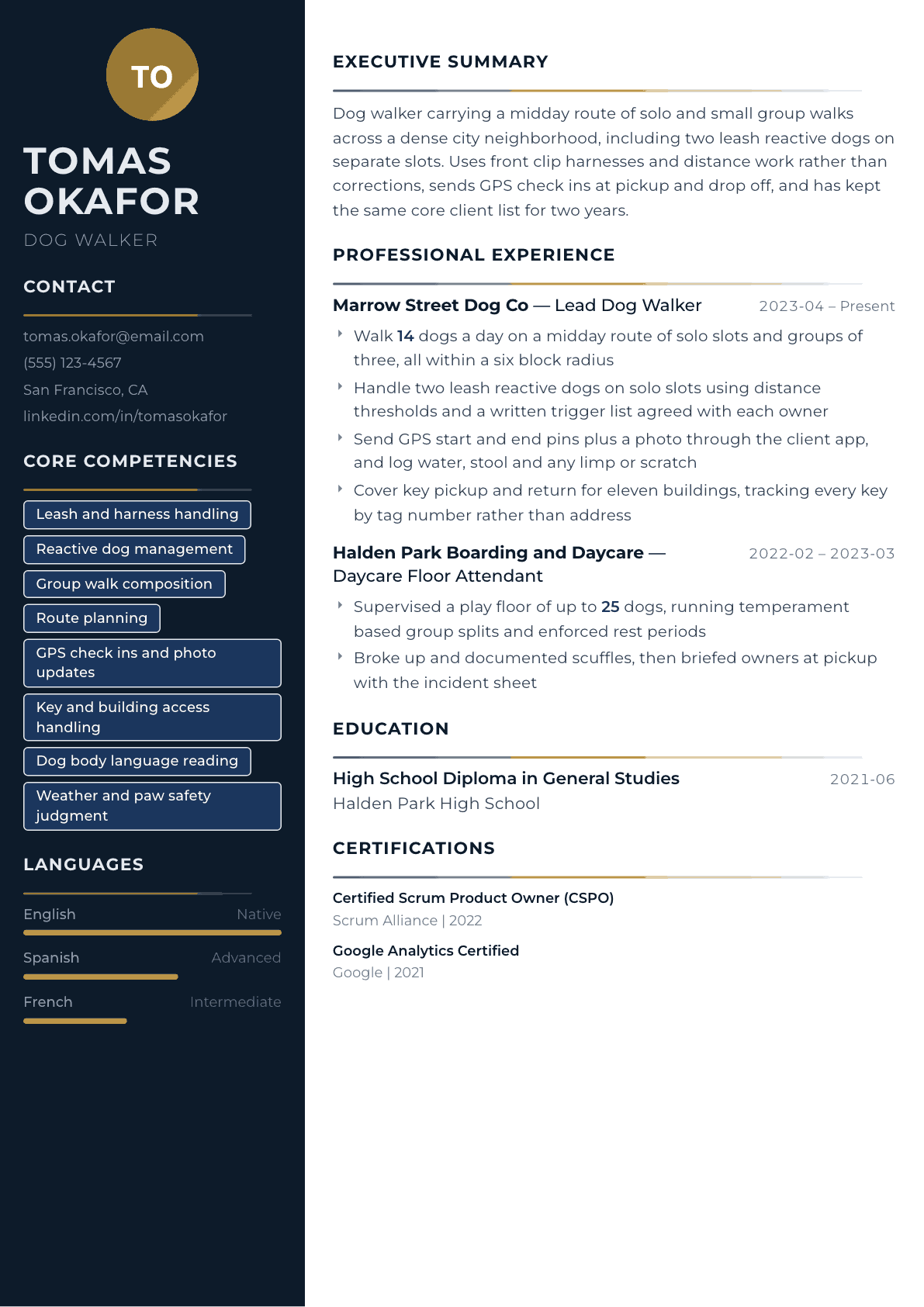
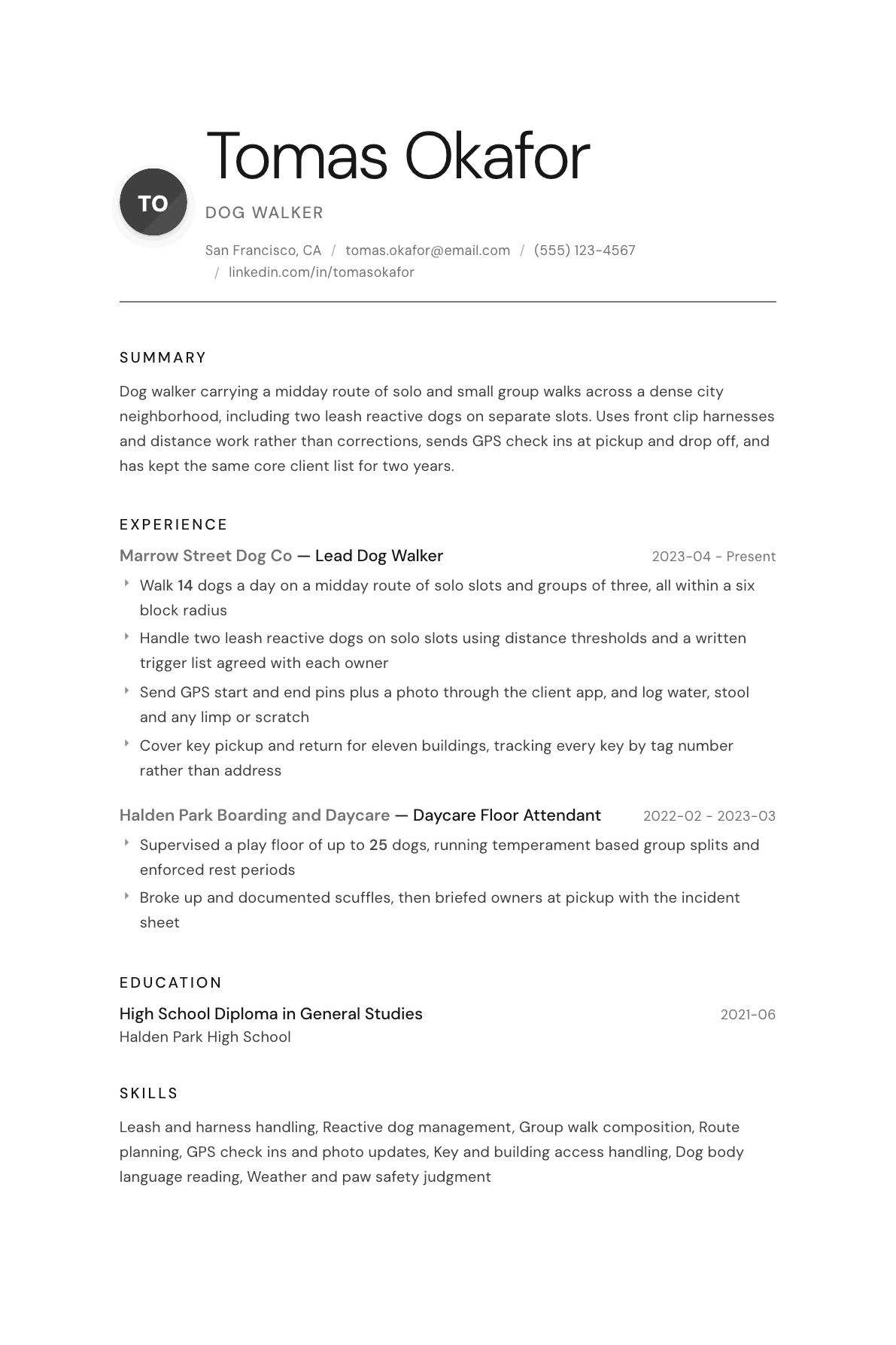
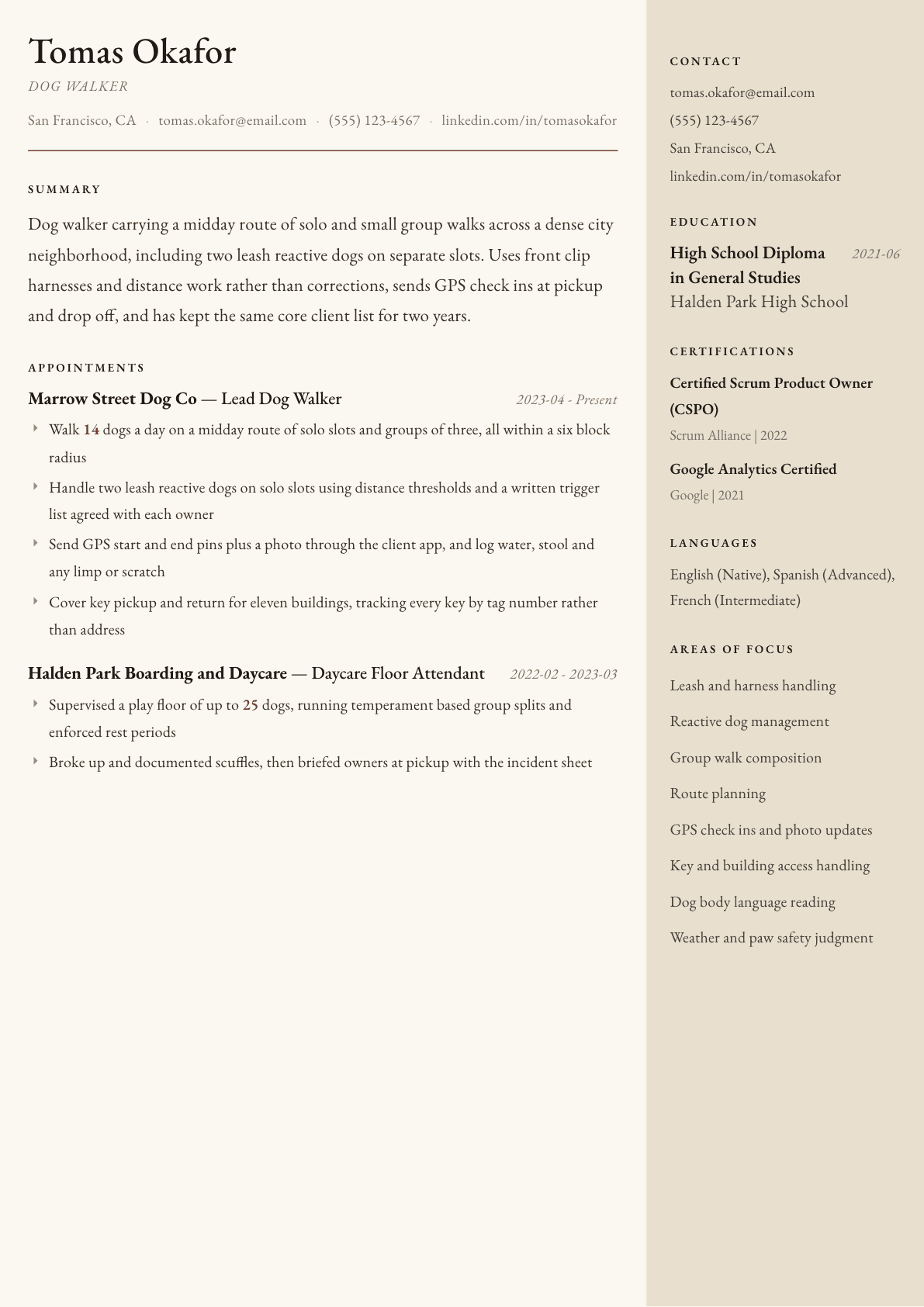
Example Dog Walker summary
Dog walker holding a midday route of fourteen dogs a day across solo slots and groups of three inside a six block radius, including two leash reactive dogs walked alone on agreed trigger thresholds. Sends GPS pins and a photo at every pickup and drop off, logs water and stool, and manages keys for eleven buildings by tag number. Has kept the same core client list for two years with no missed walk and no escape.
Skills to list on a Dog Walker resume
- Leash handling
- Harness fitting
- Reactive dog protocols
- Group walk management
- Dog body language
- Route and time block planning
- Client app check ins
- Key and lockbox security
- Basic obedience cues
- Paw and pavement safety
- Incident reporting
- Waste and neighborhood etiquette
- Emergency veterinary escalation
- Client retention and rebooking
What actually gets this resume read
- Give your daily dog count and whether they walk solo or in groups, because that number defines the job you can hold.
- Describe how you handle a reactive dog by method, not by claiming every dog behaves well when you are walking it.
- Show route geography: blocks covered, buildings served and how many pickups you can fit inside a midday window.
- Name the client app you work in and the check in habit you keep, since owners judge you on updates they can see.
- Explain your key handling, from tag numbers to lockboxes, because access to a home is the real thing being trusted.
- Include hot pavement, ice and heat rules, since owners want a walker who will shorten a walk instead of pushing through.
How to write a dog walker resume
A dog walker is hired on two numbers and one fear. The numbers are how many dogs you can move through a midday window and how tightly those addresses sit together. The fear is a leash coming off a collar at an intersection. Every other line on your resume is background to those three things, whether the reader is a walking company owner building routes or an owner comparing three strangers on a listing.
The craft here is invisible to people who have not done it. Fitting a harness on a dog that spins, reading the moment a tail goes stiff at forty feet, choosing the far sidewalk before the other dog is close enough to matter, getting three animals through a lobby door without a tangle. Owners cannot see that skill directly, so your page has to describe it in terms of decisions rather than affection.
This guide covers writing route geography and daily dog counts, describing leash handling and reactive dogs by method, presenting group walks honestly, handling building access and weather judgment, and using check-in habits and retention to prove reliability to somebody who will never watch you work.
Lead with route density, not with a love of animals
The first block should read like a route sheet: dogs per day, how they split between solo slots and groups, the size of the area you cover, and the window you work inside. A company owner is trying to work out whether you can absorb the eleven o clock to three o clock block that keeps breaking, and that block is the entire economics of the business.
Geography matters as much as volume. Fourteen dogs inside six blocks is a completely different job from fourteen dogs spread across a suburb, and the second one is not possible without a car. Say which you have done, say whether you drive between stops, and give the buildings or streets in general terms rather than naming client addresses.
- Dogs per day, split into solo walks and group walks with the maximum group size you take.
- Coverage area described by radius or block count, and whether you walk it or drive it.
- The daily window you hold, plus any early morning, evening or weekend slots you can add.
- Longest unbroken stretch of holding a route, since coverage without gaps is what owners buy.
Leash handling and reactivity, written as method
Never write that dogs love you or that you have never had a problem. Write the method. Which harness types you fit and why, how you check a collar before the first step outside, how you hold a leash in a crowd, and what you do with your body when a loose dog appears ahead. Those sentences separate a walker with real hours from somebody who has borrowed a friend's dog.
Reactivity is the subject that decides serious hires. Describe how you work a threshold distance, how you agree a trigger list with the owner in writing, how you use parked cars and building corners for visual blocks, and how you report a bad encounter afterward. A walker who can take the reactive dog off a company's books is worth more than one who can take three easy ones.
Say what you do not do as well. Refusing to walk a dog whose equipment is unsafe, declining to add a fourth dog to a group that is not working, and asking for a meet before the first walk are all statements of judgment, and owners read them as maturity rather than as limitations.
Group walks, composition and the honest version
If you run groups, say how you build them: size, energy match, sex and neutering considerations, which dogs you would never pair, and how you introduce a new dog to an established group. Group composition is a skill that takes months to learn and is almost never written down, so putting it on paper immediately distinguishes you.
Be honest about the ceiling. Local rules and company policy often cap the number of dogs one person may handle at once, and a walker claiming an implausible group size reads as either careless or exaggerating. State your cap and note that you follow whatever the local limit is.
Include the unglamorous mechanics: leash management with multiple dogs, water on hot days, waste handling and the neighborhood etiquette that keeps a company out of complaints. Owners of walking businesses have all lost clients over a bag left on a lawn.
- Maximum group size and the energy or size criteria you build groups on.
- Introduction routine for a new dog joining an existing group.
- What you carry: spare leash, slip lead, water, waste bags, treats the owner has approved.
- How a scuffle is broken up, documented and reported to both owners the same day.
Access, weather and the things that go wrong
Building access is half the day in a city route. Explain how you handle keys and fobs, doorman buildings, package rooms, elevators with a dog on a short leash, and what happens when a code changes without notice. A walker who has solved those problems before saves an owner a week of phone calls.
Weather judgment belongs on the page because owners worry about it and rarely see it addressed. Hot pavement checks, shortened routes in heat, ice melt on paws, coats for thin-coated dogs in cold, and the decision to do a short walk plus indoor time rather than push through. A walker who will shorten a walk and say so is more trusted than one who never mentions the question.
Then the incidents. A slipped collar, a scuffle, a dog that goes lame mid-route, a door left unlocked by a cleaner. Describe one you handled and what you changed afterward. Owners know these happen. What they are buying is a walker who reports the same day instead of hoping nobody notices.
Proof: check-ins, retention and the words in the posting
Check-in habits are the only thing an owner sees during the walk, so they carry disproportionate weight. Name the app you work in and describe exactly what you send: a start pin, an end pin, a photo, and a note on water, elimination and anything unusual. Consistency here is what generates the referrals that fill a route.
Retention is the strongest number you have. How long your core clients have stayed, how many households rebooked after a trial week, and how many walks you have completed without a missed slot or an escape. Say the escape figure plainly if it is zero, because it is the fear the whole hire is built around.
For keywords, mirror what postings ask for: leash handling, reactive dogs, group walks, midday route, harness fitting, key handling, dog body language, incident reporting, pet first aid, reliable transportation. Put each one inside a line that shows the work rather than in a list on its own.
Dog Walker resume summary examples
First walking job
Dog walker starting out after a year of daily walks for three neighborhood households and a summer on a daycare play floor. Fits front-clip harnesses, reads basic body language and holds pet first aid. Available for a midday block on weekdays and happy to start on solo walks before taking groups.
Full midday route
Dog walker holding a route of 14 dogs a day across solo slots and groups of three inside a six-block radius, including two leash-reactive dogs walked alone on agreed thresholds. Sends GPS pins and a photo at every pickup and drop-off, manages keys for 11 buildings, and has kept the core client list for two years.
Lead walker
Lead dog walker with six years on city routes, now building group composition and training new walkers on harness fitting, threshold work and incident reporting. Carries the reactive and post-surgical cases other walkers hand back, holds pet first aid, and has completed 6000 walks with no escape and no missed slot.
Work experience bullets: before and after
Before: Walked dogs for clients in the neighborhood.
After: Walked 14 dogs a day on a midday route of solo slots and groups of three, all within a six-block radius, five days a week for two years.
Count, group structure, radius and duration describe a route somebody could hand you tomorrow.
Before: Good with difficult and reactive dogs.
After: Walked two leash-reactive dogs on solo slots using agreed distance thresholds and a written trigger list, choosing parked cars and building corners as visual blocks on busy stretches.
Method and an agreement with the owner replace a claim nobody can check.
Before: Sent updates to owners after each walk.
After: Sent a GPS start and end pin plus a photo through the client app on every walk, with a note on water, elimination and any limp or scratch noticed on route.
Naming the artifacts an owner receives shows exactly what the service feels like to buy.
Before: Never lost a dog.
After: Completed roughly 4000 walks with no escape and no missed slot, running a collar and harness check at the door before every departure.
A volume figure and the routine behind it turn a negative claim into a practice.
Before: Handled keys for clients.
After: Covered key pickup and return for 11 buildings, tracking every key by tag number rather than address and reporting a changed door code to the office the same afternoon.
A security system with a reporting habit is the part a walking company owner checks first.
Hard skills
- Leash handling with multiple dogs
- Harness and collar fitting
- Reactive dog threshold work
- Group walk composition
- Dog body language reading
- Route planning and time blocking
- Client app check-ins and GPS pins
- Key, fob and building access security
- Basic obedience cues on route
- Hot pavement and cold weather judgment
- Waste handling and neighborhood etiquette
- Incident documentation and same-day reporting
- Pet first aid and CPR
Soft skills
- Staying steady when a loose dog appears ahead
- Saying no to a group that is not working
- Reporting a scuffle the same day to both owners
- Holding a fixed window in rain, heat and ice
- Reading an owner's real worry behind a short message
Certifications worth listing
- Cat and Dog First Aid (American Red Cross)
- Professional Animal Care Provider (Professional Animal Care Certification Council)
- Certified Professional Dog Trainer, Knowledge Assessed (Certification Council for Professional Dog Trainers)
Mistakes that cost dog walker candidates the interview
- Opening with a love of animals when the buyer is looking for route capacity and a walker who shows up at eleven.
- Claiming every dog behaves well for you instead of describing how you handle the ones that do not.
- Leaving out the coverage area, so nobody can tell whether your volume is walkable or needs a car.
- Naming an implausible group size, which reads as either exaggeration or a walker who ignores handling limits.
- Skipping building access entirely, when keys, fobs and door codes are half the friction in a city route.
- Never mentioning weather decisions, which is the judgment owners quietly worry about most in summer.
- Hiding an incident rather than describing how it was reported and what changed afterward.
Dog Walker resume questions
How many dogs should a dog walker resume say they can handle at once?
State the maximum you have genuinely run and note that you follow whatever local rule or company policy applies. Three or four is a normal group ceiling for one handler on a leash. An inflated figure reads badly to anyone who has done the work and raises a safety flag rather than an experience one.
What do I put on a dog walker resume with no professional experience?
Regular unpaid walking for neighbors and family counts if you give the dogs, the frequency and the duration. Add shelter volunteering, daycare or boarding shifts, and a pet first aid card. Then be explicit that you would start on solo walks, which is where every company puts a new walker anyway.
Should I mention that I walk reactive dogs?
Yes, if you genuinely do, and describe the method rather than the outcome. Reactive dogs are the bookings companies struggle to staff, so a walker who works thresholds and agrees a trigger list with the owner is immediately more valuable than one who only takes easy dogs.
Do I need insurance to work as a dog walker?
Independent walkers generally carry their own coverage, while company walkers are usually covered by the business. Either way, say which situation applies to you. Clients hiring an individual want to know what happens if their dog is injured or a third party is bitten, and silence on the point costs bookings.
How do I show reliability when nobody watches me work?
Through numbers and habits. Length of time on the same route, walks completed without a missed slot, the share of clients who stayed past a year, and the exact check-in you send at every door. Consistency you can count is the only substitute for supervision in this job.