Kindergarten Teacher Resume Examples: what gets the call
Write a Kindergarten Teacher Resume That Shows Reading Growth
By Mustafa Tarabya, founder of CVBooster · Published · Updated
Kindergarten teacher resume examples with phonics and assessment keywords, classroom sample bullets, and a guide to certification and data evidence.
Sample resumes for a kindergarten teacher
The same kindergarten teacher content laid out in three CVBooster templates, so you can see what the finished document looks like before you write a word.
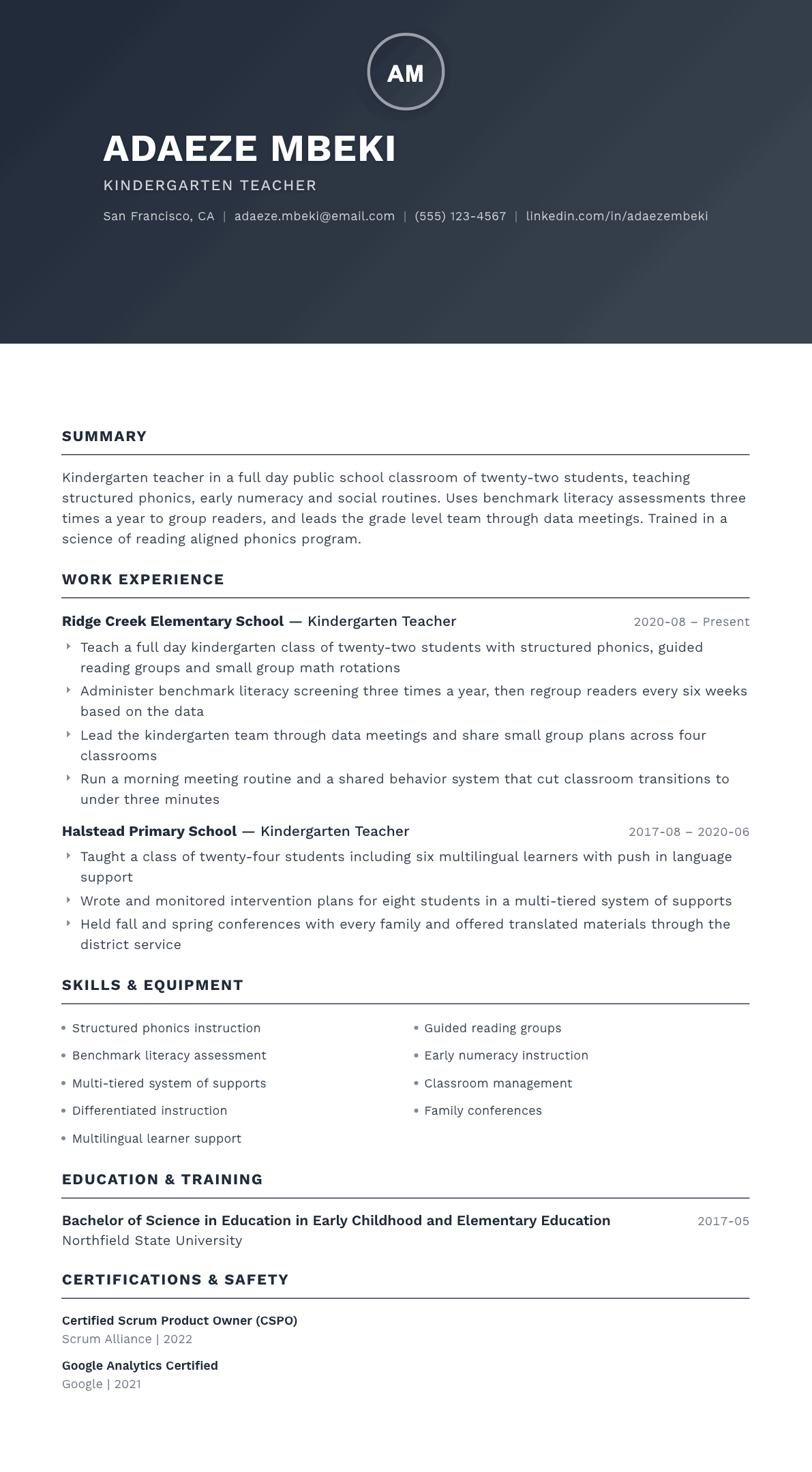
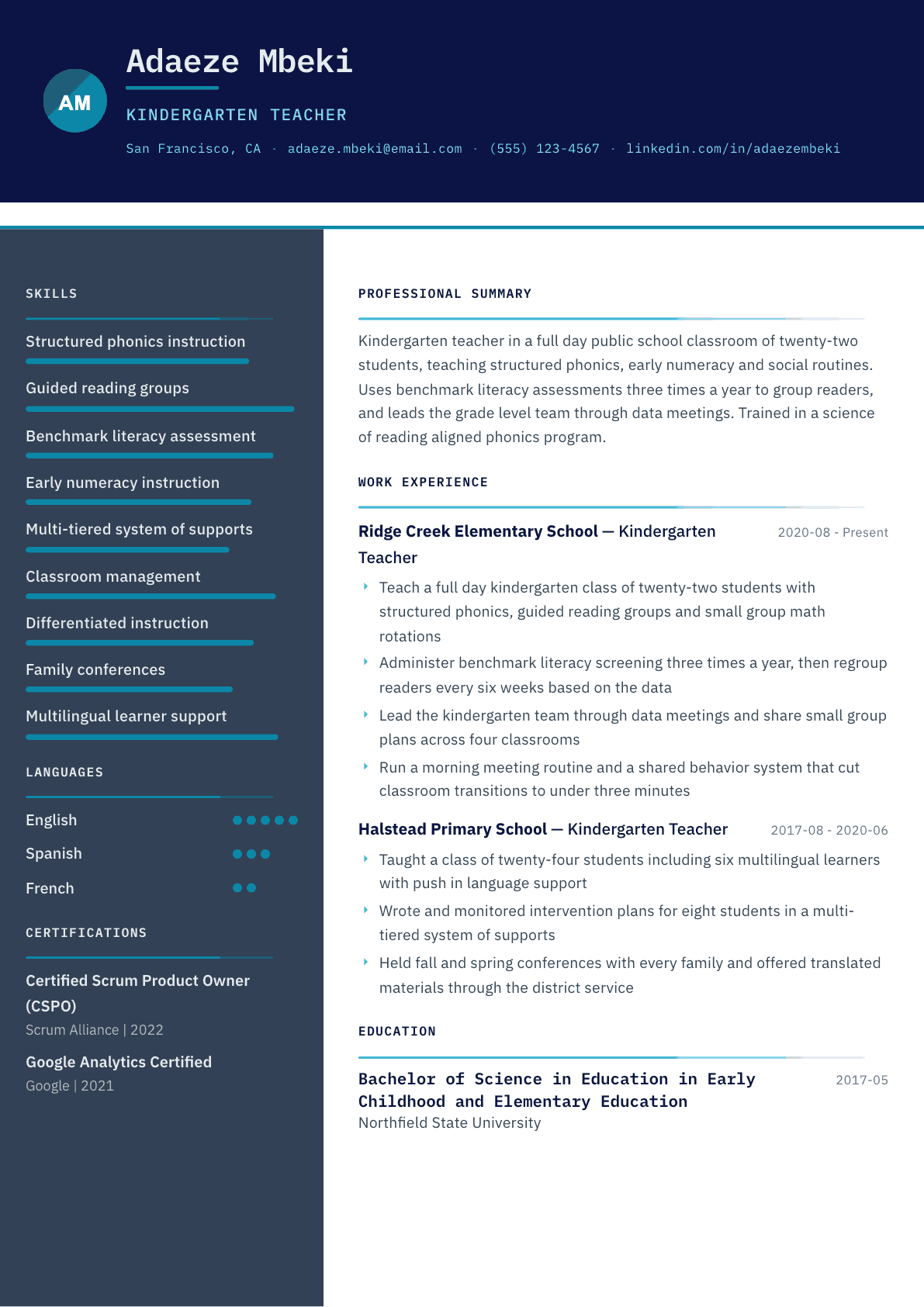
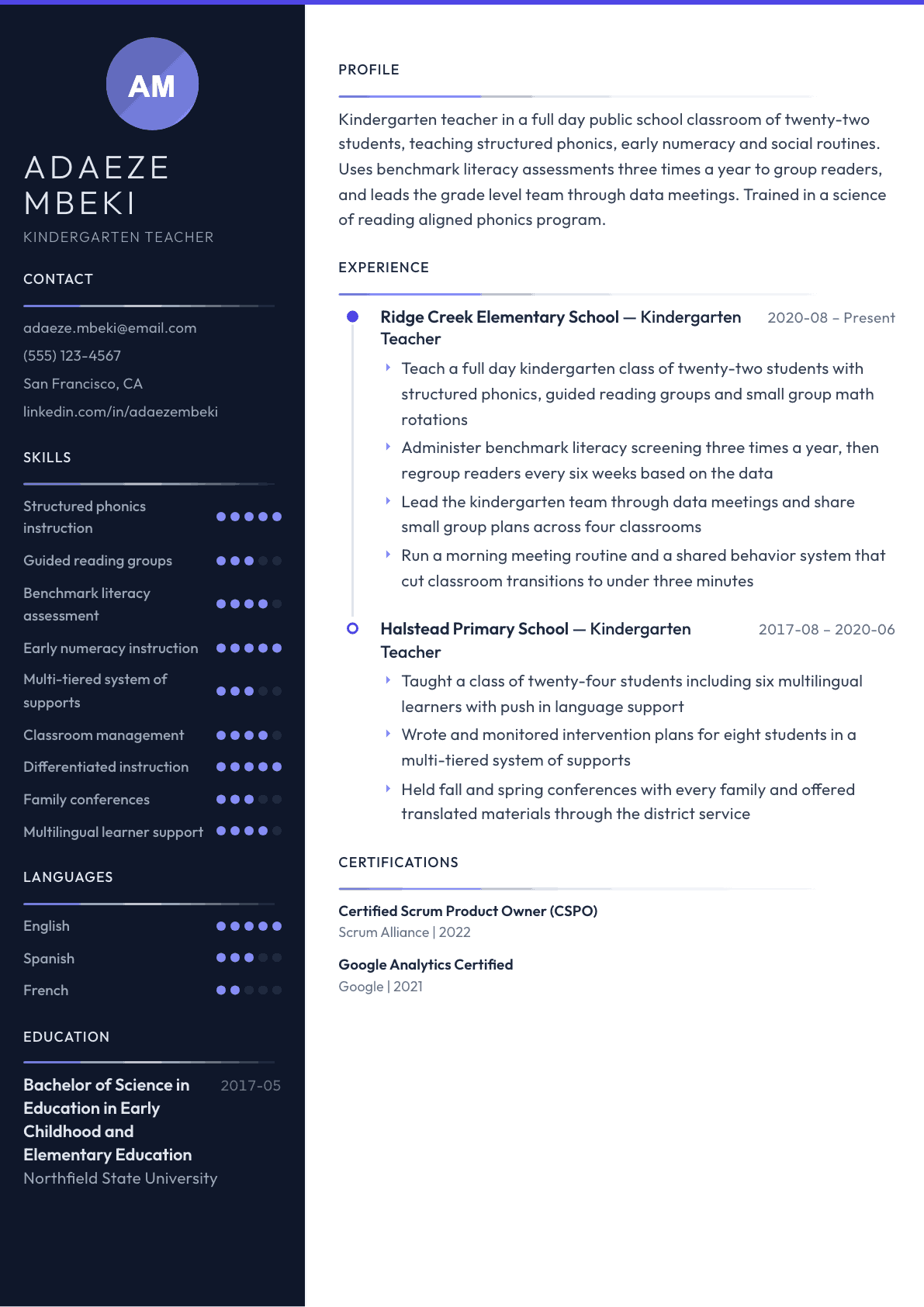
Example Kindergarten Teacher summary
Kindergarten teacher with seven years in full day public school classrooms of twenty-two to twenty-four students. Teaches structured phonics and early numeracy, administers benchmark literacy screening three times a year, and regroups readers every six weeks from the data. Leads the grade level team through data meetings. Seeking a kindergarten position in a district committed to science of reading practice.
Skills to list on a Kindergarten Teacher resume
- Structured phonics instruction
- Guided reading
- Benchmark literacy assessment
- Progress monitoring
- Early numeracy instruction
- Small group rotations
- Multi-tiered system of supports
- Differentiated instruction
- Classroom routines and transitions
- Positive behavior supports
- Family conferences
- Multilingual learner strategies
- Individualized education program collaboration
- Grade level team leadership
- Play based learning
What actually gets this resume read
- State your class size, whether the day is full or half, and the number of adults in the room for every position.
- Name the phonics or literacy program you were trained in and the benchmark assessment you administer by name.
- Show reading growth with grouping decisions and progress monitoring rather than a single test score claim.
- Describe your classroom management system concretely: the routine, the transition, the reinforcement, not the adjective.
- Put your state teaching certificate, grade band and endorsements in a section a screener can find in two seconds.
- Include your work with multilingual learners and students on individualized education programs, since most kindergarten rooms have both.
How to write a kindergarten teacher resume
Kindergarten is the year a school district measures hardest, because early reading data follows a cohort for the rest of elementary school. The principal reading your resume wants to know two things: can you teach a child to decode, and can you hold twenty-two five year olds together long enough to do it. A resume that only shows warmth answers neither.
The screening itself is layered. A human resources office confirms the certificate, the grade band and the endorsements. A principal or hiring committee then reads for the literacy program you were trained in, the assessment you administer, how you group readers, and what your classroom sounds like during a transition. Those are the parts most candidates leave general.
This guide covers how to order a kindergarten teacher resume, three summaries from student teaching to a grade level lead, before and after bullets that turn classroom routine into evidence, and the questions primary teachers ask when they apply to a new district.
Format: certification block a screener cannot miss
One page for the first several years, two pages once you have leadership or curriculum work. Put certification directly under the summary: the state, the license type, the grade band and every endorsement including reading, early childhood, special education or multilingual instruction.
District applicant systems parse this field literally, and a principal reviewing forty files uses it to sort. Keep the layout single column with clear headings, because school systems still run resumes through parsers that mishandle columns.
- Header: name, city and state, phone, email, certification summarized in one line.
- Order: summary, certification and endorsements, teaching experience, education, professional learning, skills.
- New teachers add a student teaching block with the grade, the class size, the mentor and the units taught.
Summary: class size, day length, program, evidence
Say how many students, whether the day is full or half, how many adults are in the room, and which literacy program you teach. Then add the assessment you use and what you do with the results, because that sentence is what separates you from every other applicant claiming to differentiate.
For a first year applicant, use the student teaching placement the same way. The grade, the class size, the mentor teacher and the program you delivered are concrete, and they beat a paragraph about your teaching philosophy.
Experience: instruction, grouping, routines
Lead each position with the school, the grade, the class size and the composition: multilingual learners, students with individualized education programs, and any co-teaching or paraprofessional support. Principals staff by that shape.
Then build bullets in three areas. Instruction should name the phonics or literacy program, the math approach, and the structure of your small group rotations. Assessment should name the benchmark screening tool, the frequency and the regrouping decision you make from it. Routines should describe a specific system: morning meeting, transitions, the reinforcement structure and how long a transition takes.
Kindergarten resumes get stronger when they include the adult work: leading a grade level team, running data meetings, mentoring a first year teacher, or sharing small group plans across classrooms. A principal reading that sees a colleague, not just a teacher.
Data, intervention and families
Talk about intervention as a system rather than an effort. Name the tiered support structure your school used, how many students you monitored, how often you collected progress data, and who else was in the meeting when a plan changed. That describes a teacher who works inside a school rather than beside one.
Family communication in kindergarten carries more weight than in later grades because it is many families first year in a school. Name the conference cycle, the weekly communication, the translation support you arranged, and any family literacy event you ran.
Professional learning and the district vocabulary
Add a short professional learning section with the training that actually changed your practice, naming the program and the provider. Districts moving toward structured literacy hire for it directly, and a named training reads as verified.
Then mirror the posting language once high on the page and once inside a bullet: structured phonics, guided reading, benchmark assessment, progress monitoring, small group instruction, tiered supports, differentiation, classroom management, play based learning and family engagement. Use the district wording rather than your preferred synonym.
Kindergarten Teacher resume summary examples
First year applicant
Newly certified teacher in early childhood and elementary education with a full semester student teaching in a kindergarten class of twenty-one, delivering structured phonics and small group math rotations under a mentor teacher. Trained in a benchmark literacy screening tool. Seeking a kindergarten position with induction support.
Five years in
Kindergarten teacher with five years in full day classrooms of twenty-two to twenty-four students, teaching structured phonics and early numeracy. Administers benchmark literacy screening three times a year and regroups readers every six weeks from the results. Supports multilingual learners with push in language services.
Grade level lead
Kindergarten teacher and grade level lead with ten years in primary classrooms, guiding four teachers through data meetings and shared small group planning. Coordinates tiered reading intervention with the literacy coach, mentors new teachers through district induction, and runs the school family literacy night.
Work experience bullets: before and after
Before: Taught reading and math to kindergarten students.
After: Taught a full day kindergarten class of twenty-two through structured phonics, guided reading groups and small group math rotations with daily independent center work.
Class size, day length and the named instructional structures show what the room actually runs on.
Before: Used assessments to track student progress.
After: Administered benchmark literacy screening three times a year, monitored flagged readers every two weeks, and regrouped small groups every six weeks based on the results.
Frequencies and the regrouping decision prove the data changed instruction rather than sitting in a file.
Before: Had good classroom management.
After: Ran a morning meeting routine with a shared behavior system and taught transition procedures explicitly, bringing classroom transitions down to under three minutes.
A named routine and a measurable transition are things a principal can picture and verify.
Before: Worked with English learners.
After: Taught six multilingual learners with push in language support, previewed vocabulary before each read aloud, and arranged translated conference materials through the district language service.
Student count and specific strategies replace a label with practice.
Before: Collaborated with other teachers.
After: Led the kindergarten team through monthly data meetings, shared small group plans across four classrooms, and aligned the phonics pacing calendar with first grade.
It shows leadership across a grade level rather than participation in a meeting.
Hard skills
- Structured phonics instruction
- Guided reading and small group rotations
- Benchmark literacy screening
- Progress monitoring
- Early numeracy instruction
- Multi-tiered system of supports
- Differentiated instruction
- Play based learning
- Individualized education program collaboration
- Multilingual learner strategies
- Classroom routines and transition design
- Family conference facilitation
Soft skills
- Patience with five year olds
- Consistency in routines
- Grade level team leadership
- Family partnership
- Clear feedback to paraprofessionals
- Flexibility during interruptions
Certifications worth listing
- State Teaching Certificate, Early Childhood or Elementary (State Department of Education)
- National Board Certification, Early Childhood Generalist (National Board for Professional Teaching Standards)
- English as a Second Language Endorsement (State Department of Education)
- Orton-Gillingham Classroom Educator Credential (Academy of Orton-Gillingham Practitioners and Educators)
Mistakes that cost kindergarten teacher candidates the interview
- Burying the certification and endorsements at the bottom when the human resources screen looks for them first.
- Naming no literacy program, which makes a district committed to structured reading unable to place you.
- Describing management with adjectives rather than the routine, the system and the transition it produces.
- Reporting a test score with no context instead of showing the grouping decisions the data drove.
- Leaving out class size and adult support, which is how a principal judges the load you have carried.
- Writing nothing about work with colleagues, which reads as a teacher who closes the classroom door.
Kindergarten Teacher resume questions
How do I write a kindergarten teacher resume with only student teaching experience?
Give the placement the same detail a job would get: the school, the grade, the class size, the length of the placement, the programs you delivered and the units you planned independently. Add the mentor relationship and any assessment training, then keep coursework brief.
Should I include test scores on a teaching resume?
Only data you personally collected and can explain, such as benchmark screening results for your own class or growth for a small group you monitored. Report it as a grouping decision or an intervention outcome, and never present a whole school score as your result.
How much does the literacy program name matter?
A great deal right now, because districts adopt a specific approach and want teachers who need less retraining. Name the program and the provider that trained you, and if your district used something different, add a line about adapting to an adopted curriculum.
What goes in a professional learning section?
Training that changed your practice, with the provider and the year of completion left out unless the district asks. Literacy training, behavior frameworks, multilingual learner endorsement coursework and assessment certification all belong. Skip generic one hour workshops entirely.
Is one page enough for a kindergarten teacher resume?
One page is right through your first several years. Move to two once you have grade level leadership, curriculum work, mentoring or a second certification area, and use the extra space for those roles rather than for longer bullets on classroom duties.