Federal Agent Resume Examples: free ATS score and gap list
Build a Federal Agent Resume That Rates Well on the Panel
By Mustafa Tarabya, founder of CVBooster · Published · Updated
Federal agent resume example, keyword list and guide covering case load, interviews, warrants, task force work and federal application formatting.
Sample resumes for a federal agent
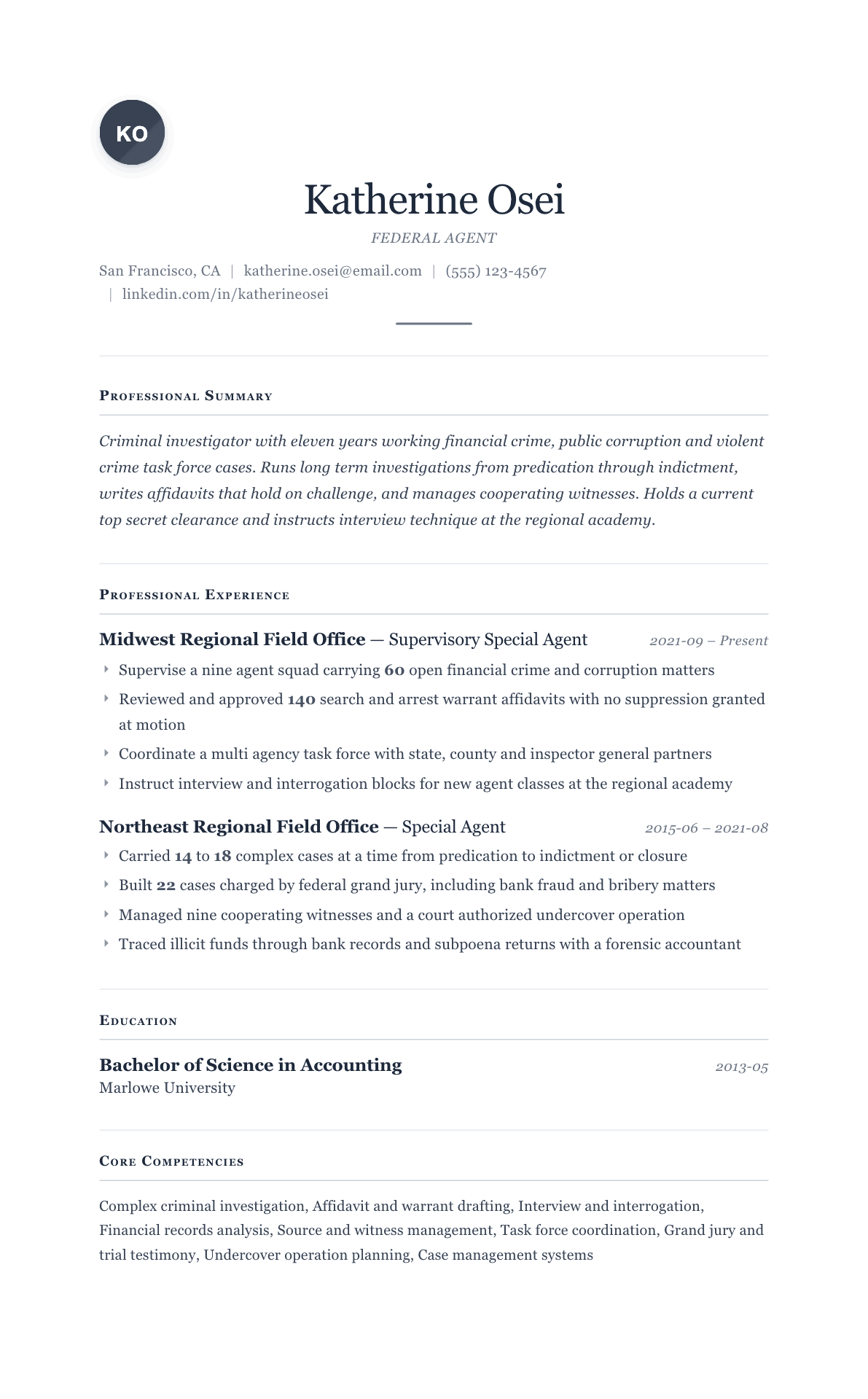
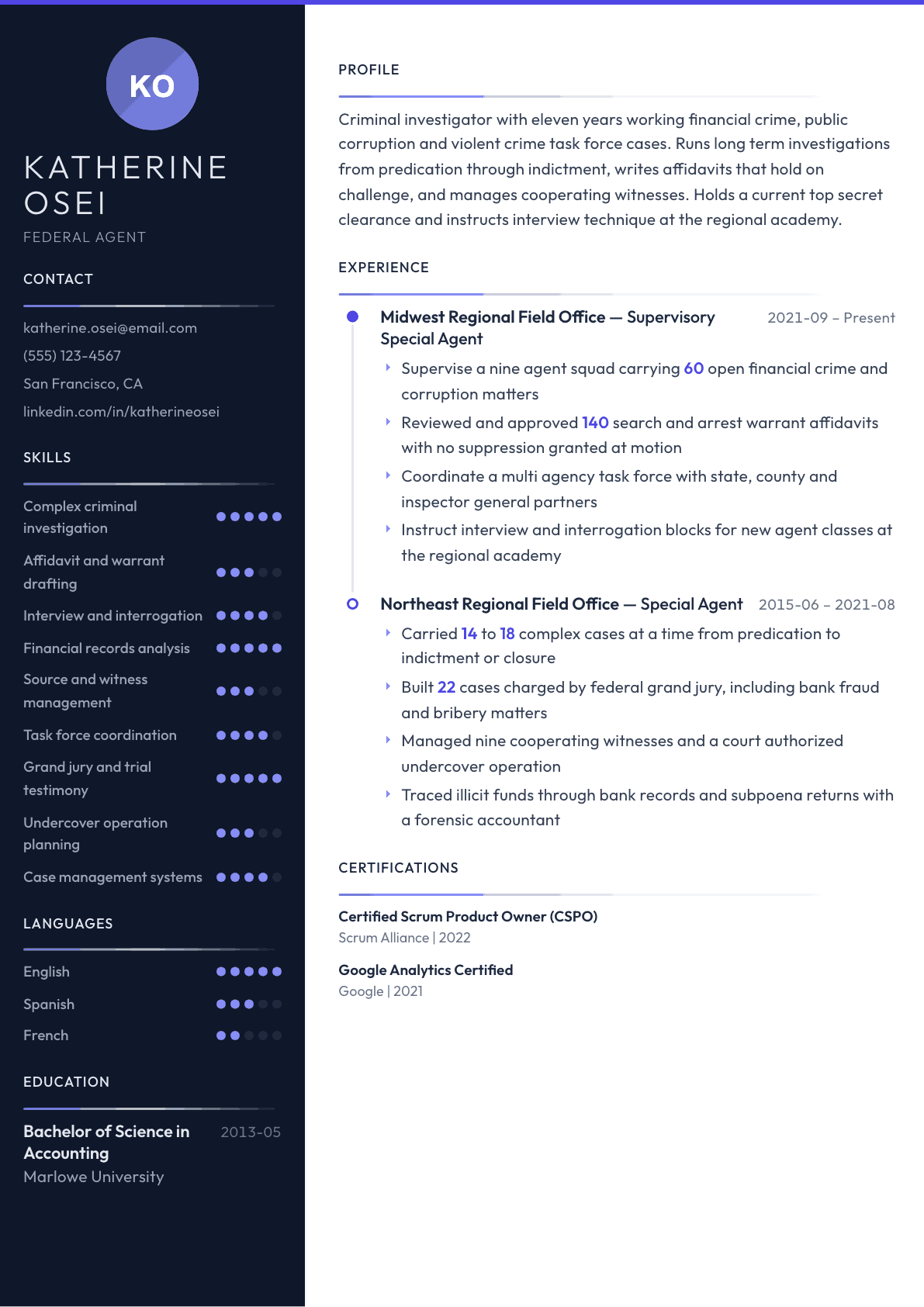
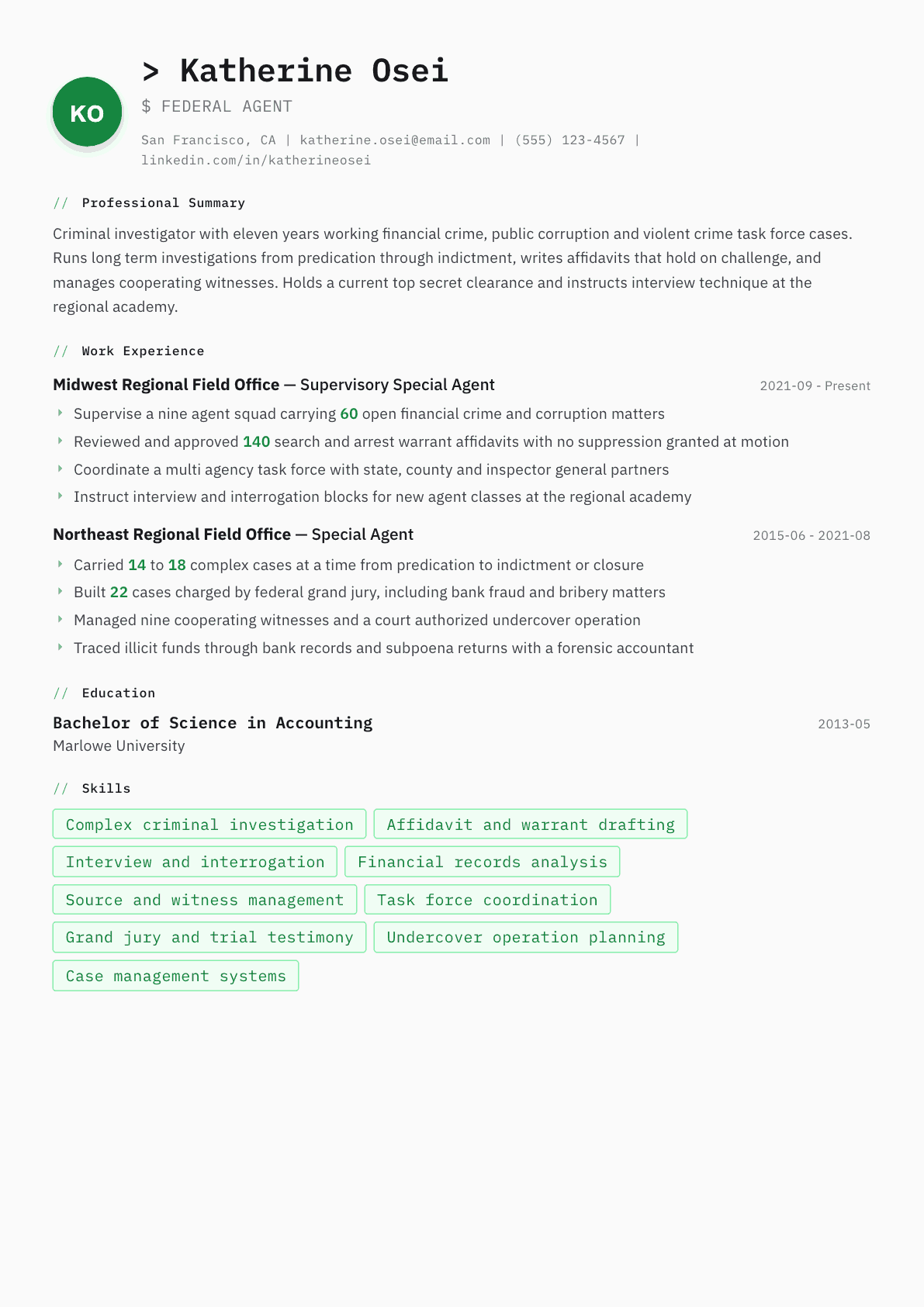
The same federal agent content laid out in three CVBooster templates, so you can see what the finished document looks like before you write a word.
Example Federal Agent summary
Federal agent with eleven years in financial crime, public corruption and violent crime task force work. Runs long term investigations from predication to indictment, drafts affidavits that survive suppression motions, and manages cooperating witnesses and undercover operations. Now supervises a nine agent squad and instructs interview technique for new agent classes. Holds a current top secret clearance.
Skills to list on a Federal Agent resume
- Criminal investigation management
- Search and arrest warrant affidavits
- Interview and interrogation technique
- Financial records and subpoena analysis
- Money laundering detection
- Confidential source management
- Undercover operation planning
- Surveillance and technical collection
- Evidence control and chain of custody
- Grand jury and trial testimony
- Task force and interagency coordination
- Intelligence reporting
- Firearms and tactical qualification
- Case management systems
- Squad supervision
- Instruction and curriculum delivery
What actually gets this resume read
- Lead with case types and complexity, because a rating panel scores what you investigated more than where you sat.
- Give case load carried at once, cases charged and the judicial outcomes you can honestly claim.
- Name your clearance level and its most recent adjudication window without listing anything classified.
- Show your writing volume, since affidavits, reports and subpoena work fill most of a federal agent week.
- Describe task force and interagency roles by what you coordinated rather than by acronyms alone.
- Write the federal version long and mirror the language of the announcement in your specialized experience statements.
How to write a federal agent resume
A federal agent application is scored twice. A rating panel measures your narrative against the specialized experience statement in the announcement and assigns points. Only the applications that clear that bar reach a supervisory agent who reads for judgment: what you investigated, how you built it, and whether your affidavits held up when defense counsel came after them.
The mistake experienced investigators make is writing for the second reader and not the first. They compress a decade of complex casework into six tight bullets, and the panel, which cannot infer, rates the application below the grade the applicant deserves. The other mistake is the reverse: pages of duty language with no case outcome anywhere in it.
This guide shows how to write for both. It covers the federal resume structure, how to describe case load, warrants, sources and testimony without disclosing anything you should not, three summaries by career stage, rewritten bullets, and the questions agents ask when they move between agencies or into a supervisory position.
Format: long narrative, exact detail, grade visible
Write the federal version at whatever length the record honestly requires, often four pages or more for a senior agent. Every position carries the organization, the office and location, the grade or pay band, dates by month and year, hours worked per week, and supervisor contact permission. A rating panel that cannot find your grade cannot credit you at the level you earned.
Structure each position as a short duty paragraph followed by accomplishment statements. The paragraph establishes scope, the accomplishments prove outcome. Mirror the announcement wording where it is honest to do so, because the panel is matching language against a checklist rather than reading your record for its own sake.
- Header for a federal agent: name, city and state, phone, email, current office, grade and clearance status.
- Clearance line under the summary: level held, whether it is current, and the last adjudication window in general terms.
- Order the page as summary, clearance, investigative experience, specialized training, instruction, awards, education.
- Applicants entering from state or local law enforcement lead with complex case work and federal task force time.
Summary: violation types, complexity, clearance
Four lines. Name the violation types you have worked, the complexity level, your years as a sworn investigator and your clearance standing. Financial crime, public corruption, violent crime, counterintelligence and cyber intrusion are separate skill families, and a panel wants yours identified rather than described as federal investigations.
For a supervisory application, shift the emphasis to what you run rather than what you carry: squad size, matters under your review, warrant affidavits you approve, and the interagency relationships you manage. Panels for supervisory positions score program management and personnel judgment more heavily than personal case production.
Experience: case load, warrants and outcomes
Give case load as a number carried at once, not a career total. An agent holding fourteen to eighteen complex matters simultaneously is describing a workload a supervisor recognizes immediately. Then give what those cases produced: charges brought, indictments returned, convictions, forfeitures, and matters closed on the merits without charges, which is an outcome too.
Warrant and affidavit work is the clearest evidence of investigative writing quality. State how many search and arrest warrant affidavits you drafted or approved, and whether any resulted in suppression. That single line does more for your credibility than any adjective, because every agent reading it knows what it takes to write affidavits that survive challenge.
Then the collection methods: interviews and interrogations, confidential source management, court authorized techniques described in general terms, financial record analysis, subpoena work, and coordination with forensic accountants or technical specialists. Say what you personally did rather than what the squad accomplished around you.
Testimony, task forces and what stays off the page
Testimony belongs on a federal agent resume: grand jury appearances, suppression hearings, trials, and any expert qualification you have received. A panel treats courtroom experience as proof that your case work reached the end of the process and held together there, which is the only real test of an investigation.
Task force roles should be written by function rather than by acronym. Say what you coordinated, which partner agencies were involved and what the joint effort produced. And keep the obvious boundaries: no case specifics from open matters, no source identifying detail, no classified program names, no technique detail beyond what appears in public court filings.
Training, instruction and keywords
Group your investigative training so the panel can read it as a picture: academy, advanced investigative courses, financial or cyber specialty schools, firearms and tactical requalification, and any interview methodology you were certified in. Spell every course out fully before using an acronym, because the panel may sit in a different agency entirely.
Instruction is worth its own line. Teaching interview technique, affidavit drafting or financial analysis to new agent classes signals both mastery and the willingness to build others, and supervisory panels weigh it. Use the announcement vocabulary throughout: investigation, surveillance, source development, evidence, prosecution, coordination, program management.
Federal Agent resume summary examples
Entering federal service
Certified public accountant with four years of forensic audit work on embezzlement and vendor fraud engagements, plus two years as a state fraud investigator. Traces funds through bank records, writes findings that support prosecution, and is applying for a federal criminal investigator position.
Six years as a special agent
Special agent with six years working bank fraud, bribery and money laundering matters. Carries fourteen to eighteen complex cases at a time from predication to indictment, has drafted warrant affidavits with no suppression granted, and manages cooperating witnesses on long term investigations.
Supervisory agent
Supervisory special agent leading a nine agent squad with sixty open financial crime and corruption matters. Reviews and approves warrant affidavits, coordinates a task force with state and inspector general partners, and instructs interview technique for new agent classes at the regional academy.
Work experience bullets: before and after
Before: Conducted federal criminal investigations.
After: Carried 14 to 18 complex bank fraud, bribery and money laundering matters at a time, taking each from predication through indictment or documented closure.
Concurrent case load and violation types tell a panel your working complexity.
Before: Prepared search warrants and affidavits.
After: Drafted and reviewed 140 search and arrest warrant affidavits with no evidence suppressed at motion, coordinating each with the assigned prosecutor before submission.
The suppression record is the only objective measure of affidavit quality there is.
Before: Interviewed witnesses and subjects.
After: Managed nine cooperating witnesses through debriefing, corroboration and testimony preparation, and conducted subject interviews that produced admissible statements in four charged cases.
Source handling with outcomes is a distinct skill from simply conducting interviews.
Before: Worked with other agencies on cases.
After: Coordinated a multi agency task force with state police, county prosecutors and two inspector general offices, producing 22 cases charged by federal grand jury.
Naming partners and the charging outcome shows coordination that actually delivered.
Before: Testified in court on my cases.
After: Testified in 30 grand jury proceedings, six suppression hearings and four federal trials, including expert qualification on financial records tracing.
The breakdown by proceeding type, plus expert qualification, shows depth in the courtroom.
Hard skills
- Complex criminal investigation management
- Search and arrest warrant affidavits
- Interview and interrogation technique
- Confidential source development and handling
- Financial record and subpoena analysis
- Money laundering and asset tracing
- Undercover operation planning
- Surveillance and technical collection coordination
- Evidence control and chain of custody
- Grand jury and trial testimony
- Task force and interagency coordination
- Intelligence and investigative reporting
- Squad supervision and case review
Soft skills
- Patience across a multi year investigation
- Judgment about when a case should close
- Credibility with prosecutors and judges
- Handling sources without losing control of a case
- Coaching newer agents through their first prosecutions
Certifications worth listing
- Certified Fraud Examiner (CFE) (Association of Certified Fraud Examiners)
- Certified Anti-Money Laundering Specialist (CAMS) (ACAMS)
- Certified Public Accountant (CPA) (State Board of Accountancy)
- Certified Information Systems Security Professional (CISSP) (ISC2)
Mistakes that cost federal agent candidates the interview
- Compressing a decade of complex casework into six bullets that a rating panel cannot score.
- Describing squad accomplishments in a way that hides which parts you personally performed.
- Giving career case totals rather than the number of matters you carried at one time.
- Leaving out warrant and affidavit volume, the clearest available proof of investigative writing quality.
- Writing task force work as a list of acronyms with no partner agencies or outcomes attached.
- Including case specifics, source detail or program names that should never appear on an application.
Federal Agent resume questions
How long should a federal agent resume be?
As long as the record requires, often four pages or more for a senior investigator applying through a federal announcement. Length is not penalized there. Keep a two page version for interagency details, task force introductions and any private sector investigative role you pursue.
How do I write case work without disclosing sensitive information?
Stay at the level of violation type, complexity, method and outcome. Charged cases that became public through court filings can be described in general terms. Open matters, source identities, technique detail and classified programs stay off the page entirely.
I am a state detective. How do I make the jump to federal work?
Lead with the most complex, longest running cases you have carried and any federal task force time, since that experience is what a panel can map directly. Emphasize warrant affidavits, financial analysis, source handling and grand jury or trial testimony over patrol era duties.
How should I present my security clearance?
State the level, whether it is current and roughly when it was last adjudicated. Do not list programs, briefings or access categories. If your clearance has lapsed, say so plainly with the date range, because reinvestigation timing affects how quickly an agency can bring you on.
What matters most on a supervisory agent application?
Program management rather than personal case production: squad size, matters under review, affidavit approvals, budget or resource decisions, personnel development and interagency relationships you own. Panels want evidence you have already been making decisions for other agents.
Related resume examples
- Criminal Investigator Resume example
- Fraud Investigator Resume example
- Private Investigator Resume example
- Border Patrol Agent Resume example
- Intelligence Officer Resume example
- Crime Analyst Resume example