Marketing Manager Resume Examples: the lines they read
Write a Marketing Manager Resume That Drives Results
By Mustafa Tarabya, founder of CVBooster · Published · Updated
Build an impactful marketing manager resume with campaign metrics, digital strategy highlights, and templates optimized for ATS.
Sample resumes for a marketing manager
The same marketing manager content laid out in three CVBooster templates, so you can see what the finished document looks like before you write a word.
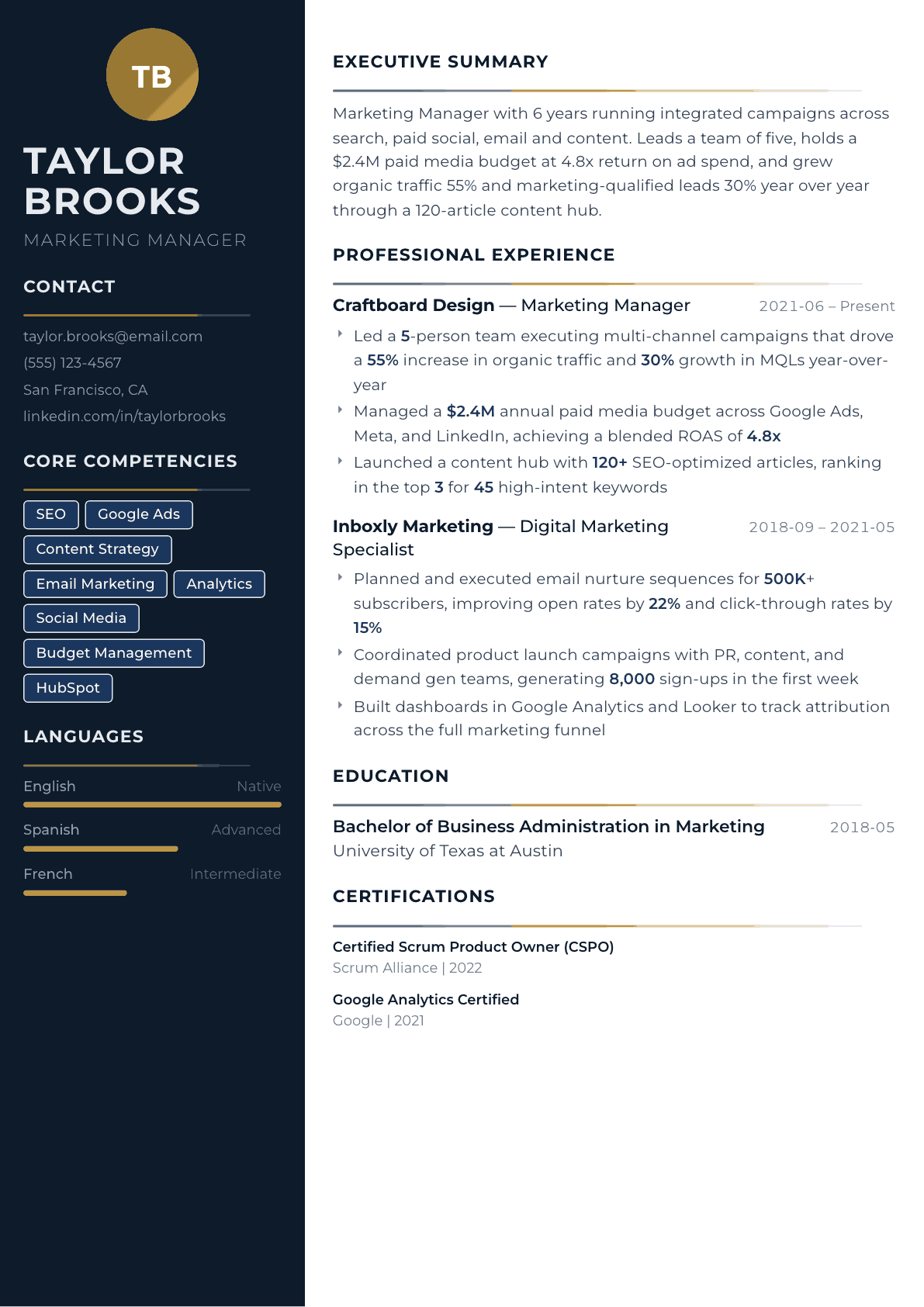
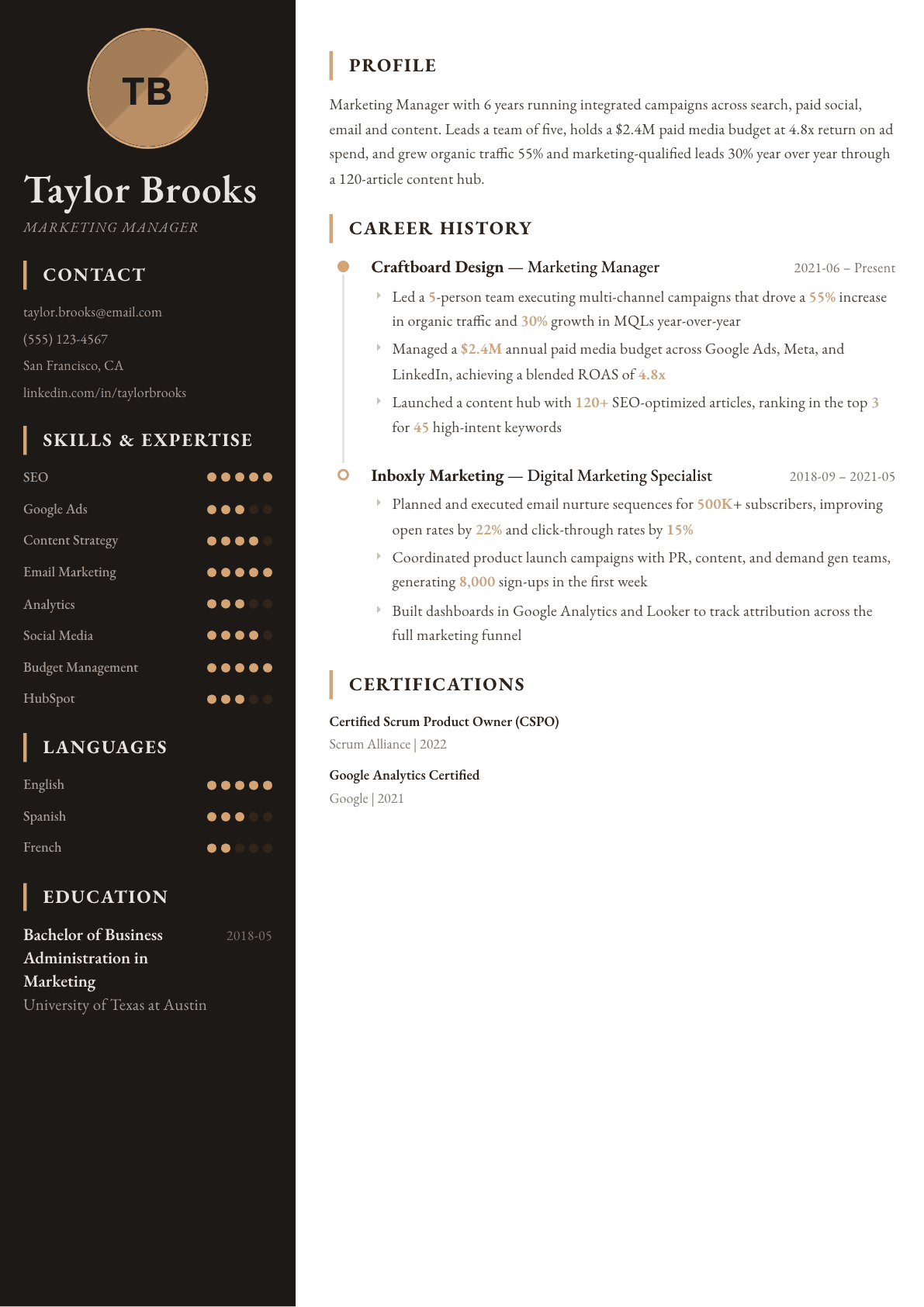
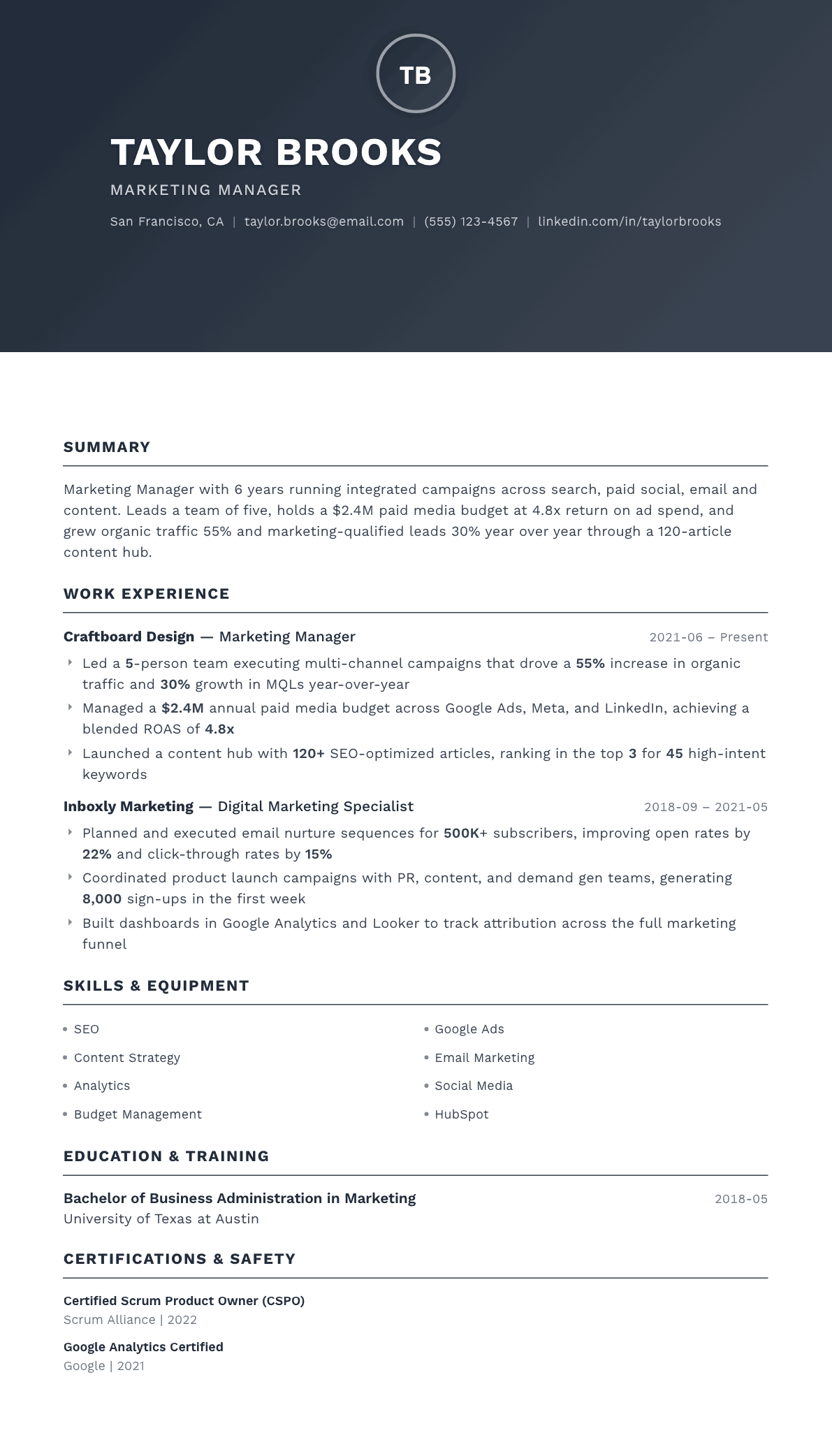
Example Marketing Manager summary
Demand generation manager, 6 years, owning a $2.4M media budget across Google, Meta and LinkedIn at a blended 4.8x return. Built the content and SEO program that holds 45 high-intent keywords in the top three, and reports pipeline contribution through a Looker attribution model rather than channel vanity metrics.
Skills to list on a Marketing Manager resume
- SEO
- SEM / Google Ads
- Content Marketing
- Email Marketing
- Social Media Marketing
- Marketing Automation
- Google Analytics
- HubSpot
- Copywriting
- Brand Strategy
- Paid Social
- Conversion Rate Optimization
- Budget Management
- Campaign Management
- Market Research
What actually gets this resume read
- Lead with ROI metrics: ROAS, cost per acquisition, conversion rates, and revenue influenced.
- Specify the channels you managed (SEO, paid search, social, email) and the budget size for each.
- Demonstrate both strategic thinking (campaign planning, brand positioning) and hands-on execution (copywriting, ad management).
- Mention marketing tools by name: HubSpot, Google Analytics, Semrush, Marketo, etc.
- Show progression from specialist to manager by highlighting team leadership and cross-functional collaboration.
- Include certifications like Google Ads, HubSpot Inbound, or Meta Blueprint to strengthen credibility.
How to write a marketing manager resume
Marketing manager is one of the most crowded titles on any job board, partly because it means five different jobs. At a startup it means you are the entire function and you write the ads yourself. At a large company it means you own one segment or one product line and coordinate agencies and specialists. A resume that does not say which version you are gets read as the wrong one and screened out.
The hiring panel is usually a marketing director plus somebody from sales or finance. The director reads for judgment: how you chose channels, how you set a budget, what you cut. The sales or finance reader looks for whether your programs produced revenue anyone downstream recognized. Both are bored of resumes that list responsibilities and stop.
This guide covers how to signal the scope you actually ran, how to write about budget and channel mix without vague claims, three summaries by career stage, before and after bullets, and the questions marketing managers ask when they need the resume to show leadership as well as execution.
Format: scope first, one page until you manage managers
Reverse chronological, one page for under ten years. The single most useful formatting decision is a scope line under each job title: the channels you owned, the annual budget band, the team or agency headcount, and the business you supported. Without it a reader cannot tell a manager of a two channel program from one running a full mix.
Avoid heavy design. Marketing resumes are the ones most likely to arrive with columns, icons and brand colors, and they are also the ones most likely to lose their dates in a parser. Keep the layout plain and put the creativity into the writing.
- Order: summary, experience, skills, certifications, education.
- Scope line per role: channels, budget band, direct reports, agencies managed.
- Name the products or segments you marketed, not just the employer.
Summary: the mix you own and the growth you are accountable for
Three lines that answer what you market, to whom, through which channels, and at what scale. A business software marketer running demand generation for a sales led motion and a consumer brand marketer running retail media are both marketing managers and share almost no daily work, so say which you are in the first clause.
End on the outcome you are measured against: pipeline, revenue, subscriptions, qualified leads, retail sell through, or brand measures if that is genuinely your remit. Naming your own primary metric tells a director immediately whether you are the kind of marketer they need.
Experience: campaigns are the unit, decisions are the content
Organize each role around the three or four campaigns or programs that mattered, not around every activity. For each, give the objective, the channel mix, the budget scale, your role in the decision, and the result in the metric the business used. A product launch bullet that names the segment, the channels, the spend band and the pipeline it produced is worth six bullets of duties.
Show the cutting as well as the building. Directors hire managers who can kill a channel that stopped paying, renegotiate an agency retainer, or shift budget mid quarter when the return curve flattened. These decisions are rare on resumes and memorable in interviews.
Distinguish clearly between work you did and work you directed. Wrote the launch messaging and the landing page copy is a different claim from briefed the agency on messaging and approved the final copy. Both are legitimate; conflating them falls apart in the first interview.
Include cross functional work explicitly. Marketing managers live or die on their relationship with sales and product. Say that you ran the monthly pipeline review with sales leadership, or that you built the launch checklist product now uses, because that is the part of the job a director cannot verify from a campaign metric.
Budget and results without inventing numbers
Give budget as a band rather than a precise figure, and give results in ratios and rates where possible: return on ad spend, cost per acquisition, conversion rate from lead to opportunity, share of pipeline sourced by marketing. Ratios travel between companies; raw totals do not, and a total with no context invites suspicion.
When you inherited a program, say what it looked like when you arrived. Took a channel from a single always on campaign to a segmented program across three audiences is a stronger claim than a percentage improvement with no baseline, and it is defensible.
Skills and certifications: fewer, and specific
A skills block of thirty nouns says nothing. Choose the ten to fourteen that a posting in your niche would actually screen for, split between channel skills and tools. Name the marketing automation platform, the analytics stack, the ad platforms and the content or project tooling you genuinely work in.
Certifications carry modest weight at manager level but they are cheap signals for a career changer or someone moving between channels. Google Ads, Meta Blueprint and HubSpot credentials are recognized and easy to verify; list them with the issuing body and leave off anything that cannot be checked.
Keywords for the applicant tracking screen
Manager postings repeat a predictable set: demand generation, campaign management, go to market, brand positioning, budget management, channel strategy, conversion rate optimization, marketing automation, cross functional leadership, and the named platforms. Mirror the posting's wording once in the summary or skills and once inside an experience bullet. Keep the phrasing natural, because after the parser passes it a director reads the same sentences and stuffed keywords are obvious.
Marketing Manager resume summary examples
Newly promoted manager
Marketing manager with three years in business software, promoted from specialist after running paid search and email for the mid market segment. Own a program budget in the low six figures, manage one coordinator, and produced 34% of the quarter's marketing sourced pipeline from two campaigns.
Six years in
Marketing manager with six years running demand generation for a subscription business across paid search, paid social, email and events. Manage a team of three plus two agencies, own the annual channel budget, and hold return on ad spend above 4 while growing marketing sourced pipeline 60% year over year.
Senior manager leading a team
Senior marketing manager with ten years across consumer and business marketing, currently leading a team of seven covering brand, performance and lifecycle for two product lines. Rebuilt the channel mix after retiring two underperforming channels, and run the go to market process used for every launch.
Work experience bullets: before and after
Before: Managed digital marketing campaigns across multiple channels.
After: Owned paid search, paid social and email for the mid market segment, running a seven figure annual budget across four always on programs and three seasonal launches.
Naming the channels, the segment, the budget scale and the program count converts a title into a scope a director can size.
Before: Increased leads through better campaigns.
After: Rebuilt the paid search account into segment level campaigns with negative keyword hygiene and landing pages per audience, lifting lead to opportunity conversion from 9% to 17%.
The mechanism explains why the number moved, which is the difference between a claim and a case study.
Before: Worked with the sales team.
After: Ran the monthly pipeline review with regional sales leadership, agreed the definition of a qualified lead with them, and cut rejected leads by more than half in two quarters.
A named ritual and a jointly agreed definition show real cross functional work rather than proximity to sales.
Before: Managed the marketing budget.
After: Reallocated a fifth of the annual budget out of display and trade press after two quarters of flat return, moving it into paid social and a partner program that produced pipeline within one quarter.
Cutting a channel is the decision that proves budget ownership; managing a budget only proves access to one.
Before: Launched a new product.
After: Led the go to market for a new product tier: positioning and messaging with product, a three channel launch campaign, sales enablement decks and a launch week that produced 400 qualified signups.
Listing the workstreams shows what you actually coordinated, where launched a product hides all of it.
Hard skills
- Demand generation
- Paid search and Google Ads
- Paid social
- Email and lifecycle marketing
- Search engine optimization
- Content marketing
- Marketing automation
- Google Analytics 4
- HubSpot
- Budget planning and forecasting
- Conversion rate optimization
- Brand positioning and messaging
- Go to market planning
- Agency management
Soft skills
- Cross functional leadership
- Coaching specialists
- Executive communication
- Negotiating with vendors
- Prioritizing under a fixed budget
- Written clarity
Certifications worth listing
- Google Ads Search Certification (Google Skillshop)
- Google Analytics Certification (Google Skillshop)
- Meta Certified Digital Marketing Associate (Meta Blueprint)
- HubSpot Inbound Marketing Certification (HubSpot Academy)
- Professional Certified Marketer (American Marketing Association)
Mistakes that cost marketing manager candidates the interview
- Using the title marketing manager without a scope line, so nobody can tell whether you ran one channel or eight.
- Listing responsibilities from the job description instead of the campaigns you actually chose and ran.
- Blurring hands on execution and agency direction, which collapses under a single interview question.
- Reporting a growth figure with no baseline and no mechanism behind it.
- Filling the skills block with thirty terms, which dilutes the ten that match the posting.
- Leaving out sales and product collaboration, which is most of the job above specialist level.
- Submitting a heavily designed two column file that loses dates and headings in the parser.
Marketing Manager resume questions
How do I show I am ready to move from specialist to marketing manager?
Show ownership of a whole program rather than a channel: the plan, the budget, the sequencing and the readout. Add any coaching, agency direction or cross functional leadership you have done, since those are the parts of the manager job a specialist rarely gets to practice.
Should I put budget figures on my resume?
Use bands rather than exact amounts, and only where the number tells the reader something about scope. A budget band paired with the channels it covered is informative, while a total with no context reads as boasting and cannot be verified.
How long should a marketing manager resume be?
One page through roughly ten years of experience. Go to two only when you manage other managers or carry multiple product lines, and use the second page for the earlier roles compressed to a line or two each rather than for more bullets on recent work.
Do certifications matter for a marketing manager?
They are a modest signal at this level and a useful one for career changers or people switching between channels. List them with the issuing body, keep them to a short block near education, and never let them take space away from campaign results.
How do I write this resume for a business software role after consumer work?
Rewrite the summary around the sales motion and the funnel, lead every job with pipeline and lead quality rather than reach, and translate your consumer channels into their business equivalents. Name any experience with long sales cycles, sales enablement or account based programs.