UX Designer Resume Examples: free ATS score and gap list
Design a UX Designer Resume That Passes the Usability Test
By Mustafa Tarabya, founder of CVBooster · Published · Updated
Craft a UX designer resume with research methods, portfolio highlights, and user-centered design skills that impress hiring teams.
Sample resumes for a ux designer
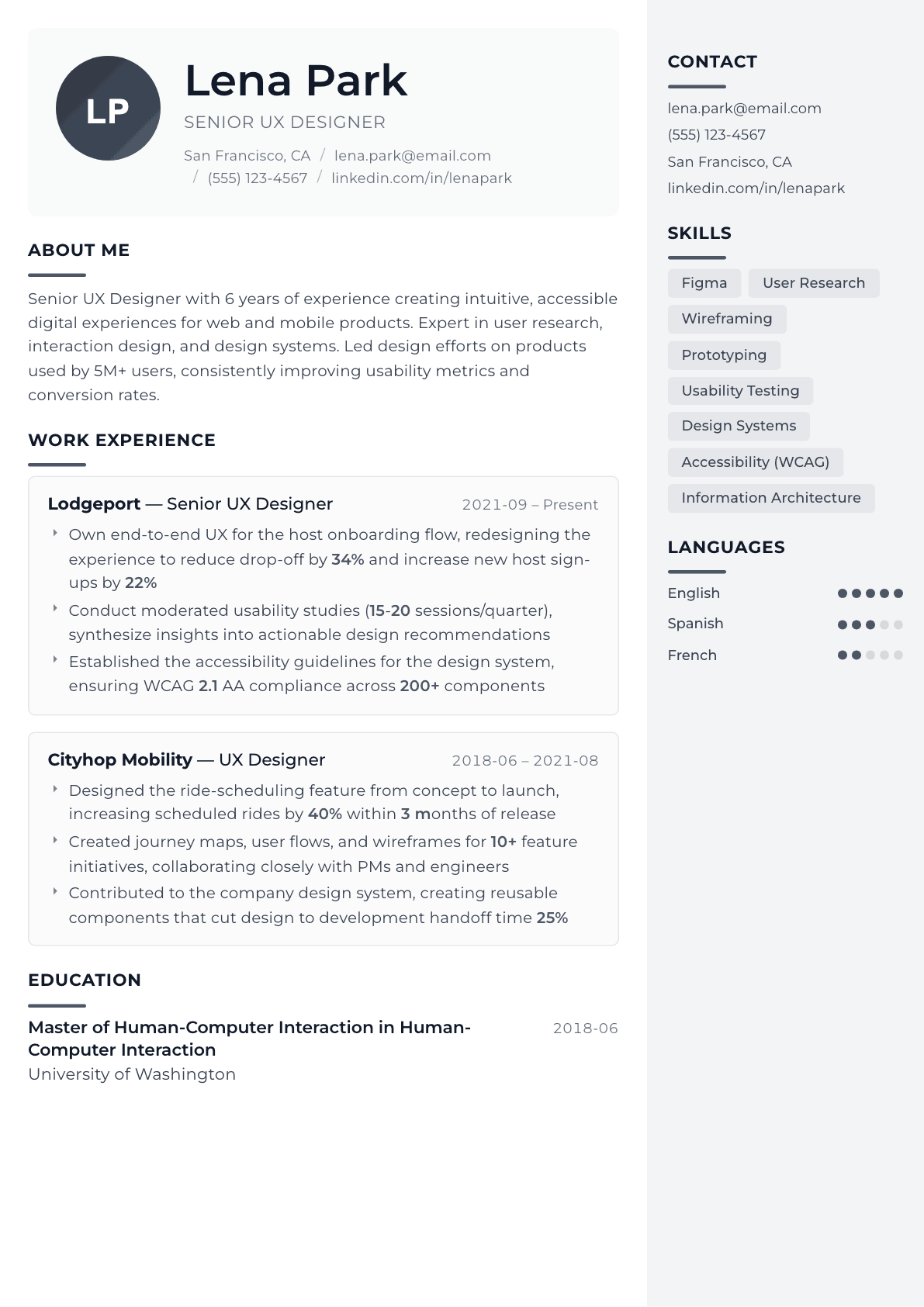
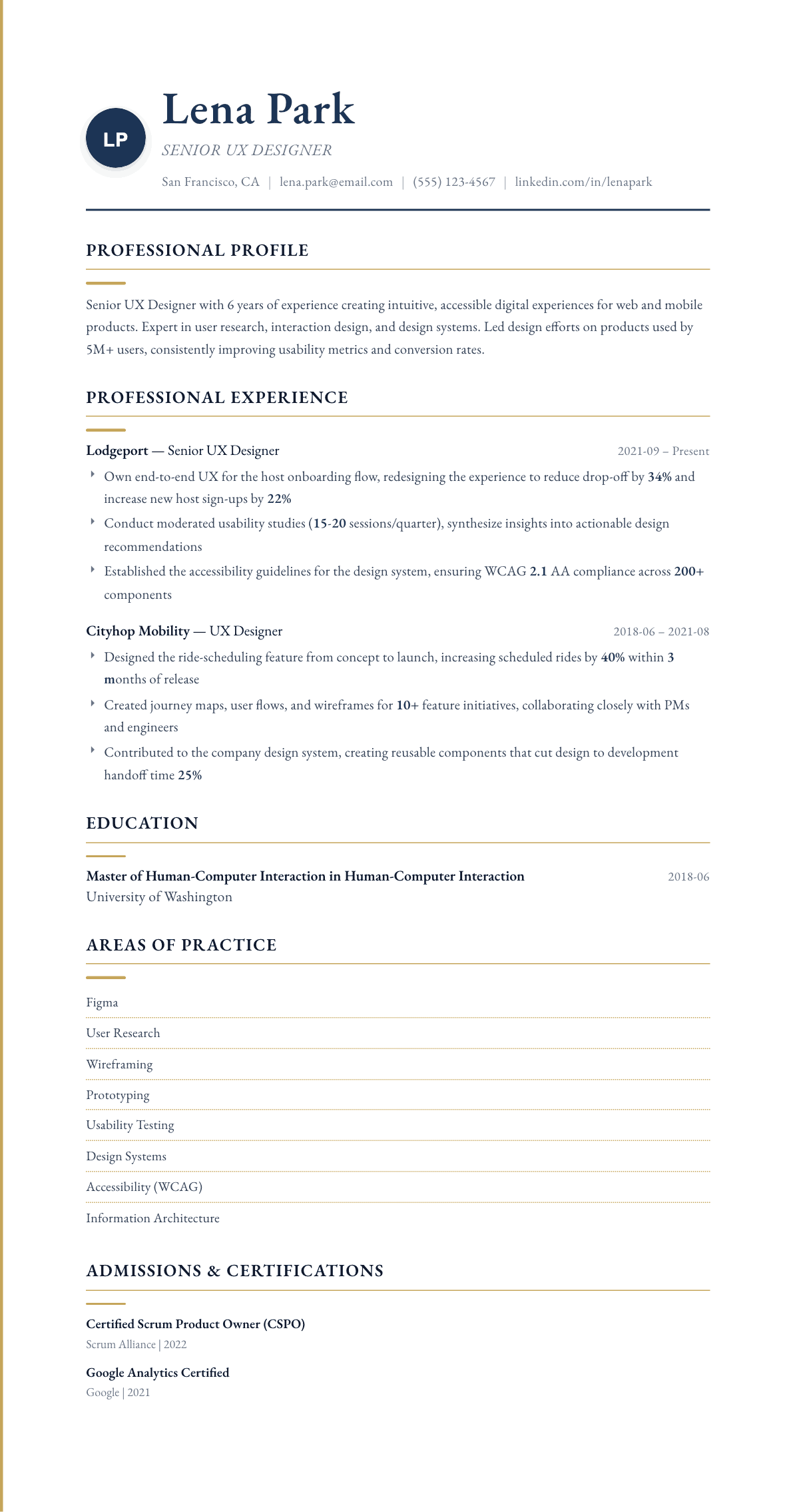
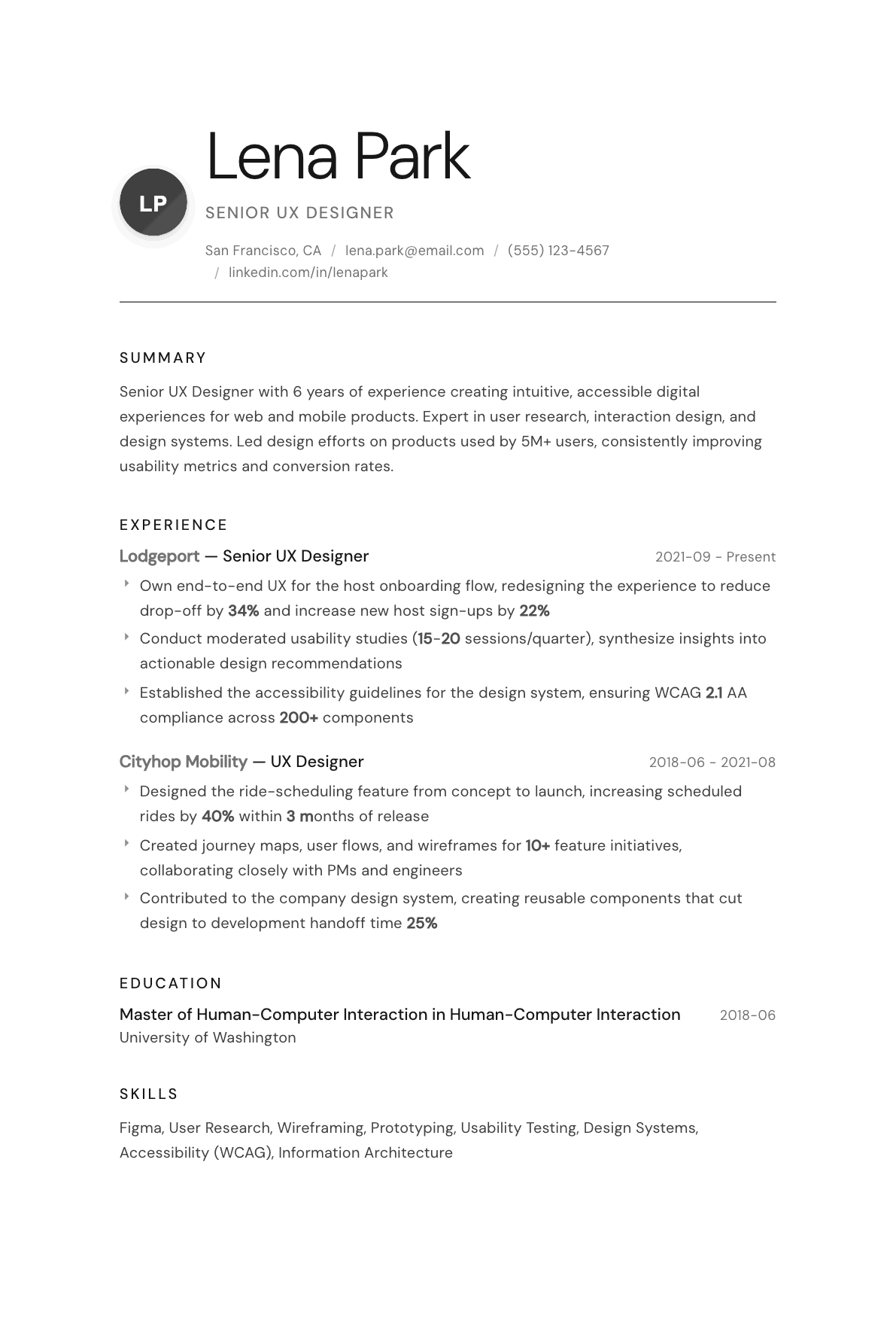
The same ux designer content laid out in three CVBooster templates, so you can see what the finished document looks like before you write a word.
Example UX Designer summary
UX designer, 6 years on web and mobile products used by 5M people, owning research through handoff. Redesigned a host onboarding flow to cut drop-off 34%, runs 15 to 20 moderated usability sessions a quarter, and wrote the accessibility guidelines that hold 200 design system components to WCAG 2.1 AA.
Skills to list on a UX Designer resume
- Figma
- Sketch
- Adobe XD
- User Research
- Usability Testing
- Wireframing
- Prototyping
- Information Architecture
- Interaction Design
- Design Systems
- Accessibility (WCAG)
- Journey Mapping
- User Flows
- A/B Testing
- Design Thinking
What actually gets this resume read
- Link to your portfolio prominently; hiring managers will not consider UX candidates without seeing their work.
- Describe your research methods (usability testing, card sorting, surveys, A/B testing) with specifics on sample sizes and findings.
- Quantify design impact: conversion rate improvements, task completion rates, error reduction, or NPS changes.
- Showcase your process: discovery, ideation, prototyping, testing, iteration, and handoff.
- Mention design tools (Figma, Sketch, Adobe XD, Miro, Maze) and prototyping tools (InVision, Principle, Framer).
- Highlight accessibility expertise; it is increasingly a must-have for UX roles at major companies.
How to write a ux designer resume
The hiring manager for a UX designer role is trying to answer a question your portfolio alone cannot settle: did this person actually change how a product works, or did they produce artifacts. Journey maps, personas and wireframes are evidence of activity. Shipped flows that moved a number are evidence of impact. A UX resume that lists deliverables reads as process theater, and a UX resume that names problems, decisions and outcomes reads as a designer worth interviewing.
The title also covers a wide span. At a startup a UX designer researches, designs, prototypes, writes the interface copy and draws the final pixels. At a large company the role is narrower, sitting between a researcher and a UI designer, owning flows, information architecture and interaction rather than visual language. Say which environment you have worked in and which one you are applying to, because the interview loops are completely different.
What follows is the structure that surfaces outcomes early, three summaries at different levels, before and after bullets that turn design activity into design impact, and the questions UX designers keep hitting when they write about work that a whole team shipped.
Format: one page, portfolio in the header, outcomes above process
One page, two only past a decade. Header carries name, city, email, portfolio URL and the password if the site is gated. The portfolio is the primary artifact and the resume is the index to it, so make the link impossible to miss and make sure the case studies it points to are the ones this employer would care about.
Section order: summary, experience, skills and methods, tools, education. Skip a separate deliverables list. Nobody is impressed that you have made wireframes, and the space is better spent on what a flow did after it launched.
- Put the portfolio URL, and its password when the site is gated, on the same line as your email.
- Name the product domain: consumer marketplace, enterprise workflow tooling, fintech, health, developer tools.
- Say whether you worked with a dedicated researcher and a dedicated UI designer, which defines the scope you owned.
- Keep the resume itself clean and single column so that both a human and a parser can read it.
Summary: domain, surface, scope, and one outcome
Three lines. State the domain and the platform, the kind of problems you work on, and the scope you own end to end. Then a single outcome that is genuinely attributable to design work: a drop off you removed, a task that became completable, an activation step that stopped losing people, a support burden that fell.
Avoid the phrase user centered. Every designer claims it and it carries no information. Replace it with the specific practice you actually run: talking to users before designing, testing prototypes before build, or instrumenting a flow so you can see what happened after launch.
Experience: the problem, the decision, the result
Write bullets in three parts: what was broken, what you decided, and what changed. The middle part is what most UX resumes omit, and it is the part interviewers probe hardest. A design decision has alternatives that were rejected, a constraint that shaped it, and a reason it was chosen. Naming one rejected alternative in a bullet tells a hiring manager you were thinking rather than following a template.
Give scope honestly. Say how much of the flow you owned, how many designers and engineers were on it, and whether you were the sole designer or one of several. Claiming a team result as personal work is the most common failure mode in design interviews, and it collapses under a single follow up question.
Attach numbers where they exist and be conservative where they do not. Task completion in usability testing, drop off between two steps, error rates on a form, support tickets about a specific screen, and time on a task are all defensible design metrics. When you have no numbers, describe the qualitative change concretely instead: a flow that went from eleven steps to four, a setting that stopped needing a support article.
- One bullet per meaningful project, not one bullet per deliverable produced.
- Say what launched. Concepts and explorations are worth mentioning, but only when labeled as such.
- Include the collaboration: which decisions you made with product and engineering, and how disagreements resolved.
- Mention instrumentation, since a designer who asks for events to be logged sees the result of their own work.
Methods, research and the honest version of your practice
List the methods you have actually run, with the shape of them. Moderated usability sessions with sample sizes, unmoderated tests, concept testing, card sorting and tree testing for information architecture, diary studies, stakeholder interviews, and reading existing support and analytics data before designing anything. Method names without any indication of scale read as a syllabus rather than a practice.
Information architecture is a distinct and undervalued strength. Restructuring navigation, naming things so people find them, and resolving a taxonomy that grew by accretion are hard problems that many designers avoid. If you have done it, describe the before and after structure and how you validated the new one.
Interface writing belongs here too. In most products the words are the interface: labels, empty states, error messages, permission prompts and confirmation copy. A designer who writes these carefully removes more confusion than one who redraws the layout, so say if you own the copy.
Accessibility, systems and working with engineering
Accessibility is now an expectation rather than a specialty. Describe what you do rather than claiming compliance: designing keyboard paths and focus order, writing alternative text guidance, checking contrast, structuring headings and landmarks, testing with a screen reader, and specifying how a component announces state changes. Naming the standard you design against is fine, but the practice is what a manager wants to see.
Then show that your designs survive contact with engineering. Prototypes that answer the questions engineers actually have, specifications for states and edge cases, participation in refinement and estimation, and being present during build to make judgment calls when something turns out to be expensive. Designers who stay through implementation are the ones whose work reaches users intact.
UX Designer resume summary examples
First UX role
UX designer with two years on a small product team, owning flows for onboarding and account settings. Runs moderated usability sessions with 5 to 8 participants per round, prototypes in Figma before build, and works with two engineers through implementation and release.
Product UX designer
UX designer with six years across marketplace and subscription products, owning end to end flows from problem framing to launch. Redesigned a sign up flow that cut drop off by 34%, restructured a navigation taxonomy through tree testing, and writes the interface copy for every flow shipped.
Senior UX designer
Senior UX designer with ten years in enterprise workflow tooling, leading design for a product used by administrators at large organizations. Owns information architecture across four modules, mentors three designers, and partners with research and engineering from discovery through instrumentation after launch.
Work experience bullets: before and after
Before: Created wireframes, user flows and personas for the product.
After: Reframed an eleven step account setup as a four step flow after watching 12 new users abandon it, then validated the shorter path in two rounds of testing before build.
It replaces a list of artifacts with a problem, a decision and the evidence that supported it.
Before: Conducted user research to inform design decisions.
After: Ran 18 moderated sessions with two distinct user groups, found that a shared label meant opposite things to each, and renamed the section, which ended a recurring support question.
A specific finding and the change it caused prove the research mattered rather than merely happened.
Before: Improved the usability of the dashboard.
After: Rebuilt the dashboard around the three tasks accounting for most sessions, moved secondary controls behind a details view, and cut median time to the most common task by half in follow up testing.
Naming what was prioritized and what was demoted shows the tradeoff a designer actually made.
Before: Worked with engineers to implement the designs.
After: Specified interaction states and edge cases in the prototype, joined refinement to estimate design work, and made scope calls during build when two interactions turned out to be expensive to implement.
It shows a designer who stays through implementation instead of handing off and hoping.
Before: Made the product more accessible for all users.
After: Designed keyboard paths and focus order for the primary workflow, tested the flow with a screen reader, and rewrote form errors so each one named the field and the fix.
Concrete accessibility work is checkable, while a claim about all users is not.
Hard skills
- End to end flow design
- Information architecture
- Interaction design
- Wireframing and prototyping
- Usability testing, moderated and unmoderated
- Card sorting and tree testing
- Interface copywriting
- Journey and service mapping
- Figma
- Design system usage and contribution
- Accessibility practice
- A/B test design with product partners
- Analytics and event instrumentation
- Competitive and heuristic evaluation
Soft skills
- Framing an ambiguous problem
- Explaining a design decision to executives
- Facilitating workshops
- Negotiating scope with product and engineering
- Accepting evidence that contradicts your design
- Mentoring less experienced designers
Certifications worth listing
- Certified Professional in Accessibility Core Competencies (CPACC) (International Association of Accessibility Professionals)
- Nielsen Norman Group UX Certification (Nielsen Norman Group)
- Google UX Design Certificate (Google)
Mistakes that cost ux designer candidates the interview
- Listing deliverables produced instead of problems solved, which reads as activity rather than impact.
- Claiming a whole team's launch as personal work, a claim that falls apart at the first follow up question.
- Describing yourself as user centered without naming a single method, sample size or finding.
- Leaving the portfolio password off the resume when the site is gated, which quietly ends the application.
- Omitting what happened after launch, so the reader cannot tell whether the design worked.
- Applying to a narrow large company role with a resume that mixes research, visual design and front end work into one undifferentiated claim.
UX Designer resume questions
What metrics can a UX designer honestly claim?
Task completion and time on task from testing, drop off between defined steps, form error rates, support contacts about a specific screen, and adoption of a feature you designed. Avoid attributing company revenue or retention to a single flow you touched among many changes.
How do I write a UX resume when the whole team shipped the work?
State the team size and your specific ownership in the same bullet: which parts of the flow were yours, which decisions you made, and who else was involved. Naming the boundary of your contribution reads as honesty and it makes the claim survive an interview.
Do I need a portfolio if I have a strong UX resume?
Yes. Nearly every UX opening screens on the portfolio, and a resume without a link is usually not read at all. Three well chosen case studies that show problem, decision and result matter more than a large collection of finished screens.
How do I move into UX design from another field?
Lead with the transferable problem solving from your previous work, then show at least one real project where you interviewed users, designed a flow and tested it. Volunteer or contract work counts if it is genuine, and label it accurately rather than dressing it up as a staff role.
Should a UX designer list research methods separately?
Yes, briefly, with the scale attached. Method names alone read like a course syllabus. Saying you ran moderated sessions in rounds of a stated size, or used tree testing to validate a navigation change, shows a practice instead of a vocabulary.