Technical Program Manager Resume Examples: free score
Write a Technical Program Manager Resume That Shows Cross-Team Scope
By Mustafa Tarabya, founder of CVBooster · Published · Updated
Technical program manager resume examples, TPM keywords and a writing guide covering program scope, dependency tracking, risk logs and launch outcomes.
Sample resumes for a technical program manager
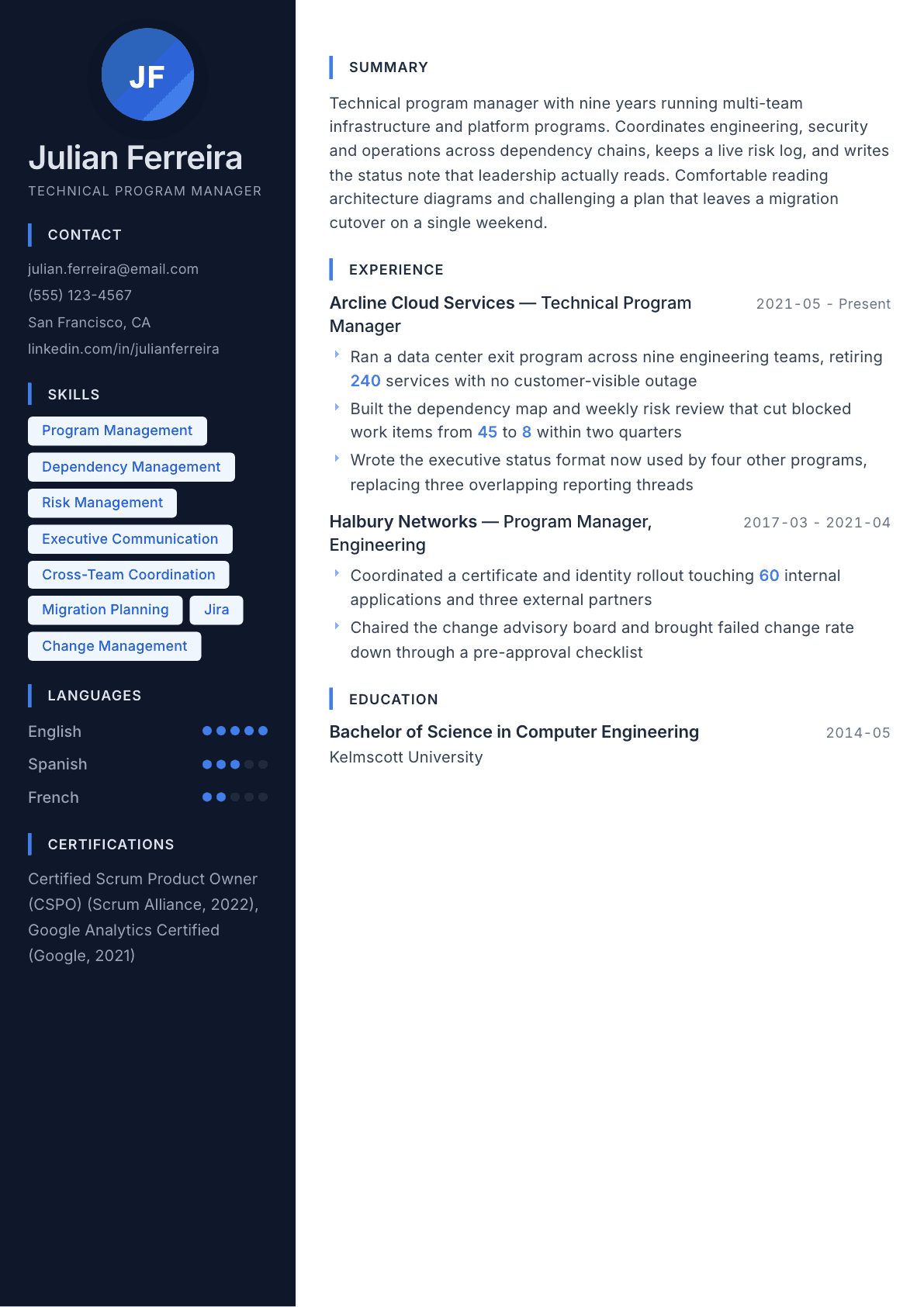
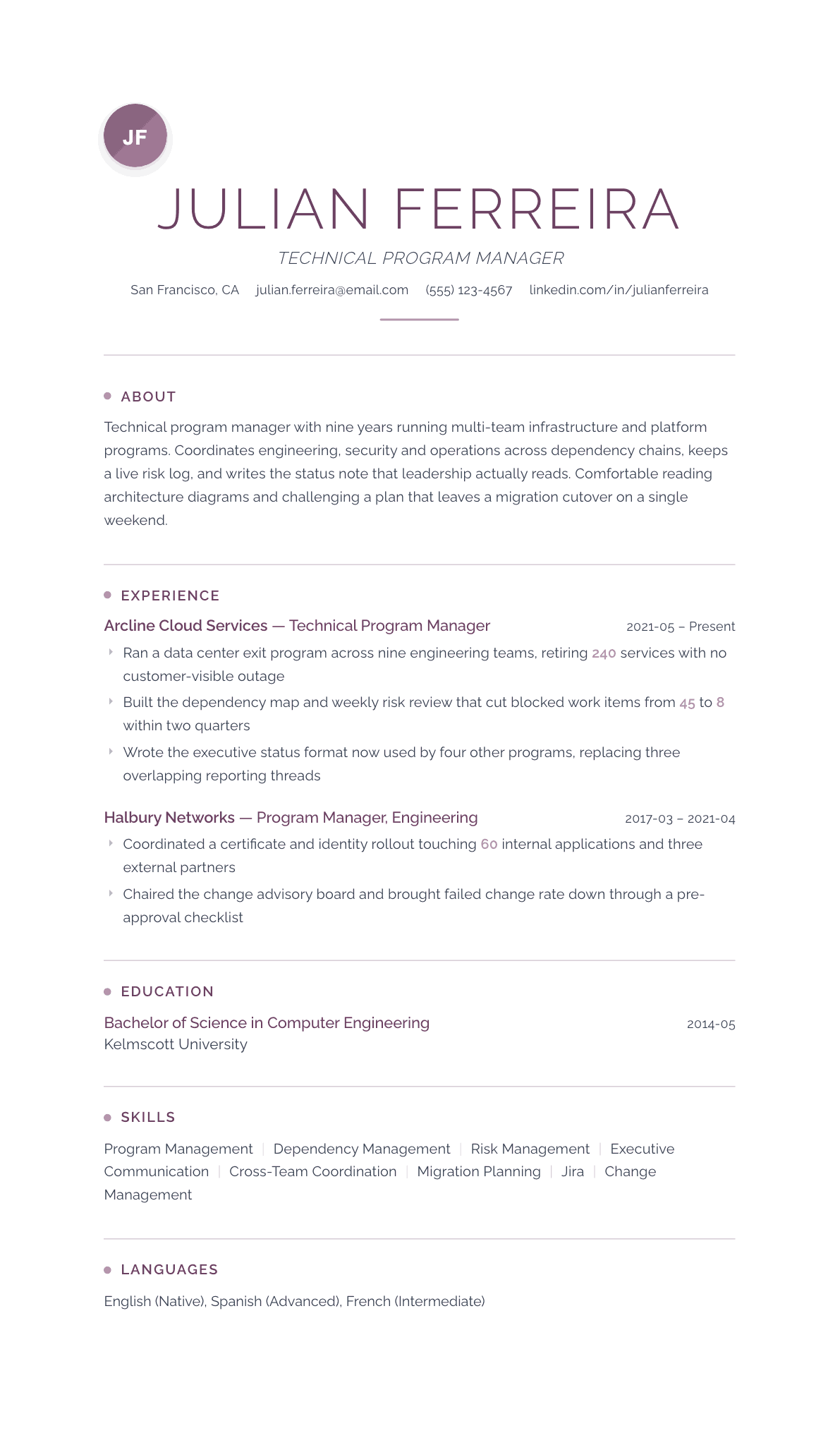
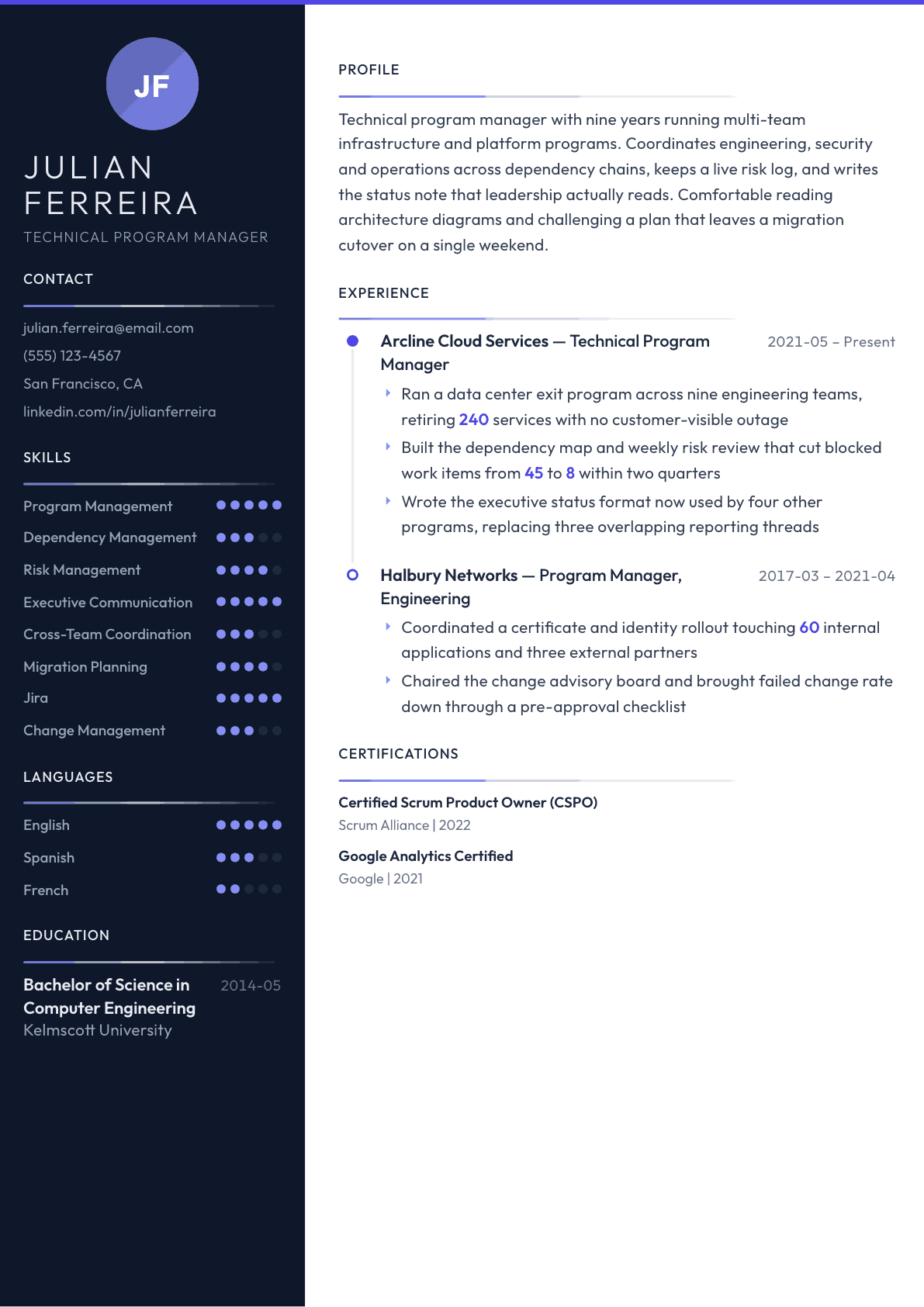
The same technical program manager content laid out in three CVBooster templates, so you can see what the finished document looks like before you write a word.
Example Technical Program Manager summary
Technical program manager with nine years leading infrastructure and platform programs across many engineering teams. Recent work retired hundreds of services in a data center exit without customer-visible downtime, built the dependency map that unblocked stalled work, and set the executive status format now reused by other programs. Reads architecture well enough to challenge a plan before it becomes a risk item.
Skills to list on a Technical Program Manager resume
- Technical Program Management
- Cross-Team Coordination
- Dependency Mapping
- Risk and Issue Management
- Migration Planning
- Executive Reporting
- Roadmap Planning
- Change Management
- Capacity Planning
- Vendor Coordination
- Jira
- Confluence
- Agile Delivery
- Incident Postmortems
- Stakeholder Alignment
- Systems Architecture Literacy
What actually gets this resume read
- State program scope in teams, services and quarters, because that is how a TPM interview loop sizes your experience.
- Show technical depth by naming the systems involved, such as a data center exit, an identity rollout or an API migration.
- Prove dependency work with a number: blocked items removed, critical path shortened or cutovers split into stages.
- Include the reporting you own, since writing a status leadership trusts is half of the role.
- Separate program management from people management, because many postings are individual contributor roles.
- Name the risk practice you use: a live log, review cadence, and what actually got escalated and resolved.
How to write a technical program manager resume
A technical program manager resume has to clear two very different bars in the same page. Engineering leadership wants proof that you understand the systems well enough to challenge a plan. Program leadership wants proof that you can hold nine teams to a sequence for four quarters without the schedule quietly dissolving. Candidates who prove only one of the two get filtered.
The word technical in the title is load bearing. It is the difference between coordinating a program and understanding why the migration cannot cut over in a single weekend. Resumes that read like generic project coordination lose immediately, however well written, because the systems detail never appears.
This guide sets out how to structure the page around programs rather than jobs, how to write about dependencies and risk in a way senior engineers respect, three summaries by level, before and after bullets, and the questions technical program managers ask when they move between infrastructure, product and platform work.
Format: programs as the unit, two pages is normal
Keep employers in reverse chronological order, but make the program the unit inside each one. Give each program a name, a scope line and three to five bullets. A technical program manager with two employers and six programs who writes two job blocks has hidden the entire body of evidence.
Two pages is expected at this level. Use the space for scope and outcomes, not for a competency graphic. Put a short technical block near the top naming the domains you have worked in, since a cloud migration program manager and a mobile release program manager get screened by different people.
- Header: name, title, city, phone, email, and any program or agile credentials.
- Order: summary, technical and domain areas, program experience, certifications, education.
- Scope line per program: teams involved, systems in scope, duration, and your decision rights.
Summary: scale, systems, and the type of program
Three lines. Give the scale in teams and quarters, the class of program you run, and the systems domain. Retiring services in a data center exit, running a compliance driven identity rollout and coordinating a mobile platform rewrite are three different jobs, and the summary should name yours.
Say whether you are an individual contributor or manage program managers. Many postings at this title are individual contributor roles and a mismatch wastes both sides a screening call.
Experience: dependencies, risk, cutover, and communication
Dependency work is the core craft. Describe the map you built, how you found hidden dependencies, and what changed as a result. Blocked work items removed, a critical path shortened, or a cutover split into staged waves are all concrete evidence that the mapping had teeth.
Risk bullets should show a practice rather than a document. A live risk log, a review cadence, an escalation path with named owners, and one risk that actually materialized and was handled. Interviewers ask about the one that went wrong far more often than the ones that did not.
Migration and cutover bullets carry the technical proof. Naming the services, the traffic pattern, the rollback plan and the verification step tells an engineering director that you were in the design conversation. Delivered on time tells him nothing at all.
Communication is a deliverable in this role, so treat it as one. The status format you built, the audiences you write for, the meeting you eliminated, and the reporting threads you consolidated all belong on the page. A program leader who trusts your written status will forgive a slipped date.
Technical depth: prove it without claiming to be an engineer
Name the systems and the concepts you work with fluently: service dependencies, data replication, identity and certificate management, capacity planning, release trains, feature flags, or whichever apply. Depth is shown by using the right nouns in the right context, not by claiming to write code.
Include the artifacts you produce that engineers actually read: a dependency map, a sequencing plan, a cutover runbook, a launch readiness checklist. Those are the documents that separate a technical program manager from a coordinator with a schedule.
- Systems domains you have run programs in, stated plainly.
- Artifacts you author, including runbooks, sequencing plans and readiness checklists.
- Where you have challenged an engineering plan and what changed as a result.
- Incident or postmortem involvement, and any process change that came out of it.
Keywords and credentials for this title
Postings repeat a small vocabulary: cross-functional, dependency management, risk mitigation, critical path, launch readiness, executive stakeholders, roadmap, capacity planning and operational readiness. Attach each to a program where it was real.
Program credentials help with automated filters, especially in larger enterprises. They matter far less than a program description that a senior engineer would find accurate, so spend your effort there first.
Technical Program Manager resume summary examples
Moving up from project management
Project manager with three years on engineering delivery, moving into technical program work. Coordinated a certificate renewal effort across 20 internal applications, built the dependency tracker the teams used, and chaired weekly risk review. Comfortable reading architecture diagrams and holding engineers to a sequence.
Nine years, infrastructure programs
Technical program manager with nine years running multi-team infrastructure programs. Led a data center exit across nine engineering teams that retired 240 services with no customer-visible outage, and built the dependency map and risk review that cut blocked items from 45 to 8 in two quarters.
Principal program manager
Principal technical program manager with fourteen years across platform, security and infrastructure programs. Runs the portfolio review for three engineering directors, sets the sequencing and readiness standards other program managers reuse, and owns the executive reporting line into quarterly planning.
Work experience bullets: before and after
Before: Managed a large infrastructure migration project.
After: Ran a data center exit across nine engineering teams, retiring 240 services over five quarters with no customer-visible outage and a staged rollback point at each wave.
Team count, service count, duration and the rollback design give an engineering director something concrete to test.
Before: Tracked dependencies between teams.
After: Built the dependency map across nine teams and ran a weekly unblocking review that cut blocked work items from 45 to 8 within two quarters.
The before and after count turns dependency tracking from an activity into a measurable result.
Before: Reported program status to leadership.
After: Wrote the executive status format now used by four other programs, replacing three overlapping reporting threads with one weekly note carrying risk, decision and ask.
Adoption by other programs is external proof that the communication artifact was genuinely better.
Before: Managed risks and issues on the program.
After: Kept a live risk log with named owners and review dates, and split the single-weekend cutover into three waves after a capacity risk surfaced in review.
A risk that changed the plan proves the log drove decisions rather than sitting in a status pack.
Before: Coordinated with security and operations teams.
After: Coordinated an identity and certificate rollout across 60 internal applications and three external partners, chairing the change board and adding a pre-approval checklist that reduced failed changes.
Naming the systems, the partners and the specific control shows the coordination had technical substance.
Hard skills
- Program planning and sequencing
- Dependency mapping across teams
- Risk and issue management
- Migration and cutover planning
- Launch and operational readiness reviews
- Executive status reporting
- Capacity planning coordination
- Change management and approval boards
- Vendor and partner coordination
- Jira and Confluence program tracking
- Postmortem facilitation
- Roadmap and quarterly planning
Soft skills
- Influence without authority
- Challenging an engineering plan respectfully
- Written clarity for executive audiences
- Escalation timing
- Facilitating disagreement between teams
- Holding scope when a date is at risk
Certifications worth listing
- Project Management Professional (PMP) (Project Management Institute)
- Program Management Professional (PgMP) (Project Management Institute)
- PMI Agile Certified Practitioner (PMI-ACP) (Project Management Institute)
- Certified ScrumMaster (Scrum Alliance)
Mistakes that cost technical program manager candidates the interview
- Writing like a project coordinator, with schedules and meetings but no systems named anywhere on the page.
- Reporting only that a program landed on time, which hides the sequencing and risk work that made it possible.
- Collapsing six programs into one job block, so the reader cannot count what you have actually run.
- Claiming engineering skills you do not have, when depth is better shown through artifacts and accurate vocabulary.
- Leaving out whether the role was individual contributor or people management, which wastes a screening call.
- Listing stakeholder management as a skill with no evidence of a hard conversation you handled.
Technical Program Manager resume questions
How technical does a technical program manager resume need to be?
Technical enough that a staff engineer reading it recognizes the vocabulary as accurate. Name systems, dependencies and cutover mechanics. You are not expected to claim coding ability unless the posting specifically asks for it.
How do I show program scope without naming confidential projects?
Use the shape rather than the name: number of teams, services or applications in scope, duration in quarters, and the class of change. That gives a reader everything needed to size the work without revealing internal detail.
Is a PMP certification useful for this role?
It helps clear filters at larger enterprises and signals formal training in scheduling and risk. Technology companies weight it lightly and interview instead on dependency reasoning, technical judgment and written communication.
Should I include programs that failed or were stopped?
Include one if you can describe what you learned and what you changed afterward. A stopped program handled with a clean wind-down and honest reporting often interviews better than a list of uniform successes.
What separates a technical program manager from a project manager on paper?
The unit of work and the depth. Project managers own a defined deliverable with a schedule; program managers own an outcome spanning several teams and quarters, with dependency and risk ownership plus technical judgment about sequencing.
Related resume examples
- IT Project Manager Resume example
- Release Manager Resume example
- Engineering Manager Resume example
- Product Owner Resume example
- IT Director Resume example
- IT Business Analyst Resume example