Program Manager Interview Questions and Answers: 8 Samples
By Mustafa Tarabya, founder of CVBooster · Published · Updated
10 min read
Program manager interview questions test one thing above all: whether you can run several related projects as one effort that delivers a business result, not just keep each project on schedule. Expect five groups of questions: program versus project, strategy and benefits, dependencies and risk, stakeholders and governance, and leading people you do not manage. The one constraint: every answer needs a real program behind it, with the scope and outcome stated plainly, because a hypothetical answer sounds like a project manager guessing. The Project Management Institute describes program work as "managing multiple projects in a coordinated way." Below are eight complete sample answers, tagged by level, and a section on UK programme manager interviews. Written by Mustafa Tarabya, who hired for his own company, read every application himself and now writes CVBooster's guides.
You have run a program with nine workstreams, three vendors and a steering committee that has never once agreed on a date. Then the first question is "So what is the difference between a project and a program?" Answer it well anyway. It is the question that tells the panel whether the next forty minutes are worth having.
What is the difference between a program manager and a project manager?
Expect it early, at any level. A good answer is short, uses an example from your own work and ends on outcomes, not deliverables.
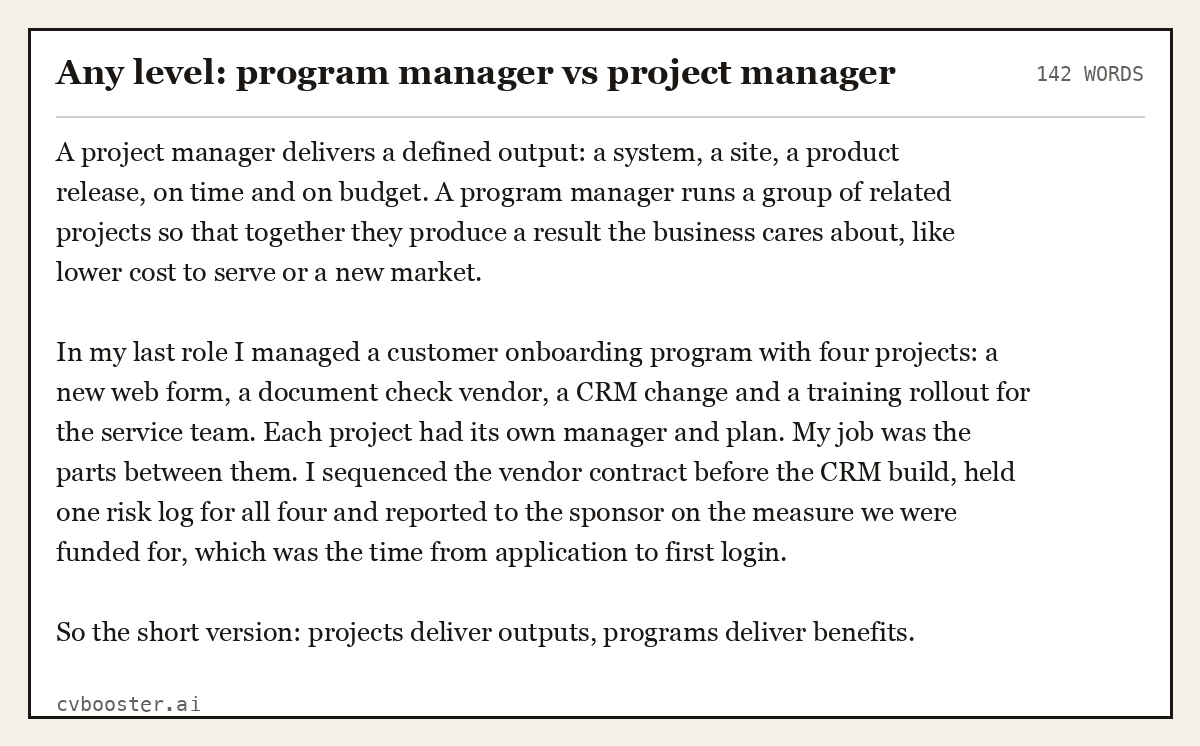
Any level: program manager vs project manager (142 words)
A project manager delivers a defined output: a system, a site, a product release, on time and on budget. A program manager runs a group of related projects so that together they produce a result the business cares about, like lower cost to serve or a new market.
In my last role I managed a customer onboarding program with four projects: a new web form, a document check vendor, a CRM change and a training rollout for the service team. Each project had its own manager and plan. My job was the parts between them. I sequenced the vendor contract before the CRM build, held one risk log for all four and reported to the sponsor on the measure we were funded for, which was the time from application to first login.
So the short version: projects deliver outputs, programs deliver benefits.
What interviewers score in a program manager answer
The panel is listening for scale, coordination and alignment. PMI puts it this way in its description of the PgMP credential: "PgMP certification verifies that as a program management professional, you have the experience to navigate complexity and align to strategic objectives." Those two ideas, complexity and strategic objectives, are the spine of almost every question below.
Four habits make an answer score:
- Start with scope. Number of projects, budget or headcount you can stand behind, sponsor and duration.
- Name the benefit. What the business expected to get, and how it was measured.
- Show the joins. Dependencies, shared resources and the decisions you made between projects.
- Own the result. Including what went wrong and what you changed.
Use the STAR shape (situation, task, action, result) for behavioral questions, and keep each answer to about two minutes. Our STAR interview questions guide has the format in detail.
How do you align a program with business strategy?
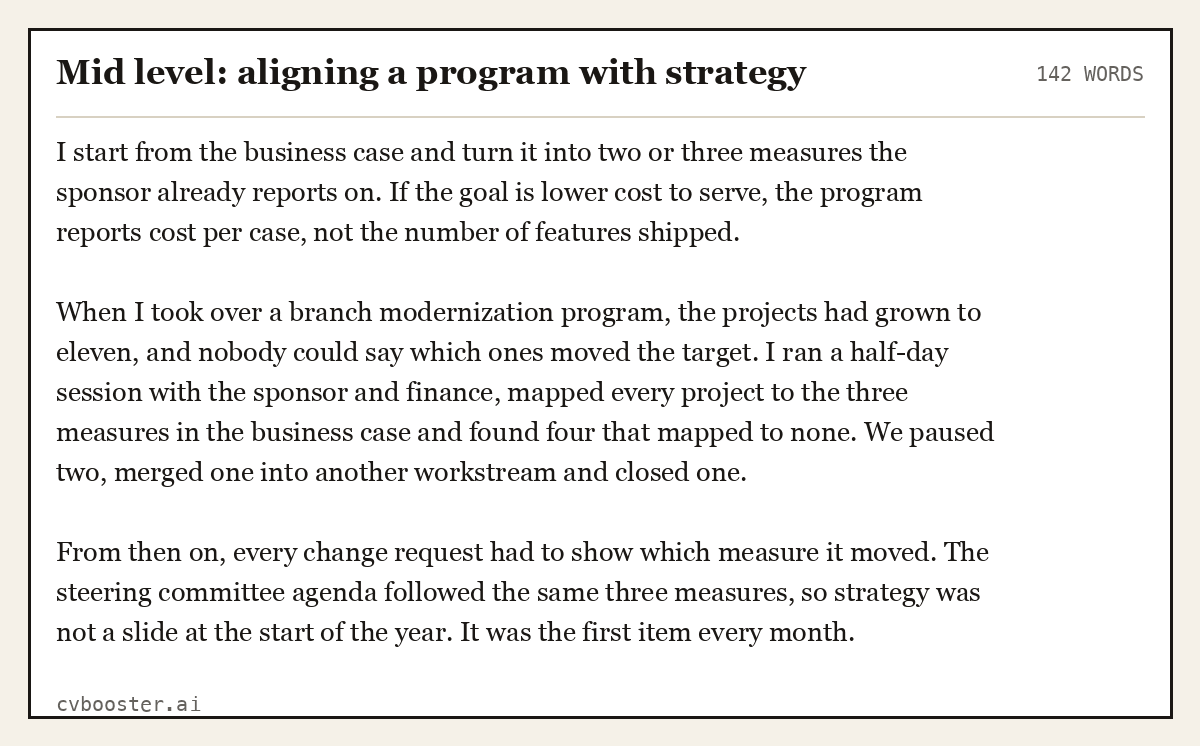
Mid level: aligning a program with strategy (142 words)
I start from the business case and turn it into two or three measures the sponsor already reports on. If the goal is lower cost to serve, the program reports cost per case, not the number of features shipped.
When I took over a branch modernization program, the projects had grown to eleven, and nobody could say which ones moved the target. I ran a half-day session with the sponsor and finance, mapped every project to the three measures in the business case and found four that mapped to none. We paused two, merged one into another workstream and closed one.
From then on, every change request had to show which measure it moved. The steering committee agenda followed the same three measures, so strategy was not a slide at the start of the year. It was the first item every month.
How do you manage dependencies between projects?
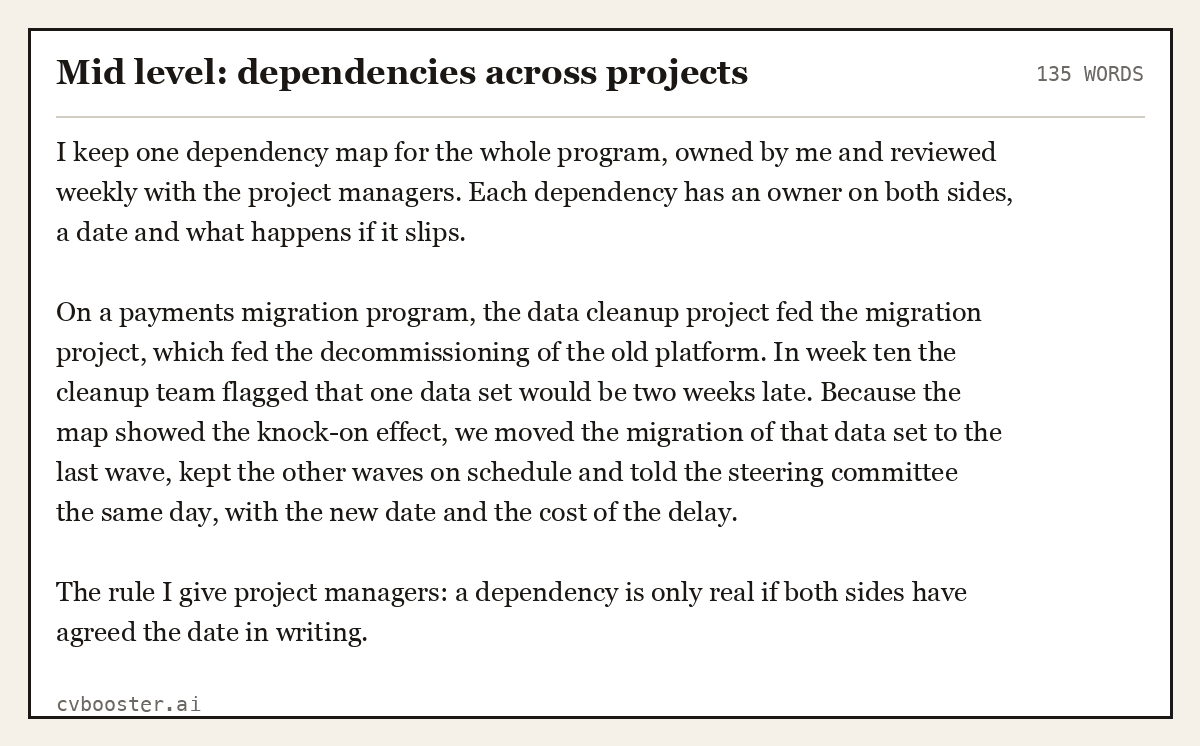
Mid level: dependencies across projects (135 words)
I keep one dependency map for the whole program, owned by me and reviewed weekly with the project managers. Each dependency has an owner on both sides, a date and what happens if it slips.
On a payments migration program, the data cleanup project fed the migration project, which fed the decommissioning of the old platform. In week ten the cleanup team flagged that one data set would be two weeks late. Because the map showed the knock-on effect, we moved the migration of that data set to the last wave, kept the other waves on schedule and told the steering committee the same day, with the new date and the cost of the delay.
The rule I give project managers: a dependency is only real if both sides have agreed the date in writing.
Tell me about a time you managed conflicting stakeholders
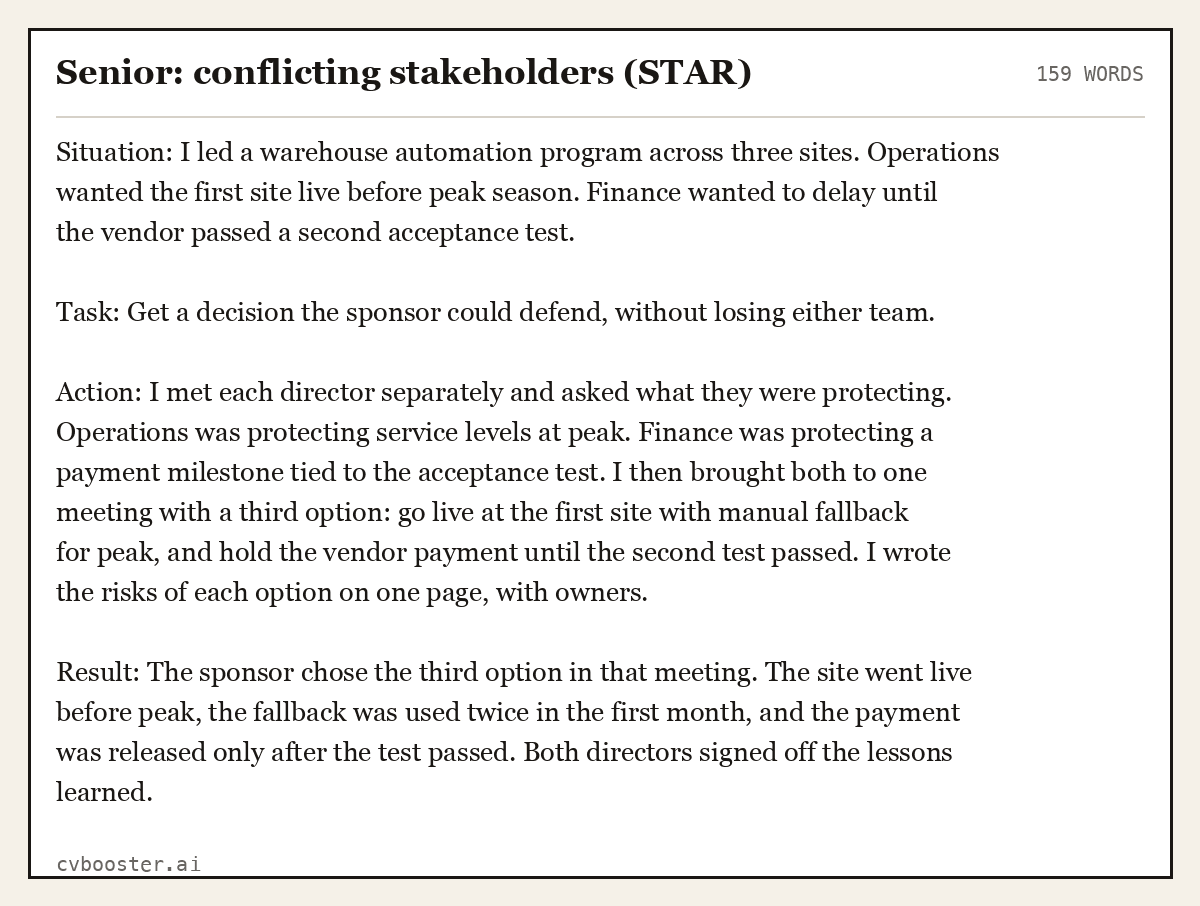
Senior: conflicting stakeholders (STAR) (159 words)
Situation: I led a warehouse automation program across three sites. Operations wanted the first site live before peak season. Finance wanted to delay until the vendor passed a second acceptance test.
Task: Get a decision the sponsor could defend, without losing either team.
Action: I met each director separately and asked what they were protecting. Operations was protecting service levels at peak. Finance was protecting a payment milestone tied to the acceptance test. I then brought both to one meeting with a third option: go live at the first site with manual fallback for peak, and hold the vendor payment until the second test passed. I wrote the risks of each option on one page, with owners.
Result: The sponsor chose the third option in that meeting. The site went live before peak, the fallback was used twice in the first month, and the payment was released only after the test passed. Both directors signed off the lessons learned.
Tell me about a program that went off track
Expect some version of this question. Pick a real one, say what you missed early and show the recovery.
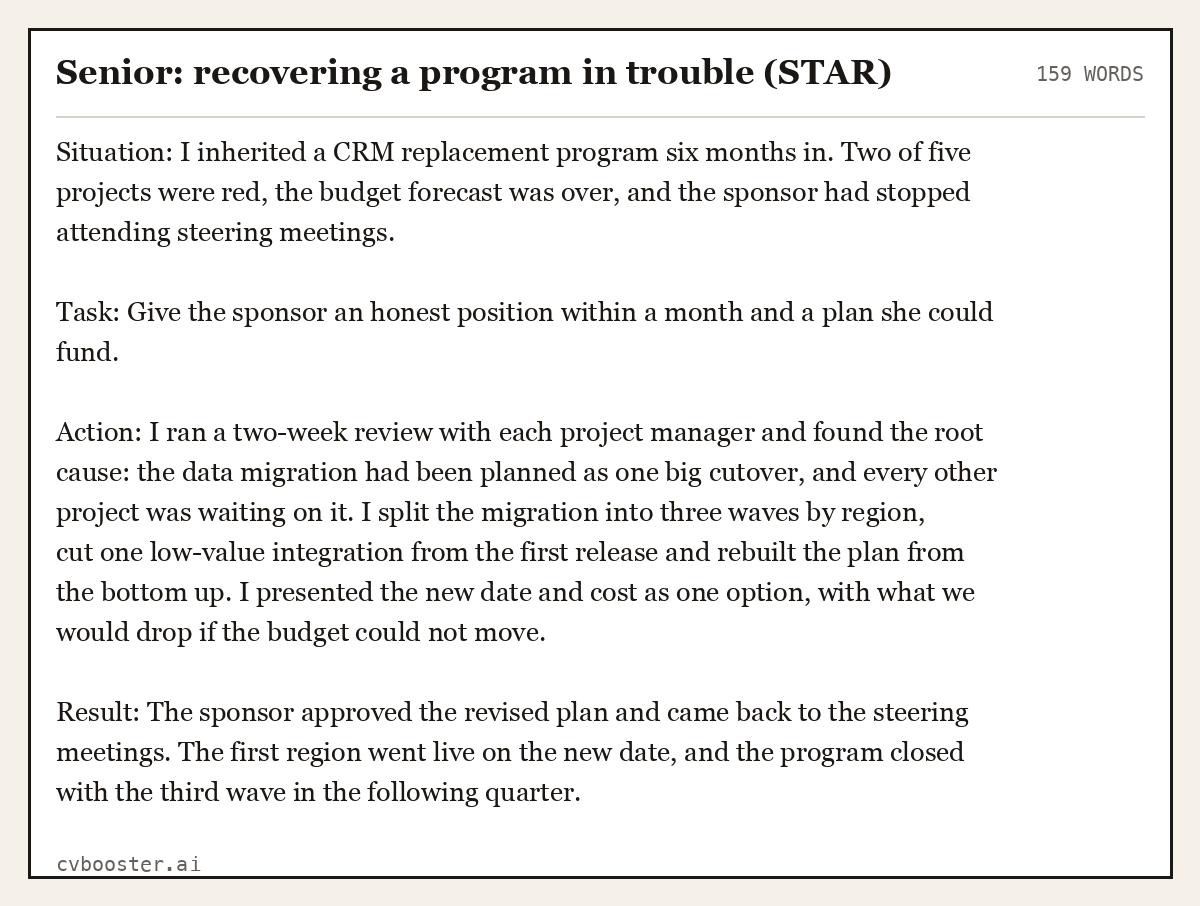
Senior: recovering a program in trouble (STAR) (159 words)
Situation: I inherited a CRM replacement program six months in. Two of five projects were red, the budget forecast was over, and the sponsor had stopped attending steering meetings.
Task: Give the sponsor an honest position within a month and a plan she could fund.
Action: I ran a two-week review with each project manager and found the root cause: the data migration had been planned as one big cutover, and every other project was waiting on it. I split the migration into three waves by region, cut one low-value integration from the first release and rebuilt the plan from the bottom up. I presented the new date and cost as one option, with what we would drop if the budget could not move.
Result: The sponsor approved the revised plan and came back to the steering meetings. The first region went live on the new date, and the program closed with the third wave in the following quarter.
How do you lead project managers who do not report to you?
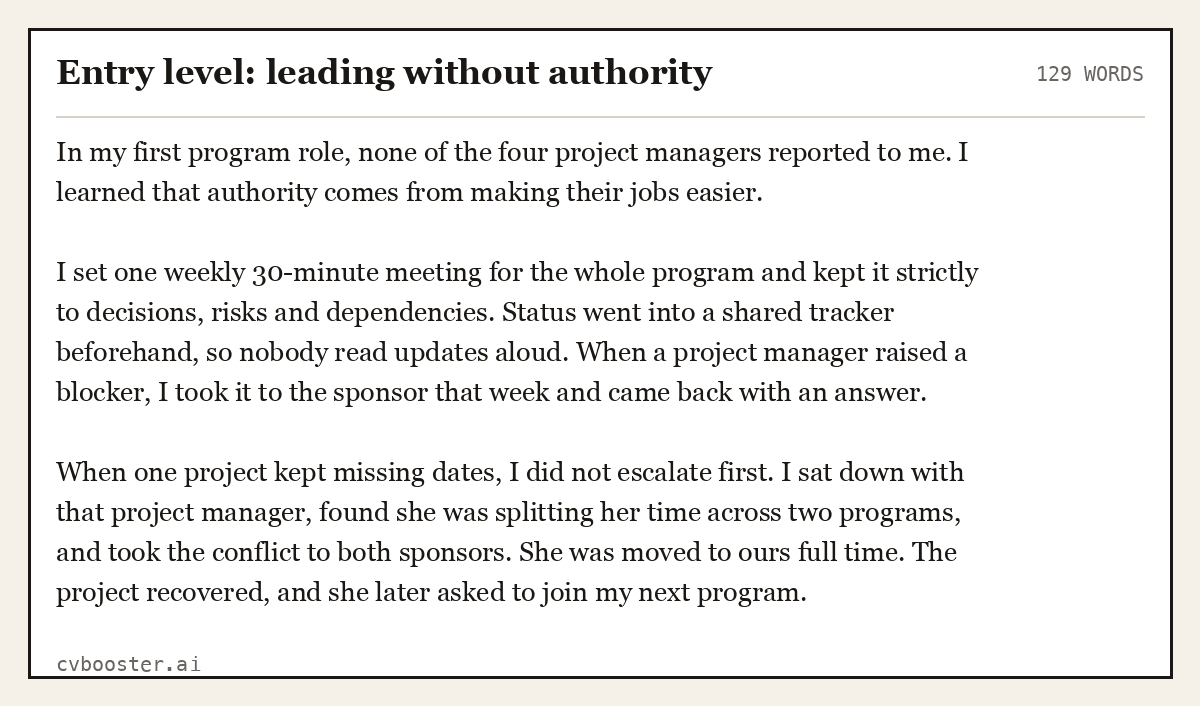
Entry level: leading without authority (129 words)
In my first program role, none of the four project managers reported to me. I learned that authority comes from making their jobs easier.
I set one weekly 30-minute meeting for the whole program and kept it strictly to decisions, risks and dependencies. Status went into a shared tracker beforehand, so nobody read updates aloud. When a project manager raised a blocker, I took it to the sponsor that week and came back with an answer.
When one project kept missing dates, I did not escalate first. I sat down with that project manager, found she was splitting her time across two programs, and took the conflict to both sponsors. She was moved to ours full time. The project recovered, and she later asked to join my next program.
Technical program manager interview questions
Technical program manager interviews add system design and engineering trade-off questions. Expect to explain how systems fit together and how you would sequence a technical launch; whether you also get a coding question depends on the company. See the technical program manager resume for the matching resume language.
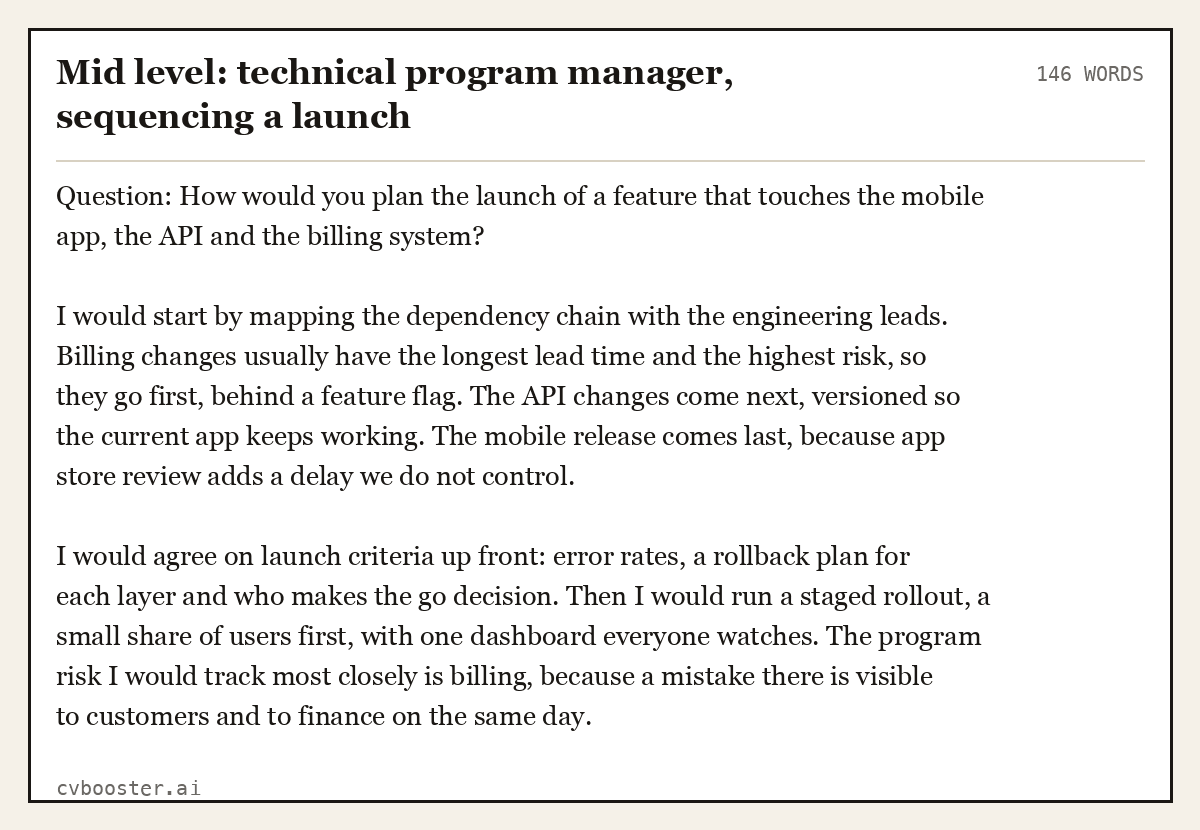
Mid level: technical program manager, sequencing a launch (146 words)
Question: How would you plan the launch of a feature that touches the mobile app, the API and the billing system?
I would start by mapping the dependency chain with the engineering leads. Billing changes usually have the longest lead time and the highest risk, so they go first, behind a feature flag. The API changes come next, versioned so the current app keeps working. The mobile release comes last, because app store review adds a delay we do not control.
I would agree on launch criteria up front: error rates, a rollback plan for each layer and who makes the go decision. Then I would run a staged rollout, a small share of users first, with one dashboard everyone watches. The program risk I would track most closely is billing, because a mistake there is visible to customers and to finance on the same day.
Programme manager interview questions and answers in the UK
In the UK the role is spelled programme manager, and in government it sits in the Project Delivery Profession, which GOV.UK describes as "a network of over 10,000 professionals in government who are involved with the delivery of projects, programmes and portfolios." Civil Service interviews are built on Success Profiles. The Civil Service Jobs guidance says interviews "may include questions to understand more about your behaviours, strengths, experience, or technical skills."
For Grade 7 and Grade 6 posts, the Civil Service behaviours framework lists examples such as to "ensure plans and activities in your area of work reflect wider strategic priorities and communicate effectively with senior leaders to influence future strategies" (Seeing the Big Picture) and "identify early signs that things are going wrong and respond promptly" (Changing and Improving). Prepare one example per behaviour named in the advert.
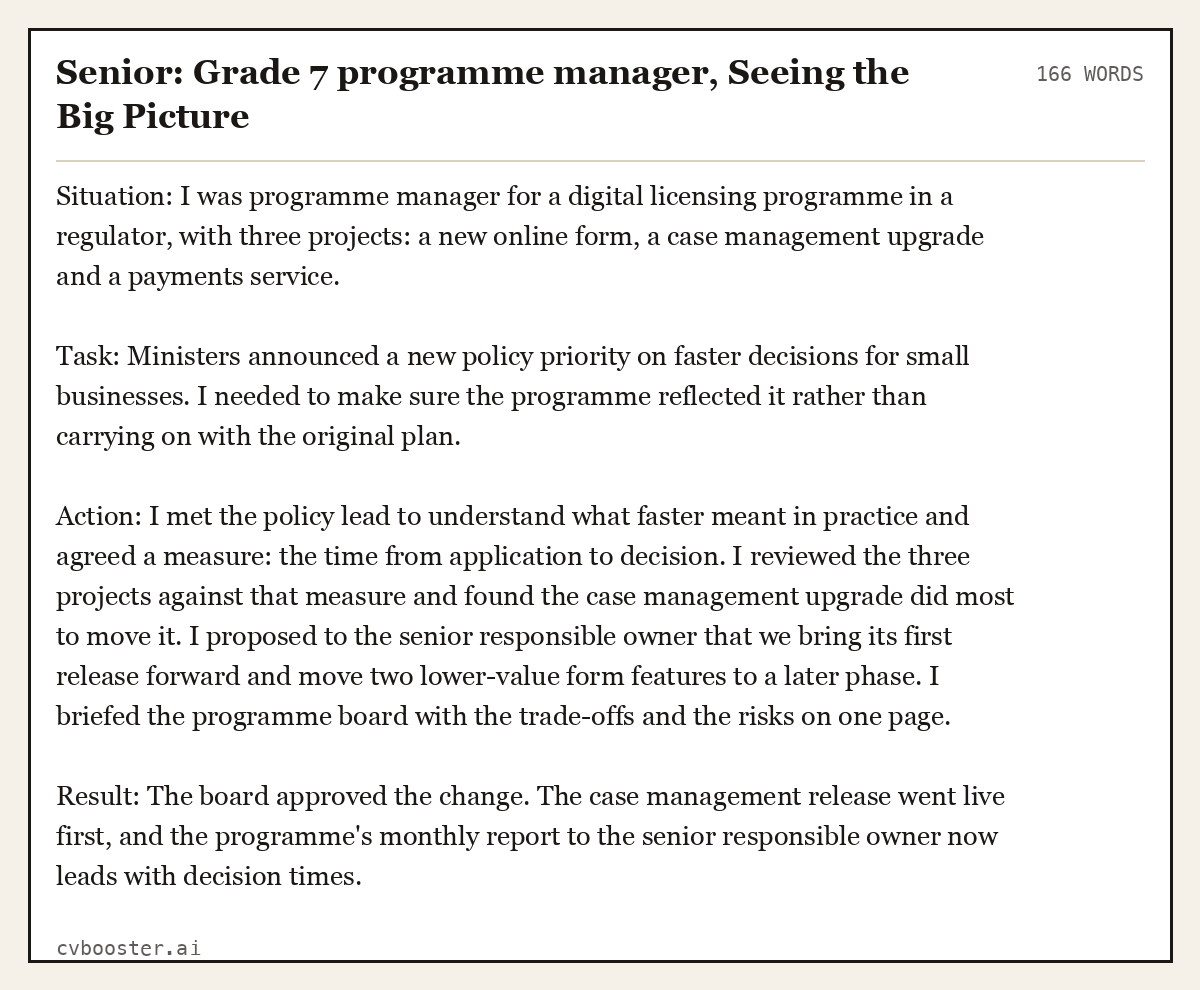
Senior: Grade 7 programme manager, Seeing the Big Picture (166 words)
Situation: I was programme manager for a digital licensing programme in a regulator, with three projects: a new online form, a case management upgrade and a payments service.
Task: Ministers announced a new policy priority on faster decisions for small businesses. I needed to make sure the programme reflected it rather than carrying on with the original plan.
Action: I met the policy lead to understand what faster meant in practice and agreed a measure: the time from application to decision. I reviewed the three projects against that measure and found the case management upgrade did most to move it. I proposed to the senior responsible owner that we bring its first release forward and move two lower-value form features to a later phase. I briefed the programme board with the trade-offs and the risks on one page.
Result: The board approved the change. The case management release went live first, and the programme's monthly report to the senior responsible owner now leads with decision times.
Questions to ask at the end of a program manager interview
Ask about the program, not the perks. Three that work:
- "Which benefit is this program funded to deliver, and how is it measured today?"
- "Where are the hardest dependencies, inside the company or with vendors?"
- "What would make the sponsor say this program is going well in six months?"
For more, see questions to ask in an interview. Before the interview, make sure your program manager resume uses the same program examples you plan to talk about, and check the wording against our project management resume keywords.
Frequently asked questions
What are the most common program manager interview questions?
Expect the difference between a program and a project, how you align a program with strategy, how you manage dependencies and risk, a stakeholder conflict, a program that went off track and how you lead project managers who do not report to you. Technical program manager roles add system design and launch planning questions.
How do I answer program manager interview questions with no program title?
Use the closest real work: a large project with several workstreams, a portfolio you coordinated or a cross-team rollout. Say plainly what your role was, then show the program skills the panel is scoring: sequencing work across teams, managing shared risks and reporting against a business measure rather than a delivery date.
Are programme manager interview questions different in the UK?
The content is the same, but the spelling and the format often differ. UK public sector interviews use Success Profiles, so questions are tied to named behaviours such as Seeing the Big Picture or Delivering at Pace. Prepare one STAR example per behaviour listed in the advert and expect a presentation task for senior posts.
Do I need PgMP or MSP certification for a program manager interview?
Neither is a legal requirement, and the panel will ask about the programs you have run either way. PMI describes the PgMP as proof of experience managing multiple projects in a coordinated way. If you hold PgMP, MSP or PMP, mention it once in your answers and on your resume, then talk about results.
How long should a program manager interview answer be?
Aim for about two minutes per behavioral answer. Spend a few sentences on the situation, most of the time on what you did and close with the result and what you would repeat. If the interviewer wants more detail on dependencies or numbers, they will ask, and that follow up is a good sign.
Related articles
- Accountancy CV Example: 6 UK Accounts CVs by Career Level
- Accounting Interview Questions and Answers: 7 Full Examples
- Activity Resume Example: 6 Samples for College Applications
- Administration CV Example: 6 Admin CVs from Entry to Senior
More articles
- Project Management Keywords for a Resume: 6 Examples
- PSW Resume Example: 7 Samples for Personal Support Workers
- Psychology Resumes Samples: 6 Full Examples by Career Stage
Looking for a worked example for your job title? Browse the resume examples by job title.