Project Analyst Resume Examples: the lines they read
Build a Project Analyst Resume That Proves You Read the Numbers
By Mustafa Tarabya, founder of CVBooster · Published · Updated
Project analyst resume example with sample bullets, reporting and forecasting keywords, a skills list and a section by section guide.
Sample resumes for a project analyst
The same project analyst content laid out in three CVBooster templates, so you can see what the finished document looks like before you write a word.
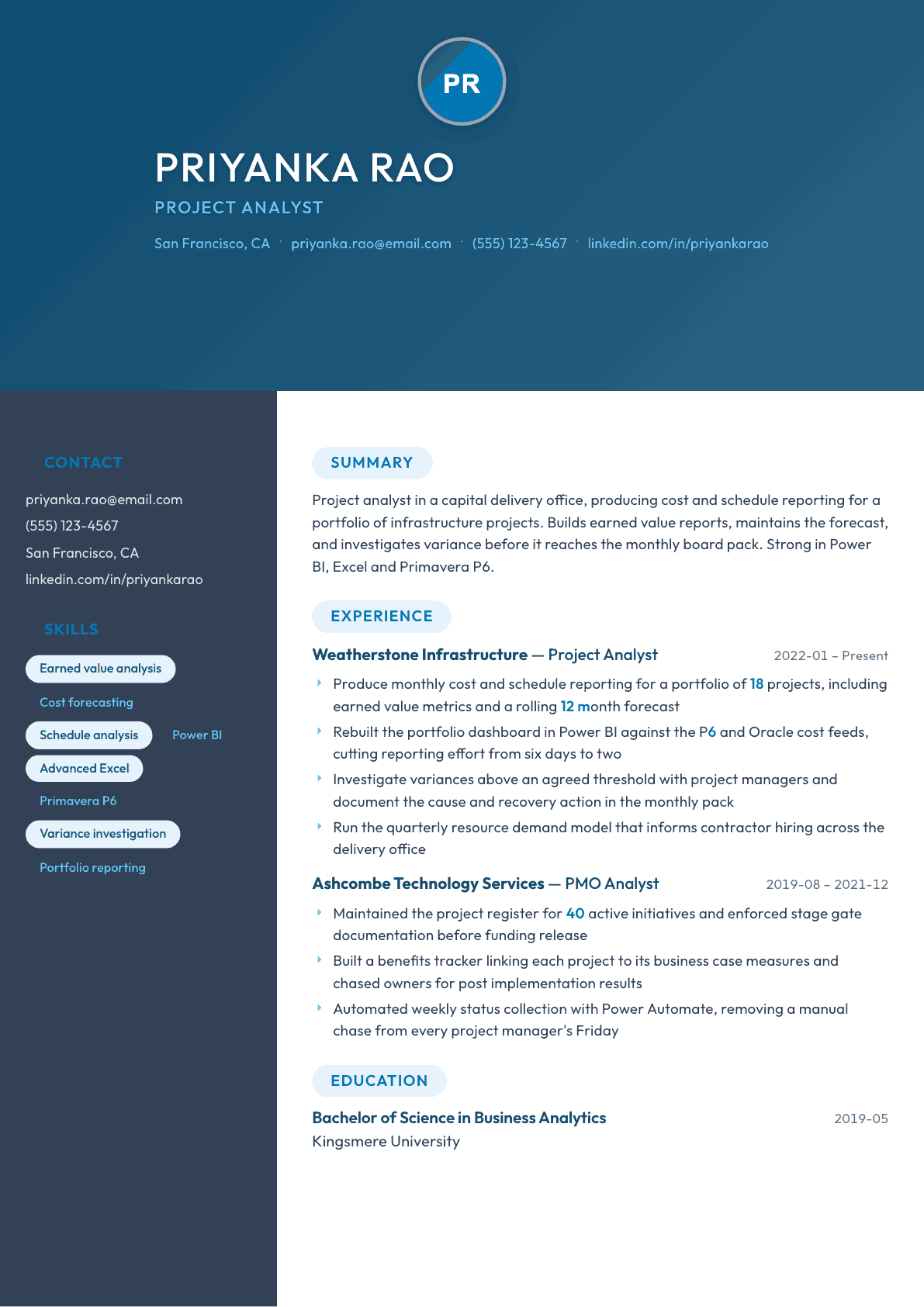
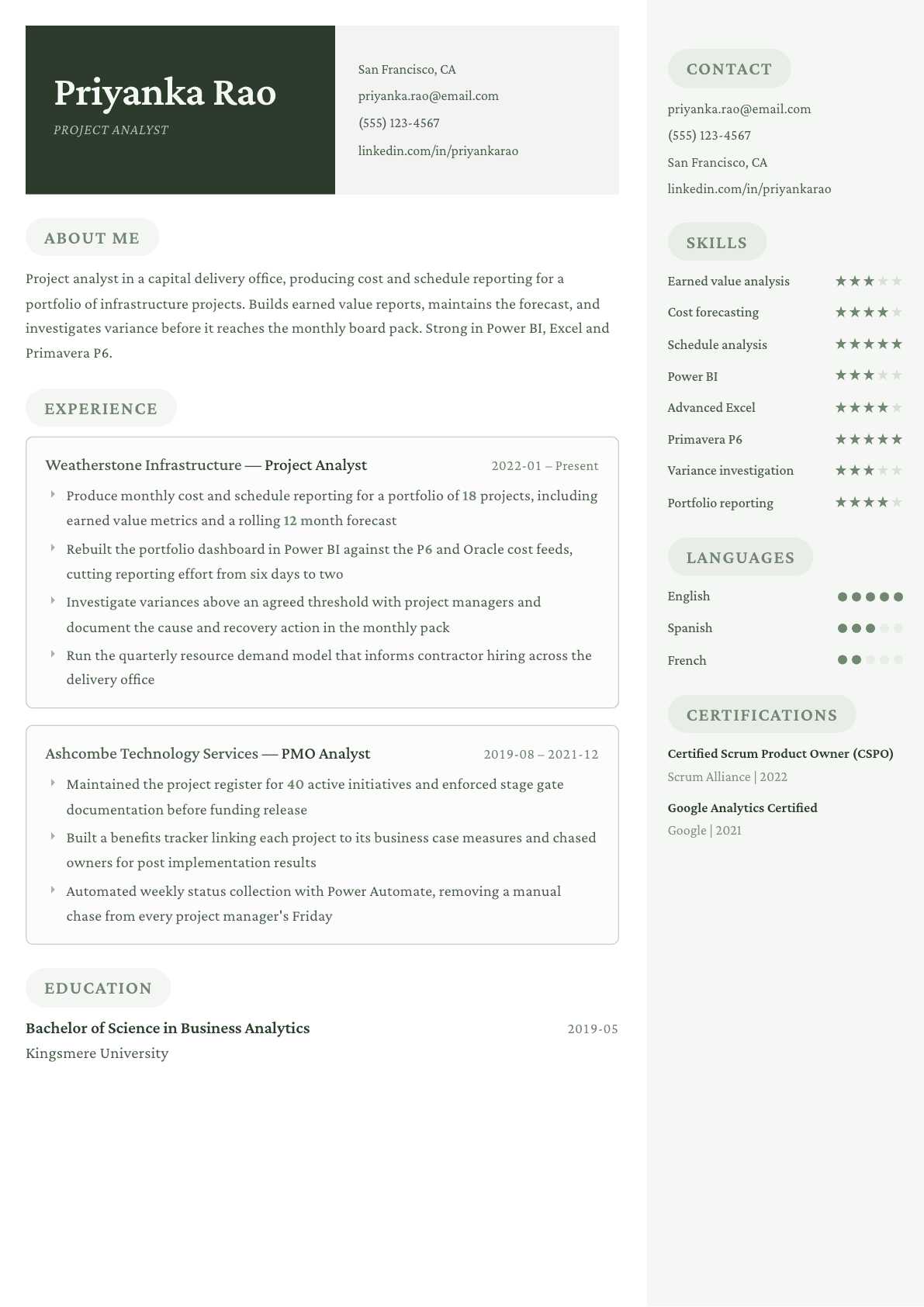
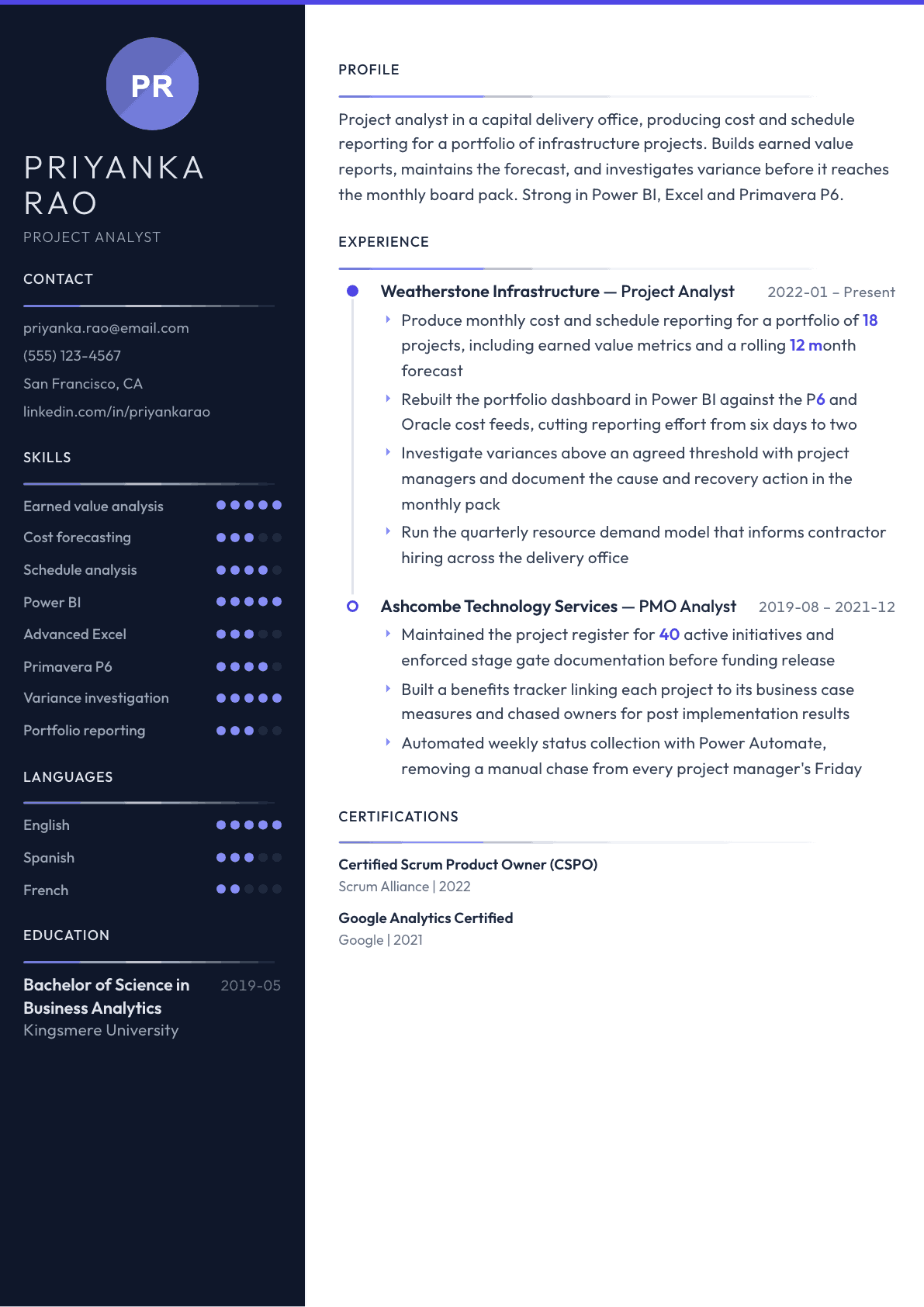
Example Project Analyst summary
Project analyst with five years reporting cost, schedule and benefits across capital and technology portfolios, currently eighteen live projects. Produces earned value reporting and a rolling twelve month forecast, investigates variance with project managers before it reaches the board pack, and rebuilt the portfolio dashboard in Power BI to cut the reporting cycle from six days to two. Strong in Excel, Primavera P6 and SQL.
Skills to list on a Project Analyst resume
- Earned value analysis
- Cost and schedule reporting
- Variance analysis
- Forecasting
- Portfolio reporting
- Resource demand modeling
- Benefits tracking
- Power BI
- Advanced Excel
- Primavera P6
- Microsoft Project
- SQL
- Stage gate governance
- Data validation
- Business case analysis
What actually gets this resume read
- Lead with the portfolio you report on: number of projects, combined value, and whether reporting is cost, schedule or both.
- Name the analytical techniques you actually run, such as earned value, variance analysis, resource demand or trend forecasting.
- Pair every tool with an output, so Power BI appears next to the dashboard it produced and P6 next to the schedule analysis.
- Show what happened after your analysis, because an analyst is valued for the decision they changed, not the report they issued.
- Include the governance you support, such as stage gates, funding release checks or the monthly board pack.
- Quantify time saved through automation, since portfolio offices hire analysts partly to shorten the reporting cycle.
How to write a project analyst resume
A project analyst sits between the delivery teams and the people who fund them. The job is to turn cost, schedule and benefit data into a number a decision maker can act on, and then to explain why it moved. Hiring managers in a project or portfolio office screen for two things: whether you can actually build the analysis, and whether you can defend it to a project manager who disagrees with what it says.
Most project analyst resumes fail on the second. They list tools and reports without ever showing a decision that changed. A dashboard is not the output of this role. The output is a variance investigated, a forecast corrected, a resource shortfall exposed early enough to hire against, or a business case measured after go-live instead of forgotten.
This guide covers how to size the portfolio you report on, how to write analysis bullets that name a technique and a consequence, which tools and data sources to list, and the questions analysts ask when moving toward project management or portfolio leadership.
Format: one to two pages, portfolio sized under each job
One page early in the career, two once you have covered several portfolios or added modeling and automation work. Reverse-chronological, single column, and keep the numbers inside the bullets rather than in a decorative sidebar that parsers separate from the job.
Under each employer, give the portfolio profile: number of active projects, combined value, the delivery type, and whether you covered cost, schedule, benefits or all three. That line is what lets a reader compare your analytical load to theirs.
- Header: name, title, city and state, phone, email, and any project or analytics certification.
- Sections in this order: summary, technical skills, experience, education, certifications.
- Portfolio line per job: active projects, combined value, reporting scope, reporting cycle.
Summary: portfolio, technique, and the cycle you own
Three lines. The portfolio you report on, the analytical techniques you run, and the reporting cycle you are accountable for. Naming the cycle matters, because monthly cost and schedule reporting to a board pack is a hard deadline with real consequences, and it tells a reader you have worked to one.
Add one efficiency fact. Analysts are often hired partly to shorten the reporting cycle, so a figure such as reducing a six day close to two days speaks directly to what the hiring manager wants back.
Experience: technique, source, consequence
Write each analysis bullet as technique, data source and consequence. Earned value reporting built from the scheduling tool and the cost ledger, feeding a monthly board pack, is a complete claim. Produced reports is not.
Variance work is the heart of the role. Say what threshold triggered an investigation, how you worked with the project manager to find the cause, and what was documented as the recovery action. This is the bullet that proves you can handle the political half of the job, where a number contradicts what a delivery lead has been reporting.
Forecasting deserves its own bullet: the horizon, the inputs, and whether you tracked forecast accuracy afterward. Checking your own forecast against actuals is unusual on a resume and reads as professional maturity.
Add the automation. Rebuilding a manual reporting pack in Power BI against live data feeds, or automating status collection so project managers stop being chased, is measurable work that scales beyond your own desk.
- Name the technique: earned value, variance analysis, trend forecasting, resource demand modeling, benefits tracking.
- Name the data source: the scheduling tool, the cost ledger, the timesheet system, the project register.
- End with the consequence: a decision made, a hire approved, a gate held, a cycle shortened.
Governance work: gates, registers and business cases
Portfolio offices run on governance and analysts usually administer part of it. Stage gate documentation checked before funding release, a project register kept accurate, a benefits tracker linking each project to its business case measures, and post implementation reviews chased to completion. These bullets show that you understand what the analysis is for.
Where you have influenced a governance decision, say so carefully and factually. Recommending that a gate be held because the forecast did not support the remaining scope is legitimate analyst work, and it is the strongest evidence available that your reporting was trusted.
Tools, data and keywords
List the platforms with specifics: Primavera P6 or Microsoft Project for schedule, the cost system or enterprise ledger, Power BI or Tableau for reporting, and Excel at the level you actually work, meaning Power Query, advanced formulas and model structure. Add SQL if you query source data yourself, because that single line moves you above most applicants for the role.
Recurring keywords include earned value, cost and schedule reporting, variance analysis, forecasting, portfolio reporting, resource planning, benefits tracking, stage gate governance and business case analysis. Mirror the posting wording once in the technical skills block and once inside a bullet.
Project Analyst resume summary examples
First analyst role
Business analytics graduate with eighteen months in a project office maintaining the register for forty active initiatives and enforcing stage gate documentation before funding release. Built a benefits tracker linking each project to its business case measures. Strong in Excel and learning Power BI.
Four years in
Project analyst producing monthly cost and schedule reporting for a portfolio of eighteen infrastructure projects, including earned value metrics and a rolling twelve month forecast. Rebuilt the portfolio dashboard in Power BI against the scheduling and cost feeds, cutting reporting effort from six days to two.
Senior portfolio analyst
Senior project analyst covering a capital portfolio above two hundred million dollars, owning the forecast model, the quarterly resource demand run and the benefits register. Recommended holding two stage gates on forecast evidence and mentors two junior analysts on earned value method.
Work experience bullets: before and after
Before: Produced monthly project reports.
After: Produced monthly cost and schedule reporting for a portfolio of eighteen projects, including earned value metrics and a rolling twelve month forecast presented in the board pack.
Portfolio size, the techniques and the audience turn a routine task into a defined analytical deliverable.
Before: Investigated budget variances.
After: Investigated every variance above the agreed threshold with the responsible project manager and documented cause and recovery action in the monthly pack before it reached the sponsor.
A threshold, a collaborator and a documented outcome show a controlled process rather than occasional curiosity.
Before: Built dashboards in Power BI.
After: Rebuilt the portfolio dashboard in Power BI against live scheduling and cost ledger feeds, cutting reporting effort from six days to two and removing manual re-keying entirely.
Naming the data sources and the time saved shows engineering value, where built dashboards names only a tool.
Before: Helped with resource planning.
After: Ran the quarterly resource demand model across the portfolio, exposing a shortfall of six delivery roles two quarters ahead and informing contractor hiring for the delivery office.
A model with a lead time and a hiring decision attached proves the analysis changed something outside the spreadsheet.
Before: Maintained the project register and supported governance.
After: Maintained the register for forty active initiatives and checked stage gate documentation before funding release, returning incomplete submissions rather than passing them to the board.
Describing the control you actually applied shows governance ownership instead of record keeping.
Hard skills
- Earned value analysis
- Cost and schedule reporting
- Variance analysis
- Forecasting and forecast accuracy tracking
- Resource demand modeling
- Benefits tracking
- Portfolio reporting
- Stage gate governance
- Advanced Excel and Power Query
- Power BI
- Primavera P6
- Microsoft Project
- SQL
Soft skills
- Defending a number to a delivery lead
- Written clarity for executive readers
- Attention to data quality
- Working to a hard reporting deadline
- Questioning without accusing
- Explaining method to non-specialists
Certifications worth listing
- Certified Associate in Project Management (CAPM) (Project Management Institute)
- Project Management Professional (PMP) (Project Management Institute)
- Earned Value Professional (EVP) (AACE International)
- Certified Cost Technician (CCT) (AACE International)
- Microsoft Certified: Power BI Data Analyst Associate (Microsoft)
Mistakes that cost project analyst candidates the interview
- Listing reports and tools with no decision attached, so the analysis looks like output rather than influence.
- Omitting the portfolio size and value, which leaves the reader unable to judge the analytical load you carried.
- Writing reporting software instead of Primavera P6, Power BI or the cost ledger the posting is matching on.
- Claiming Excel without a level, when Power Query, model structure and lookups are what distinguish an analyst.
- Avoiding the variance work, which is the political core of the role and the subject of most interview questions.
- Never mentioning data quality, although reconciling two disagreeing source systems is much of the real job.
Project Analyst resume questions
What is the difference between a project analyst and a PMO analyst?
The titles overlap heavily. A project analyst often sits closer to cost and schedule data on specific projects, while a PMO analyst leans toward portfolio governance, registers and standards. Evidence both if you have done both.
Do I need to know earned value management?
For capital, defense and infrastructure portfolios, yes, and postings say so directly. For technology portfolios it matters less than forecasting, resource demand and benefits tracking. Learn the method your target sector reports on.
How much Excel is enough for a project analyst role?
Enough to build a maintainable model, not just a spreadsheet: structured inputs, lookups, Power Query for repeatable data loads, and clear separation of source data from calculation. Say which of those you use rather than claiming advanced Excel.
Should I learn SQL as a project analyst?
It helps considerably. Analysts who can query the source systems themselves stop depending on extract requests, produce reporting faster, and catch data quality problems earlier. One line naming SQL separates you from most applicants for the role.
How do I move from project analyst to project manager?
Ask to own a small project or a workstream, then write it up with scope, plan, budget and outcome. Pair that with a project management certification, and lead your summary with delivery rather than reporting when you apply.
Related resume examples
- Business Analyst Resume example
- Project Manager Resume example
- PMO Manager Resume example
- Project Coordinator Resume example
- Operations Analyst Resume example
- Program Manager Resume example