Quality Manager Resume Examples: the lines they read
Create a Quality Manager Resume That Sets the Standard
By Mustafa Tarabya, founder of CVBooster · Published · Updated
Build a quality manager resume demonstrating ISO certification leadership, defect reduction, and continuous improvement with measurable quality outcomes.
Sample resumes for a quality manager
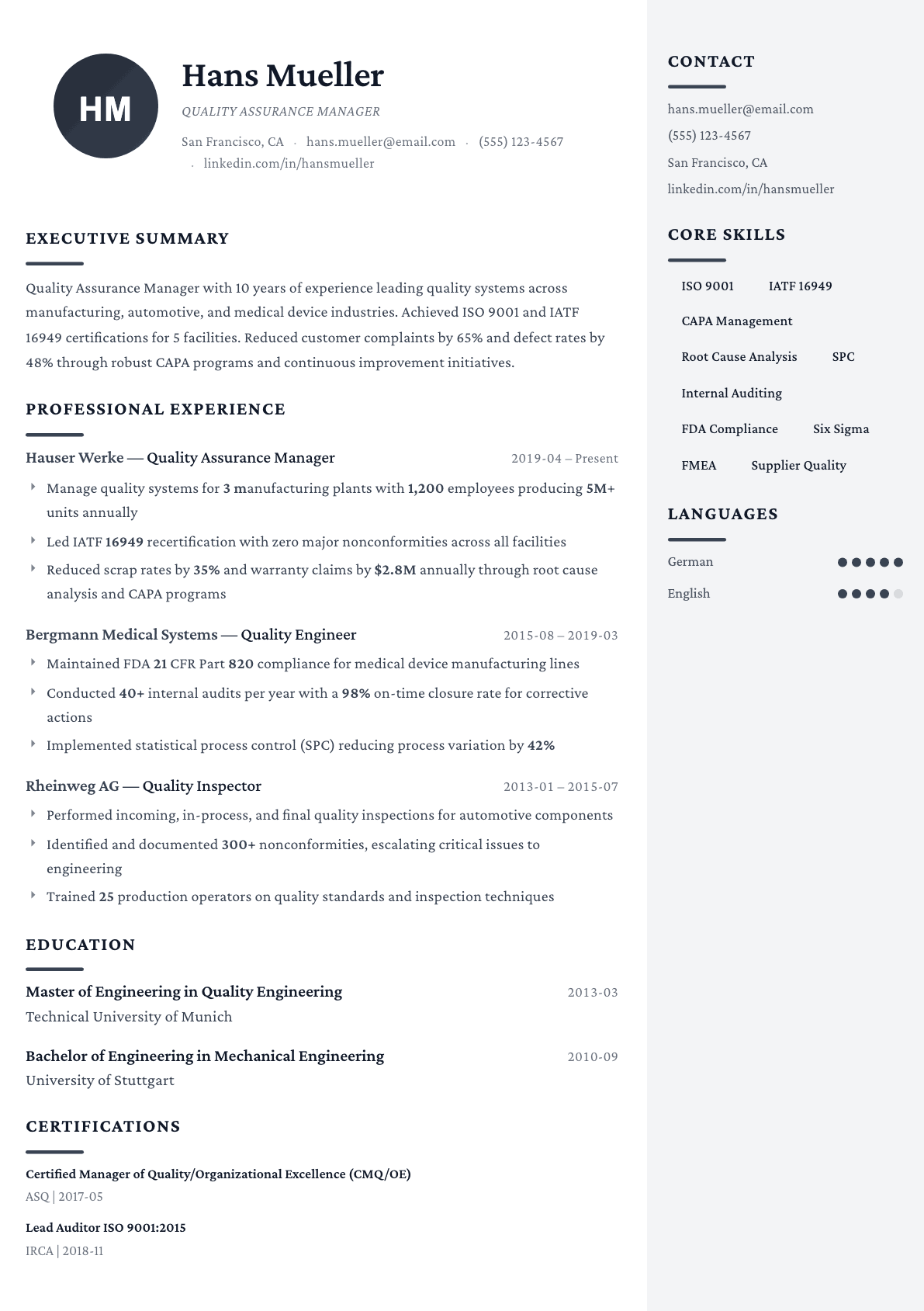
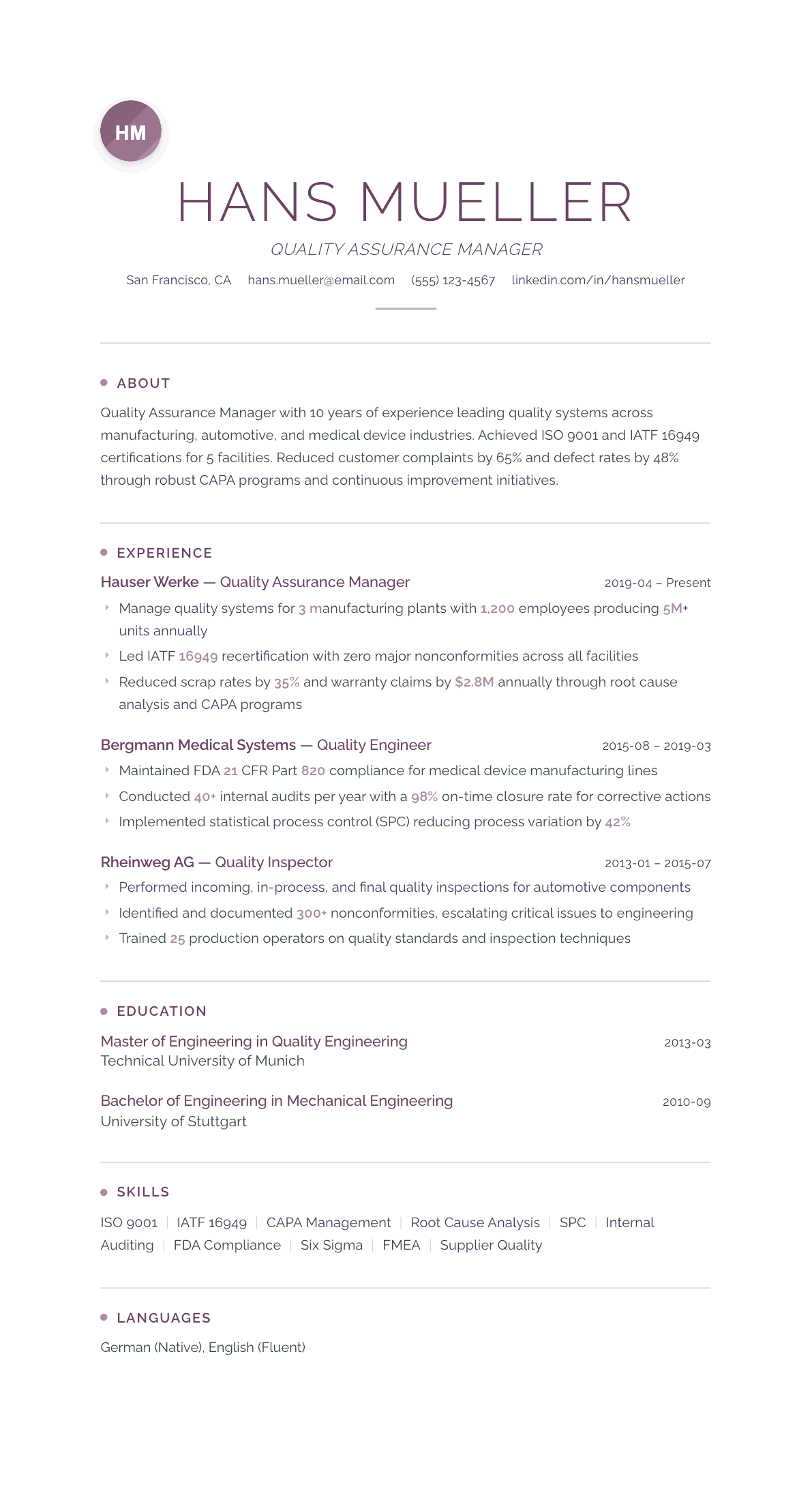
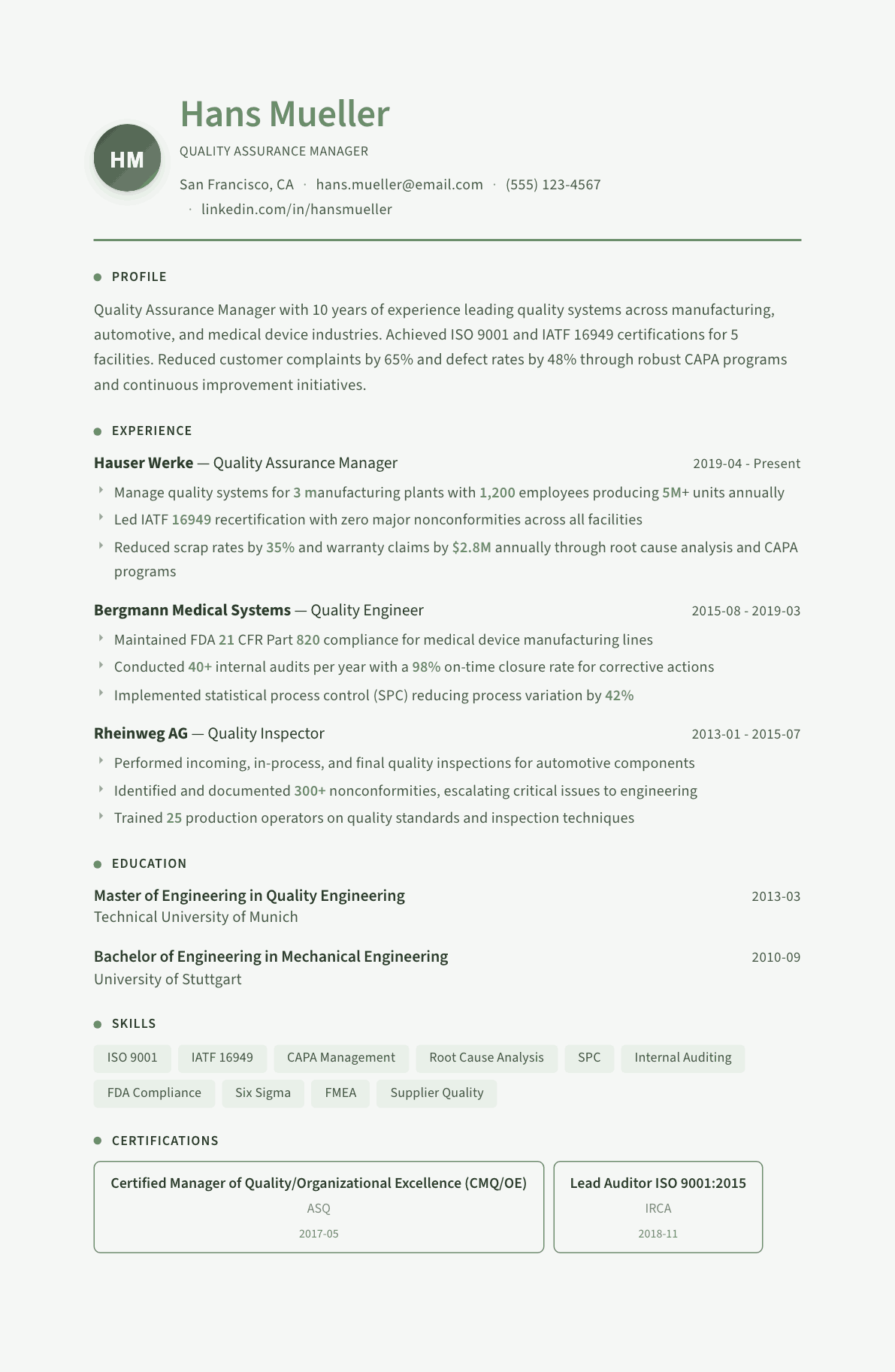
The same quality manager content laid out in three CVBooster templates, so you can see what the finished document looks like before you write a word.
Example Quality Manager summary
Quality Assurance Manager with 10 years of experience leading quality systems in automotive and medical device manufacturing. Achieved ISO 9001 and IATF 16949 certifications across 5 facilities with zero major nonconformities. Reduced defect rates by 48% and warranty costs by $2.8M through robust CAPA programs. Seeking a Director of Quality role to drive operational excellence.
Skills to list on a Quality Manager resume
- Quality Management Systems
- ISO 9001
- IATF 16949
- CAPA Management
- Root Cause Analysis
- Statistical Process Control
- Internal Auditing
- FDA Compliance
- Six Sigma
- FMEA
- Supplier Quality
- Continuous Improvement
- 8D Problem Solving
What actually gets this resume read
- Highlight ISO and industry-specific certifications you have achieved or maintained.
- Quantify defect reductions, scrap rate improvements, and cost savings from quality initiatives.
- Show experience with quality tools: FMEA, SPC, 8D, root cause analysis, CAPA.
- Include audit experience with numbers: audits conducted, findings resolved, closure rates.
- Demonstrate regulatory compliance experience relevant to your industry (FDA, IATF, AS9100).
- Position continuous improvement as a core theme throughout your resume.
How to write a quality manager resume
A quality manager is the person a plant director calls when a customer complaint arrives, when a registrar auditor walks in, and when a launch is held because a part will not pass. The people hiring for the role read a resume for three things: which standards you have run a system to, whether you have faced an external auditor and survived, and whether your problem solving actually closed the loop.
Standards are the fastest filter. A quality management system built to a general standard is not the same as one running under an automotive standard, an aerospace standard, a medical device standard, or a food safety scheme, and each carries its own audit regime, documentation set and customer expectations. A resume that says quality standards without naming them will be passed over by every employer who has to pass a specific one.
This guide covers where standards, audits and industry belong on the page, how to write about corrective action so it reads as engineering rather than paperwork, summaries for a quality engineer, an established quality manager and a director, and the questions people ask when moving between regulated industries.
Format: standards and industry above the fold
One page for quality engineers, two for managers and above. Directly under the header, put a standards and industry line: the standards you have maintained a system to, the regulatory bodies whose inspections you have been through, and the product types you have released. A hiring manager in a medical device firm and one in automotive stamping are looking for entirely different lines there, and neither will hunt for it on page two.
Under each role, add a site profile: the plant or facility type, headcount, the number of production lines or product families, whether the site was registered to a standard while you were there, and the customers whose audits you hosted. Customer names matter in supply chains where the original equipment manufacturer runs its own supplier quality program.
- Standards line: the management system standards you have run, with the industry.
- Regulatory line: inspections and audits faced, and the outcome of each.
- Site profile: facility type, headcount, lines or product families, customer base.
- Methods block: the problem solving, statistical and validation tools you use.
Audits: say who audited you and what they found
Audit history is the most persuasive material a quality manager has, and it is usually undersold. Write the audit type, who performed it, the scope, and the result: a certification audit by a registrar, a customer supplier audit, a regulatory inspection, or an internal audit program you ran. Then the finding count and how it closed. Zero major nonconformities is a real achievement, and so is closing eleven minor findings inside the deadline after a difficult first assessment.
Include the audit program you owned as well as the audits you received. Say how many internal audits per year, who your trained auditors were, how you scheduled coverage across the standard clauses, and what a management review looked like when you presented the results.
Corrective action written as engineering, not paperwork
Corrective and preventive action is where quality resumes either come alive or die. Write a bullet that follows the discipline: containment of affected product, the root cause method used, the actual root cause found, the permanent action, the verification of effectiveness, and the read across to similar processes. That sequence tells a reader you close loops rather than file forms.
Name the method honestly. Eight discipline problem solving, fishbone with five why drilldown, fault tree analysis, or a designed experiment are different tools for different failure types, and picking the right one is a judgment a quality director will test. Add the failure mode and effects analysis and control plan updates that came out of the action, because updating the risk documents is the step most people skip and most auditors check.
Numbers a quality leader recognizes
Use the measures the plant already reports: parts per million defective, first pass yield, scrap and rework rate, cost of poor quality as a share of sales, customer complaint volume, on time closure of corrective actions, supplier defect rate, and process capability indices on the characteristics that matter. Give the baseline period and the measurement window so the improvement can be examined.
Supplier quality deserves its own numbers if you owned it. Supplier audits performed, part approval submissions reviewed and approved, containment actions run at a supplier site, and the movement in incoming defect rate after a supplier development plan all show a quality manager who works upstream instead of only sorting the results.
Keywords and tailoring by industry
The recurring vocabulary is stable: quality management system, internal audit, corrective and preventive action, nonconformance, root cause analysis, statistical process control, process capability, gauge repeatability and reproducibility, failure mode and effects analysis, control plan, validation, document control and management review. Place each where it is attached to a real activity.
Then tailor. Automotive expects production part approval, advanced product quality planning, layered process audits and customer specific requirements. Medical device expects design history files, risk management to the device standard, complaint handling and reportable event decisions. Aerospace expects first article inspection and counterfeit parts control. Food expects hazard analysis, prerequisite programs and a recognized certification scheme. Using the wrong dialect signals that you have not worked in the industry.
Quality Manager resume summary examples
Quality engineer
Quality engineer with three years in automotive stamping, running gauge studies and layered process audits across four presses. Cut a recurring burr defect from 4,100 parts per million to 620 through a fixture change verified with capability studies, and supported two customer audits with no findings in my area.
Quality manager
Quality manager for a 210 person injection molding site registered to an automotive standard, leading five quality engineers and the internal audit program. Hosted seven customer audits and two registrar surveillance visits with no major nonconformities, and reduced cost of poor quality by 38% over two years.
Director of quality
Director of quality with fifteen years across medical device and automotive manufacturing, currently accountable for quality systems at four sites. Led two sites through initial certification, rebuilt complaint handling and reportable event decision making, and closed a regulatory inspection with a single voluntary observation.
Work experience bullets: before and after
Before: Maintained the quality management system.
After: Owned the quality management system for a four line molding site, running 48 internal audits a year against the standard clauses, chairing quarterly management review, and holding document control across 340 controlled procedures and work instructions.
Audit volume, review cadence and document scope show a system being operated rather than a title being held.
Before: Led root cause analysis on customer complaints.
After: Led an eight discipline investigation on a field return, contained 14 suspect lots within 24 hours, traced the cause to a worn cavity insert, revised the preventive maintenance interval, and verified effectiveness across three subsequent production runs.
Containment, cause, permanent action and verification are the sequence an auditor checks, so writing all four proves discipline.
Before: Reduced defects and improved quality metrics.
After: Cut external parts per million from 4,100 to 620 over three quarters by adding an in process check at the operation that generated most escapes and retraining 26 operators on the revised control plan.
The before and after with the mechanism lets a reader judge whether the gain was engineering or inspection.
Before: Handled supplier quality issues.
After: Audited nine suppliers against the customer specific requirements, placed two on formal escalation with sorting at their own cost, and ran a development plan with one that lowered its incoming defect rate enough to exit escalation in five months.
Naming the audits, the controls applied and the exit condition shows upstream quality work with a defined end point.
Before: Prepared the site for external audits.
After: Prepared and hosted the registrar certification audit, running two internal readiness passes, closing eleven prior minor findings in advance, and completing the assessment with no major nonconformities raised.
The preparation method and the audit result together make the outcome credible rather than lucky.
Hard skills
- Quality management system ownership
- Internal audit program management
- Corrective and preventive action
- Eight discipline problem solving
- Root cause analysis
- Failure mode and effects analysis
- Control plans and process flow
- Statistical process control and capability studies
- Measurement system analysis
- Production part approval and first article inspection
- Supplier quality and supplier audits
- Document and change control
- Validation and qualification protocols
- Complaint handling and nonconformance management
Soft skills
- Holding a line under production pressure
- Auditor interview composure
- Training operators clearly
- Cross functional investigation leadership
- Explaining quality risk to commercial teams
Certifications worth listing
- Certified Manager of Quality / Organizational Excellence (CMQ/OE) (American Society for Quality)
- Certified Quality Engineer (CQE) (American Society for Quality)
- Certified Quality Auditor (CQA) (American Society for Quality)
- Certified Six Sigma Black Belt (CSSBB) (American Society for Quality)
- Lead Auditor Certification (Exemplar Global)
Mistakes that cost quality manager candidates the interview
- Writing about quality standards generically instead of naming the ones your system was registered to.
- Describing corrective action without containment, verification of effectiveness or the read across to similar processes.
- Leaving audit history off the page when it is the single most persuasive evidence a quality manager owns.
- Reporting defect improvements with no baseline, no measurement window and no explanation of the mechanism.
- Using the vocabulary of one regulated industry when applying to another that has its own required terms.
- Presenting inspection headcount as a quality achievement rather than the process change that removed the need for it.
Quality Manager resume questions
Which quality standards should I name on my resume?
Name the ones your site was actually registered or inspected to, and the industry each belongs to. Add customer specific requirements you worked under, since in many supply chains those carry as much weight with a hiring manager as the base standard does.
How do I show audit experience if I never led the audit?
Describe your role precisely. Escorting an auditor, presenting a process area, retrieving records under time pressure, or writing and closing a finding are all real audit experience. State the audit type and body, your part in it, and the result for the area you were responsible for.
How do I move from automotive quality into medical device quality?
Lead with the transferable system work: audit programs, corrective action discipline, risk documentation, validation and supplier controls. Then be explicit about the device specific areas you have not yet owned, and name any training or credential you are taking toward the regulatory framework.
Should a quality manager resume include statistical detail?
Include enough to prove you use the tools rather than delegate them: capability indices on characteristics that mattered, gauge studies you ran, and control charts that triggered an action. Skip textbook definitions, which take space and tell a hiring manager nothing about your judgment.
What if my improvements came from adding inspection rather than fixing the process?
Say so honestly, then show what came next. Containment through inspection is legitimate as a short term control, and the strong version of the story is how long it ran, what the permanent fix was, and how you proved the additional inspection could be removed safely.
Related resume examples
- Compliance Officer Resume example
- Operations Manager Resume example
- Procurement Manager Resume example
- Continuous Improvement Manager Resume example
- Plant Manager Resume example
- Director of Operations Resume example