Plant Manager Resume Examples: free ATS score and gap list
Write a Plant Manager Resume That Proves Site Ownership
By Mustafa Tarabya, founder of CVBooster · Published · Updated
A plant manager resume showing safety, output, cost per unit and the crews you led, with a sample resume and a section by section writing guide.
Sample resumes for a plant manager
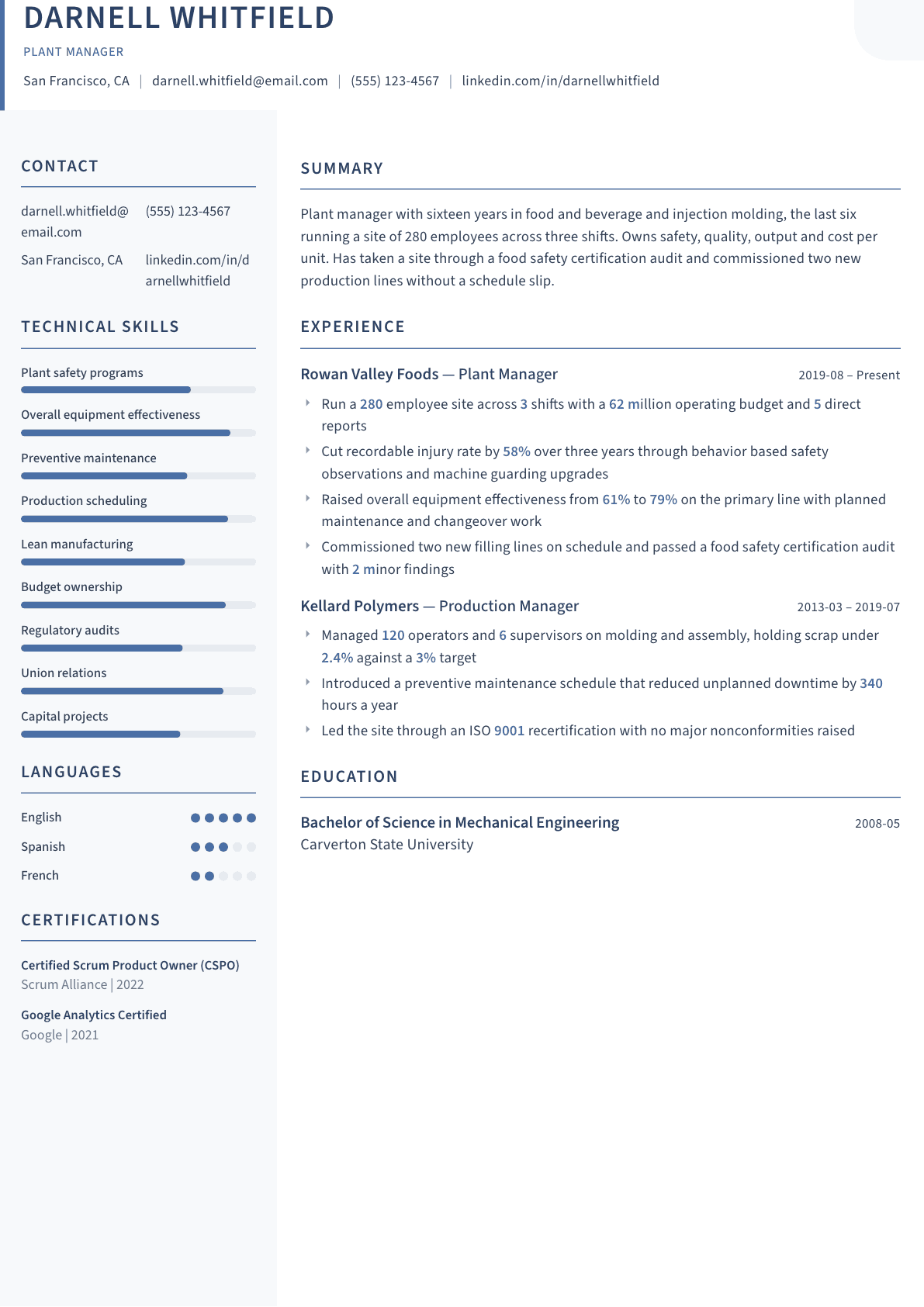
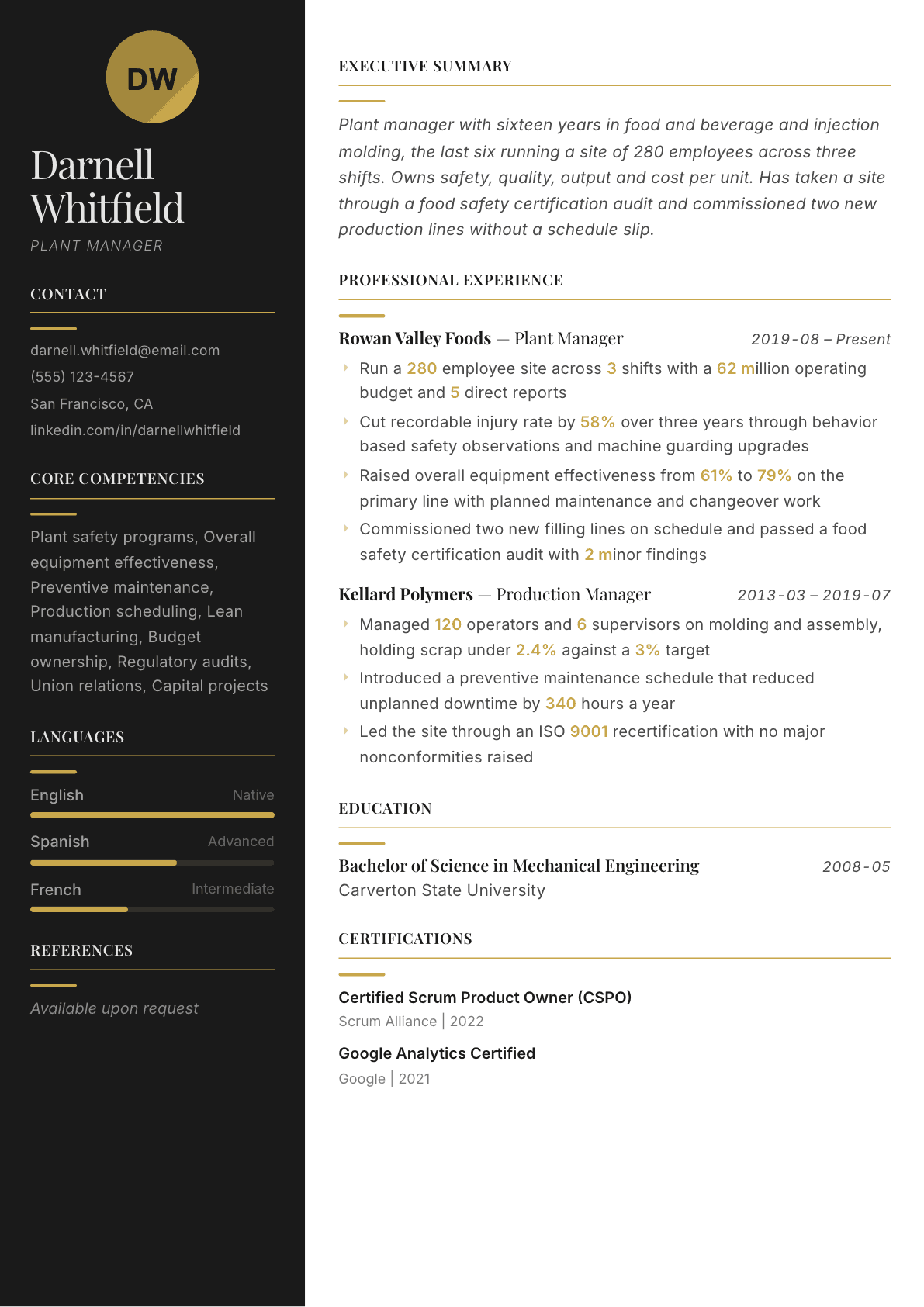
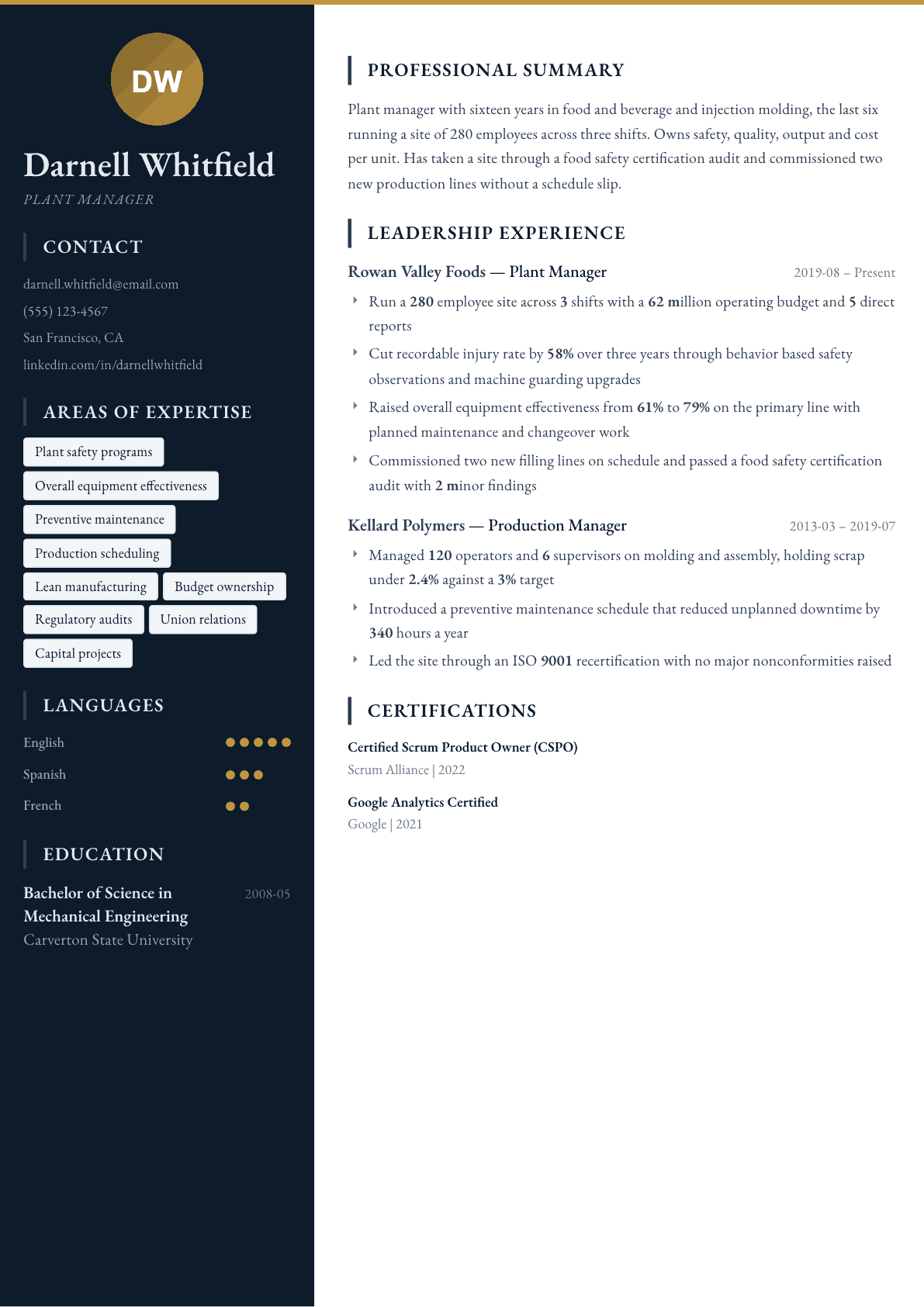
The same plant manager content laid out in three CVBooster templates, so you can see what the finished document looks like before you write a word.
Example Plant Manager summary
Plant manager with sixteen years in food and beverage and injection molding, currently running a two hundred eighty person site across three shifts with full budget ownership. Cut the recordable injury rate by more than half, lifted overall equipment effectiveness on the primary line, commissioned two filling lines on schedule, and passed a food safety certification audit with only minor findings.
Skills to list on a Plant Manager resume
- Plant safety management
- Overall equipment effectiveness
- Production planning
- Preventive maintenance
- Lean manufacturing
- Cost per unit control
- Capital project delivery
- Quality systems
- Regulatory and customer audits
- Labor relations
- Inventory management
- Supervisor development
- Budget ownership
- Root cause analysis
What actually gets this resume read
- Put safety first in the most recent role, because a site leader who cannot show a safety record does not get past the screen.
- Give the site profile in one line: headcount, shift pattern, product, square footage and whether the workforce is unionized.
- Report the operating measures a plant is actually run on, such as overall equipment effectiveness, scrap, yield and cost per unit.
- Include capital projects and line commissioning with the value and whether they landed on schedule and on budget.
- Name the audits you have passed, whether food safety, ISO or a customer audit, and how many findings were raised.
- Describe how you developed supervisors, since a plant manager is hired partly to stabilize a frontline leadership team.
How to write a plant manager resume
A plant manager resume is read by an operations executive who has run a site herself, which means the vague version fails immediately. She knows what a shift pattern costs, what a recordable injury rate means for insurance and morale, and how hard it is to move overall equipment effectiveness by ten points. A page that avoids those numbers reads as someone who was near the plant rather than accountable for it.
Safety comes first on this page, not because it is polite but because a site leader who cannot show a safety record will not be trusted with a workforce. After safety, the reader wants the operating measures the plant is actually run on, then the capital work, the audits, and the supervisors you developed.
This guide covers how to lay out a site profile, which measures belong in the bullets, three example summaries from production supervisor to multi site leader, before and after bullets, and the questions plant leaders ask when they change industries or step up from production management.
Format: two pages with a site profile under each employer
Two pages, reverse chronological, single column, no graphics. Under each employer, write a site profile line before the achievements: headcount, shift pattern, product, process type, whether the workforce is unionized, and the budget you owned.
That line is the fastest way to establish credibility. A site profile reading two hundred eighty employees across three shifts, high speed filling and packaging, unionized, with a sixty-two million operating budget, tells an executive reader more than any summary paragraph.
- Header: name, city and state, phone, email, and willingness to relocate if that is true.
- Sections: summary, site leadership highlights, professional experience, certifications, education.
- Site profile: headcount, shifts, product, process, union status, budget.
Safety before anything else
Put safety in the first or second bullet of your current role. Give the measure your company used, the movement over a defined period, and the specific programs behind it: behavior based observations, machine guarding upgrades, lockout tagout audits, near miss reporting, a safety committee with frontline members.
If your site had an event, do not put it on the resume, but be ready to discuss what you changed afterward. What you should never do is claim a perfect record vaguely, because a reference call will test it.
Operating measures a plant is actually run on
Choose from the measures a manufacturing executive already tracks: overall equipment effectiveness, scrap and yield, cost per unit, schedule attainment, unplanned downtime hours, inventory turns, labor efficiency and on time delivery. Give the starting figure and the result over a named period, and name the mechanism.
The mechanism matters as much as the number. Overall equipment effectiveness moving from sixty-one to seventy-nine is an impressive claim, and it becomes a credible one when you add that it came from a planned maintenance routine, changeover work and a downtime coding discipline that finally made the losses visible.
Avoid stacking every measure you have ever seen. Four strong, defensible numbers persuade more than twelve that read as a dashboard screenshot.
Capital projects, audits and quality systems
Line commissioning and capital work separate a plant manager from a production manager. Give the value of the project, what it added in capacity, whether it landed on schedule and on budget, and how you kept output running during installation.
Audits are the other differentiator. Name what you have passed and the findings raised: a food safety certification scheme, ISO 9001, a customer audit, a regulatory inspection. Findings counts are more credible than a claim of a clean audit and they show you know how the process works.
People, labor relations and the keywords screeners match
A plant manager is hired partly to stabilize a frontline leadership team, so say how many supervisors reported through you, how many you developed or promoted, and what you changed about how shifts hand over to each other. If you worked in a union environment, name the experience: grievance handling, contract administration, working with stewards, or a negotiation you supported.
Screening software matches on plant manager, manufacturing operations, overall equipment effectiveness, preventive maintenance, lean manufacturing, continuous improvement, safety programs, capital projects, quality systems, inventory management and site profit and loss. Place each one where you actually did the work.
Plant Manager resume summary examples
Production manager stepping up
Production manager with 6 years in injection molding, leading 120 operators and 6 supervisors across molding and assembly. Held scrap under 2.4% against a 3% target, introduced a preventive maintenance schedule that removed 340 downtime hours a year, and led an ISO 9001 recertification with no major findings.
Running a single site
Plant manager with 16 years in food and beverage and molding, currently running a 280 employee site across 3 shifts with a 62 million budget. Cut the recordable injury rate by 58% in three years, lifted overall equipment effectiveness from 61% to 79%, and commissioned two filling lines on schedule.
Multi site manufacturing leader
Senior plant leader with 22 years in food manufacturing, now responsible for 3 plants, 900 employees and a combined budget across the group. Standardized maintenance and safety systems across all sites, closed one plant and transferred its volume without a customer service failure.
Work experience bullets: before and after
Before: Responsible for all plant operations and staff.
After: Run a 280 employee site across 3 shifts with a 62 million operating budget, 5 direct reports covering production, maintenance, quality, planning and safety.
Headcount, shift pattern, budget and the shape of the leadership team establish the scope that a duty statement leaves undefined.
Before: Improved plant safety performance.
After: Cut the recordable injury rate by 58% over three years through behavior based safety observations, machine guarding upgrades on 14 assets and a near miss reporting routine owned by shift teams.
A measured reduction with three named programs proves a safety system was built rather than that safety was talked about.
Before: Increased production efficiency on the main line.
After: Raised overall equipment effectiveness on the primary line from 61% to 79% by introducing planned maintenance windows, reducing changeover time and enforcing accurate downtime coding.
The baseline, the result and the three mechanisms let a manufacturing reader judge whether the gain was real and repeatable.
Before: Managed capital projects at the site.
After: Commissioned two new filling lines on schedule, sequencing installation around production so weekly output was maintained throughout the changeover period.
Delivering capital work without losing output is the hard part, and naming it shows an understanding of what the job requires.
Before: Passed food safety and quality audits.
After: Passed a food safety certification audit with 2 minor findings and closed both within 30 days, after rebuilding the site sanitation verification records.
Findings counts, closure time and the underlying fix are far more credible than an unqualified statement about passing audits.
Hard skills
- Plant safety program leadership
- Overall equipment effectiveness improvement
- Production planning and scheduling
- Preventive and predictive maintenance
- Lean manufacturing
- Cost per unit and budget control
- Capital project delivery
- Quality systems and audit readiness
- Inventory and materials management
- Labor relations
- Root cause analysis
- Environmental and regulatory compliance
Soft skills
- Supervisor coaching
- Frontline communication
- Decision making under pressure
- Conflict resolution
- Cross-shift alignment
Certifications worth listing
- Certified in Production and Inventory Management (CPIM) (Association for Supply Chain Management)
- Certified Six Sigma Black Belt (CSSBB) (American Society for Quality)
- Certified Maintenance and Reliability Professional (CMRP) (Society for Maintenance and Reliability Professionals)
- OSHA 30-Hour General Industry (Occupational Safety and Health Administration)
- Preventive Controls Qualified Individual (Food Safety Preventive Controls Alliance)
Mistakes that cost plant manager candidates the interview
- Leaving safety off the page, which reads as either inexperience or a record the candidate would rather not discuss.
- Describing the site without headcount, shifts, union status or budget, so the reader cannot calibrate the scale you ran.
- Quoting operating measures with no starting point, which makes every improvement figure impossible to judge.
- Listing a dozen metrics instead of four you can defend line by line in an interview with an operations executive.
- Omitting capital projects and line commissioning, which are often exactly why a plant is recruiting a new leader.
- Ignoring the supervisors you developed, when a stable frontline leadership team is what makes a site run without you.
Plant Manager resume questions
What belongs in the first three bullets of a plant manager resume?
Site scope, safety performance, and the operating measure you moved the most. Those three answer the questions an operations executive asks in the first minute, and everything else on the page is read in their light.
How do I show site profit and loss ownership?
State the operating budget you controlled and the cost measures you were held to, such as cost per unit or conversion cost. If you owned the full site profit and loss including revenue, say so directly rather than leaving it implied.
Does experience in one industry transfer to another?
Safety systems, maintenance discipline, planning and labor leadership transfer well. Regulatory requirements and process knowledge do not, so name the compliance schemes you know and be honest about which industry rules you would be learning.
Should I mention union experience?
Yes if you have it, because employers with organized sites screen for it specifically. Say what you actually did: grievance handling, contract administration, working with stewards, or supporting a negotiation, rather than only naming the environment.
How do I move from production manager to plant manager?
Show breadth beyond production. Add bullets covering maintenance, quality, planning, safety and budget, since the step up is about owning every function on site rather than running a bigger production department.
Related resume examples
- Operations Manager Resume example
- Quality Manager Resume example
- Operations Director Resume example
- Continuous Improvement Manager Resume example
- Director of Operations Resume example
- Regional Manager Resume example