Continuous Improvement Manager Resume Examples: free
Write a Continuous Improvement Manager Resume That Shows Savings
By Mustafa Tarabya, founder of CVBooster · Published · Updated
A continuous improvement manager resume built on real kaizen events, measured savings and the lean tools employers name, with a sample and a guide.
Sample resumes for a continuous improvement manager
The same continuous improvement manager content laid out in three CVBooster templates, so you can see what the finished document looks like before you write a word.
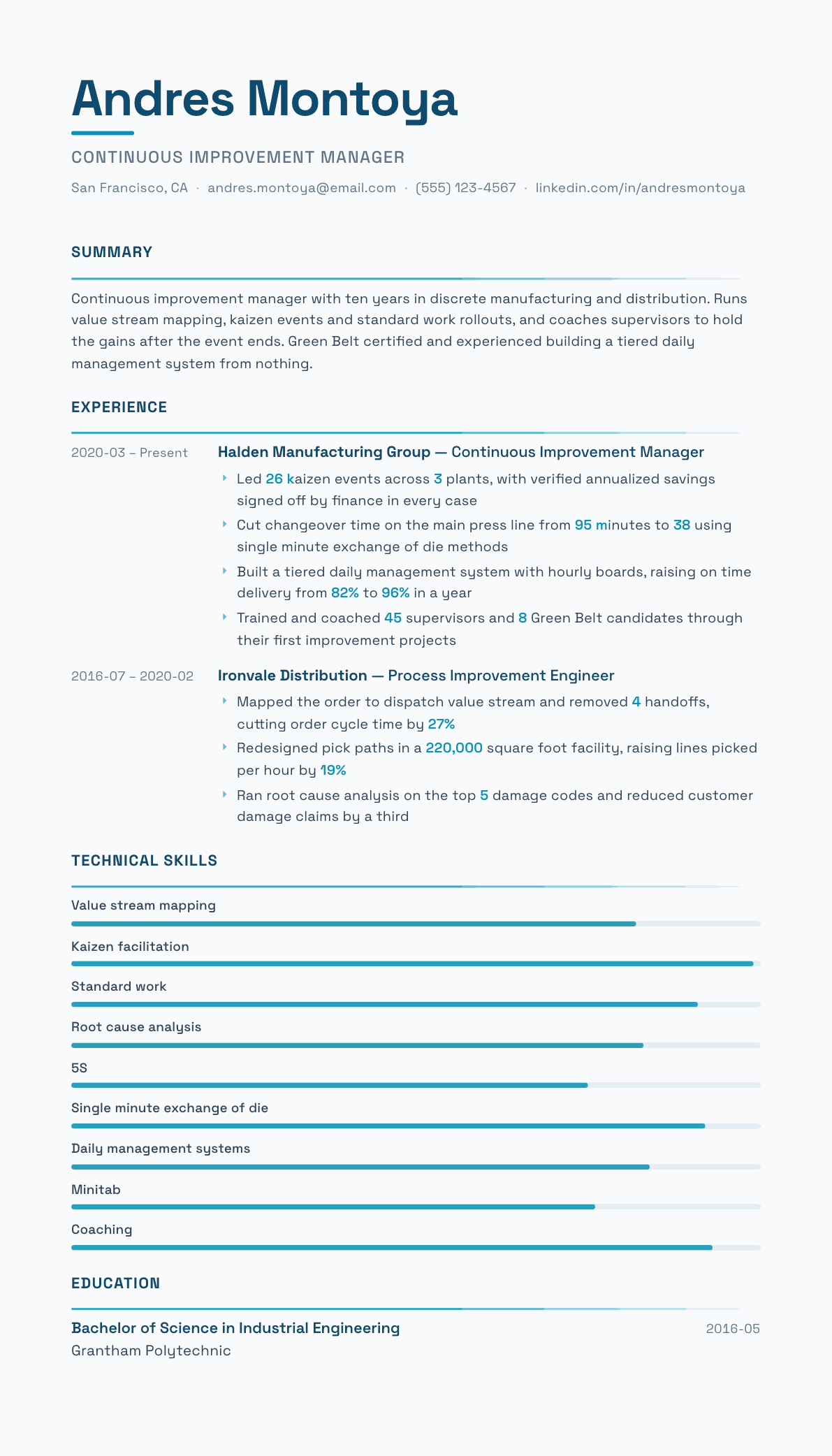
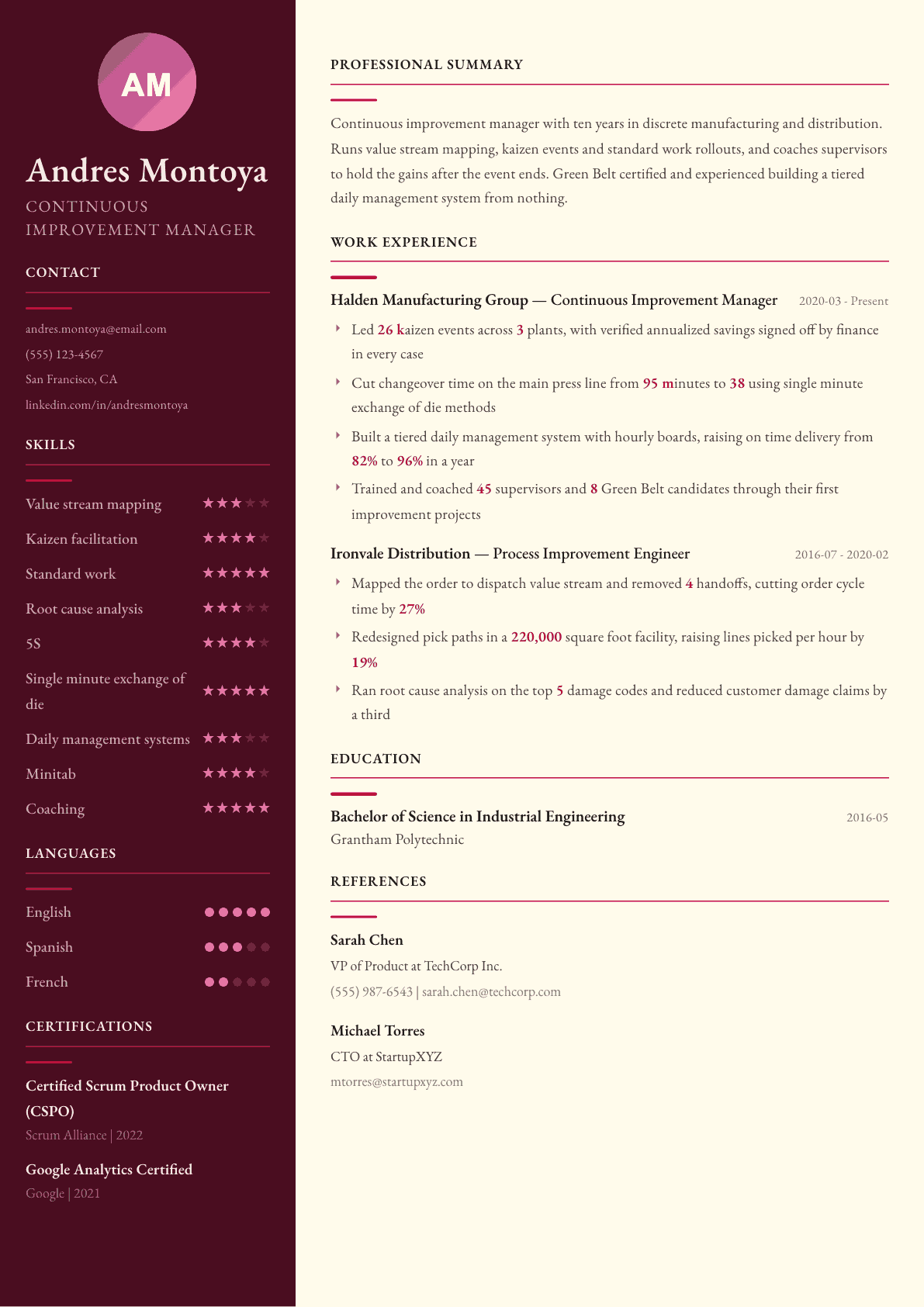
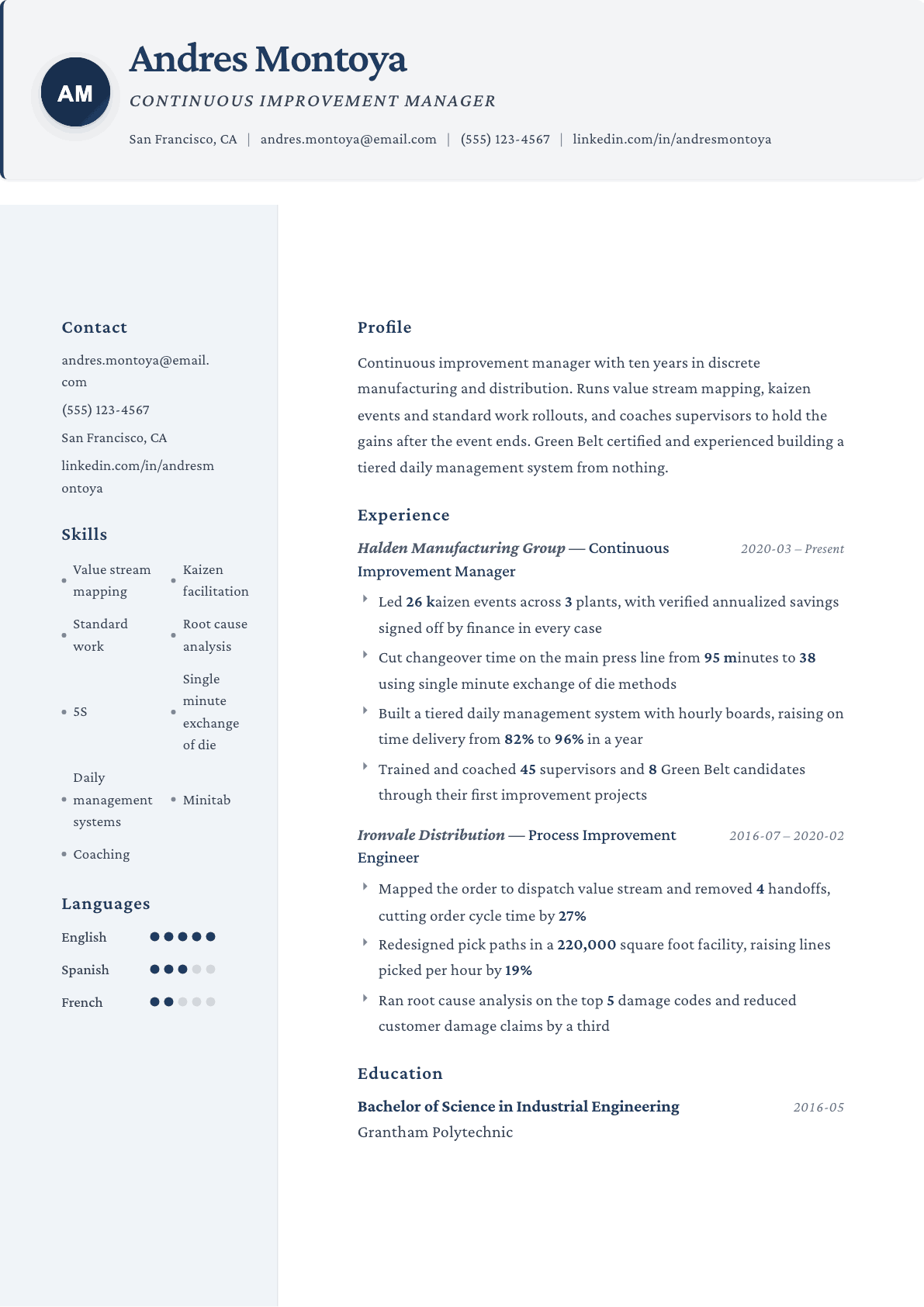
Example Continuous Improvement Manager summary
Continuous improvement manager with ten years across three manufacturing plants and a distribution network, leading kaizen events with savings signed off by finance rather than estimated. Cut press line changeover from ninety-five minutes to thirty-eight, built the tiered daily management system that lifted on time delivery, and coached forty-five supervisors through their own first improvement projects.
Skills to list on a Continuous Improvement Manager resume
- Value stream mapping
- Kaizen facilitation
- Standard work
- 5S
- Root cause analysis
- Single minute exchange of die
- Total productive maintenance
- Daily management systems
- Statistical process control
- A3 problem solving
- Minitab
- Change management
- Coaching and training
- Cost savings tracking
What actually gets this resume read
- Attach a verified number to each project and say who verified it, because unverified savings claims get discounted on sight.
- Name the specific lean tool used in each bullet rather than writing that you applied lean principles generally.
- Show the sustain step: audits, standard work, tiered boards or a coached owner who kept the gain after handover.
- Count the people you trained and certified, since a continuous improvement manager is judged on building capability.
- Give the site context, whether that is a plant, a warehouse network or an office process, as the tools differ by setting.
- Put your belt certification with the issuing body near the top, because many postings list it as a hard requirement.
How to write a continuous improvement manager resume
Every continuous improvement manager resume claims savings, so savings alone stopped being persuasive a long time ago. The resumes that get interviews do two things the others do not: they say who verified the number, and they show how the gain was held after the improvement team left the area.
The second thing a hiring operations leader looks for is capability building. A continuous improvement manager who personally delivered fifteen projects is worth less than one who trained forty supervisors to run their own, because the second one leaves a system behind. If your resume only lists your own projects, you are describing an engineer rather than a manager.
This guide covers the page structure, how to write a project so the mechanism is visible, three example summaries from a first improvement role to a site leader, before and after bullets, and the questions that come up when people move between manufacturing and transactional improvement work.
Format: scope line, then projects that carry numbers
Two pages, reverse chronological, single column. Under each employer, start with a scope line giving the setting and the reach: how many plants or sites, the headcount, the process area, and whether you led a team of practitioners or worked alone.
Then three to five bullets. Each one should be a small story with a mechanism inside it. A reader who cannot tell what you physically changed will assume the number came from somewhere else.
- Header: name, city and state, phone, email, and your belt level with the issuing body.
- Sections: summary, methodology and tools, experience, certifications, education.
- Under each employer: sites and headcount covered, then the projects with verified results.
Summary: the setting, the toolkit, and how you build capability
Name the environment first. Discrete manufacturing, process manufacturing, distribution, healthcare and shared services all use different tools, and an operations director hiring for a plant wants to see plant experience in the first line.
Then the toolkit and the coaching. A summary that says value stream mapping, kaizen facilitation, standard work and tiered daily management, plus the number of supervisors and belts you have coached, tells a reader far more than a claim of driving a culture of excellence.
Projects: the mechanism, the number, and the verification
Write each project so the physical change is visible. Reduced changeover time by fifty percent is a claim. Cut changeover on the main press line from ninety-five minutes to thirty-eight by externalizing die preheat, staging tooling on a cart and rewriting the setup sheet is a change a reader can picture, and that is what makes the number believable.
Say who signed off the savings. A finance validated number is a completely different asset from an estimate produced by the improvement team, and hiring managers ask about it in the first screening call. If your company ran a benefits tracking process with a controller sign off, say so once and it covers every project below it.
Then show the sustain step. Standard work written and trained, a layered process audit, a tiered board with a named owner, a control plan handed to the area supervisor. A gain that reversed after six months is a common story in this field and demonstrating that yours did not is a strong differentiator.
Capability building and the systems you installed
Count the people. Supervisors coached, Green Belts mentored through a first project, operators trained on standard work, leaders taught to run a daily tier meeting. Those numbers are the strongest evidence that you can scale improvement beyond your own hands.
Then name the systems you installed rather than the events you ran. A tiered daily management structure, a suggestion scheme with a closure rate, a layered audit routine, an idea to implementation pipeline: these are the things a company hires a continuous improvement manager to leave behind.
Keywords and the tools worth naming
Postings repeat a defined vocabulary: value stream mapping, kaizen, standard work, 5S, single minute exchange of die, total productive maintenance, A3 problem solving, root cause analysis, overall equipment effectiveness, daily management, and operational excellence. Use the exact phrasing from the posting inside a bullet where the tool did real work.
Add the analysis tools you use yourself. A statistical package, the spreadsheet modeling you build, the manufacturing execution or enterprise system you pull data from, and any simulation or line balancing tool all support the claim that your numbers came from data rather than from a workshop flip chart.
Continuous Improvement Manager resume summary examples
First improvement role
Process improvement engineer with 3 years in distribution operations, trained to Green Belt level. Mapped the order to dispatch value stream, removed 4 handoffs and cut order cycle time by 27%. Comfortable running time studies, redesigning pick paths and facilitating a first kaizen event with a supervisor.
Running improvement at a site
Continuous improvement manager with 10 years in discrete manufacturing and distribution. Led 26 kaizen events across 3 plants with savings signed off by finance, cut press line changeover from 95 minutes to 38, and built a tiered daily management system that lifted on time delivery from 82% to 96%.
Leading excellence across a network
Operational excellence leader with 16 years across 9 manufacturing sites, managing a team of 5 practitioners and a validated benefits pipeline. Set the improvement standard used network wide, certified 30 Green Belts, and coached plant leadership teams through their own daily management structures.
Work experience bullets: before and after
Before: Led kaizen events that saved the company money.
After: Led 26 kaizen events across 3 plants with annualized savings signed off by a finance controller in every case, the largest closing a scrap loss on the primary molding line.
Volume, site count and financial verification replace an unverifiable savings claim with something a hiring manager can trust.
Before: Reduced changeover times on production lines.
After: Cut changeover on the main press line from 95 minutes to 38 by externalizing die preheat, staging tooling on a dedicated cart and rewriting the setup sheet with the operators who use it.
Before and after times plus the three physical changes let a reader see exactly how the improvement was actually achieved.
Before: Implemented lean tools across the plant.
After: Built a tiered daily management system with hourly boards at the line, a shift tier and a site tier, raising on time delivery from 82% to 96% over a year.
A named system with its structure and a tracked outcome is far stronger than a general statement about implementing lean.
Before: Trained employees in continuous improvement.
After: Trained and coached 45 supervisors on standard work and problem solving, and mentored 8 Green Belt candidates through their first projects to certification.
Counting the people coached and taken to certification proves you build capability rather than delivering everything personally.
Before: Improved warehouse productivity.
After: Redesigned pick paths and slotting across a 220 thousand square foot facility, raising lines picked per hour by 19% without adding headcount.
The facility size, the specific redesign and the constraint of flat headcount make the productivity gain concrete and defensible.
Hard skills
- Value stream mapping
- Kaizen facilitation
- Standard work development
- 5S and workplace organization
- Single minute exchange of die
- Total productive maintenance
- A3 problem solving
- Root cause analysis
- Statistical process control
- Overall equipment effectiveness
- Tiered daily management
- Benefits tracking and validation
Soft skills
- Coaching supervisors
- Facilitating under conflict
- Influencing without authority
- Change management
- Frontline communication
Certifications worth listing
- Certified Six Sigma Green Belt (CSSGB) (American Society for Quality)
- Certified Six Sigma Black Belt (CSSBB) (American Society for Quality)
- Certified Manager of Quality/Organizational Excellence (CMQ/OE) (American Society for Quality)
- Lean Bronze Certification (Association for Manufacturing Excellence)
- Project Management Professional (PMP) (Project Management Institute)
Mistakes that cost continuous improvement manager candidates the interview
- Claiming savings with no mention of who verified them, which invites the reader to discount every number on the page.
- Writing that you applied lean principles instead of naming the tool and the physical change it produced.
- Leaving out the sustain mechanism, when reversal after a few months is the most common failure in this field.
- Listing only your own projects and never the supervisors or belts you coached to run their own.
- Skipping the setting, so a plant hiring manager cannot tell whether your work was on a press line or in a back office.
- Padding the page with event counts while never showing one project end to end with its mechanism intact.
Continuous Improvement Manager resume questions
Do I need a Black Belt to be a continuous improvement manager?
Not always. Many postings accept a Green Belt with strong delivery experience, and some ask for a lean certification instead. Where a Black Belt is listed as required, apply anyway if you have coached belts and delivered validated results.
How do I prove savings that finance never signed off?
Report the operational measure instead of a currency figure: minutes of changeover removed, scrap rate movement, downtime hours avoided, units per labor hour. Those are verifiable from plant records and do not invite doubt about the calculation behind them.
Does improvement experience outside manufacturing count?
Yes, and it is increasingly valuable. Transactional work in claims, finance operations or healthcare uses the same problem solving structure. Name the process, the cycle time and the defect you removed so the transfer is obvious to a manufacturing reader.
How many projects should I list?
Three to five per role, chosen for variety rather than size. Show one changeover or flow project, one quality project, one system you installed and one where you coached someone else to lead, so the range of your work is visible.
What if my improvements did not stick?
Write the ones that did. If a gain reversed, you can discuss what you learned in the interview, but the resume should carry the projects where the standard work, audit or ownership structure kept the result in place after handover.
Related resume examples
- Operations Manager Resume example
- Quality Manager Resume example
- Lean Six Sigma Black Belt Resume example
- Plant Manager Resume example
- Director of Operations Resume example
- Operations Consultant Resume example