Director of Operations Resume Examples: read this first
Write a Director of Operations Resume That Proves Throughput
By Mustafa Tarabya, founder of CVBooster · Published · Updated
A director of operations resume guide with a sample profile, the throughput and cost metrics hiring managers check, keyword lists, and section by section tips.
Sample resumes for a director of operations
The same director of operations content laid out in three CVBooster templates, so you can see what the finished document looks like before you write a word.
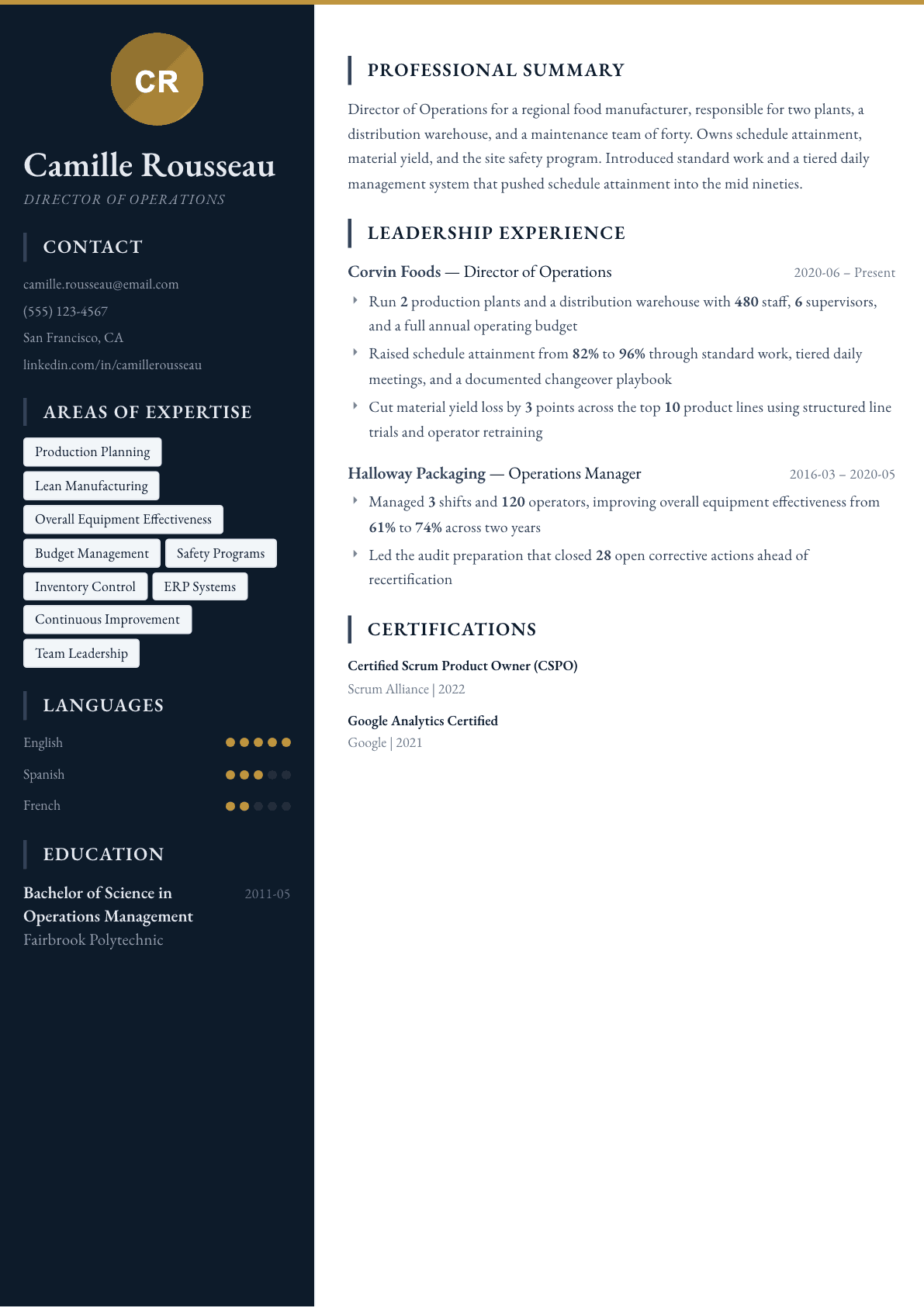
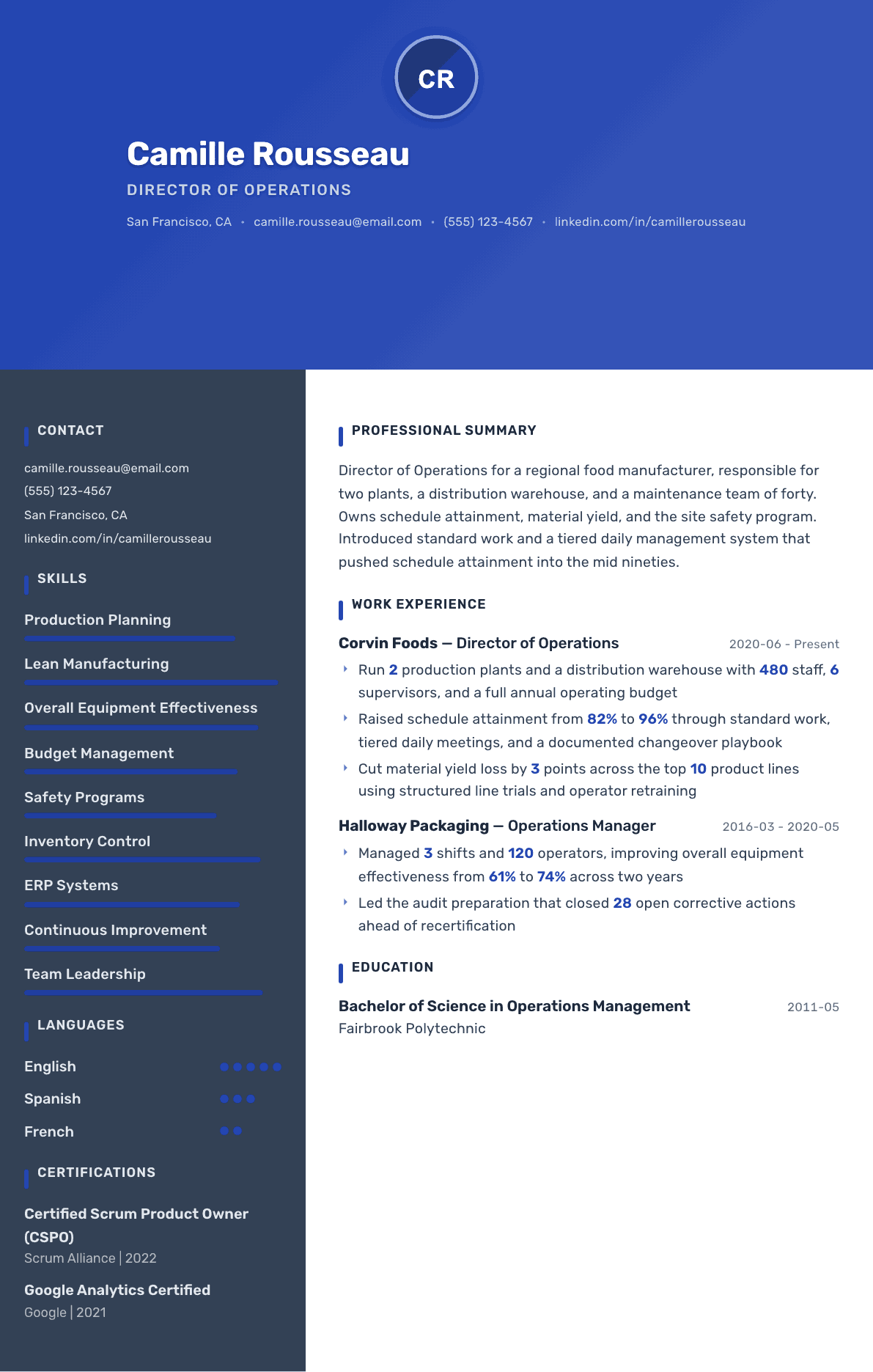
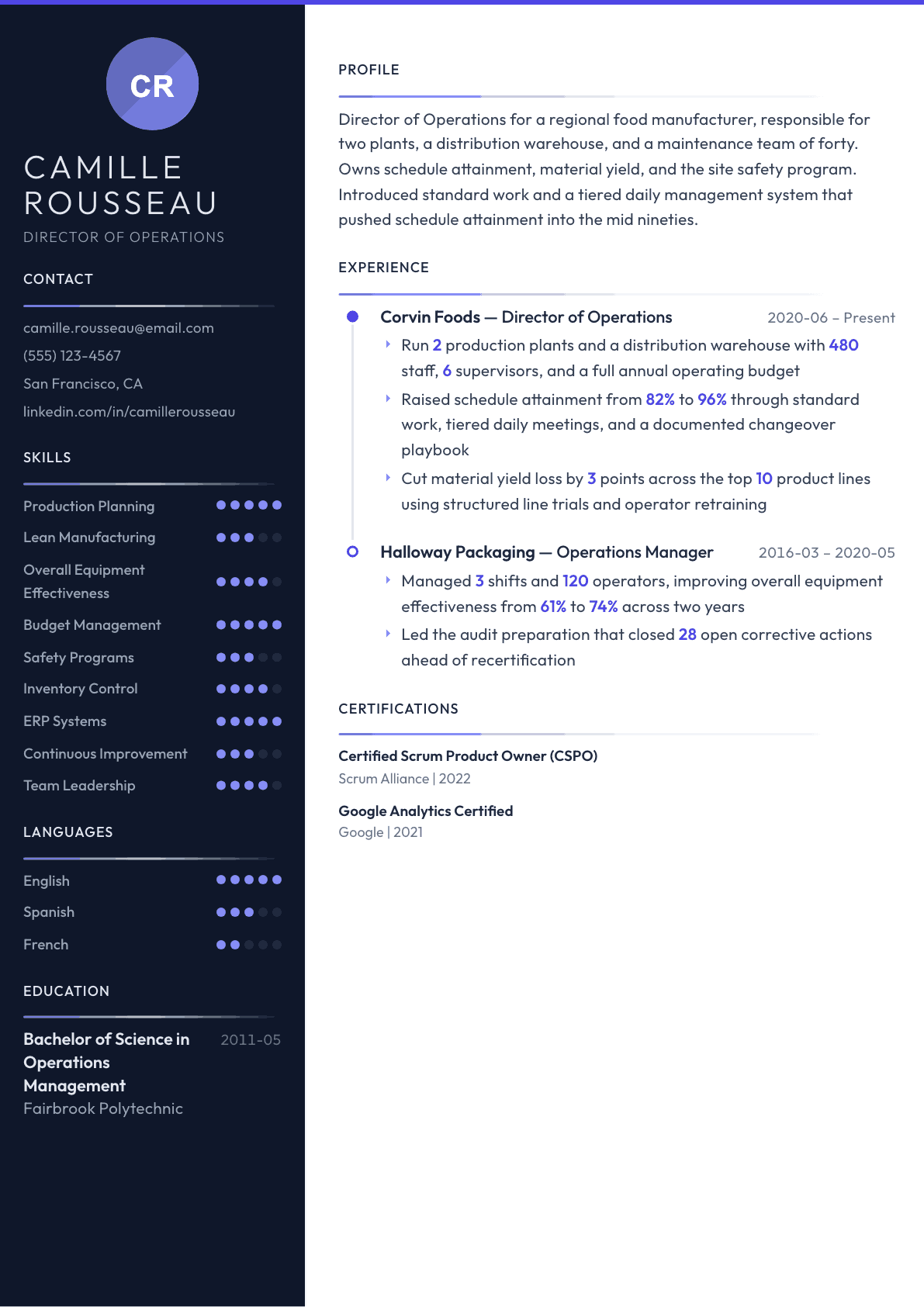
Example Director of Operations summary
Director of Operations with twelve years in food manufacturing and packaging, currently running two plants and a distribution warehouse with four hundred and eighty staff. Owns schedule attainment, material yield, and the site safety program, and built the daily management system that lifted attainment into the mid nineties. Comfortable leading audits, developing supervisors, and holding a budget through a volume swing.
Skills to list on a Director of Operations resume
- Operations Management
- Production Planning
- Lean Manufacturing
- Continuous Improvement
- Overall Equipment Effectiveness
- Standard Work
- Budget Management
- Inventory Control
- ERP Systems
- Safety Program Management
- Quality Audits
- Supervisor Development
- Capacity Planning
- Vendor Management
- Root Cause Analysis
What actually gets this resume read
- Open with sites, shifts, headcount, and budget so a hiring manager immediately knows the scale you have actually run.
- Pick the metrics your industry uses, such as overall equipment effectiveness, schedule attainment, or on time in full delivery.
- Show the management system you built, including tiered meetings, standard work, and escalation, not only the improvement number.
- Name the planning or resource system you operated in, because that decides how quickly you become useful on a new site.
- Include audits, certifications, and corrective actions you closed, since regulated operations screen hard for that experience.
- Add one example of developing supervisors, because directors are hired to build a layer of leaders they can rely on.
How to write a director of operations resume
A director of operations resume is usually read by a general manager or an operating officer who has a specific problem. Output is short of plan, a site is running on overtime, quality escapes have gone up, or a supervisor layer has stopped functioning. She is scanning for someone who has fixed that exact class of problem at roughly her scale, and she will make that judgment from the first six lines.
The trap is writing the resume as a list of responsibilities. Almost every operations director oversees production, staffing, budgets, and safety, so a responsibilities list makes every candidate identical. What separates the file that gets a call is the shape of the operation you ran and the specific management systems you installed to make it perform.
This guide covers how to establish scale immediately, which metrics belong on the page in each sector, three summaries at different levels, before and after bullets from plant and warehouse work, the certifications that carry weight, and the questions candidates ask when moving between operation types.
Format: one clean column, scale in the profile
One to two pages depending on history, single column, no graphics. Open with the shape of the operation: number of sites, shifts, headcount, supervisor layer, and whether you carried a budget. Those facts frame every result that follows, and without them a strong improvement number is impossible to size.
Add the operation type. Continuous manufacturing, batch food production, a distribution center, a service depot network, and a contract packing site all demand different instincts, and a hiring manager sorts by that before she reads anything else.
- Header: name, city, phone, email, and a professional profile link.
- Order: profile, selected results, experience, certifications, education, systems.
- Name the planning and resource systems you have run, because they determine your ramp up time.
Use the metrics your operation is actually measured on
Manufacturing reads overall equipment effectiveness, schedule attainment, yield, scrap, changeover time, and unplanned downtime. Distribution reads units per labor hour, on time dispatch, inventory accuracy, and cost per unit handled. Both read recordable incident rate and quality escapes. Choosing the right vocabulary is the quickest way to sound like an insider.
Give a before and after for the two or three metrics you genuinely moved, and leave the rest as context. A resume claiming improvement in eight measures at once is rarely believed, because operations people know that pushing one number usually pressures another.
The management system is the real achievement
Numbers move when the system underneath changes. Tiered daily meetings with a clear escalation path, standard work for operators and supervisors, documented changeover playbooks, layered process audits, and a visible performance board are the mechanisms that make an improvement stick after the attention moves elsewhere.
Describe one of these in enough detail that a reader can picture it running: who attends, how often, what is reviewed, and what happens when a target is missed. That paragraph does more for your credibility than three more percentage improvements.
Improvement methodology belongs here rather than as a badge. If you ran structured line trials, root cause analysis, or a formal problem solving cycle, say what problem it was applied to and what changed, so the method reads as practice rather than training.
Safety, quality, and audits
In a regulated or physical operation, safety and quality performance are screened before efficiency. Give recordable incident performance, the program behind it, and how site leaders were held to it. For food, pharmaceutical, or medical operations, name the audit regimes you prepared for and the corrective actions you closed.
Audit history is a strong differentiator because it is verifiable and unglamorous. Leading preparation that closed a backlog of open findings ahead of recertification tells a hiring manager you can impose discipline on a site that has been letting things slide.
Building the supervisor layer
Most operations problems are supervisor problems. Show what you did with that layer: how many supervisors you had, what you changed in how they were selected or trained, and what happened to their turnover and to shift performance variance afterward.
Shift to shift variance is a particularly useful number, because it exposes whether the operation depends on one strong crew or runs consistently. Reducing it is proof that you built capability rather than personally supervising harder.
Director of operations resume sample, start to finish
Here is a complete director of operations resume sample for a distribution and light assembly business. The person and the companies are invented; the order is the part to copy. Read it the way a general manager would: scale in the first line, the management system in the second, results after that.
Profile: Marcus Ellery, Director of Operations. Runs a three-site distribution and kitting network with 310 employees, nine supervisors and two maintenance crews across two shifts. Built the daily management system the sites still run on, and owns safety, service and cost per unit for the whole network.
- Current role, Director of Operations, Brightline Supply, four years: accountable for three warehouses, 310 staff and the full operating budget for the network.
- Cut late dispatches from about one order in nine to one in thirty by moving pick waves to a fixed cutoff schedule and adding a midday shortage review.
- Introduced tiered daily meetings at line, site and network level, with a written escalation rule for any order at risk of missing its truck.
- Cut recordable injuries from eleven in a year to three by retraining forklift operators and adding pre-shift equipment checks signed by the supervisor.
- Previous role, Operations Manager, Kestrel Components, five years: ran one assembly plant with 140 operators on two shifts.
- Reduced changeover time on the main line from 95 minutes to 40 with a documented playbook and a pre-staged parts cart.
- Promoted two team leads to supervisor and rewrote the supervisor onboarding plan later used across the company.
- Education and credentials: Bachelor of Science in Industrial Management, CPIM, OSHA 30-Hour General Industry. Systems: SAP, a warehouse management system, Power BI.
Director of Operations resume summary examples
Moving up from operations manager
Operations Manager stepping into a director role after running three shifts and 120 operators at a packaging site. Improved overall equipment effectiveness from 61% to 74% in two years and led the audit preparation that closed 28 open corrective actions ahead of recertification.
Multi site director
Director of Operations running two production plants and a distribution warehouse with 480 staff, six supervisors, and a full annual operating budget. Raised schedule attainment from 82% to 96% through standard work, tiered daily meetings, and a documented changeover playbook.
Regional operations leader
Operations Director with twelve years in food manufacturing and packaging, currently accountable for two plants, warehousing, and maintenance across a regional network. Cut material yield loss by three points across the top ten product lines and has developed four supervisors into site management roles.
Work experience bullets: before and after
Before: Responsible for improving production performance at the site.
After: Raised schedule attainment from 82% to 96% across two plants by introducing standard work, tiered daily meetings, and a documented changeover playbook for the top 10 product lines.
Three named mechanisms explain why the number moved and suggest it will hold without you watching.
Before: Reduced waste in the production process.
After: Cut material yield loss by 3 points across the top 10 product lines through structured line trials, revised setpoints, and operator retraining on the two worst performing lines.
The method and the targeted scope turn a general waste claim into a controlled improvement.
Before: Managed a team of supervisors and operators across shifts.
After: Led 6 supervisors and 480 staff across three shifts, rewrote the supervisor selection criteria, and cut shift to shift output variance by half within a year.
Variance between shifts is the number that proves capability was built rather than effort applied.
Before: Prepared the site for audits and inspections.
After: Led audit preparation across the site, closing 28 open corrective actions and introducing layered process audits, and passed recertification with no major findings.
Closing a specific backlog and adding an ongoing audit routine shows discipline that outlasts the inspection.
Before: Controlled the operating budget for the department.
After: Held the annual operating budget through a 15% volume swing by flexing agency labor against a weekly plan and deferring two non critical capital projects.
Naming the pressure and the two levers used shows budget control as an active decision, not an outcome.
Hard skills
- Production planning and scheduling
- Lean manufacturing and standard work
- Overall equipment effectiveness improvement
- Root cause analysis and problem solving
- Operating budget management
- Inventory and materials control
- Resource planning systems
- Safety program management
- Quality systems and audit preparation
- Capacity and labor planning
- Preventive maintenance programs
- Supplier and vendor management
Soft skills
- Supervisor coaching and development
- Shop floor communication
- Holding a standard consistently
- Cross shift alignment
- Calm handling of escalations
- Union and works council relations
Certifications worth listing
- Certified Six Sigma Green Belt (CSSGB) (American Society for Quality)
- Certified in Production and Inventory Management (CPIM) (Association for Supply Chain Management)
- Certified Manager of Quality and Organizational Excellence (American Society for Quality)
- OSHA 30-Hour General Industry (Occupational Safety and Health Administration)
Mistakes that cost director of operations candidates the interview
- Listing responsibilities every operations director shares, which makes the resume indistinguishable from the rest of the pile.
- Omitting sites, shifts, headcount, and budget, leaving a hiring manager unable to size any improvement you claim.
- Claiming improvement in every metric at once, which operations readers treat as a sign the numbers were not owned.
- Describing improvement results with no management system behind them, so nothing suggests the gains persisted.
- Leaving out audits, corrective actions, and certifications in a regulated sector where they are a screening criterion.
- Ignoring the supervisor layer, which is where most operational performance problems actually originate.
Director of Operations resume questions
How long should a director of operations resume be?
Two pages once you have more than about ten years of history, one page before that. Keep page one for scope, selected results, and your current role, and compress older positions into two or three lines each on page two.
Can I move from distribution operations into manufacturing?
Yes, and the transferable parts are planning discipline, labor management, safety accountability, and daily management systems. Lead with those, learn the target sector metric vocabulary before you apply, and be candid about what you have not run.
Should I list the resource planning system I worked in?
Yes, because it affects how quickly you become effective. Naming the planning, maintenance, and warehouse systems you have actually operated in gives a hiring manager a realistic view of your ramp up time on a new site.
What if my improvements were made by a wider team?
Say what you led and what the team delivered. Directors are expected to work through others, so describing the structure you put in place and the result the site achieved is accurate and reads better than an implausible solo claim.
How do I show experience with a union workforce?
Name it directly and describe what you handled: agreement negotiation, grievance resolution, shift pattern changes, or consultation on a restructure. Operations leaders hiring into a unionized site treat this as essential experience rather than an optional extra.
Related resume examples
- Operations Manager Resume example
- VP Operations Resume example
- Operations Director Resume example
- COO Resume example
- Plant Manager Resume example
- Team Leader Resume example