Records Manager Resume Examples: the lines they read
Build a Records Manager Resume Built on Retention and Audits
By Mustafa Tarabya, founder of CVBooster · Published · Updated
A records manager resume example plus the retention, governance and audit keywords hiring committees look for, with a full writing guide.
Sample resumes for a records manager
The same records manager content laid out in three CVBooster templates, so you can see what the finished document looks like before you write a word.
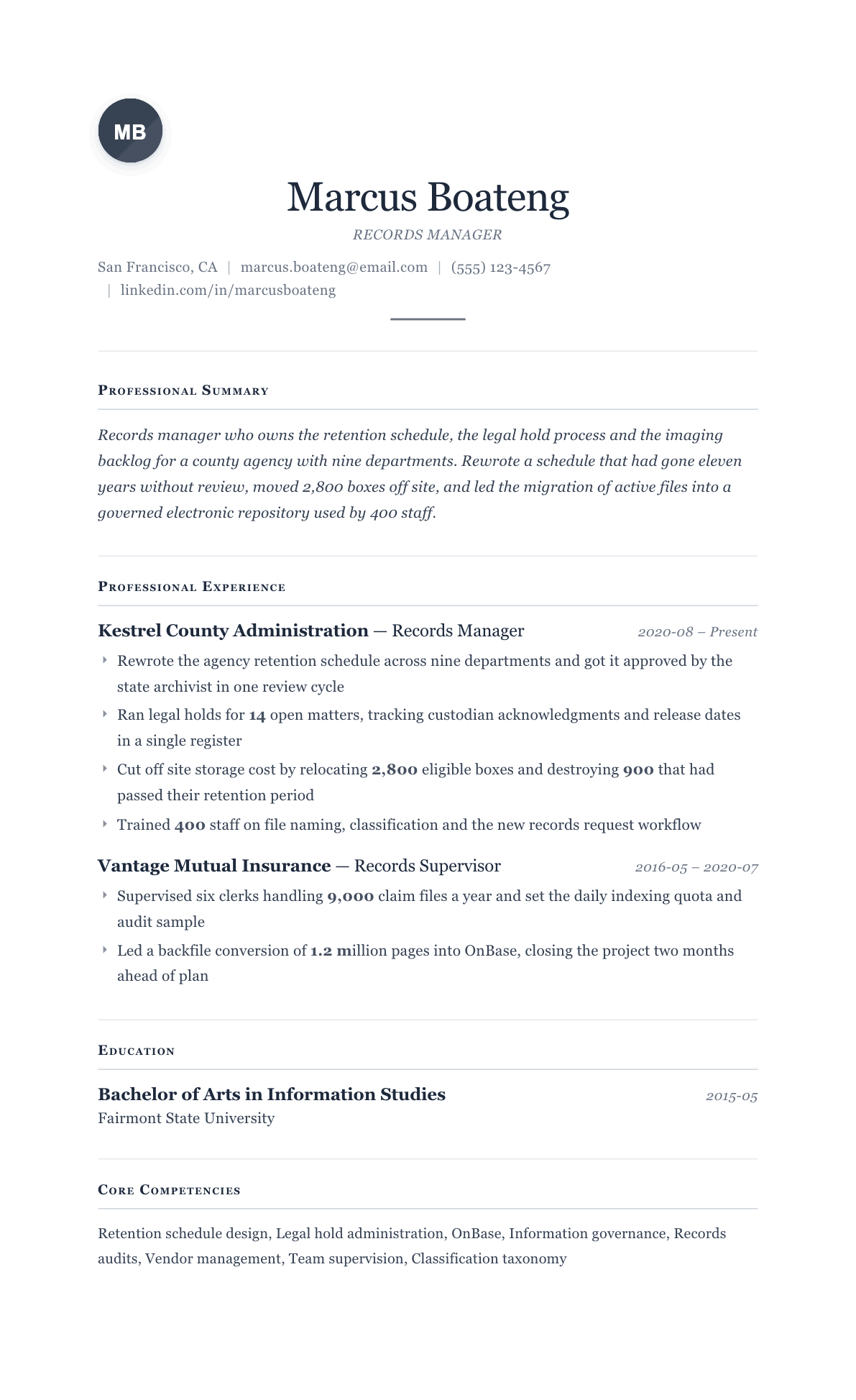
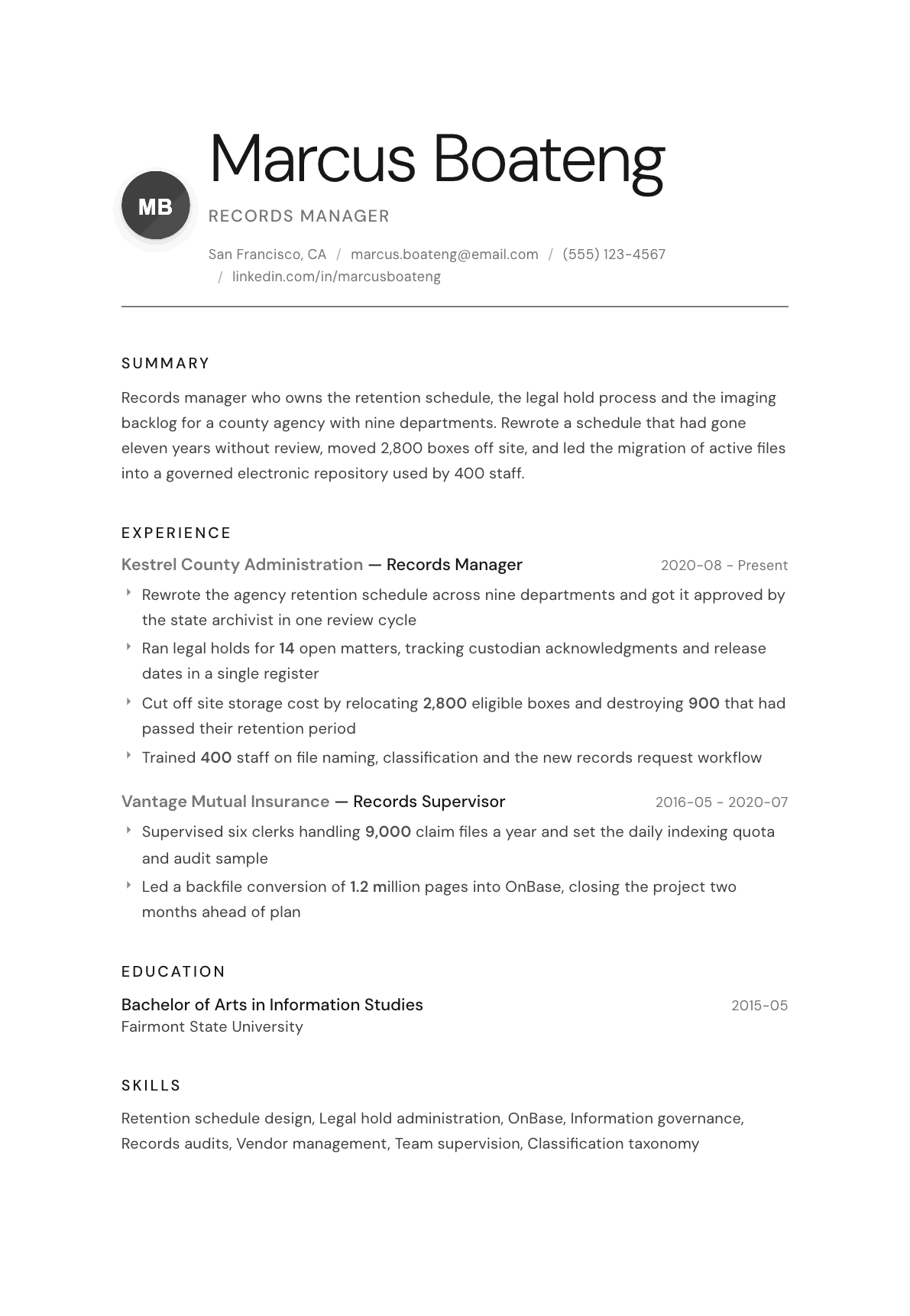
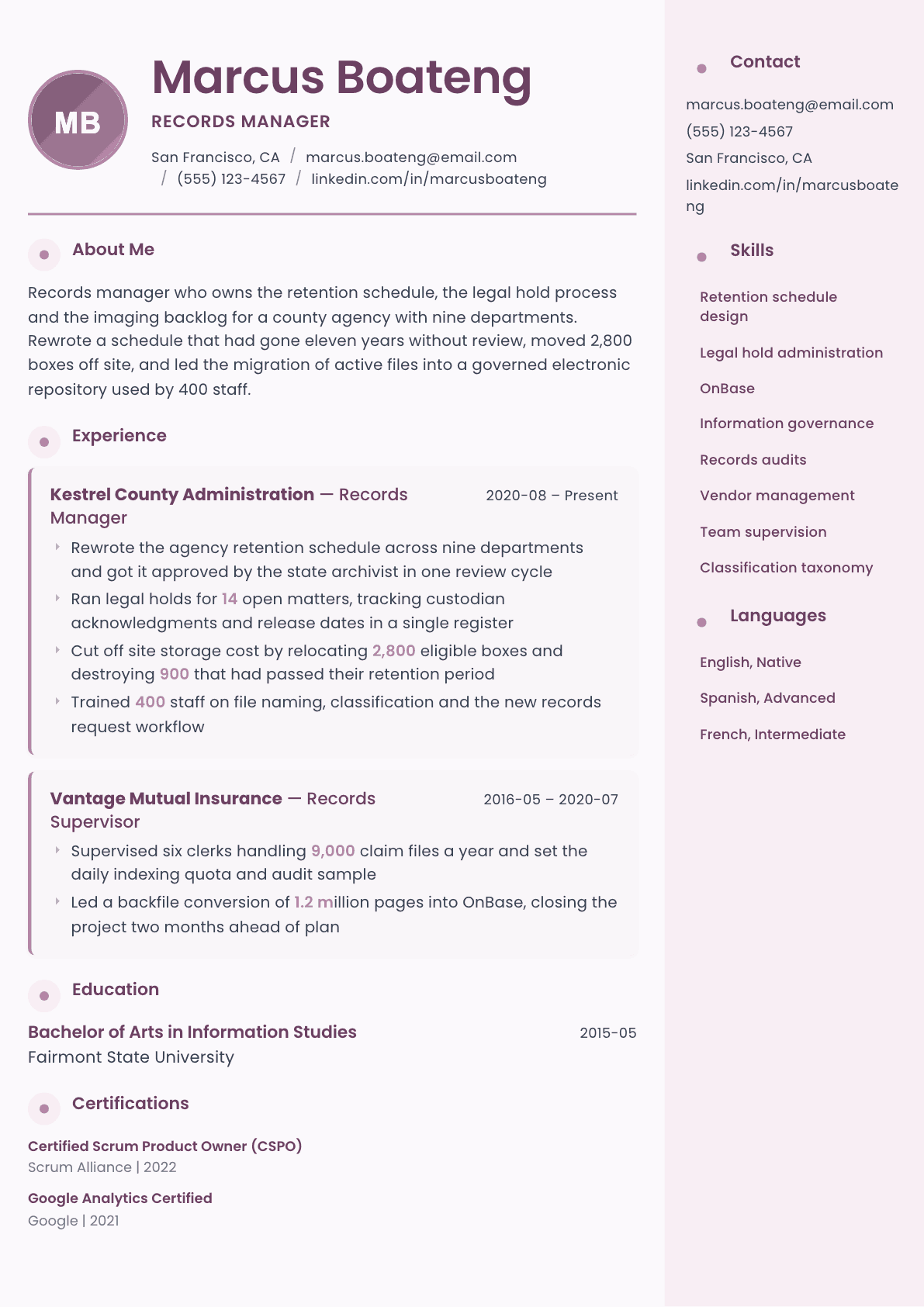
Example Records Manager summary
Records manager with nine years across county government and insurance, owning retention schedules, legal holds and imaging programs. Rebuilt a schedule covering nine departments, moved 2,800 boxes to controlled storage, and led a backfile conversion of 1.2 million pages into OnBase. Seeking an information governance role where policy, audit readiness and staff training sit with one owner.
Skills to list on a Records Manager resume
- Records retention schedules
- Information governance
- Legal hold management
- Records classification
- OnBase
- SharePoint records center
- Backfile conversion
- Vital records planning
- Audit and compliance reporting
- Vendor and storage management
- Team supervision
- Policy writing
- Metadata standards
- Disposition and destruction
- Change management training
What actually gets this resume read
- Open with the scope you govern: departments covered, record series owned and how many staff follow your schedule.
- Separate governance work from clerical work, because a hiring committee is buying policy ownership, not filing speed.
- Name the repository you administer and say whether you configured retention rules inside it or only used it.
- Include legal hold experience with the number of matters tracked, since litigation readiness is what worries counsel.
- Quantify storage reductions in boxes, linear feet or terabytes rather than in dollars you cannot verify publicly.
- Put the Certified Records Manager credential or IGP in the header if you hold either, then again in its own section.
How to write a records manager resume
A records manager is hired to remove a specific fear from an organization: that a subpoena, an audit or a public records request will arrive and nobody will be able to say what exists, where it sits, or whether it should have been destroyed already. The resume that wins the seat answers that fear on the first screen. It shows an owner of policy, not a fast filer.
This is where most candidates lose the job. They write a longer version of a clerk resume, full of boxes moved and documents scanned, and the hiring committee reads it as operational help rather than governance. The work that gets interviews is the retention schedule you wrote, the legal holds you administered, the classification taxonomy you imposed, and the staff you trained to follow it.
What follows is the section order a general counsel and a records committee expect to see, summaries for three stages of a governance career, before and after bullets drawn from schedule rewrites and disposition programs, and the questions candidates ask when their governance experience keeps reading as clerical.
Format: two pages, governance first, clerical work compressed
Two pages is normal once you own a schedule and supervise staff, and one page will force you to cut the very evidence the committee needs. Keep reverse chronological order and a single column, because public sector and insurance applicant tracking systems handle nothing else reliably.
The structural decision that matters is the split. Give governance work its own bullets at the top of each job and compress the clerical duties into a single closing line. A reader deciding between two candidates is buying policy ownership, and the resume should make that ownership impossible to miss.
- Header: name, city and state, phone, email, and the records credential after your name if you hold one.
- Section order: summary, credentials, professional experience, program highlights, education.
- Optional program highlights block: schedule scope, repository administered, holds tracked, storage reduced.
Summary: scope of the program you govern
Lead with scope, because scope is what separates a records manager from a senior clerk. Departments covered, record series owned, staff who follow your schedule, and the repository you administer. A reader can size the job you have held from those four numbers in a single line.
Then name the two responsibilities that make counsel comfortable: legal hold administration and defensible disposition. A records manager who has never issued a hold is a different hire from one who has tracked custodian acknowledgments through a live matter, and the summary should settle that question immediately.
Experience: schedules, holds, disposition, migration
Every job opens with the environment: the sector, the number of departments or business units, and whether the program was inherited, neglected or new. A schedule that had gone unreviewed for a decade is a harder assignment than a maintained one, and saying so frames everything that follows.
Write the bullets around the four things a governance seat is judged on. First, schedule work: series covered, approval path, and who signed off, which in the public sector often means a state archivist. Second, legal holds: matters tracked, custodians notified, release process. Third, disposition: boxes or terabytes eligible, destroyed, and how it was documented. Fourth, adoption: staff trained, classification taxonomy rolled out, and what changed in behavior.
Migration and imaging projects belong here too, but frame them as governed programs rather than volume. A backfile conversion matters because metadata and retention rules were applied on the way in, not because pages went through a scanner.
Skills: the vocabulary of information governance
The skills block should read like the language of the profession, since that is what both the parser and the committee are scanning. Retention schedule design, records classification, legal hold administration, vital records planning, disposition and destruction, metadata standards, audit and compliance reporting.
Name the systems and be honest about depth. Administering retention rules inside a repository is a different skill from using it, and a records manager who configured the rules should say configured. Add the storage vendor relationship if you managed one, since offsite contracts and retrieval fees sit with this role in most organizations.
- Governance: retention schedules, classification taxonomy, policy writing, vital records and continuity planning.
- Legal: hold issuance and release, custodian tracking, defensible disposition, audit response.
- Systems: OnBase, a SharePoint records center, or an equivalent governed repository plus offsite storage administration.
Credentials: the two that a committee recognizes
The certified records manager designation and the information governance professional credential are the two that a hiring committee in this field recognizes on sight, and each belongs in the header as well as its own section. They are not required for most postings, but they close the argument about whether you know retention theory or only retention practice.
Related credentials in privacy and information management help when the program touches personal data. List only what you hold, with the issuing body written out, because these bodies are small enough that a committee member may well know the exam.
Records Manager resume summary examples
Moving up from lead clerk
Records supervisor stepping into program ownership after six years in filing and imaging operations. Supervises six clerks handling 9,000 claim files a year, sets the daily indexing quota and audit sample, and drafted the first written retention schedule the department has held. Seeking a records manager seat in a regulated environment.
Program owner
Records manager owning the retention schedule, legal hold process and imaging backlog for a county agency with nine departments. Rewrote a schedule that had gone unreviewed for eleven years, relocated 2,800 boxes to controlled storage, and trained 400 staff on classification and the records request workflow.
Information governance lead
Information governance lead with twelve years across public sector and insurance, accountable to counsel for holds across fourteen open matters and for defensible disposition of a nine department schedule. Led a backfile conversion of 1.2 million pages into OnBase with retention rules applied at ingest, closing two months ahead of plan.
Work experience bullets: before and after
Before: Updated the records retention schedule.
After: Rewrote the agency retention schedule across nine departments, mapped every record series to its statutory authority, and secured state archivist approval in one review cycle.
The series mapping and the single review cycle prove the schedule was defensible rather than merely refreshed.
Before: Managed legal holds for the legal department.
After: Administered legal holds on fourteen open matters, issuing custodian notices, tracking acknowledgments in a single register, and releasing each hold only on written instruction from counsel.
Counsel cares about the acknowledgment trail and the release control, which is exactly what the weak version leaves out.
Before: Reduced offsite storage.
After: Relocated 2,800 eligible boxes to controlled storage and destroyed 900 that had passed their retention period, documenting eligibility and certificate of destruction for each pallet.
Disposition is only creditable when the documentation is described, since undocumented destruction is a liability rather than a saving.
Before: Trained staff on the new system.
After: Trained 400 staff across nine departments on file naming, classification and the records request workflow, then measured adoption through a quarterly sample of newly created files.
The adoption sample turns a training event into a governance control that actually changed behavior.
Before: Oversaw a large scanning project.
After: Led a backfile conversion of 1.2 million pages into OnBase, applying classification and retention metadata at ingest so imaged records inherited their disposition dates automatically.
Applying retention at ingest is the difference between an imaging project and a governance program, and it is the detail a committee looks for.
Hard skills
- Retention schedule design
- Information governance frameworks
- Legal hold administration
- Records classification and taxonomy
- Defensible disposition and destruction
- OnBase administration
- SharePoint records center
- Vital records and continuity planning
- Metadata standards
- Backfile conversion management
- Audit and compliance reporting
- Offsite storage and vendor management
Soft skills
- Policy writing for non specialists
- Working with counsel
- Change management
- Committee presentation
- Cross department negotiation
- Supervision and coaching
Certifications worth listing
- Certified Records Manager (CRM) (Institute of Certified Records Managers)
- Information Governance Professional (IGP) (ARMA International)
- Certified Information Professional (CIP) (AIIM)
- Certified Information Privacy Professional (CIPP/US) (International Association of Privacy Professionals)
- Project Management Professional (PMP) (Project Management Institute)
Mistakes that cost records manager candidates the interview
- Writing a longer clerk resume, so the committee reads filing volume where it needed policy ownership.
- Leaving legal holds off the page, which is the first thing counsel asks about and the fastest way to be screened out.
- Claiming a repository without saying whether you configured retention rules inside it or only filed into it.
- Describing destruction without the documentation, which reads as risk rather than as a completed disposition program.
- Burying the certified records manager or information governance credential in the education block instead of the header.
- Quantifying storage savings in money you cannot substantiate rather than in boxes, linear feet or terabytes.
Records Manager resume questions
Do I need the certified records manager credential to be hired?
Most postings list it as preferred rather than required, and plenty of managers hold the seat without it. It matters most in public sector and regulated industries, where a committee uses it as a shortcut for confirming you understand retention theory and defensible disposition.
How do I show governance work when my title was records supervisor?
Lead each job with the policy work rather than the title. If you drafted a schedule, set an audit sample, or wrote the destruction procedure your team followed, those are governance activities and belong in the top bullets regardless of what the title said.
Should I list every record series or system I have touched?
No. List the repositories you administered and the record categories that carry risk, such as personnel, litigation, clinical or financial. An exhaustive inventory reads as padding and pushes the schedule, hold and disposition evidence onto the second page.
How much detail should I give about a migration project?
Enough to show it was governed: pages or terabytes moved, the target repository, whether classification and retention metadata were applied at ingest, and how the legacy source was retired. Volume alone reads as an imaging job rather than a program.
What if my program had no budget or no staff?
Say so and make it an advantage. Running a schedule and a hold process alone, with departmental liaisons rather than direct reports, demonstrates influence without authority, which is the harder version of the job and is worth naming explicitly.
Related resume examples
- Records Clerk Resume example
- Document Controller Resume example
- Office Manager Resume example
- Data Entry Clerk Resume example
- Administrative Officer Resume example
- File Clerk Resume example