File Clerk Resume Examples: free ATS score and gap list
A File Clerk Resume That Shows You Can Find Anything
By Mustafa Tarabya, founder of CVBooster · Published · Updated
File clerk resume example with records volume bullets, retention and indexing keywords, tips and a section by section writing guide.
Sample resumes for a file clerk
The same file clerk content laid out in three CVBooster templates, so you can see what the finished document looks like before you write a word.
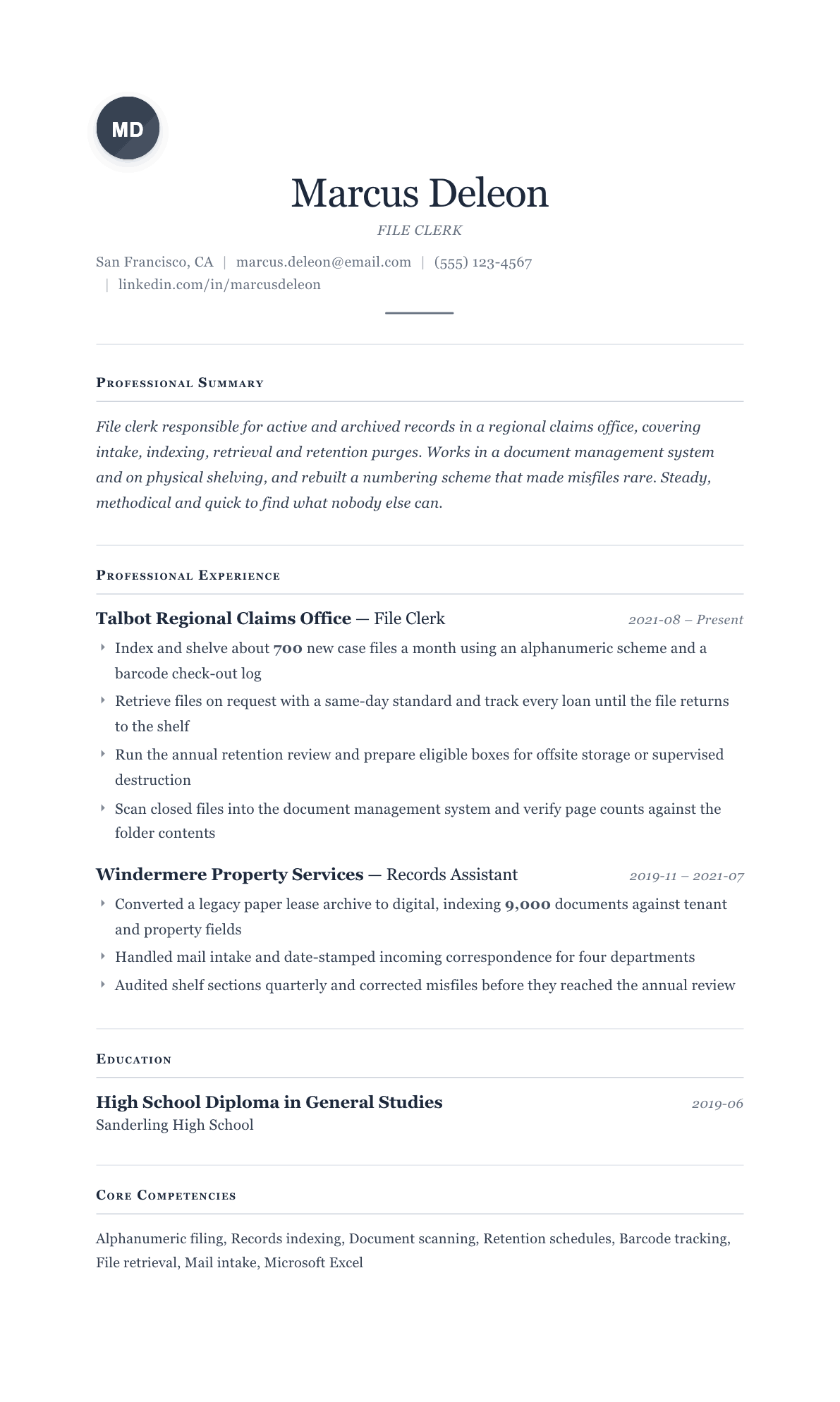
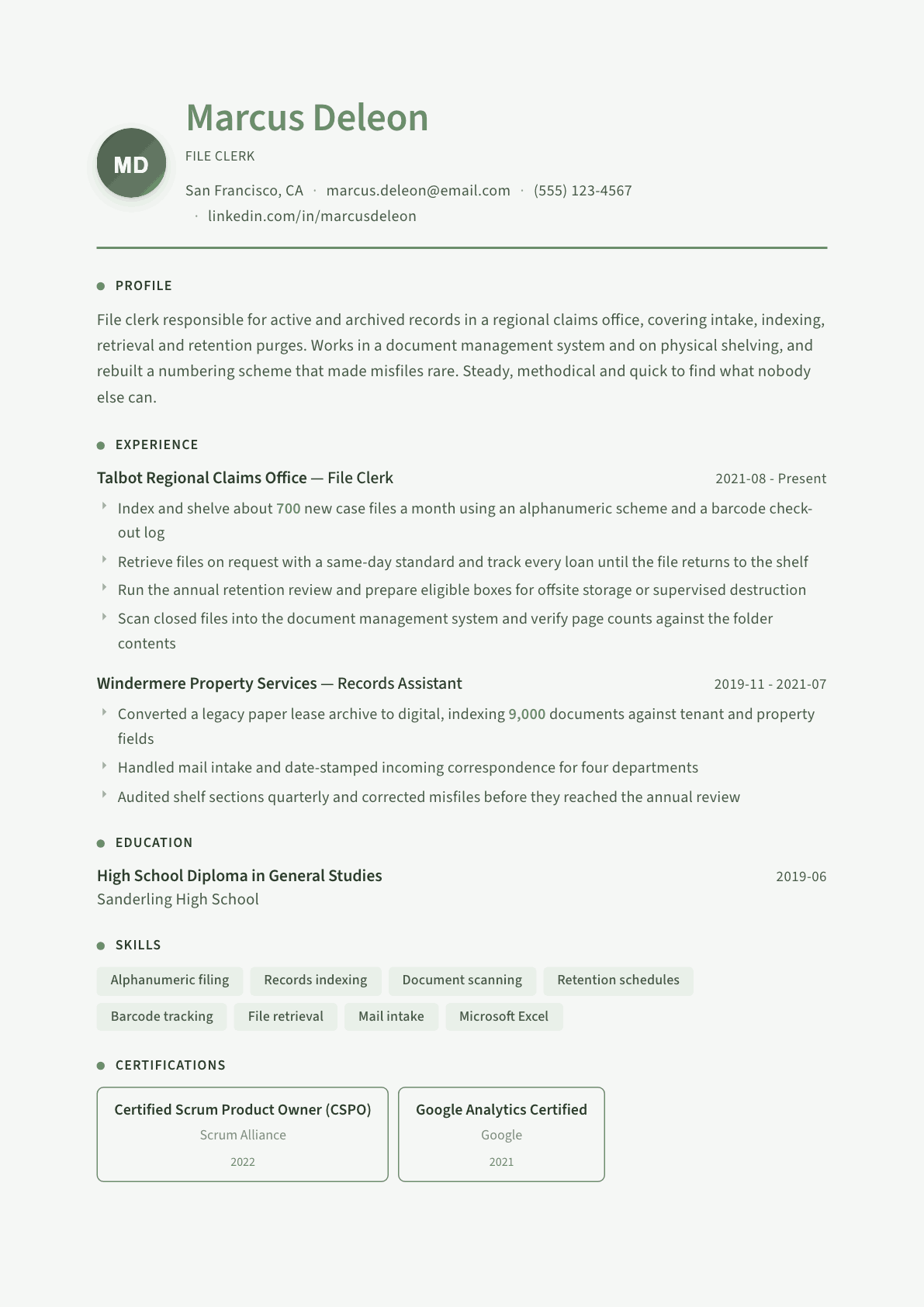
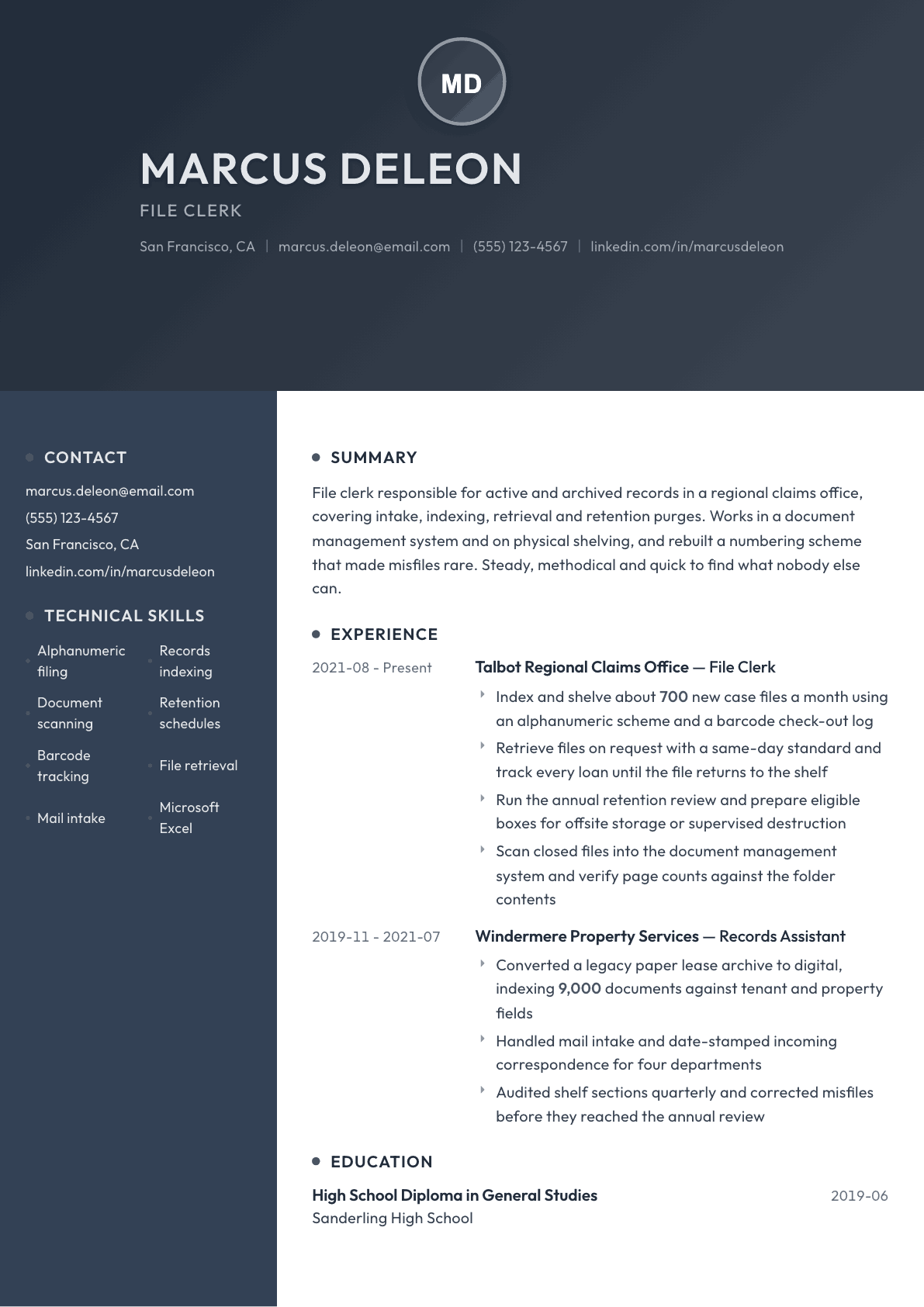
Example File Clerk summary
File clerk with five years managing active and archived records in claims and property offices. Indexes and shelves hundreds of new files a month, tracks every loaned file to its return, and runs the retention review that clears eligible boxes for storage or destruction. Converted a paper lease archive to a searchable digital index. Seeking a records role in an office with a real archive to keep in order.
Skills to list on a File Clerk resume
- Alphanumeric filing
- Terminal digit filing
- Records indexing
- Document scanning
- Document management systems
- Retention schedules
- Records destruction
- Barcode tracking
- File retrieval
- Archive organization
- Mail intake
- Data entry
- Microsoft Excel
- Confidential records handling
What actually gets this resume read
- State the volume you handle: files created a month, boxes archived, documents scanned. Volume is the whole credential here.
- Name the filing systems you know, such as alphabetic, numeric, terminal digit or subject filing, using the standard terms.
- Include retention schedules and destruction procedures, because compliance is why an employer keeps a file clerk on staff.
- Mention any document management system by name and say whether you indexed, scanned or only retrieved in it.
- Show retrieval speed and file tracking, since the real complaint about records teams is that files go missing.
- Add physical requirements plainly if the role has them, such as lifting boxes or working from a ladder in an archive.
How to write a file clerk resume
Records teams exist because an organization has to produce a document on demand, sometimes years later and sometimes for a regulator. That is the frame a file clerk resume should be written in. The office manager or records supervisor reading it wants to know the volume you handle, the filing scheme you work in, whether you understand retention and destruction, and whether files you check out actually come back.
The complaint that gets a records job funded is always the same: something cannot be found. So the strongest resume in the pile is the one that shows tracking and retrieval, not just filing. A same-day retrieval standard with a check-out log behind it answers the question the employer is really asking.
This guide covers how to state records volume, which filing systems to name using their standard terms, how to write about retention schedules and supervised destruction, how to present a paper to digital conversion project, and how to handle the physical parts of the job on paper.
Format: one page, volume and systems up front
One page is right for almost every records career. Single column, plain font, month and year dates. Put a short line under each employer describing the records environment: an active claims file room, a property lease archive, a medical records department or an offsite storage operation. That sentence tells the reader what kind of order you have kept.
Do not use a graphic template. Records work is often hired through general office recruitment software, and the simplest layout gives your document management system names and volumes the best chance of being read as written.
- Employer lines that name the records environment and whether it was paper, digital or both.
- Section order: summary, filing and records skills, experience, systems, education.
- Volume in every role: files created a month, boxes archived, documents scanned or indexed.
Summary: scope, scheme, and retrieval standard
Open with the records you are responsible for and whether they are active, archived or both. Then the filing scheme and the system, then your retrieval standard. A file clerk who indexes several hundred new case files a month under an alphanumeric scheme and retrieves on a same-day standard has described the job better than a paragraph of adjectives ever could.
End on the improvement you made. Rebuilding a numbering scheme, converting a paper archive, or clearing a backlog are the projects a records supervisor recognizes, and each shows initiative in a role often assumed to be purely routine.
Filing systems: use the standard terms
Name the scheme with the vocabulary the field uses: alphabetic, straight numeric, terminal digit, middle digit, subject and chronological filing. Terminal digit filing in particular signals real records experience, since it is used where large numbered file sets need even shelf distribution, and it is not a term anyone picks up by accident.
Describe how a file enters and leaves the system. Intake and date stamping, indexing against the agreed fields, shelving, the check-out log, the return, and the shelf audit that catches a misfile before the annual review. Written as a cycle, the work reads as a controlled process rather than a stack of tasks.
Retention, destruction and compliance
This is the section that raises a file clerk resume above a general office one. Say that you work to a retention schedule, how the annual review runs, how eligible boxes are identified, and what happens next: transfer to offsite storage or supervised destruction with a certificate. Naming the destruction control matters, because unauthorized disposal is the failure an employer fears most.
Add any legal hold experience if you have it, meaning records pulled out of the normal retention cycle because of litigation or an audit. Even a short line showing you know files can be frozen tells a records supervisor you have worked somewhere with real governance.
Digital conversion, systems and the physical job
Scanning projects deserve their own bullets. Give the document count, the index fields used, the verification step that checks page counts against the folder, and the quality standard for a rescan. A conversion of a legacy lease archive indexed against tenant and property fields is a project with a shape, and it reads far better than the phrase scanned documents.
Name the document management system and be honest about your role in it: whether you indexed, scanned, applied retention codes or only retrieved. Then state the physical realities plainly if the role has them, such as lifting record boxes, working from a step ladder in an archive, or covering an offsite storage run. Employers ask about that anyway, and a candidate who states it first looks like someone who has done the job.
File Clerk resume summary examples
First records job
High school graduate with an office placement covering mail intake, date stamping and shelving for a four-department filing room. Comfortable with alphanumeric filing, careful with confidential correspondence, and able to lift and shelve record boxes. Seeking a file clerk position with training on a document management system.
Three years in records
File clerk responsible for active and archived records in a regional claims office, indexing and shelving around 700 new case files a month under an alphanumeric scheme with a barcode check-out log. Retrieves on a same-day standard, tracks every loaned file to its return, and prepares eligible boxes for the annual retention review.
Senior records assistant
Senior records assistant with seven years across claims and property offices, running retention reviews, supervised destruction and offsite transfers. Converted a legacy paper lease archive to a searchable digital index of 9,000 documents, and audits shelf sections quarterly so misfiles are corrected long before the annual review.
Work experience bullets: before and after
Before: Filed documents and kept records in order.
After: Indexed and shelved around 700 new case files a month under an alphanumeric scheme, verifying each index entry against the folder cover before shelving.
Monthly volume, the named scheme and the verification step turn filing into a measurable, controlled routine.
Before: Retrieved files when people asked for them.
After: Retrieved requested files to a same-day standard using a barcode check-out log and tracked every loan until the file returned to the shelf.
A retrieval standard plus tracking answers the complaint every records team is hired to solve, which is missing files.
Before: Helped with archiving old records.
After: Ran the annual retention review, identified eligible boxes and prepared them for offsite storage or supervised destruction against the retention schedule.
Retention and controlled destruction show compliance knowledge rather than moving old paper into a basement.
Before: Scanned documents into the computer.
After: Converted a legacy paper lease archive to digital, indexing 9,000 documents against tenant and property fields and verifying page counts before disposal of the paper original.
Document count, index fields and verification make a conversion project credible and show the quality control step.
Before: Checked the files were in the right place.
After: Audited shelf sections quarterly and corrected misfiles before the annual review, keeping the section error rate low enough that retrieval requests rarely escalated.
A scheduled audit is prevention, which reads as ownership of the archive rather than reacting to a complaint.
Hard skills
- Alphabetic and alphanumeric filing
- Terminal digit filing
- Records indexing
- Document scanning and imaging
- Document management systems
- Retention schedules
- Supervised records destruction
- Barcode file tracking
- File retrieval standards
- Archive and shelf organization
- Mail intake and date stamping
- Data entry
- Microsoft Excel
- Confidential records handling
Soft skills
- Methodical routine
- Accuracy in repetitive work
- Discretion with sensitive files
- Persistence when a file is missing
- Clear notes for colleagues
- Physical stamina in an archive
Certifications worth listing
- Certified Records Analyst (CRA) (Institute of Certified Records Managers)
- Certified Records Manager (CRM) (Institute of Certified Records Managers)
- Information Governance Professional (IGP) (ARMA International)
Mistakes that cost file clerk candidates the interview
- Describing filing with no volume, which makes an archive of thousands of active files read like a single cabinet.
- Writing organized filing instead of naming the scheme, when terminal digit or subject filing is the term that proves experience.
- Skipping retention and destruction entirely, which is the compliance reason an employer funds the role at all.
- Mentioning scanning without the index fields or the verification step, so the project reads as feeding paper into a machine.
- Leaving out file tracking and retrieval, when missing files are the exact problem the hiring manager wants solved.
- Hiding the physical requirements, which come up at interview anyway and are better stated by you first.
File Clerk resume questions
What should a file clerk resume include if I have no office experience?
Lead with accuracy, reliability and any work involving inventory, stock rotation or careful sorting, since those transfer directly. Add the filing terms you have learned, state that you can lift record boxes, and put any short office placement or volunteer records work at the top.
How do I show that files never go missing?
Describe the tracking mechanism rather than making a claim. A barcode or sign-out log, a named borrower, a return date and a quarterly shelf audit together prove control, and a retrieval standard shows that requests are met without a search party.
Is knowing a document management system necessary?
It is increasingly expected, but honesty about your role in it matters more than the name. Say whether you indexed, scanned, applied retention codes or retrieved, since a supervisor will assume the deepest of those unless you specify, and the gap shows quickly on the job.
Should I mention retention schedules if I only followed instructions?
Yes, and describe it accurately: you prepared boxes for review, applied the codes given, and did not authorize disposal yourself. Understanding the boundary between preparing and authorizing destruction is exactly the awareness a records supervisor wants to see.
How do I move from file clerk into records management?
Take on the parts of the job that are already governance work: retention reviews, indexing standards, audits and conversion projects, then document them with volumes. A records analyst credential from a recognized institute makes the next step visible on the page.
Related resume examples
- Mail Room Clerk Resume example
- Administrative Assistant Resume example
- Records Clerk Resume example
- Office Clerk Resume example
- Data Entry Specialist Resume example
- Data Entry Operator Resume example