Office Manager Resume Examples: the lines they read
Office Manager Resume: Job Duties, Responsibilities and Examples
By Mustafa Tarabya, founder of CVBooster · Published · Updated
Office manager resume examples with the job duties and responsibilities to list, grouped by finance, people, facilities and systems, plus a job description guide.
Sample resumes for a office manager
The same office manager content laid out in three CVBooster templates, so you can see what the finished document looks like before you write a word.
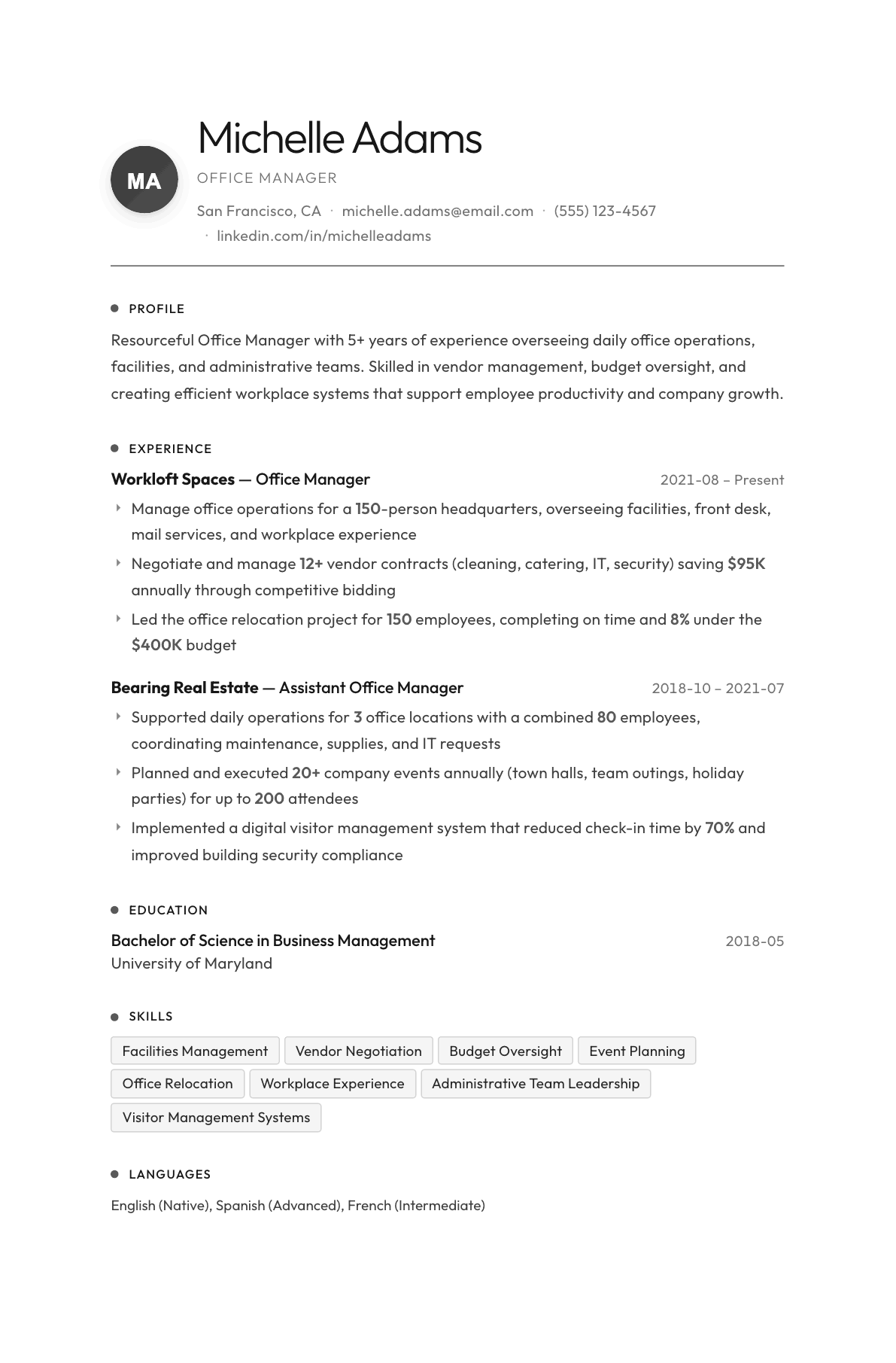
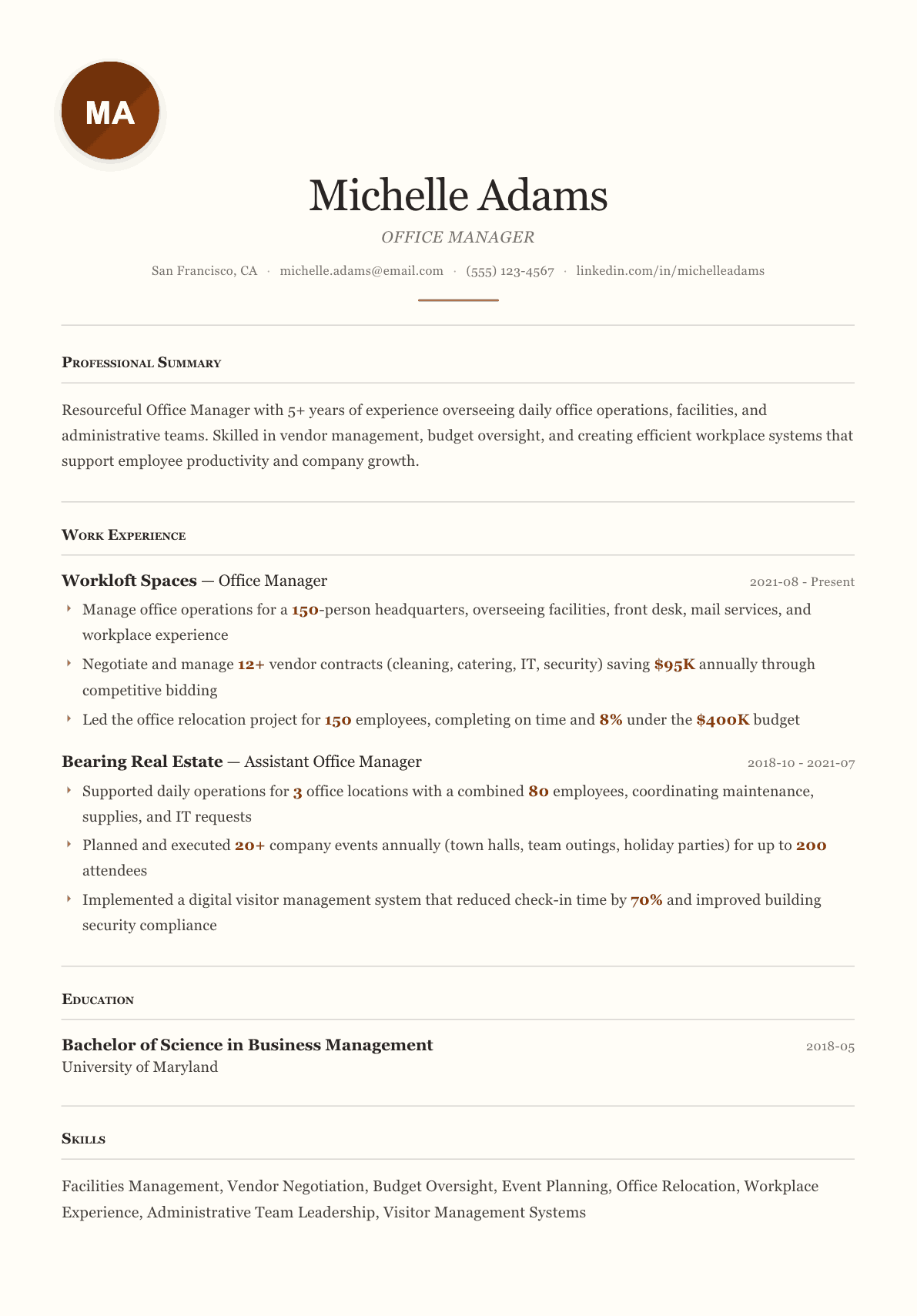
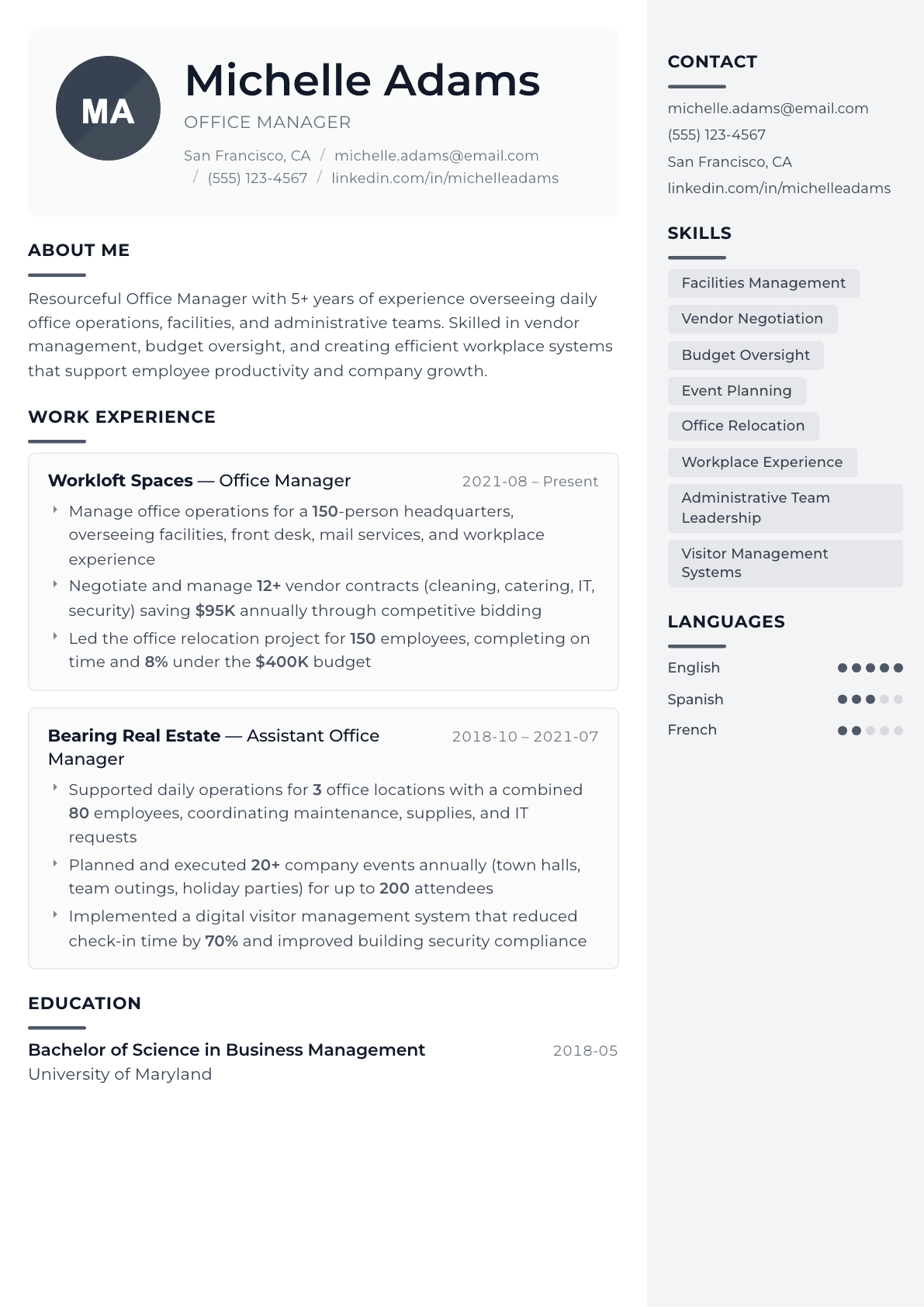
Example Office Manager summary
Office manager for a 150-person headquarters, 5 years, holding 12 vendor contracts across cleaning, catering, IT and security and $95K of annual savings from competitive rebidding. Ran the office relocation on time and 8% under a $400K budget, and runs 20 company events a year for up to 200 people.
Skills to list on a Office Manager resume
- Facilities Management
- Vendor Negotiation & Management
- Budget Planning & Oversight
- Event Planning & Coordination
- Office Relocation
- Workplace Experience
- Administrative Team Leadership
- Visitor Management Systems
- Procurement & Supply Chain
- Health & Safety Compliance
- Space Planning
- HRIS & Office Technology
What actually gets this resume read
- Quantify cost savings from vendor negotiations, office moves, or process improvements to demonstrate fiscal responsibility.
- Highlight the scale of your operations: office size (square footage or headcount), number of locations, and vendor contracts managed.
- Showcase event planning achievements with attendee counts, budgets, and employee feedback scores.
- Include facility and safety experience: building maintenance, OSHA compliance, emergency preparedness, or security protocols.
- List relevant technology: visitor management systems, space booking platforms, procurement software, or HRIS tools.
- Demonstrate leadership by describing how you managed receptionists, administrative assistants, or mailroom staff.
How to write a office manager resume
Office manager is one of the least standardized titles on any resume pile. In a 20 person firm it means bookkeeping, payroll submission, human resources paperwork and the lease. In a 400 person company it means facilities, workplace services, a team of administrative staff and a six figure operating budget. The person reading your resume has one of those two jobs in mind, and your first three lines decide whether she keeps reading.
So the resume has to fix the ambiguity immediately. State the headcount, the number of sites, the budget you controlled, the people who reported to you, and the functions that sat under you. Everything a hiring executive wants to know about an office manager is contained in those five facts, and most resumes for this role state none of them.
This guide covers how to establish scope in the first read, how to write the money and vendor work so a finance leader believes it, how to handle the bookkeeping and human resources spillover that this title always carries, and the questions office managers ask when they are moving toward operations or workplace leadership.
Format: one page under seven years, two after, scope stated first
Reverse chronological, single column, one page until you have run multiple offices or managed a team for several years. The scope line under each employer does the heavy lifting: company size, headcount you supported, sites, your direct reports and your budget authority. Put it before the bullets, not inside them.
Resist the decorative template. Office manager postings often route through a small business owner or a finance director reading on a phone between meetings, and a two column layout with icons is harder to skim and parses badly in applicant tracking systems.
- Header: name, city and state, phone, email.
- Order: summary, experience, tools and systems, certifications, education.
- Scope line under every employer: headcount, sites, direct reports, budget or spend controlled.
Summary: scope, savings, and the functions you carried
Three lines. Name the largest office you have run, the functions under you, and one financial result. This is the role where a cost outcome belongs in the summary, because office managers are among the few administrative professionals whose decisions show up directly in an operating budget.
Name the spillover functions honestly. Many office managers also run bookkeeping, payroll submission, onboarding paperwork, benefits administration and insurance renewals without those words appearing in their title. A hiring company that needs that coverage will pass over a resume that hid it.
Experience: budget, contracts, people, and the projects nobody else wanted
Money first. Vendor contracts negotiated or renewed, competitive bids you ran, the operating budget you built or held, and the savings you produced with the method attached. A saving without a mechanism reads as a rounding error; a saving that came from consolidating suppliers or rebidding a contract at renewal is a decision the reader can picture you making again.
People second. Administrative assistants, receptionists, mail and facilities staff who reported to you, plus hiring, scheduling and reviews. Office managers who supervise are a different candidate from those who do not, and it should never take three bullets to work out which one you are.
Then the projects. An office relocation, a lease renewal or fit-out, a new phone or access control system, an expansion into a second site, or a headcount doubling that you absorbed without the office falling over. These are the bullets that get an office manager interviewed for an operations role later, so give them budget, timeline and outcome.
Finally the standing operations: facilities and maintenance, health and safety, insurance certificates and renewals, records retention, supplier accounts, and the workplace services that keep people able to work. Write these compactly. They are expected, and they should not crowd out the four items above.
- Budget or spend controlled, with what it covered.
- Vendor contracts held, with any negotiated saving and how you achieved it.
- Direct reports by role, plus hiring and performance responsibilities.
- One named project with its budget, timeline and result.
- Bookkeeping, payroll or human resources functions you carried alongside the title.
Systems: finance, people, and the building
Split the tools into three groups so a reader can find the one she needs. Finance and purchasing: the accounting package, expense and card platform, purchase order and invoice approval flow. People: the human resources information system, payroll provider, applicant tracking and benefits portal. Building and workplace: visitor management, access control, desk and room booking, and the maintenance ticketing system.
If you have run a system implementation rather than only used one, say so. Selecting and rolling out a payroll platform or a visitor management system is project work, and it separates a manager who runs the office from one who maintains it.
The human resources and bookkeeping question
Small companies routinely park onboarding paperwork, benefits enrollment, time off tracking, invoice coding and bank reconciliation on the office manager. Write these with the same precision as the facilities work, naming the systems and the volume, because for many employers this is the reason the job exists and the reason they will pay more for you.
Be exact about the boundary. Preparing payroll for an accountant to run is a different claim from running payroll. Coding invoices is different from closing the books. Precision here is what makes a finance director trust the rest of the page.
Office manager job duties and responsibilities for your resume
Office manager resume duties are where most resumes go flat, because the job covers so much that people list everything in one long paragraph. Group the duties into four headings the reader recognizes, then turn the two or three that matter most for this posting into result bullets. That is the main resume idea for an office manager: show the range in the duties, show the judgment in the results.
Treat job duties and job responsibilities as two different layers. Duties are the tasks you did every week; responsibilities are the things you answered for, such as the budget, the vendors, the staff schedule and the building. On a resume the responsibility goes in the scope line under the title and the duties go in the bullets, so the reader sees what you owned before she sees what you did.
The duty groups below are written so you can lift the lines that are true for you. After them come three resume ideas for an office manager that make a page stand out.
- Finance duties: manage the office budget, process invoices and expense reports, reconcile company cards, prepare payroll inputs for the accountant.
- People duties: coordinate onboarding and offboarding, maintain personnel files, schedule front desk and administrative staff, run training on office systems.
- Facilities duties: manage the lease, cleaning, maintenance and security contracts, plan office moves and seating, handle health and safety checks.
- Systems duties: administer the phone system, shared drives and software licenses, act as first contact for the IT provider, keep equipment inventories current.
- Resume idea one: put a scope line under the job title, such as office of forty staff, two floors, budget responsibility, so every duty below has a size.
- Resume idea two: write one bullet per duty group with a result, such as renegotiated the cleaning contract and moved to a fixed monthly fee.
- Resume idea three: name the project nobody else wanted, an office move, a new phone system, a records cleanup, because it shows you can run something from start to finish.
Office Manager resume summary examples
Stepping up from coordinator
Office coordinator with three years supporting a 60 person office across supplies, vendors and onboarding, now holding purchase authority and running the supplier account renewals. Ready for a full office manager role with budget ownership and responsibility for a small administrative team.
Multi-site office manager
Office manager supporting three locations with 80 employees, coordinating maintenance, supplies and IT requests across all sites. Plans 20 company events a year for up to 200 attendees and introduced a digital visitor system that cut check in time by 70% and tightened building access compliance.
Headquarters office manager
Office manager for a 150 person headquarters, owning facilities, front desk, mail services and workplace experience with two direct reports. Negotiates 12 vendor contracts and cut annual office spend by 18% through competitive bidding, and delivered an office relocation on time and 8% under budget.
Work experience bullets: before and after
Before: Managed vendor relationships and contracts for the office.
After: Negotiated and managed 12 vendor contracts across cleaning, catering, IT and security, rebidding four at renewal and cutting annual spend by 8% without reducing service levels.
The contract count, the rebidding method and the protected service level show commercial judgment rather than administration.
Before: Led the office move to a new building.
After: Led the relocation of 150 employees to a new headquarters, running the fit-out schedule, furniture and IT vendors and the move weekend, completing on time and 8% under the approved budget.
Scope, workstreams and a budget outcome turn a project mention into a delivery record a director can trust.
Before: Supervised administrative staff.
After: Hired, scheduled and reviewed two receptionists and a mail clerk, cross-training all three on front desk coverage so the lobby was never left unstaffed during absences.
Naming the roles, the management tasks and the coverage outcome proves supervision instead of implying it.
Before: Handled some HR and payroll tasks.
After: Prepared semi-monthly payroll input for 150 employees in the payroll platform, processed benefits enrollment and time off records, and onboarded new hires through the human resources system before their start date.
The precise boundary and the systems let a finance leader see exactly what she can hand over.
Before: Improved office processes and saved money.
After: Consolidated supply, print and courier accounts from nine suppliers to three, standardized the approval flow for purchases and reduced monthly office spend by a fifth in two quarters.
A named change with a before and after count makes the saving verifiable instead of a claim.
Hard skills
- Operating budget planning and tracking
- Vendor contract negotiation and renewal
- Competitive bidding and supplier consolidation
- Facilities and building maintenance oversight
- Office relocation and fit-out project management
- Lease and landlord coordination
- Purchase order and invoice approval
- Payroll preparation and time off tracking
- Onboarding and offboarding administration
- Health, safety and emergency preparedness
- Insurance certificates and renewals
- Visitor management and access control systems
- Event planning and budget management
- Administrative team supervision
Soft skills
- Decision making without escalation
- Negotiating with suppliers
- Confidentiality with payroll and personnel data
- Coaching administrative staff
- Priority setting across functions
- Straight communication with leadership
Certifications worth listing
- Certified Administrative Professional (CAP) (International Association of Administrative Professionals)
- Facility Management Professional (FMP) (International Facility Management Association)
- Certified Facility Manager (CFM) (International Facility Management Association)
- SHRM Certified Professional (SHRM-CP) (Society for Human Resource Management)
- QuickBooks Certified User (Intuit)
- OSHA 10-Hour General Industry (OSHA Outreach Training Program)
Mistakes that cost office manager candidates the interview
- Never stating headcount, sites, direct reports or budget, which leaves the reader unable to tell a 20 person firm from a corporate headquarters.
- Claiming savings with no mechanism. A number without the decision behind it is treated as an estimate.
- Blurring the boundary on payroll and bookkeeping, when precision about what you prepared versus what you ran is exactly what builds trust.
- Hiding the human resources and finance work because it is not in the title, even though it is often why the employer is hiring.
- Filling the page with standing duties like supply ordering while the relocation, the contract rebid and the supervision sit in the last three lines.
- Using a two column designer template for a role screened by small business owners and applicant tracking systems.
Office Manager resume questions
How much detail should an office manager resume give about budget?
Give the size of the spend you controlled and what it covered, then tie at least one bullet to a decision that changed it. Employers are not comparing your budget to a benchmark, they are checking that you have held responsibility at a similar scale.
Should I list bookkeeping on an office manager resume?
Yes, when you have done it, and describe the exact scope: invoice coding, accounts payable runs, bank reconciliation, expense review, or preparing figures for an external accountant. Many small companies hire an office manager specifically to keep that work in house.
What job responsibilities should an office manager resume list?
List the things you answered for: the office budget, vendor and supplier contracts, the administrative staff schedule, facilities and safety, and any payroll or human resources work you prepared. Put them in a scope line under each job title, then show two or three of them as result bullets with a number, a deadline or a saving attached.
How do I write an office manager job description on my resume?
Do not paste the employer's job description. Group the duties under finance, people, facilities and systems, and list only the duties that are true for you and relevant to the posting. Then turn the most important two or three into result bullets with a number or an outcome. A scope line under each job title, giving staff count and budget responsibility, makes every duty easier to judge.
How do I move from office manager to an operations role?
Put your project work first: relocations, system implementations, supplier consolidations, headcount growth you absorbed. Write each with budget, timeline and result, since operations hiring reads for delivery under constraint rather than for daily office upkeep.
Related resume examples
- Administrative Assistant Resume example
- Executive Assistant Resume example
- Human Resources Resume example
- Office Coordinator Resume example
- Facilities Coordinator Resume example
- Executive Coordinator Resume example