Records Clerk Resume Examples: free ATS score and gap list
Write a Records Clerk Resume That Proves You Are Accurate
By Mustafa Tarabya, founder of CVBooster · Published · Updated
Records clerk resume examples, a filing and retention keyword list, and a writing guide that shows how to prove accuracy on paper.
Sample resumes for a records clerk
The same records clerk content laid out in three CVBooster templates, so you can see what the finished document looks like before you write a word.
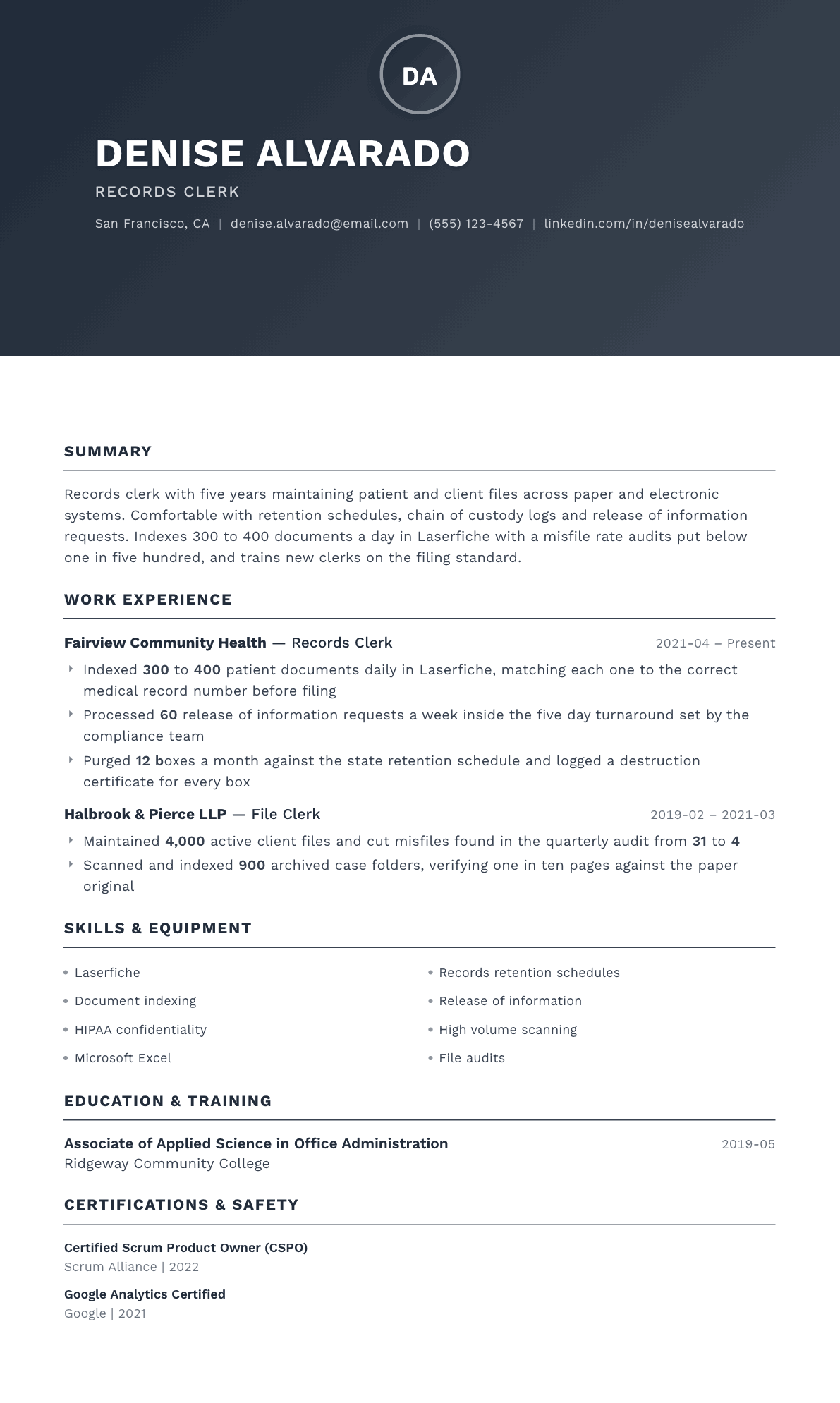
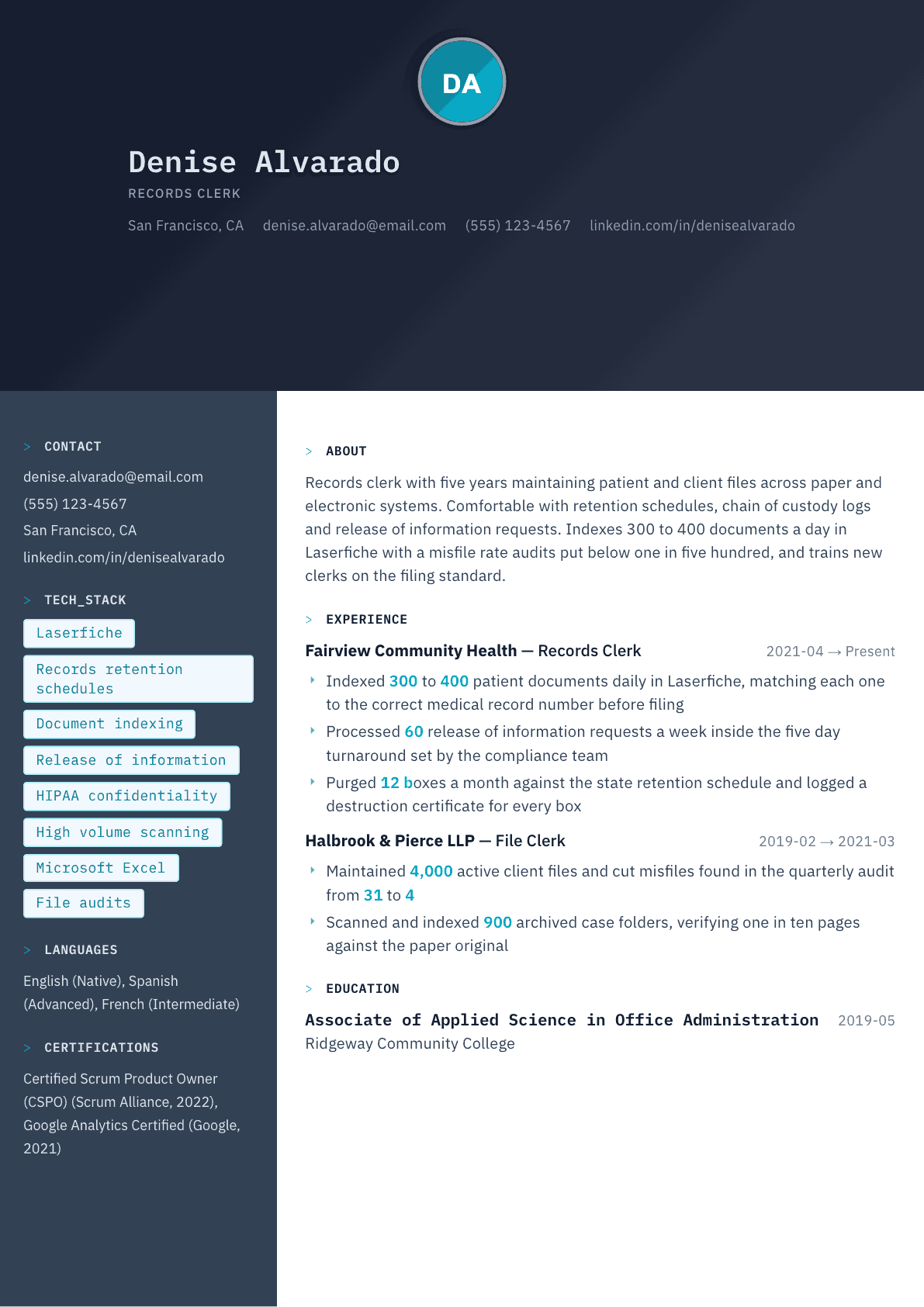
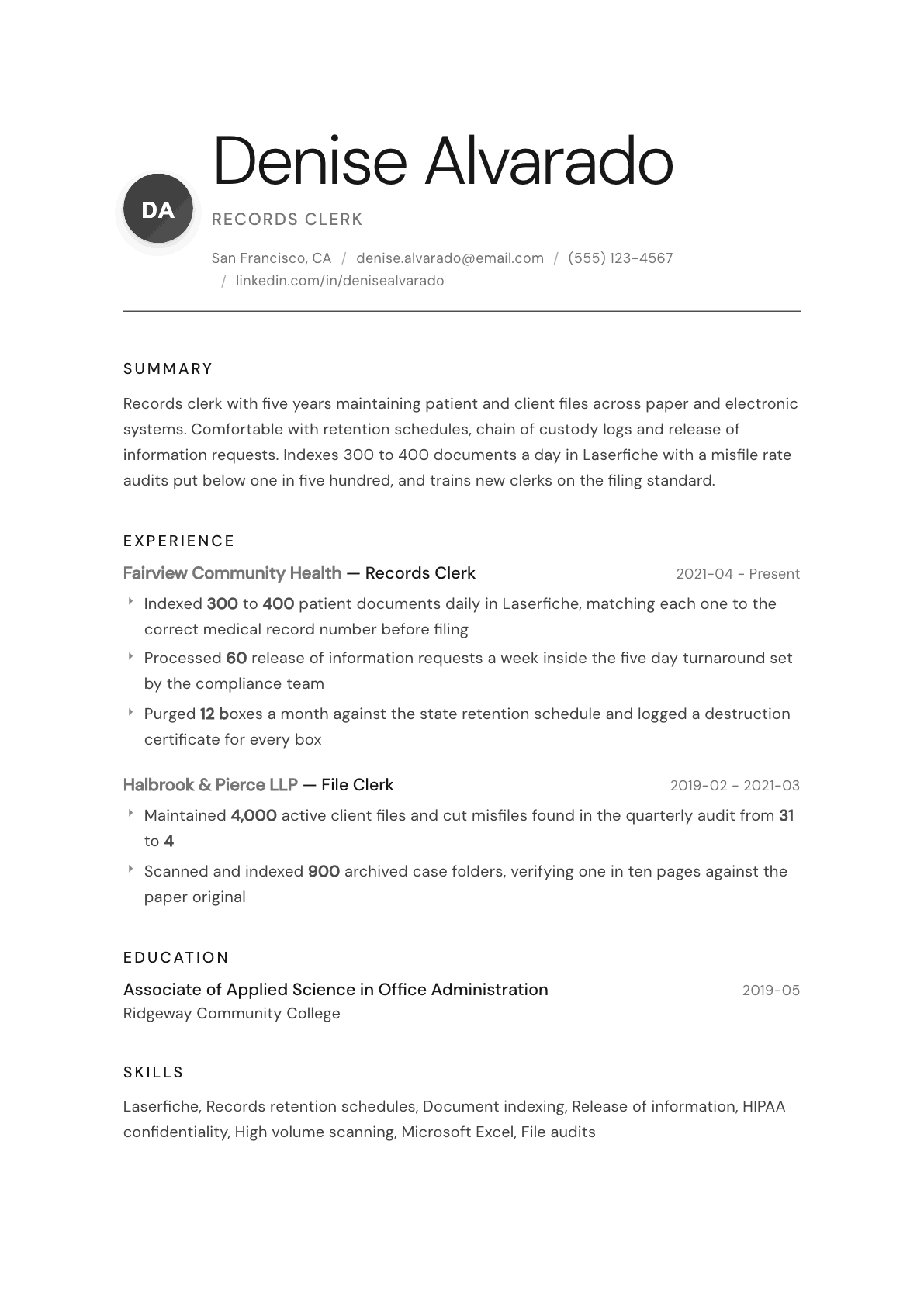
Example Records Clerk summary
Detail focused records clerk with five years in health and legal filing rooms, handling 1,500 documents a week across Laserfiche and shelf files. Trained on HIPAA confidentiality and a state retention schedule, with quarterly audits showing four misfiles across 4,000 active folders. Looking for a records role in a compliance driven office where accuracy is measured.
Skills to list on a Records Clerk resume
- Document indexing
- Records retention
- File auditing
- Laserfiche
- OnBase
- Release of information
- HIPAA confidentiality
- Chain of custody logs
- High volume scanning
- Data entry accuracy
- Microsoft Excel
- Alphanumeric filing
- Archive boxing and labeling
- Records requests tracking
What actually gets this resume read
- Name the records system you work in, whether that is Laserfiche, OnBase, Epic or a physical color coded shelf file.
- Give a daily or weekly document volume in at least one bullet so a supervisor can size the workload you carry.
- Say which retention schedule you follow, since state, federal and internal schedules are audited very differently.
- Put confidentiality training near the top when you handle medical, student or personnel files under HIPAA or FERPA.
- Show accuracy with an audit result or a misfile count instead of calling yourself detail oriented in the summary.
- List the scanner and indexing software by name, because postings for backfile conversion projects screen for them.
How to write a records clerk resume
A records clerk resume is judged on one question that the reader never writes into the posting: can this person be trusted alone with a file room where a single misfile can lose a chart, a case or a personnel action. Everything else on the page is secondary to that. The supervisor reading it has usually cleaned up after a clerk who filed by memory instead of by the standard, and she is screening for the opposite habit.
That makes the records clerk resume unusual among administrative resumes. Volume and accuracy carry it, not adjectives. A screener wants to know how many documents a day you index, in which repository, against which retention schedule, and what the last audit said about your work. Those four facts turn a generic clerical resume into a hire.
This guide covers the section order a filing room supervisor expects, three summaries for different stages of a records career, before and after bullets built from indexing and release of information work, and the questions clerks ask when their resume keeps getting filtered out of medical and legal postings.
Format: one page, single column, dates that line up
Use reverse chronological order and one column. Records postings in hospitals, courts and county offices are almost always screened through an applicant tracking system first, and the same parsers that scramble a designer template will scramble your employment dates. A file clerk whose own dates parse wrong has already lost the argument about accuracy.
Keep it to one page until you have supervised other clerks. The reader is scanning for systems, volumes and confidentiality training, and those fit comfortably above the fold when you stop writing full sentences.
- Header: name, city and state, phone, email, and the confidentiality training you hold if the target is a clinical or student records office.
- Section order: summary, skills and systems, experience, certifications, education.
- Name the repository in the skills block and again inside at least two experience bullets.
Summary: volume, system, retention schedule, audit result
Three lines. Say how many documents you handle in a day or a week, which electronic system holds them, which retention schedule governs disposal, and what an audit found. A summary that opens with detail oriented is invisible, because every clerical resume in the stack opens the same way.
If you are moving between sectors, name the transfer directly. A legal file clerk applying to a hospital records department should say so and point at the confidentiality training, because the filing mechanics carry across but the privacy exposure does not.
Experience: the system, the daily count, the accuracy check
Open each job with the environment in one line: the type of office, the size of the active file base, and whether the records are paper, electronic or both. A hybrid room with color coded shelf files and a scanning backlog is a different job from a fully electronic repository, and the supervisor knows it.
Then three to five bullets. Lead with indexing volume, then release of information turnaround, then purge and destruction work against the retention schedule, then the audit or quality check that proves the numbers. Chain of custody logging belongs high when the target office handles evidence, personnel actions or litigation files.
Cut the bullets that describe filing itself. Maintained filing system and organized documents are true of every clerk who has ever held the job, and they push the specific work off the page.
Skills and systems: the block the parser reads first
This is a keyword block, so write it as one. Name the document management software you have actually worked in, the scanner and indexing workflow, the classification method, and the privacy rules you work under. Laserfiche, OnBase and a hospital electronic record are not interchangeable to a hiring manager, and a resume that says document management software instead of naming one reads as if the candidate never learned it.
Add the release of information workflow if you have run it, and the type of requester you served: patients, attorneys, insurers, auditors. Each of those brings a different turnaround clock and a different verification step.
- Repositories: Laserfiche, OnBase, SharePoint, a clinical record system, or a physical shelf file with a color coded terminal digit scheme.
- Processes: indexing, scanning and quality control, purge and destruction certificates, release of information, chain of custody logging.
- Rules: the retention schedule you follow, plus HIPAA or FERPA training when the files are medical or student records.
Certifications and education: modest, but name them properly
Most records clerk seats need a high school diploma and a clean background check, so an associate degree is a genuine advantage rather than a formality. List it plainly. If you completed annual privacy training, put it under certifications with the year left off and the training name written the way your employer wrote it.
A formal credential moves a clerk toward the manager track. The records analyst credential and the health information technician credential both signal that you understand retention theory rather than only the shelf. Neither is required to be hired, and neither should be invented.
Records Clerk resume summary examples
First records job
Administrative graduate with six months of scanning and indexing experience through a temporary assignment in a county clerk office, handling 200 documents a day. Trained on alphanumeric and terminal digit filing, comfortable with high volume scanners, and looking for a permanent records clerk seat in a compliance driven office.
Five years in
Records clerk with five years across health and legal filing rooms, indexing 300 to 400 documents a day in Laserfiche and processing 60 release of information requests a week inside a five day turnaround. Quarterly audits found four misfiles across 4,000 active folders. Trained on HIPAA confidentiality and a state retention schedule.
Lead clerk
Lead records clerk running the daily indexing quota, the audit sample and the training for four clerks in a hospital release of information unit. Owns the purge calendar against the state retention schedule, logs a destruction certificate for every box, and rebuilt the naming standard that cut misfiles found at audit to single figures.
Work experience bullets: before and after
Before: Filed documents and maintained the filing system.
After: Indexed 300 to 400 patient documents a day in Laserfiche, matching each one to the correct medical record number before release into the permanent file.
The volume, the system and the matching step show a controlled process instead of an unmeasured chore.
Before: Handled requests for records from outside parties.
After: Processed 60 release of information requests a week for patients, attorneys and insurers, verifying authorization on each one and closing inside the five day turnaround set by compliance.
Naming the requester types and the turnaround clock proves you ran a regulated workflow rather than photocopying on request.
Before: Helped with records destruction.
After: Purged 12 boxes a month against the state retention schedule, confirmed eligibility date by date, and logged a signed destruction certificate for every box.
Retention work is a legal risk, so the certificate and the eligibility check are the details a compliance reader is looking for.
Before: Improved accuracy of the file room.
After: Cut misfiles found in the quarterly audit from 31 to 4 across 4,000 active client files by relabeling the shelf and retraining two clerks on the terminal digit standard.
A before and after audit figure with the fix behind it is the single most persuasive line a records clerk can write.
Before: Scanned old files into the computer.
After: Scanned and indexed 900 archived case folders during a backfile conversion, verifying one page in ten against the paper original before the box was released for destruction.
The quality control sample turns a scanning task into evidence of a defensible conversion process.
Hard skills
- Document indexing
- Records retention schedules
- Release of information
- High volume scanning and quality control
- Laserfiche
- OnBase
- Alphanumeric and terminal digit filing
- Chain of custody logging
- File audits and sampling
- Archive boxing and labeling
- HIPAA confidentiality practice
- Microsoft Excel tracking logs
Soft skills
- Sustained concentration on repetitive work
- Discretion with sensitive files
- Following a written standard exactly
- Requester communication
- Backlog triage
- Training new clerks
Certifications worth listing
- Certified Records Analyst (CRA) (Institute of Certified Records Managers)
- Registered Health Information Technician (RHIT) (American Health Information Management Association)
- Certified Administrative Professional (CAP) (International Association of Administrative Professionals)
- Microsoft Office Specialist: Excel Associate (Microsoft)
Mistakes that cost records clerk candidates the interview
- Writing detail oriented in the summary instead of an audit result, which is the only version of that claim a supervisor believes.
- Leaving the records system unnamed, so the reader cannot tell whether you spent five years in Laserfiche or five years at a photocopier.
- Giving no daily or weekly document count, which makes the workload you carried impossible to size.
- Skipping the retention schedule, when purge decisions are the part of the job that carries legal consequences.
- Hiding confidentiality training at the bottom of the page for a medical or student records posting that screens on it first.
- Using a two column template with icons, which scrambles dates in the parsers county and hospital systems run.
Records Clerk resume questions
Do I need experience with a specific records system to get hired?
Not usually, but naming any real repository you have worked in matters more than the brand. A clerk who has indexed in one system learns the next one quickly, and a hiring manager reads that as transferable. Saying only document management software reads as no experience at all.
How do I show accuracy without inventing a number?
Use whatever your employer already measured: audit findings, misfile counts, rejected batches, rework requests, or the sample rate you verified during scanning. If nothing was measured, describe the control step you performed, such as verifying one page in ten against the paper original.
Should a records clerk resume mention HIPAA?
Yes when the target office holds medical records, and name the training rather than the statute alone. A hospital release of information unit screens for people who already understand authorization, minimum necessary and the difference between a patient request and an attorney request.
Is a records clerk resume the same as a file clerk resume?
They overlap heavily, and many postings use the titles interchangeably. Records clerk work usually carries retention and disposal responsibility on top of filing, so if you have run purges or destruction logs, lead with that to reach the better paid postings.
What if most of my filing was paper rather than electronic?
Say so plainly and describe the scheme you used, such as terminal digit or color coded shelf filing. Many offices still run hybrid rooms and need someone who can hold both. Then add any scanning or backfile conversion work, since that is the bridge into electronic seats.
Related resume examples
- File Clerk Resume example
- Data Entry Clerk Resume example
- Records Manager Resume example
- Office Clerk Resume example
- Data Entry Specialist Resume example
- Administrative Specialist Resume example