Recruiting Manager Resume Examples: the lines they read
Build a Recruiting Manager Resume That Shows Team Leadership
By Mustafa Tarabya, founder of CVBooster · Published · Updated
Recruiting manager resume example with team and funnel results, leadership keywords, and section by section writing guidance.
Sample resumes for a recruiting manager
The same recruiting manager content laid out in three CVBooster templates, so you can see what the finished document looks like before you write a word.
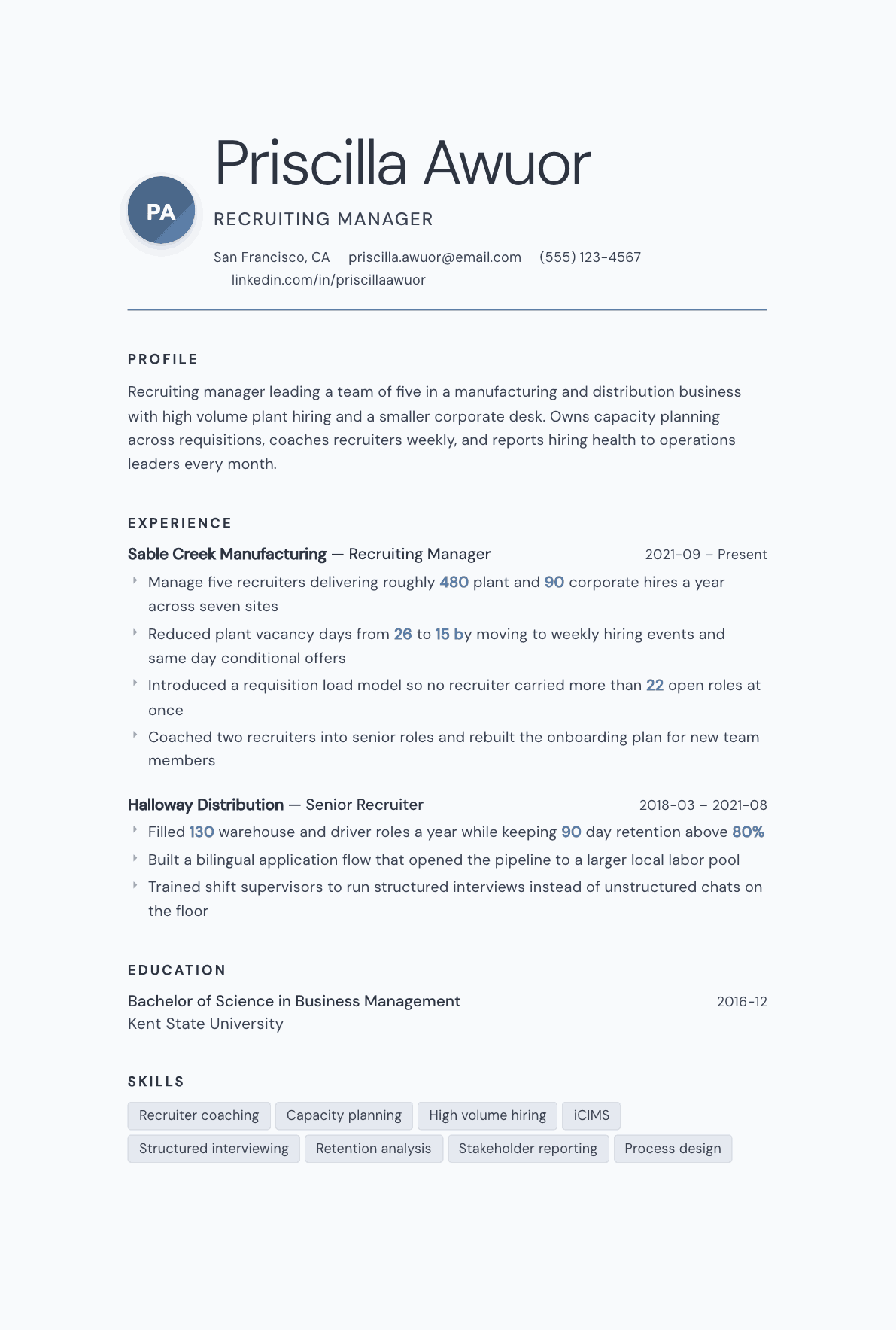
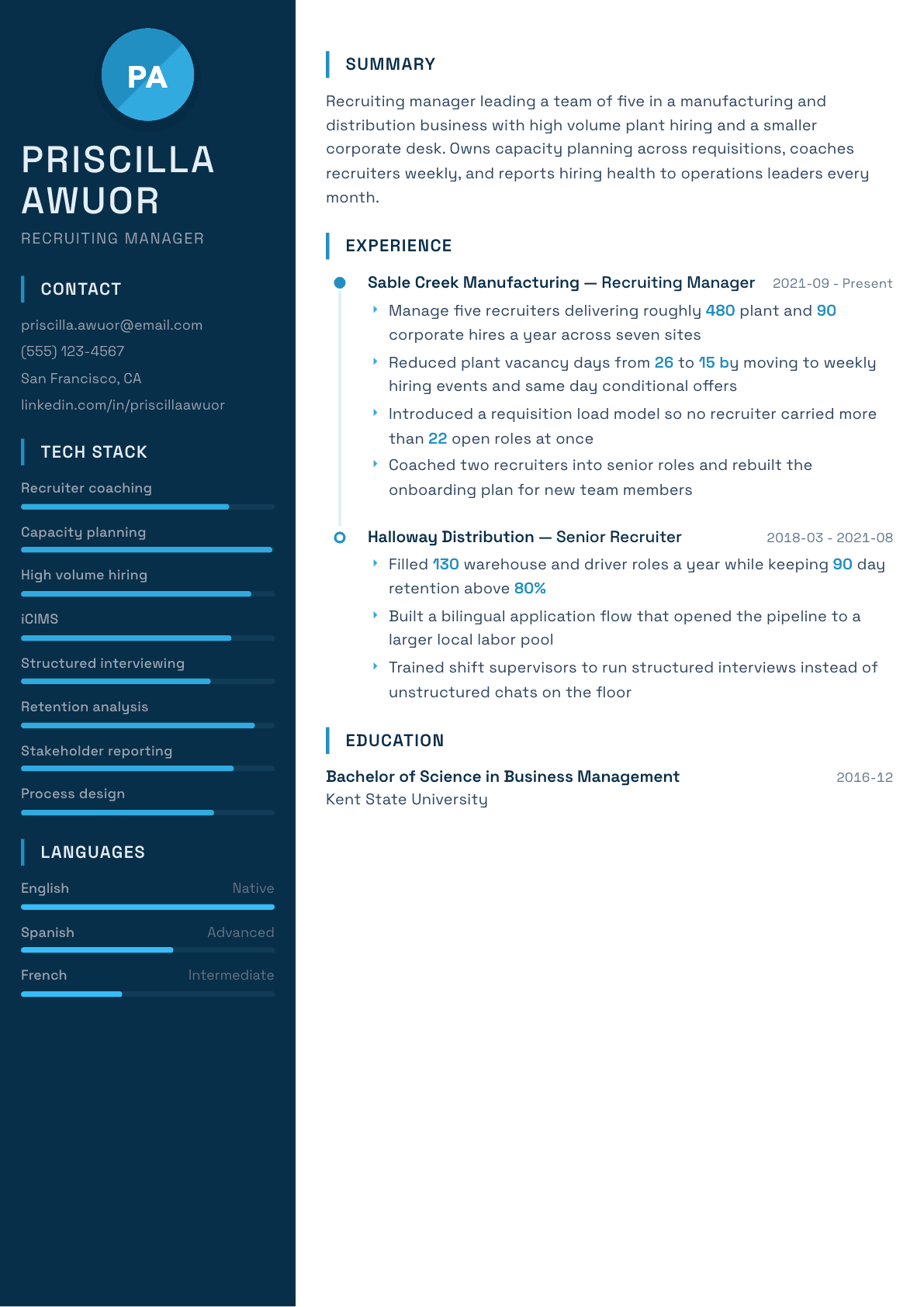
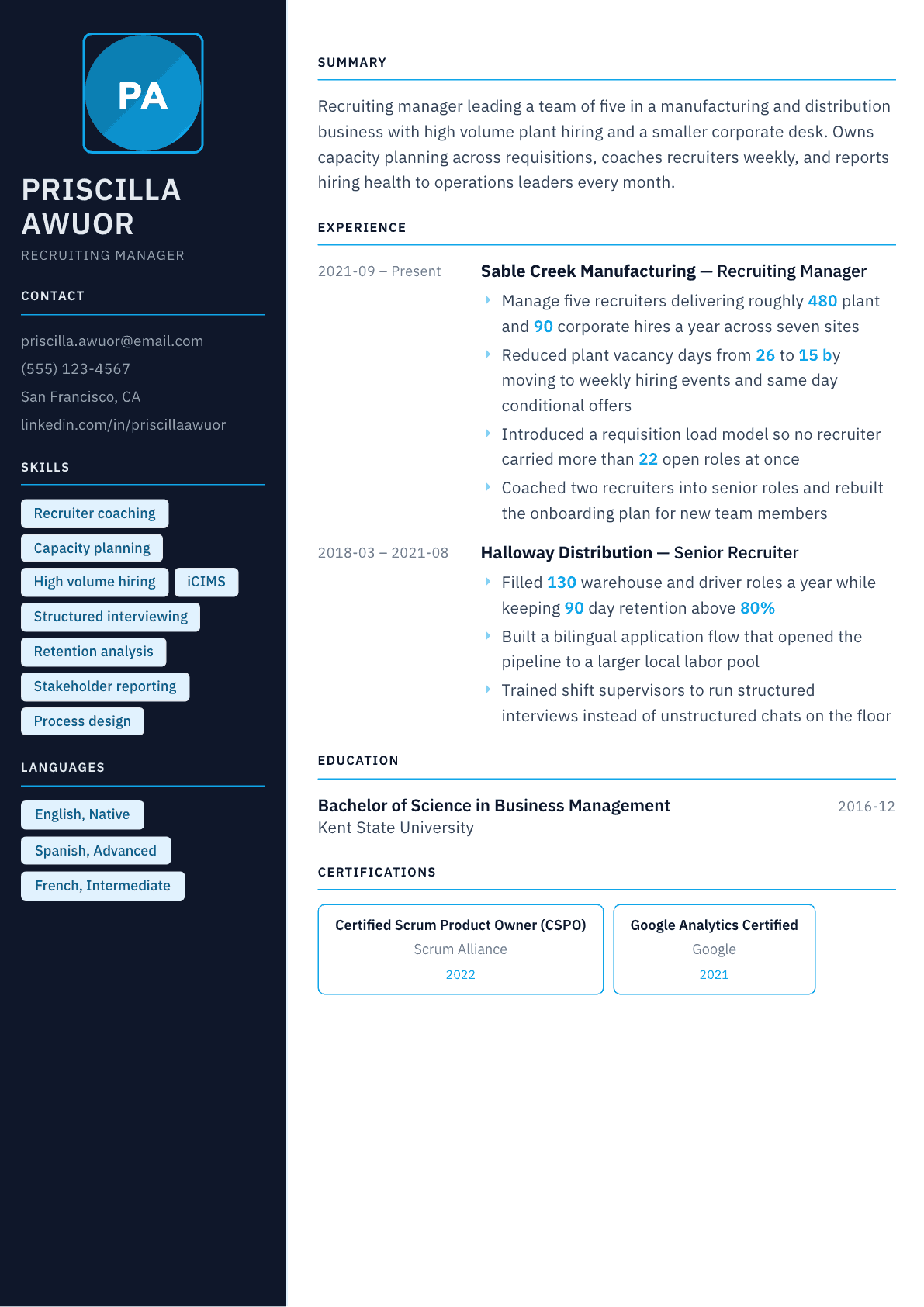
Example Recruiting Manager summary
Recruiting manager leading a team of five across seven manufacturing and distribution sites, delivering close to six hundred hires a year between plant and corporate roles. Cut plant vacancy days by more than a third through weekly hiring events, and built the requisition load model the team plans against. Looking to lead a larger recruiting group in an operations heavy business.
Skills to list on a Recruiting Manager resume
- Recruiting team leadership
- Recruiter coaching
- Capacity and requisition planning
- High volume hiring
- Applicant tracking systems
- iCIMS
- Structured interviewing
- Quality of hire measurement
- Retention analysis
- Process improvement
- Vendor management
- Hiring manager training
- Recruiting analytics
- Budget management
What actually gets this resume read
- Put your team size, the sites you cover and the annual hire volume in the first line of each job.
- Show how you allocate work, since managing requisition load is the daily job of a recruiting manager.
- Include retention or quality of hire, because volume alone hides whether the hires actually stayed.
- Name the recruiters you developed and what they moved into, as promotion is evidence of coaching.
- Describe a process you redesigned and the vacancy or cycle time it changed, with the before and after.
- Mention the operational leaders you report to, because credibility with the business is part of the role.
How to write a recruiting manager resume
A recruiting manager is hired to make a team predictable. The person reading your resume, usually an HR director or an operations leader, has a hiring plan they cannot afford to miss and a group of recruiters whose output swings from month to month. They are looking for someone who can allocate work, hold standards, and tell them the truth about the pipeline before a role goes badly wrong.
That means the resume needs to answer three things quickly: how big a team you led, how much hiring they delivered, and what you changed about how the work was done. Individual recruiting achievements belong further down. The reader assumes you can recruit; they are buying management.
This guide sets out the structure that suits a manager application, the operating metrics worth publishing, three summaries from senior recruiter to head of recruiting, before and after bullets, and the questions managers ask when writing this document.
Format: team, volume and sites in a scope line
Reverse chronological. Under every title, add a scope line with team size, sites or regions covered, annual hires delivered, and the systems in use. Recruiting management varies wildly by setting, and a reader deciding between candidates uses that line to sort applications before reading further.
Two pages is normal once you have managed for a few years. Compress your recruiter roles into short blocks that establish credibility on the desk, and give the space to team leadership, process work and reporting.
- Scope line format: five recruiters, seven sites, 480 plant and 90 corporate hires a year, iCIMS.
- Sections: summary, experience with scope lines, process and program work, education, systems and certifications.
- Add a line for budget ownership if you managed job advertising, agency contracts or event spend.
Summary: team size, hiring type, and the problem you solve
Three or four lines. Say how many recruiters you lead, what kind of hiring they do, the annual volume, and the operating problem you are known for fixing. High volume hourly hiring, professional hiring and specialist hiring demand different management, so name yours.
Include the stakeholder environment. Managing recruiters who serve plant managers on a production floor is a different job from managing recruiters who serve corporate department heads, and hiring leaders screen for the environment they have.
Experience: allocation, standards and delivery
Start each role with delivery against plan, then show how the delivery was managed. Requisition load models, desk allocation, weekly pipeline reviews and escalation rules are the mechanics that keep a team from drowning quietly. Naming them tells the reader you manage the work rather than only the people.
Include a quality measure next to a speed measure. Vacancy days paired with 90 day retention, or hires delivered paired with hiring manager satisfaction, shows you were not buying speed with bad hires. In high volume settings, early attrition is the number that reveals whether the process was working.
Show the coaching. Recruiters you developed and what they moved into, the onboarding you built for new team members, and how you handled an underperforming desk. Managers are hired on their ability to lift the weakest recruiter, not the strongest.
Process, systems and stakeholder management
Describe process changes with a before and after: hiring events replacing rolling interviews, same day conditional offers, structured interviews replacing floor chats, or an applicant tracking system configuration that removed a manual step. Give the metric that moved and the period it moved over.
Then cover the business relationship. Which leaders you reported hiring health to, how often, and what format. A recruiting manager who presents a monthly hiring review to operations leaders is doing the part of the job most candidates leave off the page entirely.
The language these postings use
Recruiting manager postings repeat a familiar vocabulary: recruitment team leadership, workforce and requisition planning, high volume hiring, structured interviewing, quality of hire, time to fill, vacancy days, retention, vendor management, recruiting analytics and process improvement. Mirror the ones you have run.
Where the employer is industrial, healthcare or retail, add their operational words: shift coverage, plant staffing, seasonal peaks, credentialing or bilingual hiring. These are the phrases that get a resume through the first screen in those industries.
Recruiting Manager resume summary examples
Senior recruiter moving to management
Senior recruiter with six years in high volume warehouse and driver hiring, filling 130 roles a year while keeping 90 day retention above 80%. Trained shift supervisors on structured interviewing and mentor two junior recruiters informally. Ready for a first recruiting manager role in an operations heavy business.
Managing a recruiting team
Recruiting manager leading five recruiters across seven manufacturing and distribution sites, delivering about 480 plant and 90 corporate hires a year. Cut plant vacancy days from 26 to 15 through weekly hiring events and same day conditional offers, and built the requisition load model the team plans against.
Head of recruiting
Recruiting leader with 13 years in the function and eight managing teams, now heading a group of 16 across four regions delivering close to 1,500 hires a year. Own the recruiting budget and vendor panel, run monthly hiring reviews with operations leaders, and led an applicant tracking system replacement across all sites.
Work experience bullets: before and after
Before: Managed a team of recruiters supporting multiple locations.
After: Led five recruiters across seven manufacturing and distribution sites delivering about 480 plant and 90 corporate hires a year against an agreed staffing plan.
Team size, site count and split volume tell the reader the shape of the operation you actually ran.
Before: Improved time to fill for hourly roles.
After: Cut plant vacancy days from 26 to 15 by moving to weekly hiring events with same day conditional offers, holding 90 day retention steady through the change.
A before and after with a quality check shows speed was gained without lowering the standard.
Before: Balanced workload across the recruiting team.
After: Introduced a requisition load model that capped each recruiter at 22 open roles and reassigned overflow weekly, which ended the pattern of roles sitting untouched for a month.
The cap and the weekly ritual describe a management system rather than an intention.
Before: Coached and developed team members.
After: Coached two recruiters from associate to senior within two years and rebuilt the team onboarding plan so a new recruiter carries a full desk by week six.
Promotions plus a ramp standard give the reader two independent pieces of evidence about your management.
Before: Reported recruiting results to leadership.
After: Presented a monthly hiring review to site operations leaders covering vacancy days, offer declines and early attrition, which moved two sites to earlier requisition approval.
Naming the audience, the content and the decision it caused shows influence rather than reporting.
Hard skills
- Recruiting team leadership
- Requisition and capacity planning
- High volume hiring operations
- Applicant tracking system administration
- Structured interview standards
- Quality of hire and retention analysis
- Recruiting analytics and dashboards
- Vendor and agency management
- Recruiting budget ownership
- Process redesign
- Hiring manager and interviewer training
- Workforce planning input
Soft skills
- Coaching underperformers
- Prioritization across competing sites
- Direct feedback
- Stakeholder credibility with operations
- Composure during hiring peaks
- Decision making with incomplete data
Certifications worth listing
- SHRM Certified Professional (SHRM-CP) (Society for Human Resource Management)
- Professional in Human Resources (PHR) (HR Certification Institute)
- Senior Professional in Human Resources (SPHR) (HR Certification Institute)
- Certified Staffing Professional (CSP) (American Staffing Association)
Mistakes that cost recruiting manager candidates the interview
- Presenting a recruiter resume with a manager title, full of personal placements and no team results.
- Leaving out team size and site coverage, the two facts that define the scope of the job.
- Publishing speed metrics with no quality measure beside them, which invites doubt about the hires.
- Describing process improvements without a before and after number or the period they covered.
- Omitting coaching and development, when lifting a weak recruiter is the core of the role.
- Skipping the business relationship, so the reader cannot tell whether operations leaders trusted you.
Recruiting Manager resume questions
What separates a recruiting manager resume from a senior recruiter resume?
Team results, allocation systems and stakeholder reporting. A senior recruiter proves personal delivery. A manager proves the team delivered, that work was distributed deliberately, and that leaders outside recruiting relied on the numbers you gave them.
How do I show quality of hire when my company never measured it?
Use the closest proxy your data supports, such as 90 day retention, first year turnover or probation pass rates. Say which measure you used. A reader accepts a proxy that is named honestly and distrusts a quality claim with nothing behind it.
Should a recruiting manager still list personal hires?
Only if you carried a desk alongside managing, which is common in smaller teams. Say so plainly and keep it to one bullet. Otherwise personal placement counts pull attention away from the team results you are being hired for.
How do I write this resume if I managed contractors rather than employees?
Describe the management you performed regardless of employment status: allocation, standards, reviews, coaching and quality control. State that the team was contract based so the reader is not surprised later, and show how you handled turnover in that model.
How much detail about systems should I include?
Name the applicant tracking system and any implementation or configuration you led, plus the reporting tool where your dashboards live. Skip long tool inventories. What matters is whether you can make a system produce trustworthy hiring data.
Related resume examples
- Recruiter Resume example
- HR Manager Resume example
- Talent Acquisition Manager Resume example
- Staffing Coordinator Resume example
- Corporate Recruiter Resume example
- Training and Development Manager Resume example