Talent Acquisition Manager Resume Examples: free score
Build a Talent Acquisition Manager Resume Hiring Leaders Believe
By Mustafa Tarabya, founder of CVBooster · Published · Updated
A talent acquisition manager resume sample, funnel metrics worth listing, ATS keywords, and section by section writing advice.
Sample resumes for a talent acquisition manager
The same talent acquisition manager content laid out in three CVBooster templates, so you can see what the finished document looks like before you write a word.
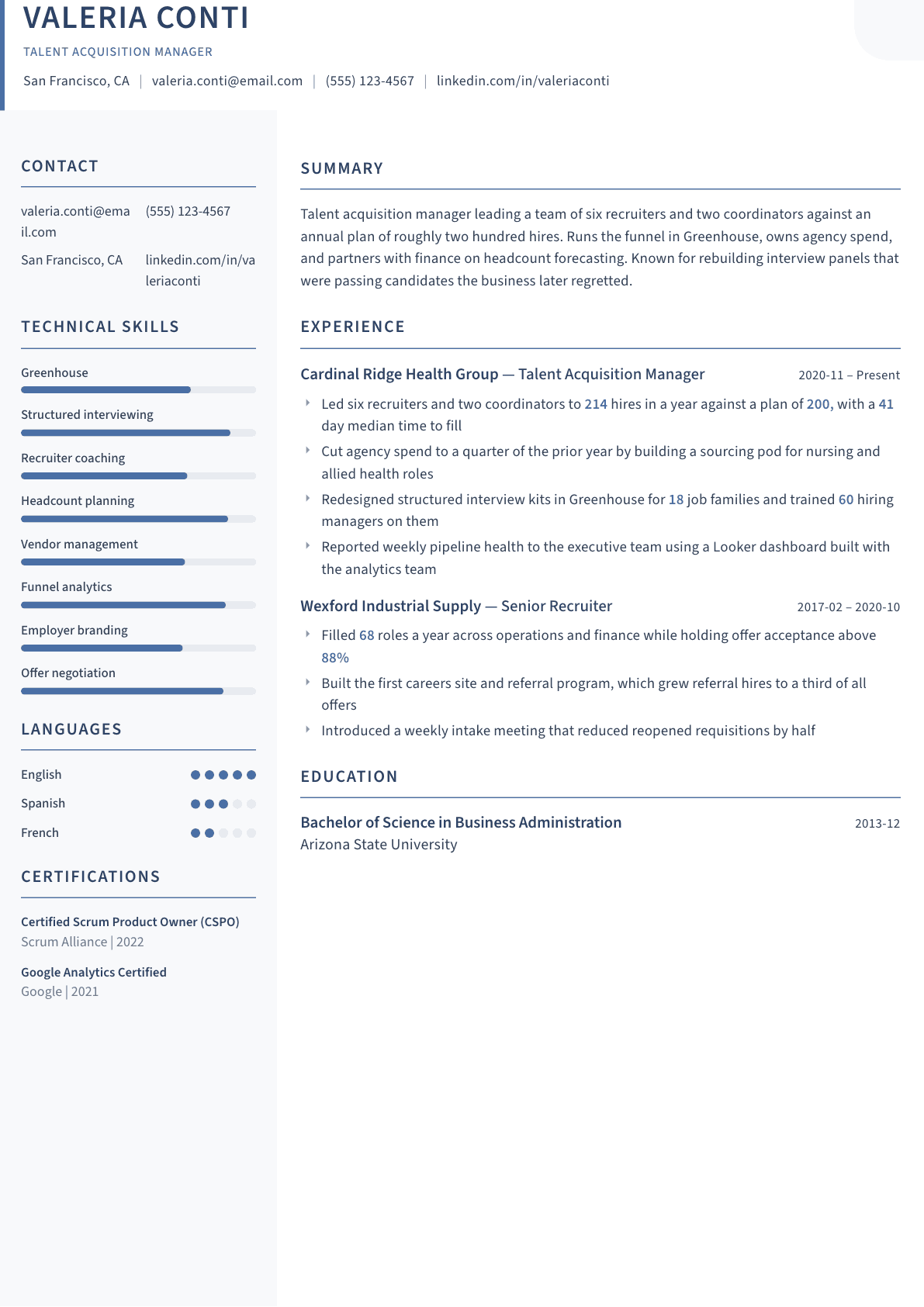
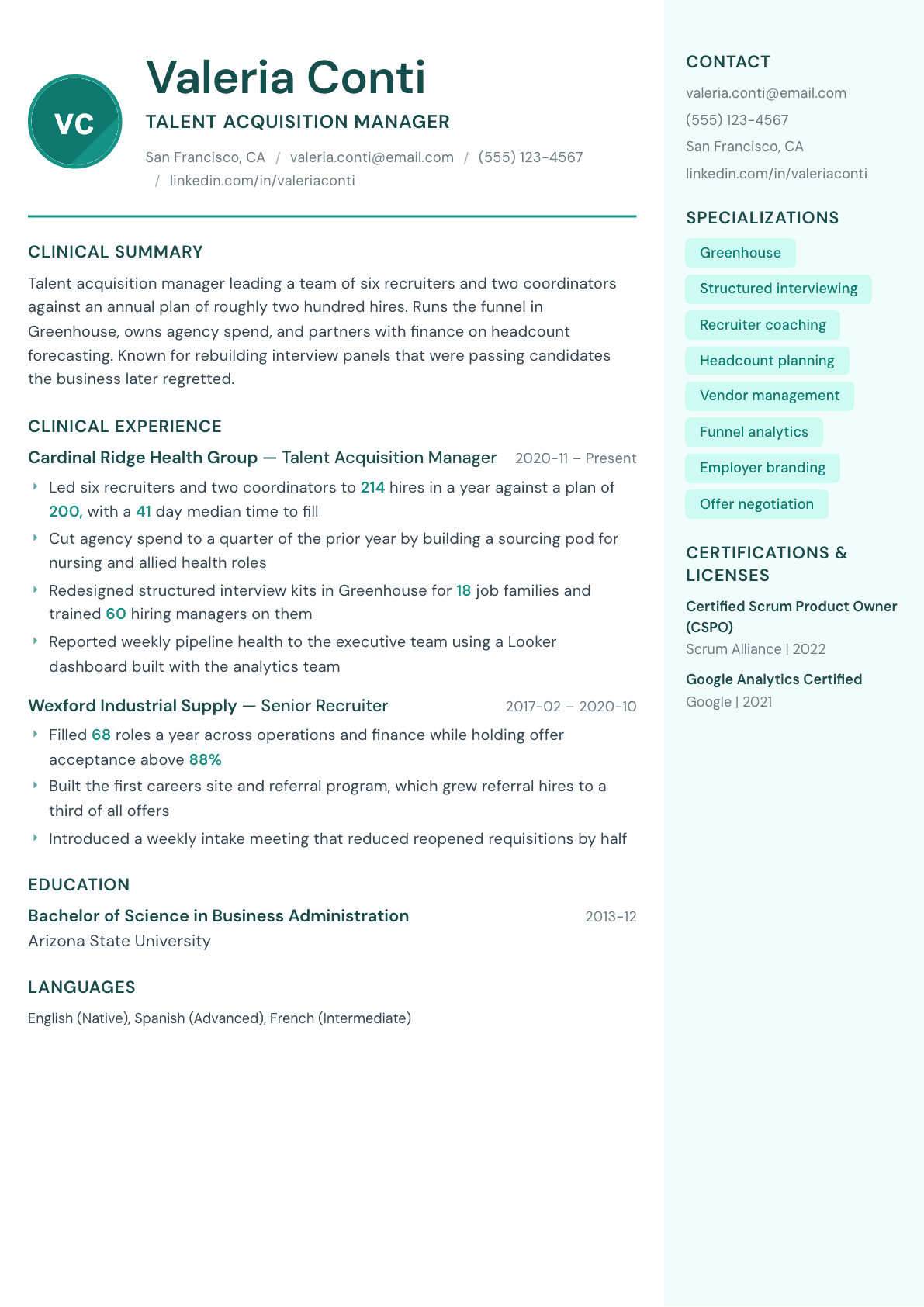
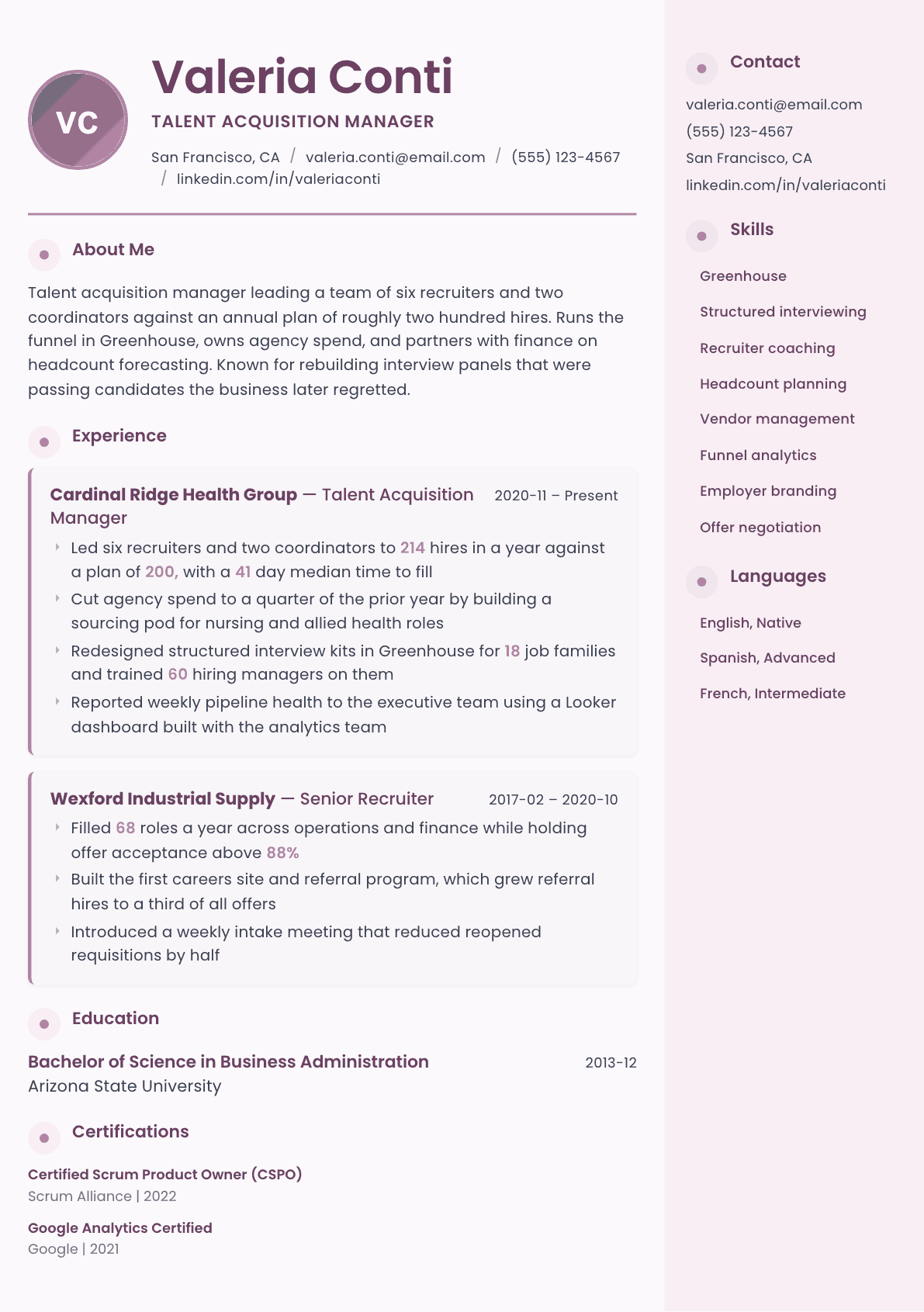
Example Talent Acquisition Manager summary
Talent acquisition manager with eight years in recruiting and four leading teams, currently responsible for a plan of two hundred hires a year across clinical and corporate functions. Rebuilt structured interviewing for eighteen job families, brought agency spend down sharply, and hold a median time to fill in the low forties. Seeking a manager seat at a company scaling its first in house recruiting function.
Skills to list on a Talent Acquisition Manager resume
- Talent acquisition strategy
- Recruitment team leadership
- Applicant tracking systems
- Greenhouse
- Workday Recruiting
- Structured interviewing
- Headcount planning
- Recruitment marketing
- Vendor and agency management
- Offer negotiation
- Funnel analytics
- Employer branding
- Candidate experience
- Interviewer training
What actually gets this resume read
- State the size of the team you manage and the annual hiring plan in your first two lines of experience.
- Report funnel numbers in pairs, such as hires against plan or time to fill next to offer acceptance.
- Name the applicant tracking system and the reporting layer you built on top of it, not just the tool.
- Show where you reduced cost, whether that is agency spend, job board contracts or job advertising waste.
- Describe how you trained hiring managers, because interview quality is the part executives complain about.
- Include the job families you hired for, since a technical plan and a clinical plan are different jobs.
How to write a talent acquisition manager resume
The person hiring a talent acquisition manager is usually an HR director or a chief people officer who has a hiring plan they are not confident of delivering. They read your resume looking for two things: whether you have carried a plan of similar size, and whether you can make hiring managers behave. Sourcing skill is assumed at this level. Operating discipline is what is being bought.
That is why a resume full of recruiting verbs stalls. Sourced, screened, coordinated and partnered describe an individual contributor. A manager resume needs team size, plan size, funnel numbers, cost, and the process changes you drove across a group of people who did not report to you.
This guide sets out how to structure the resume, what numbers to publish and which to leave out, three summaries for different stages of a talent acquisition career, before and after bullets, and the questions managers ask when they sit down to rewrite this document.
Format: plan size up front, two pages once you manage recruiters
Use reverse chronological order and put a scope line under each job title: team size, annual hiring plan, functions covered, and the systems in use. A reader deciding between twenty resumes will use that line to sort them before reading a single bullet.
Keep an early career recruiter role or two, compressed to two bullets each, so the reader can see you came up through the desk. Drop coordinator level detail entirely once you have managed a team for more than a couple of years.
- Scope line format: team of six, plan of 200 hires, corporate and clinical functions, Greenhouse and Workday.
- Sections: summary, experience with scope lines, recruiting programs and process work, education, systems and certifications.
- Keep a short line for vendor and budget responsibility if you owned agency contracts or job board spend.
Summary: the plan you carry and the problem you fix
Three or four lines. Name the years in recruiting and the years managing, the size of plan you have delivered against, the job families, and the specific operating problem you are known for solving. Hiring leaders are recruiting for a symptom: roles that sit open, offers that get declined, or managers who will not run a fair interview.
Be explicit about the type of hiring. High volume hourly hiring, professional corporate hiring and specialist technical hiring are three different disciplines, and a summary that hides which one you have done makes the reader guess wrong.
Experience: funnel numbers, cost, and process you enforced
Publish numbers in pairs so they cannot be read as spin. Hires delivered against plan. Time to fill next to offer acceptance. Direct sourced share next to agency spend. A single flattering metric invites suspicion; a pair that could have exposed you reads as honest reporting.
Then show the process work. Structured interview kits you wrote, scorecards you standardized, intake meetings you made mandatory, debrief formats you introduced, interviewer training you delivered and to how many people. This is the part of the job that survives your departure, and senior readers weigh it heavily.
Cover the commercial side too. Agency terms renegotiated, job board contracts consolidated, referral programs launched, and any move from external to internal delivery. A talent acquisition manager who can point to real cost reduction is easy for an HR director to defend at budget time.
Team leadership: how you develop recruiters
Say how many recruiters and coordinators reported to you, how you split the desks, and what your weekly rhythm was. Requisition load models, pipeline reviews and one to one coaching are the mechanics a hiring leader wants to see, because unmanaged recruiter workload is the usual reason a plan misses.
Promotions and retention within your team are strong evidence. Naming two recruiters you developed into senior roles says more about your management than any adjective you could use.
Systems, reporting and the keywords in the posting
Name the applicant tracking system and say what you did with it: configuration, an implementation you led, or the reporting layer you built on top. Add the sourcing tools, the assessment platforms and the analytics tool where your dashboards live.
Postings repeat a familiar set of phrases: talent acquisition strategy, workforce planning, stakeholder management, candidate experience, employer branding, diversity hiring, recruitment operations and vendor management. Mirror the ones you have really done, once in the skills area and once inside a bullet that proves it.
Talent Acquisition Manager resume summary examples
Senior recruiter stepping up
Senior recruiter with six years of full cycle hiring across operations and finance, currently leading two junior recruiters informally and owning the intake and offer process for 70 hires a year. Rebuilt the interview kits the wider team now uses. Ready for a first talent acquisition manager role.
Managing a small team
Talent acquisition manager leading six recruiters and two coordinators against a plan of 200 hires a year across clinical and corporate functions. Delivered 214 hires last year at a 41 day median time to fill, cut agency spend to a quarter of the prior year, and trained 60 hiring managers on structured interviewing.
Leading the function
Talent acquisition leader with 12 years in recruiting and seven managing teams, currently running a group of 14 delivering close to 600 hires a year across three regions. Own the recruiting budget, the vendor panel and the reporting the executive team reviews monthly. Led one applicant tracking system implementation end to end.
Work experience bullets: before and after
Before: Managed a team of recruiters and met hiring goals.
After: Led six recruiters and two coordinators to 214 hires against a plan of 200, holding median time to fill at 41 days across clinical and corporate roles.
Team composition, delivery against plan and a second metric turn a claim into a result the reader can weigh.
Before: Reduced agency usage.
After: Built an internal sourcing pod for nursing and allied health roles and brought agency spend down to a quarter of the previous year without missing the hiring plan.
It names the mechanism, the roles affected, and confirms the saving did not come at the cost of delivery.
Before: Improved the interview process.
After: Wrote structured interview kits and scorecards for 18 job families in Greenhouse and trained 60 hiring managers to run them, cutting reopened requisitions by half.
Scope, system, audience and an outcome show process work that outlasted the project.
Before: Provided reporting to leadership.
After: Built a weekly pipeline health dashboard with the analytics team and presented funnel risk to the executive group, which moved three at risk requisitions to earlier intake.
A dashboard only counts when the reader learns what decision it changed.
Before: Developed team members.
After: Coached two recruiters from associate to senior within two years using a weekly pipeline review and a written development plan tied to funnel quality.
The promotions, the timeframe and the coaching mechanism make the development claim verifiable.
Hard skills
- Talent acquisition strategy
- Recruiting team management
- Hiring plan and capacity modeling
- Applicant tracking system administration
- Structured interview design
- Funnel and conversion analytics
- Agency and vendor negotiation
- Recruitment marketing
- Employer branding
- Offer and compensation approvals
- Interviewer training
- Recruiting budget management
Soft skills
- Stakeholder management
- Coaching recruiters
- Negotiation
- Prioritization across competing requisitions
- Clear written reporting
- Holding hiring managers accountable
Certifications worth listing
- SHRM Certified Professional (SHRM-CP) (Society for Human Resource Management)
- Professional in Human Resources (PHR) (HR Certification Institute)
- Certified Internet Recruiter (CIR) (AIRS)
- Talent Acquisition Specialty Credential (Society for Human Resource Management)
Mistakes that cost talent acquisition manager candidates the interview
- Writing an individual contributor resume with a manager title on top, all sourcing verbs and no team or plan.
- Publishing one flattering metric with nothing beside it, which invites the reader to assume the others were bad.
- Leaving out the job families you hire for, so a reader cannot tell whether your background transfers.
- Describing tools you have logged into rather than systems you configured, reported on, or implemented.
- Omitting cost work entirely, when agency spend is often the reason the role exists.
- Claiming stakeholder management without one example of a hiring manager whose behavior you actually changed.
Talent Acquisition Manager resume questions
Which recruiting metrics belong on a talent acquisition manager resume?
Hires delivered against plan, median time to fill, offer acceptance rate, direct sourced share and agency spend. Publish them in pairs so the reader sees both speed and quality. Leave out vanity counts such as profiles viewed or applications received.
How do I show leadership if my recruiters were contractors or not direct reports?
Say so plainly and describe the leadership you exercised anyway: desk allocation, pipeline reviews, quality standards and training. A dotted line team of five that you ran weekly counts, as long as you do not present it as a direct reporting structure.
Should I list every applicant tracking system I have used?
List the two or three you know well and say what you did in each. Configuration, reporting and implementation are worth naming. A long list of systems you touched briefly makes the reader discount all of them, including the ones you know deeply.
How do I move from agency recruiting into a talent acquisition manager role?
Translate your numbers into internal language: placements become hires, job orders become requisitions, and client management becomes hiring manager partnership. Then add the internal work you have done, such as intake standards, scorecards or workforce planning input.
How long should this resume be?
Two pages once you have managed a team. One page only if you are stepping up from a senior recruiter seat and have a short history. Use the space on scope lines and process work, and compress early coordinator roles to a line or two.
Related resume examples
- Recruiter Resume example
- Talent Acquisition Specialist Resume example
- Recruiting Manager Resume example
- Sourcer Resume example
- Corporate Recruiter Resume example
- Technical Recruiter Resume example