Recruiter Resume Examples: free ATS score and gap list
Recruit the Perfect Recruiter Resume
By Mustafa Tarabya, founder of CVBooster · Published · Updated
Recruiter resume examples with expert tips, ATS keywords, and professional templates. See exactly what a winning senior technical recruiter resume looks like.
Sample resumes for a recruiter
The same recruiter content laid out in three CVBooster templates, so you can see what the finished document looks like before you write a word.
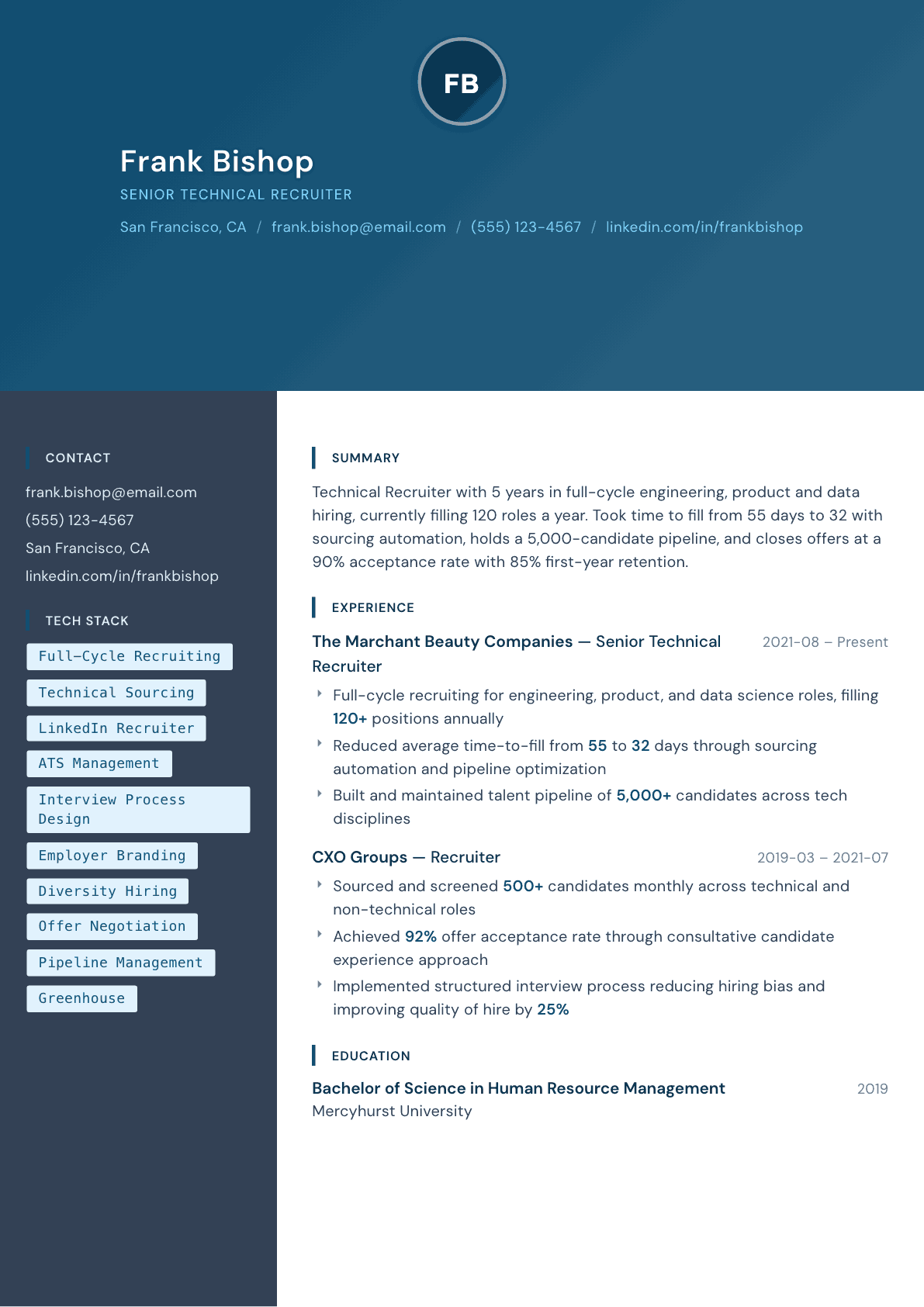
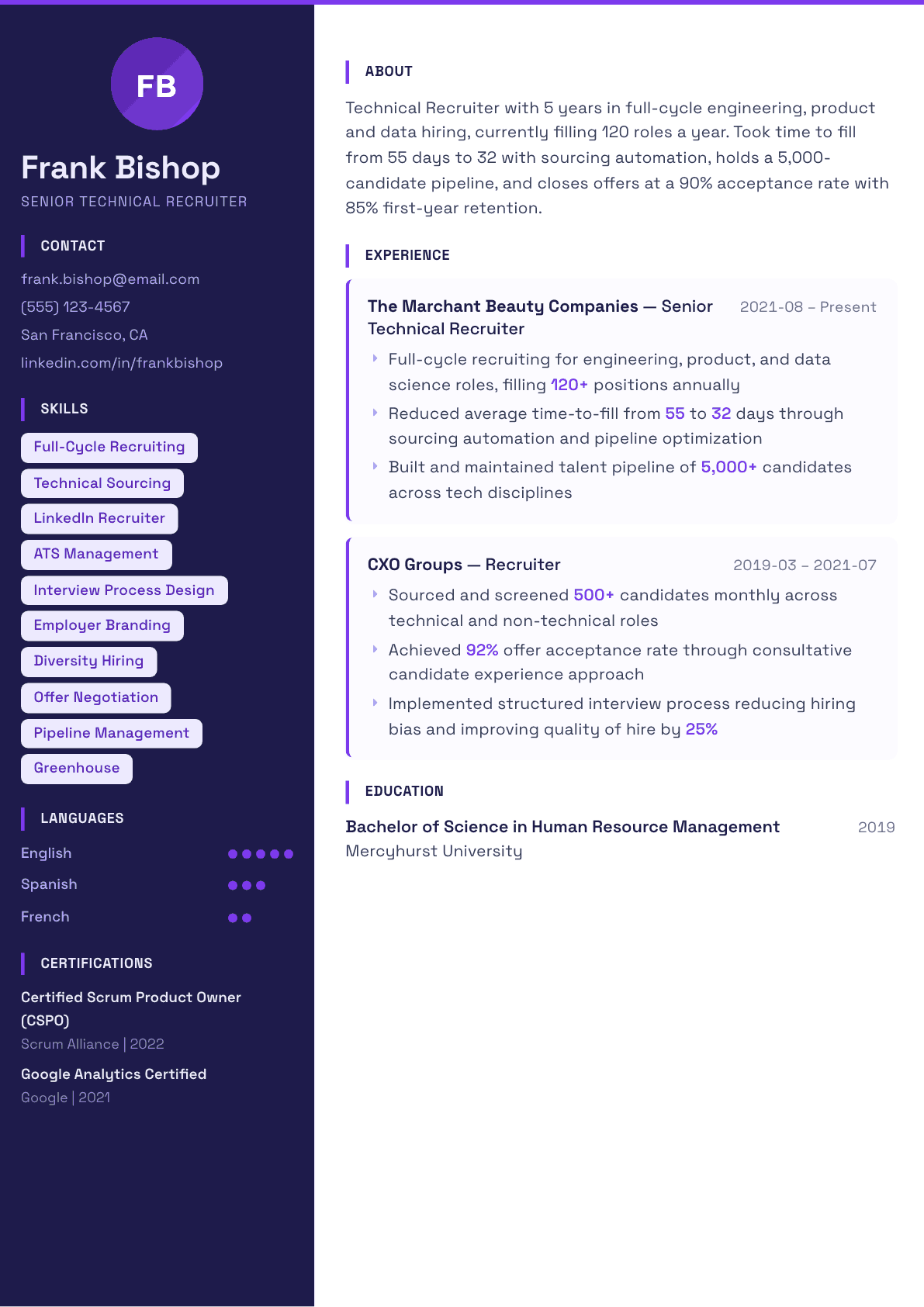
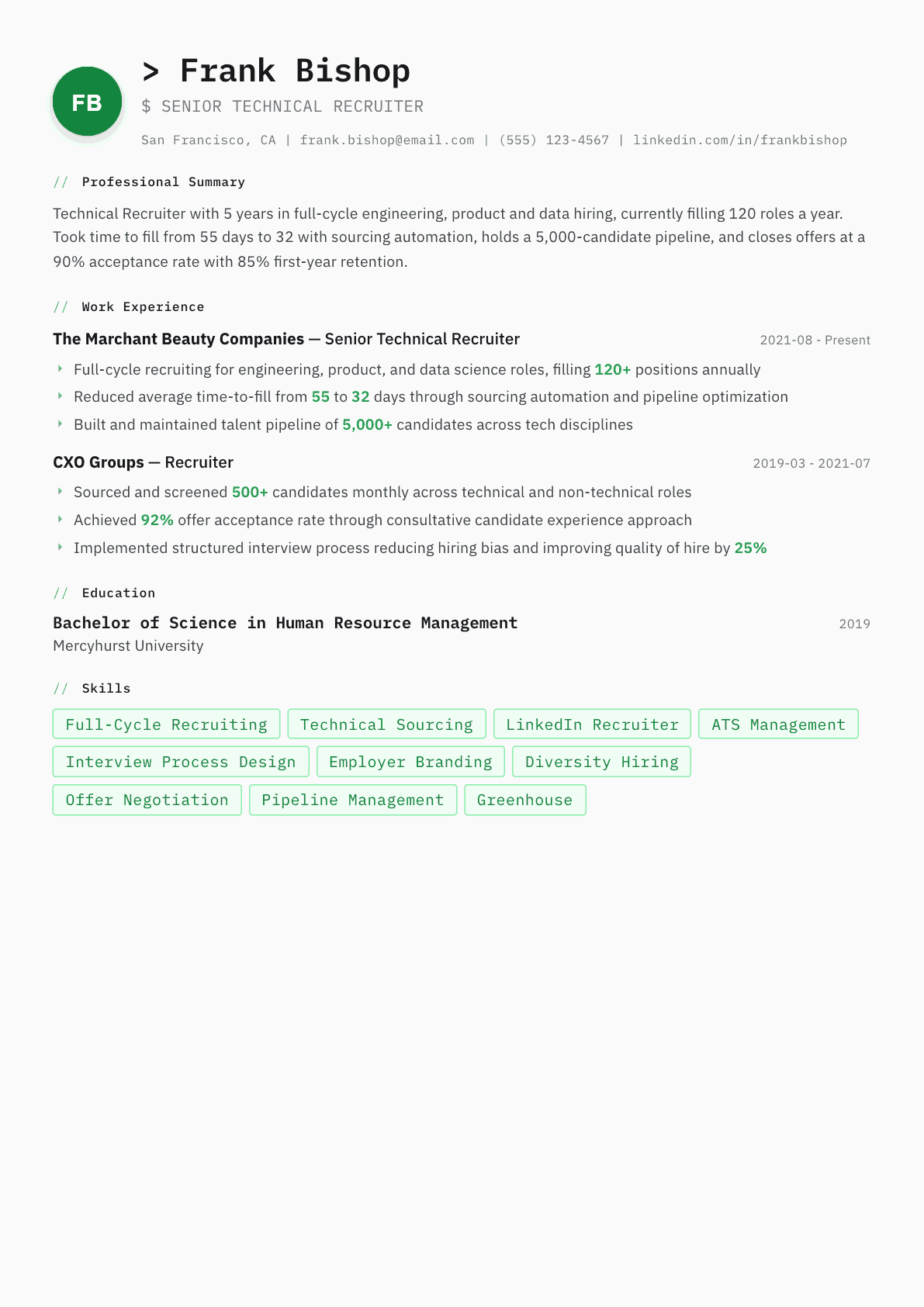
Example Recruiter summary
Technical recruiter, 5 years, 120 engineering and data hires a year at a 32-day average time to fill. Works in Greenhouse and LinkedIn Recruiter, built the structured interview process that lifted quality of hire 25%, and keeps a pipeline of 5,000 warm candidates.
Skills to list on a Recruiter resume
- Full-Cycle Recruiting
- Technical Sourcing
- LinkedIn Recruiter
- ATS Management
- Interview Process Design
- Employer Branding
- Diversity Hiring
- Offer Negotiation
- Pipeline Management
- Greenhouse
What actually gets this resume read
- Quantify: positions filled, time-to-fill, offer acceptance rates, retention.
- Show sourcing channel diversity (LinkedIn, referrals, events, etc.).
- Highlight ATS and recruiting tools proficiency.
- Include diversity and inclusion hiring initiatives.
- Show both volume recruiting and specialized/executive search experience.
How to write a recruiter resume
A recruiter resume is read by recruiters, which is both the good news and the bad news. They will not be impressed by formatting tricks, and they will notice immediately when a number has been rounded upward. What they check is a short list: how many roles you closed, how hard those roles were, how you found the people, and whether the hires stayed.
Difficulty is the part most files leave out. Filling forty support roles in a high-volume queue and filling twelve staff engineer roles in a competitive market are both respectable and completely different jobs. Say which functions you recruit for, at what level, and whether the pipeline came from inbound applicants or from sourcing you did yourself, because that single distinction shapes how a recruiting leader reads everything else on the page.
This guide covers the layout of a recruiter resume, the metrics worth listing and the ones that damage you, three summaries from coordinator-turned-recruiter to lead, five rewritten bullets, a complete sample recruiting resume, and the questions recruiters ask when their own resume needs to survive the screen they usually run.
Format: one page early, two once you have a real requisition history
Reverse chronological, single column, no rating graphics. A recruiter reading your file wants to reach requisition volume within a few seconds, so put a metrics line directly under the summary: roles filled per year, average time to fill, offer acceptance rate and first-year retention where you have it.
Under that, a stack line naming the applicant tracking system, the sourcing tools and the scheduling or CRM tooling you use. Greenhouse, Lever, Workday Recruiting, LinkedIn Recruiter, SeekOut and Gem are all searchable strings, and a hiring team running one of them will filter for it.
- Metrics line: requisition volume, time to fill, offer acceptance, retention.
- Stack line: ATS, sourcing platforms, CRM, and any assessment tooling.
- Each job: the functions recruited, the seniority band, and whether the roles were agency, in house or embedded.
Summary: what you recruit, at what level, in what market
Three sentences that place you exactly. The functions you fill, the level band, the market conditions you have worked in, and one number that shows scale. A technical recruiter hiring backend and data engineering at senior level in a competitive market is a different candidate from a generalist recruiter covering corporate functions, and both are valuable when stated clearly.
Do not open with results-driven, passionate about people, or a similar phrase. Recruiters screen these out because they have read them ten thousand times. Open with the actual specialization and let the numbers carry the enthusiasm.
Experience: sourcing channel mix is the strongest signal
Give one bullet per job to channel mix, because it is the single most revealing thing about a recruiter. What share of your hires came from outbound sourcing, referrals, inbound applications, events, communities and rehires. A recruiter whose hires came mostly from inbound volume is running a different skill set from one who books meetings with passive candidates, and a recruiting leader will ask about the split anyway.
For sourcing, name the methods. Boolean strings, LinkedIn Recruiter projects, GitHub and community searches, referral campaigns run through hiring teams, alumni and silver medalist outreach, and any talent CRM nurture you built. Add response rates only when they are genuine and you can explain the outreach behind them.
Then the funnel work: screening depth, structured interview design, scorecards, debrief facilitation and offer negotiation. Offer work in particular deserves a bullet, because closing a candidate against a competing offer is the part of the job that separates a strong recruiter from a scheduler. Say how many offers you negotiated and what you did when compensation was not the deciding factor.
Metrics: the useful ones, and the ones that backfire
Useful metrics are the ones a recruiting leader reviews weekly: requisitions filled, time to fill measured from a stated start point, offer acceptance rate, candidate to hire ratio at each stage, pipeline built, and first-year retention of your hires. Retention is the strongest of all because it survives the interview, whereas a raw hire count can be inflated by easy roles.
Metrics that backfire are the ones without context. A very short time to fill invites a question about whether the roles were high volume and easy. A perfect acceptance rate on a small number of offers invites doubt. Give the denominator, the period and the role type, and the numbers do their job instead of raising a flag.
- State the measurement point for time to fill, such as requisition opening or first candidate submitted.
- Give acceptance rates with the offer count behind them.
- Split volume roles from specialized roles rather than blending them into one average.
- Include diversity hiring outcomes with the sourcing practice that produced them.
Hiring manager partnership and employer brand
Recruiting leaders hire people who can manage hiring managers, not only candidates. Show intake meeting practice, calibration on a scorecard, pushback on unrealistic role profiles, and how you handled a search that stalled. A bullet describing how you reset a search after four rejected finalists says more about your judgment than another volume number.
Employer brand and candidate experience close the file. Careers page content, interview training you delivered to hiring panels, event or campus programs you ran, and candidate feedback you collected are all real work. Name what you built rather than saying you improved the candidate experience, since the reader has no way to picture that phrase.
Recruiting resume examples: a complete sample recruiting resume
Recruiting resume examples are most useful as one finished page, because recruiters judge their own documents by the same order they screen others: scope, difficulty, sourcing and outcomes. The sample below is invented; replace every figure with one you can defend in an interview.
Header: Priya Shah, Technical Recruiter, city, phone, email and LinkedIn. Summary: in-house technical recruiter hiring backend, data and security engineers from mid level to staff, with most hires sourced directly rather than from inbound applicants.
- Technical Recruiter, a payments company: closed 34 engineering requisitions in a year, including two staff level security roles open for months before handover; sourced most hires directly through LinkedIn Recruiter, GitHub and referrals.
- Partnered with six engineering managers on intake meetings, scorecards and structured interview loops; cut time to offer by agreeing interview slots before sourcing began.
- Agency Recruiter, a technology staffing firm: placed contract and permanent software engineers with mid sized clients; built a talent pool for data engineering that the firm reused across accounts.
- Tools: Greenhouse, Lever, LinkedIn Recruiter, Gem, Boolean search.
- Education: Bachelor of Arts in Psychology; certified in structured interviewing through an employer program.
Recruiter resume summary examples
Coordinator moving into recruiting
Recruiter with 2 years in high-volume hiring for customer support and retail operations, filling 90 roles a year in Greenhouse. Runs phone screens, coordinates panel interviews, and built a referral campaign that produced a quarter of hires in the last two quarters.
Five years in
Technical Recruiter with 5 years sourcing and hiring engineering talent, filling 120 positions a year across backend, product and data science. Cut average time to fill from 55 to 32 days through sourcing automation, and holds 90% offer acceptance with 85% first-year retention.
Lead recruiter
Lead Recruiter with 9 years across agency and in-house teams, currently covering senior and staff engineering searches and mentoring three recruiters. Built a talent pipeline of 5,000 candidates, redesigned the interview loop with structured scorecards, and runs quarterly hiring manager calibration.
Work experience bullets: before and after
Before: Managed full-cycle recruiting for open roles.
After: Ran full-cycle recruiting for 120 engineering, product and data science requisitions a year, from intake through offer close, partnering with 15 hiring managers across three business units.
Requisition volume, the functions and the hiring manager count show the actual load rather than the job title.
Before: Sourced candidates using LinkedIn.
After: Sourced passive candidates through LinkedIn Recruiter projects, GitHub and conference attendee lists, booking 40 first conversations a month and converting outbound sourcing into 60% of accepted offers.
Naming the channels and the share of hires they produced proves sourcing skill instead of tool access.
Before: Reduced time to fill.
After: Cut average time to fill from 55 to 32 days on engineering requisitions by pre-building pipelines for repeat roles, moving screens to same-week scheduling, and holding weekly pipeline reviews with hiring managers.
The baseline and the three named levers make the improvement attributable and repeatable.
Before: Negotiated offers with candidates.
After: Negotiated and closed 85 offers a year against competing processes, working with compensation on band exceptions and using start date flexibility and team fit conversations to close candidates where pay was matched.
Offer volume plus the non-compensation levers show closing skill, which is what separates a recruiter from a scheduler.
Before: Worked on diversity hiring initiatives.
After: Rebuilt sourcing for technical roles around community partnerships and structured scorecards, doubling the share of underrepresented candidates reaching onsite interviews and holding the change across three consecutive quarters.
A practice change and a sustained funnel result are more credible than a stated commitment to diverse hiring.
Hard skills
- Full-cycle recruiting
- Passive sourcing and Boolean search
- LinkedIn Recruiter and sourcing platforms
- ATS management (Greenhouse, Lever, Workday Recruiting)
- Structured interview and scorecard design
- Offer negotiation and closing
- Pipeline and funnel analytics
- Talent CRM and candidate nurture
- Employer branding content
- Hiring manager intake and calibration
- Diversity sourcing practice
- Referral program management
Soft skills
- Candidate rapport
- Persuasion under time pressure
- Managing hiring manager expectations
- Written outreach that gets replies
- Resilience through rejected searches
- Judgment on candidate fit
Certifications worth listing
- LinkedIn Certified Professional, Recruiter (LinkedIn)
- Certified Internet Recruiter (CIR) (AIRS)
- Professional Recruiter Certification (PRC) (AIRS)
- SHRM Certified Professional (SHRM-CP) (Society for Human Resource Management)
Mistakes that cost recruiter candidates the interview
- Listing hires filled without saying which functions and levels, which hides whether the roles were hard or easy.
- Reporting time to fill with no baseline, no period and no stated measurement point.
- Leaving out the sourcing channel mix, which is the fastest way a recruiting leader judges real sourcing ability.
- Skipping offer negotiation and close work, the part of the funnel that most distinguishes senior recruiters.
- Naming an applicant tracking system generically rather than the product the target employer actually runs.
- Opening the summary with results-driven or passionate about people, phrases every recruiter reading it has screened out a thousand times.
Recruiter resume questions
How many recruiting metrics should I put on the resume?
Four is usually right: requisition volume, time to fill, offer acceptance and first-year retention. Add pipeline or funnel conversion if the role is sourcing heavy. Beyond that the file starts to look like a dashboard and the reader loses the story of what you recruit.
How do I show sourcing skill rather than inbound volume?
State the share of hires that came from outbound sourcing, name the platforms and communities you searched, and give an outreach to conversation conversion you can defend. That split is exactly what a recruiting leader is trying to work out from the file.
Does agency recruiting experience transfer to in-house roles?
Yes, and the volume and closing skill are usually a strength. Reframe the bullets around requisition ownership, hiring manager partnership and quality of hire rather than placements and billings, since revenue framing reads as an agency habit to an in-house team.
What does a sample recruiting resume look like?
One page early in your career, two once you have a real requisition history: a header, a summary that names the functions and levels you hire, then each job with requisitions closed, difficulty, sourcing mix and hiring manager partnership. Finish with the applicant tracking and sourcing tools. Agency and in-house roles go in the same format, labeled clearly.
What if my hires did not stay a year?
Leave retention off rather than inventing a figure, and lead with the metrics you can defend. If attrition was driven by conditions outside hiring, such as a restructuring, you can raise that in the interview where there is room to explain it properly.
Related resume examples
- Human Resources Resume example
- Office Manager Resume example
- Administrative Assistant Resume example
- Talent Acquisition Specialist Resume example
- Technical Recruiter Resume example
- Talent Acquisition Manager Resume example