Staffing Coordinator Resume Examples: what gets the call
Write a Staffing Coordinator Resume for Scheduling Heavy Roles
By Mustafa Tarabya, founder of CVBooster · Published · Updated
Staffing coordinator resume sample with shift coverage and compliance detail, scheduling keywords, and a full writing guide.
Sample resumes for a staffing coordinator
The same staffing coordinator content laid out in three CVBooster templates, so you can see what the finished document looks like before you write a word.
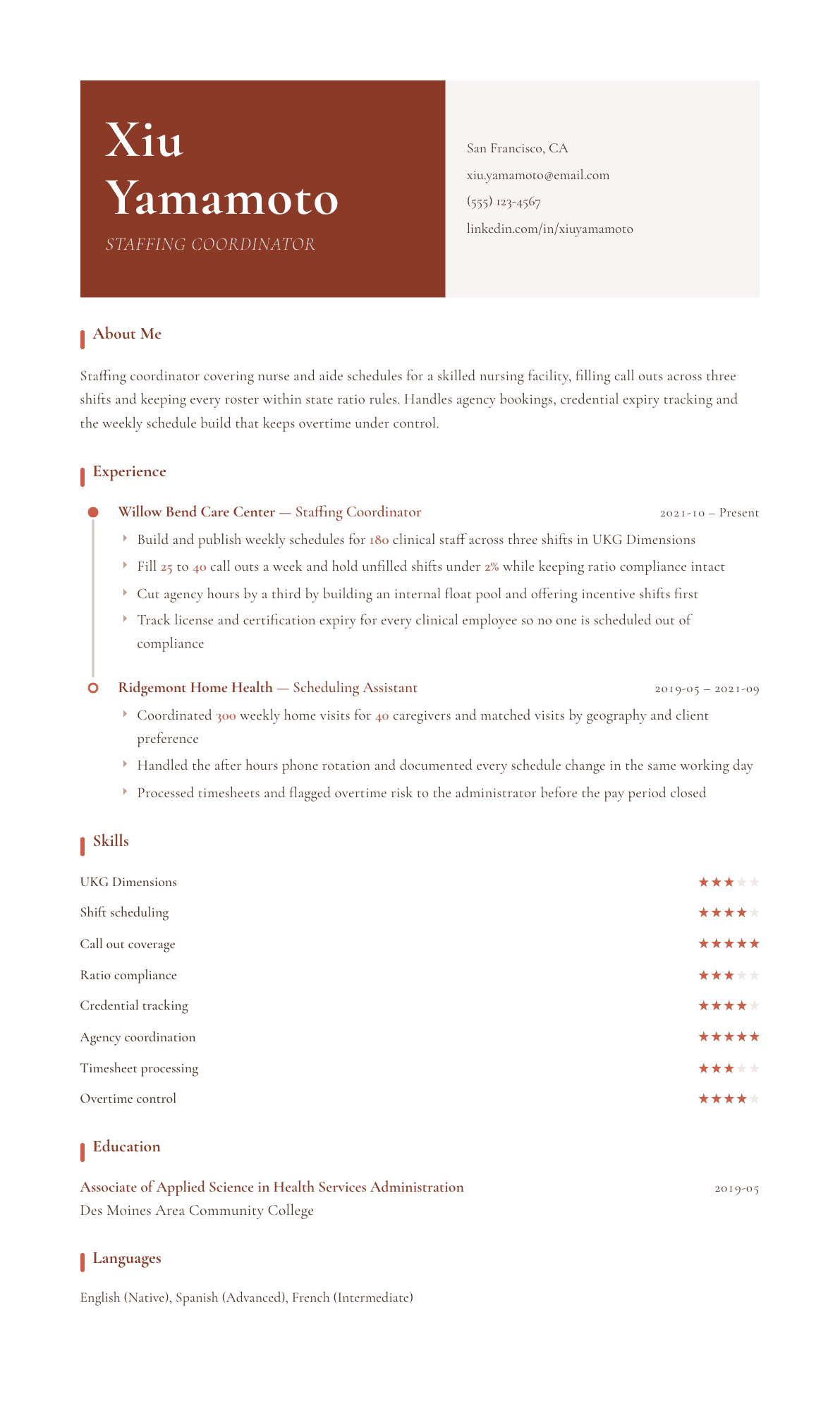
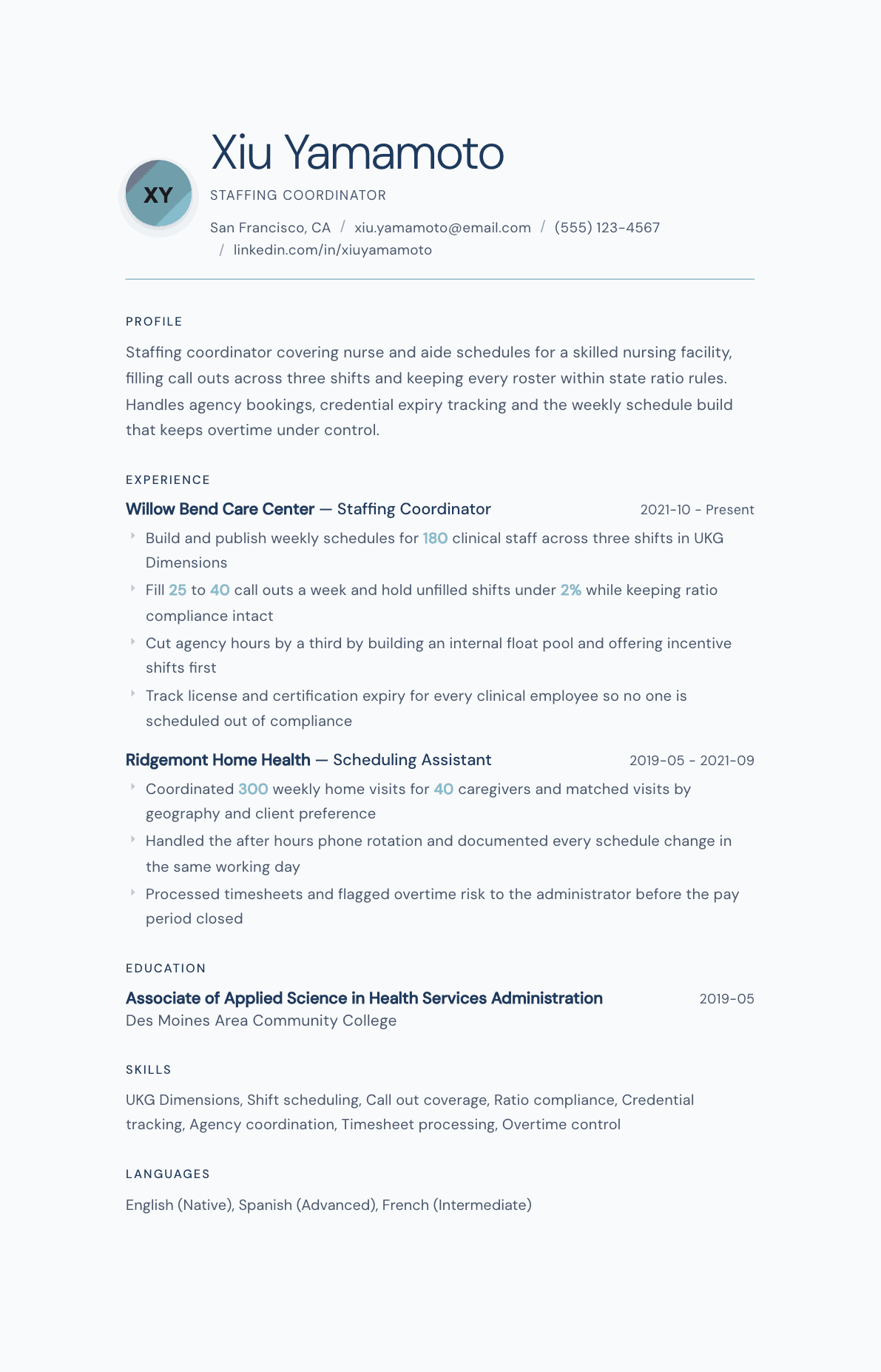
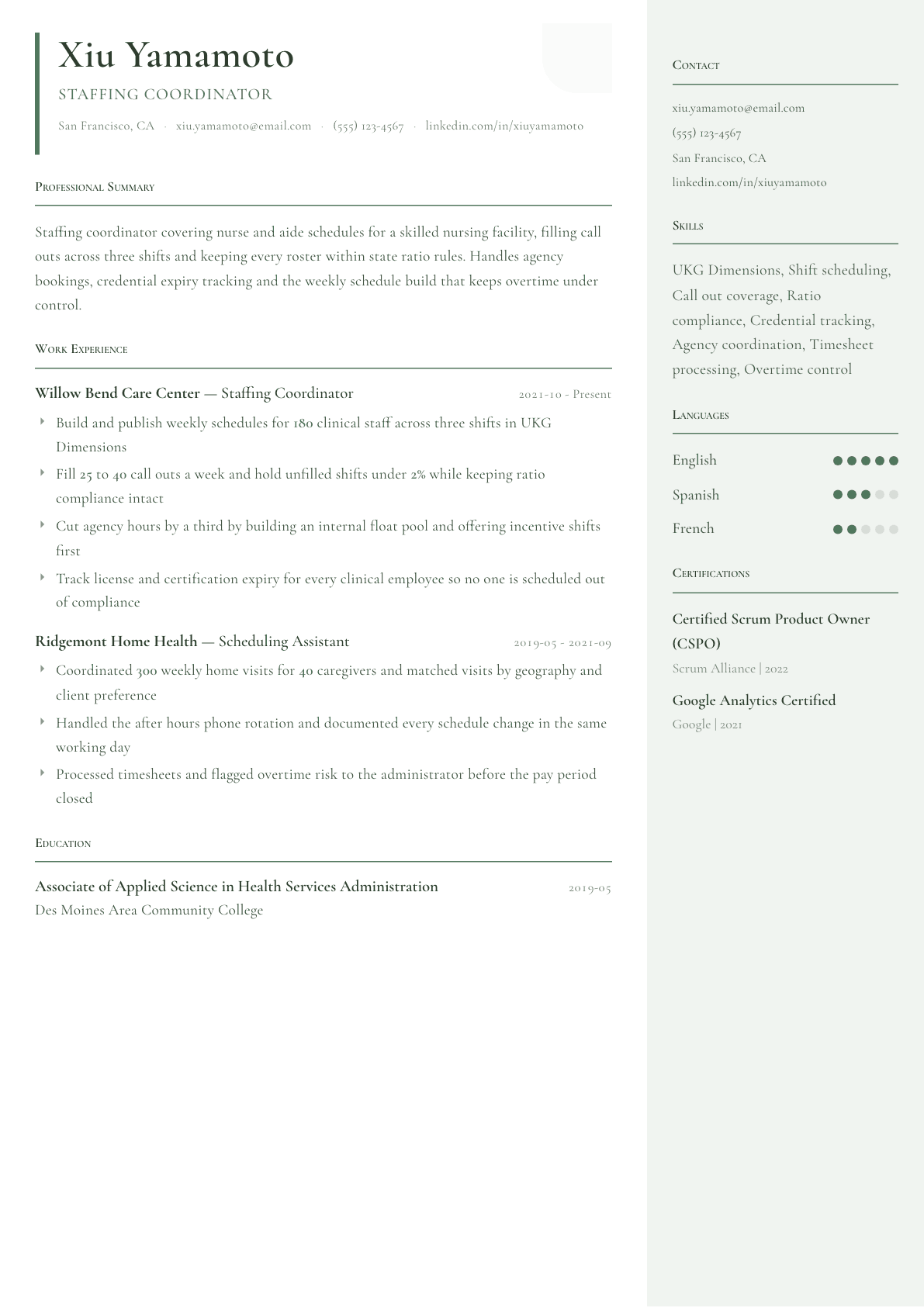
Example Staffing Coordinator summary
Staffing coordinator scheduling one hundred and eighty clinical staff across three shifts in a skilled nursing facility. Fill up to forty call outs a week, hold unfilled shifts near two percent, and cut agency hours by a third through an internal float pool. Track every license expiry so no one is rostered out of compliance. Seeking a coordinator role in a larger health system.
Skills to list on a Staffing Coordinator resume
- Shift scheduling
- Workforce scheduling systems
- UKG Dimensions
- Call out and coverage management
- Float pool coordination
- Agency staffing coordination
- Credential and license tracking
- Timesheet and payroll preparation
- Overtime management
- Staffing ratio compliance
- Onboarding logistics
- Employee records
- Reporting and forecasting
- Conflict resolution
What actually gets this resume read
- State the headcount you schedule, the number of shifts and the settings, because coverage scope is the job.
- Give your unfilled shift or fill rate figure, which is the metric an administrator watches every week.
- Show how you reduced agency use or overtime, since that is where a coordinator saves real money.
- Include the scheduling and timekeeping systems you use by name, along with any payroll handoff you own.
- Mention compliance work such as credential expiry tracking, ratio rules or union scheduling terms.
- Describe how you handle call outs under time pressure, since that is the daily test of the role.
How to write a staffing coordinator resume
A staffing coordinator resume is usually read by an administrator, a director of nursing or an operations manager who has just lost a coordinator and is watching the schedule fall apart. They want one thing: someone who can hold coverage. Every shift filled, every ratio respected, every credential current, and no surprise overtime at the end of the pay period.
The title covers two related jobs. In healthcare and care settings it means scheduling clinical staff and filling call outs. In staffing firms and manufacturing it means placing workers on assignments and keeping clients covered. Both are judged on fill rate, compliance and cost, so your resume must make clear which one you have done and how much of it.
This guide covers the structure that suits a coverage role, the numbers worth publishing, three summaries from scheduling assistant to lead coordinator, before and after bullets, and the questions coordinators ask when they apply for a bigger schedule.
Format: coverage scope in a line under each title
Reverse chronological, one page. Under each job title add a coverage line: how many staff you schedule, how many shifts or units, the settings, and the scheduling system. A coordinator covering 180 clinical staff across three shifts is carrying a very different load from one covering a single day shift office team.
Because this work is operational, keep the bullets short and factual. A hiring administrator reads quickly and wants to see numbers, systems and compliance words, not narrative.
- Coverage line format: 180 clinical staff, three shifts, skilled nursing setting, UKG Dimensions.
- Sections: summary, experience with coverage lines, compliance and cost work, education, systems.
- Add a line for payroll handoff duties if you prepare or verify timesheets for the pay run.
Summary: headcount scheduled, fill rate, and the setting
Three lines. State the setting, the number of staff you schedule, the shift pattern, and your fill or unfilled shift rate. This is the fastest way to prove you have carried a real schedule, and it is exactly the number the person hiring you is currently failing to hit.
Add the cost angle. Agency hours reduced, overtime controlled, or a float pool built. Coverage is easy to buy with agency staff and expensive to buy that way, so a coordinator who has done it cheaply stands out immediately.
Experience: the schedule build, call outs and coverage
Describe the weekly build: how far in advance you publish, how you balance requests against required coverage, and how you handle recurring gaps like weekend nights. Publishing a schedule that people can plan their lives around is the difference between a stable roster and a call out problem.
Then the call outs. How many you handle in a typical week, the order in which you offer shifts, whether incentive shifts are used, and how long a gap stays open. This is the daily test of the role and the part a new employer worries about most.
Finish with the parts that keep the operation legal: ratio or coverage rules, credential and license expiry tracking, mandatory rest periods, and any collective agreement terms you schedule around. A single expired credential on a roster is a compliance problem, so proving you track them is worth its own bullet.
Cost control: float pools, agency and overtime
Show what you did to reduce reliance on agency staff: an internal float pool, cross trained staff, incentive shifts offered before agency calls, or better forecasting of predictable absence. Give the before and after in hours or share rather than currency, since rates vary by market.
Overtime is the other lever. Describe how you flag overtime risk before the pay period closes and who you escalate it to. Administrators notice this because overtime that appears only in payroll reports is discovered too late to act on.
Systems and the words in these postings
Name the scheduling and timekeeping system, the human resources system where employee records live, and any credential tracking tool. Coordinators are hired partly for system fluency, since a new person who already knows the platform can take a schedule over in days rather than weeks.
These postings reuse consistent language: staff scheduling, shift coverage, call out management, float pool, agency coordination, staffing ratios, credential tracking, timekeeping, overtime management and payroll preparation. Mirror the ones that match your work, once in a systems or skills area and once inside a bullet.
Staffing Coordinator resume summary examples
Scheduling assistant
Scheduling assistant coordinating 300 weekly home visits for 40 caregivers, matching visits by geography and client preference and covering the after hours phone rotation. Document every schedule change the same working day and flag overtime risk before the pay period closes. Seeking a full staffing coordinator role.
Coordinator for a full facility
Staffing coordinator building weekly schedules for 180 clinical staff across three shifts in a skilled nursing facility. Fill 25 to 40 call outs a week, hold unfilled shifts under 2%, and cut agency hours by a third through an internal float pool. Track license expiry so nobody is rostered out of compliance.
Lead staffing coordinator
Lead staffing coordinator with nine years in healthcare scheduling, covering 400 staff across two sites and supervising two coordinators. Rebuilt the float pool and incentive shift policy, run the weekly staffing meeting with unit managers, and produce the coverage forecast the administrator uses for budget planning.
Work experience bullets: before and after
Before: Created staff schedules and made changes as needed.
After: Built and published weekly schedules for 180 clinical staff across three shifts in UKG Dimensions, releasing each roster two weeks ahead so staff could plan around it.
Headcount, shift pattern, system and publication lead time show a managed schedule rather than reactive edits.
Before: Filled open shifts when employees called out.
After: Covered 25 to 40 call outs a week using a set offer order of float pool, incentive shift, then agency, keeping unfilled shifts under 2% for the year.
A defined escalation order and a fill figure turn firefighting into a repeatable process.
Before: Worked to reduce agency staffing costs.
After: Cut agency hours by a third in one year by building an internal float pool of 14 cross trained staff and offering incentive shifts before any agency call.
The mechanism and the size of the pool explain how the saving was achieved and whether it will hold.
Before: Made sure staff were compliant with requirements.
After: Tracked license and certification expiry for every clinical employee and blocked scheduling for anyone within two weeks of expiry until renewal was recorded.
A specific rule shows compliance being enforced by the schedule rather than checked occasionally.
Before: Helped with payroll each period.
After: Reconciled timesheets against the published schedule each period, corrected missed punches with unit managers, and flagged overtime risk to the administrator before the run closed.
It shows the payroll handoff owned end to end, which is where scheduling errors become money.
Hard skills
- Shift and roster scheduling
- Workforce scheduling systems
- Call out and coverage management
- Float pool coordination
- Agency staffing coordination
- Staffing ratio compliance
- Credential and license expiry tracking
- Timekeeping and timesheet reconciliation
- Overtime monitoring
- Coverage forecasting
- Employee records maintenance
- Onboarding and orientation logistics
Soft skills
- Composure during coverage gaps
- Fairness in allocating shifts
- Persuading staff to pick up work
- Clear communication with managers
- Accuracy under repetition
- Discretion with personal circumstances
Certifications worth listing
- Certified Staffing Professional (CSP) (American Staffing Association)
- Associate Professional in Human Resources (aPHR) (HR Certification Institute)
- Certified Administrative Professional (CAP) (International Association of Administrative Professionals)
Mistakes that cost staffing coordinator candidates the interview
- Describing schedules created without saying how many staff, how many shifts or which setting.
- Leaving out fill rate or unfilled shift figures, the numbers the hiring administrator cares about most.
- Ignoring cost work, when agency reduction and overtime control are usually why the role is funded.
- Omitting compliance duties such as ratio rules and credential expiry, which are non negotiable in care settings.
- Naming no scheduling or timekeeping system, when system fluency shortens the handover by weeks.
- Writing the resume as general administration, which hides the coverage responsibility that defines the job.
Staffing Coordinator resume questions
What is the most important number on a staffing coordinator resume?
Fill rate, or its mirror image, the share of shifts left unfilled. Pair it with the headcount you schedule and the number of call outs you handle weekly, so the reader can judge the difficulty behind the figure.
How do I show scheduling skill if my facility used paper or spreadsheets?
Say so and describe the controls you built: a master template, a call out log, an expiry tracker, and a checking routine before publication. Manual systems run well only through discipline, and describing that discipline is persuasive on its own.
Should a staffing coordinator resume mention payroll work?
Yes, if you touch it. Timesheet reconciliation, missed punch correction and overtime flagging are where scheduling errors turn into pay problems. Employers value a coordinator who closes that loop rather than handing raw data to payroll.
How do I move from a staffing coordinator role into recruiting or HR?
Highlight the transferable parts: employee records, compliance tracking, onboarding logistics and constant negotiation with staff. Then add any hiring work you did, such as screening applicants for open shifts or coordinating orientation for new employees.
Does this role need a certification?
It rarely does. A staffing or human resources credential helps if you want to move into a broader role later, and in healthcare settings familiarity with ratio rules and credentialing requirements carries more weight than any general certificate.
Related resume examples
- HR Coordinator Resume example
- Human Resources Resume example
- Recruiting Manager Resume example
- Human Resources Assistant Resume example
- HR Operations Manager Resume example
- HR Administrator Resume example