Corporate Recruiter Resume Examples: what gets the call
Write a Corporate Recruiter Resume for In House Hiring Teams
By Mustafa Tarabya, founder of CVBooster · Published · Updated
Corporate recruiter resume sample with full cycle hiring metrics, ATS keywords, tailored tips and a section by section guide.
Sample resumes for a corporate recruiter
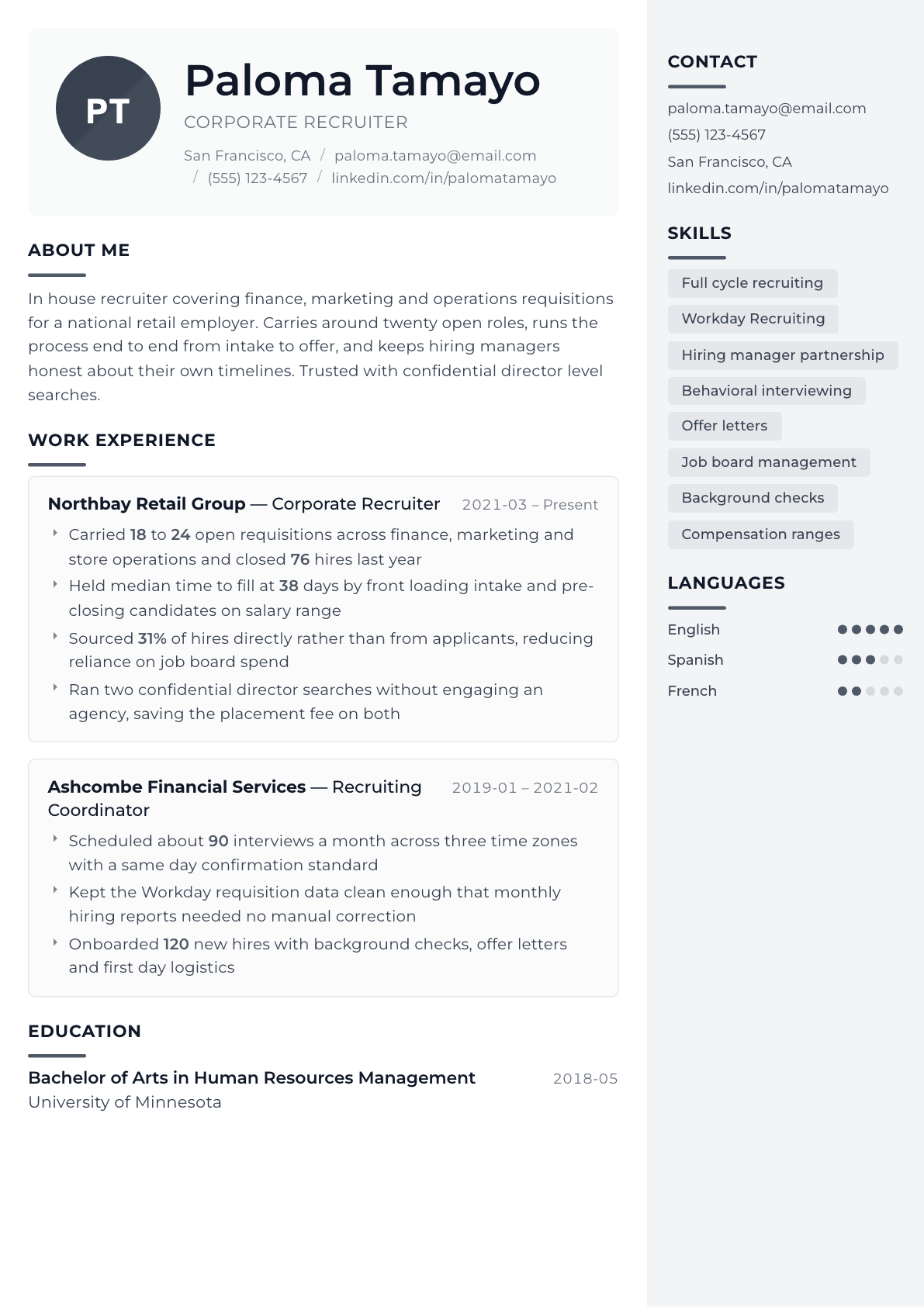
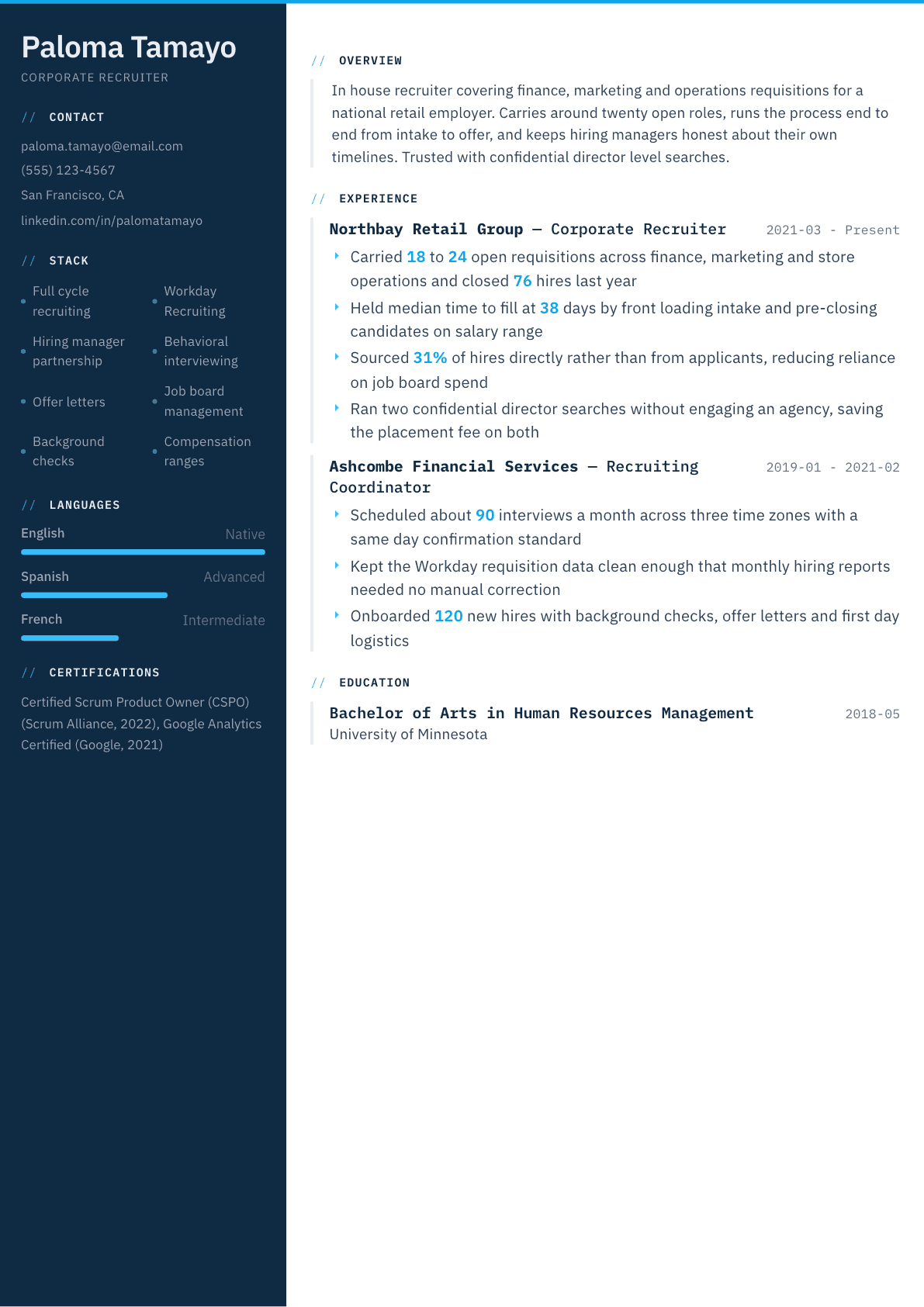
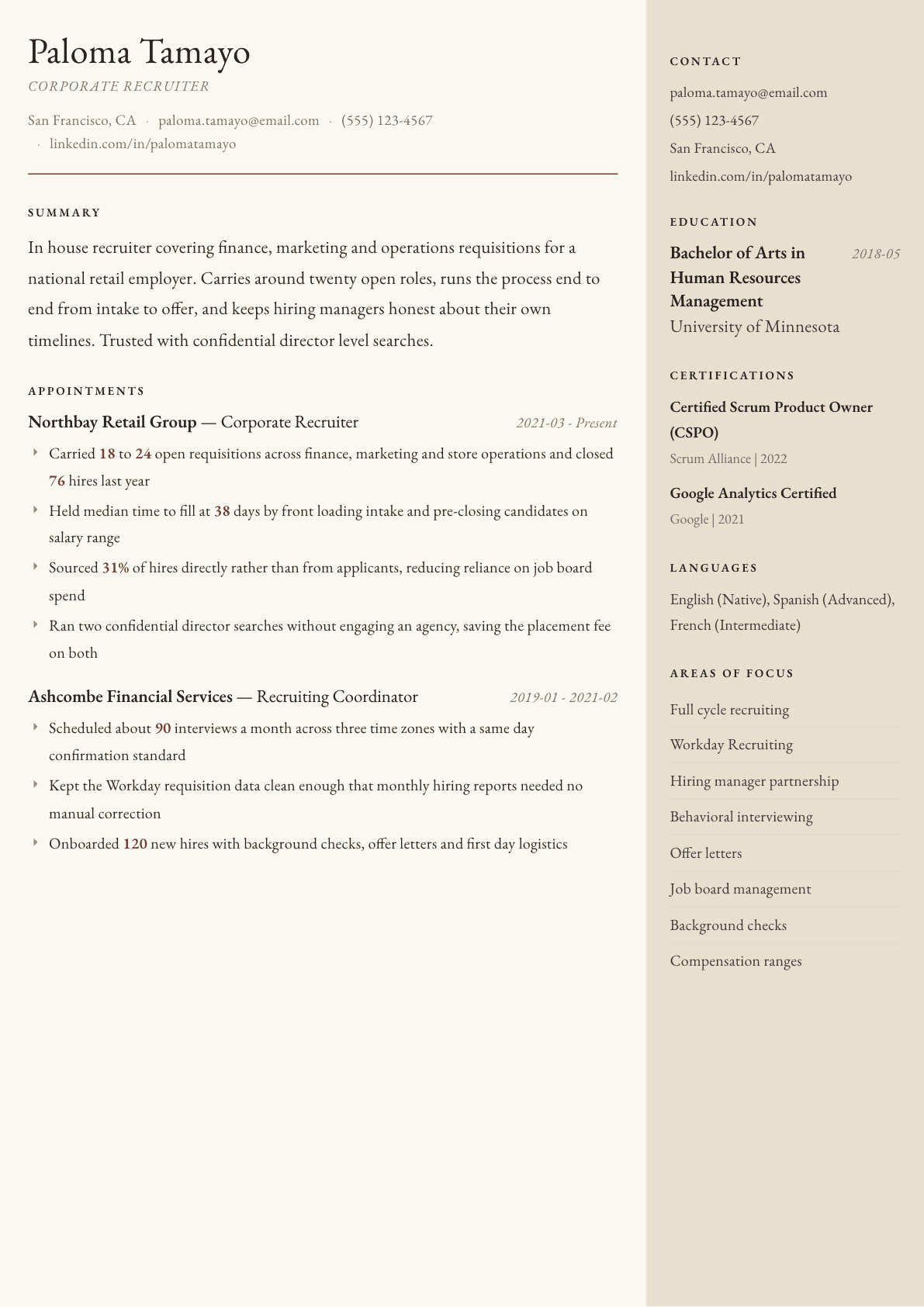
The same corporate recruiter content laid out in three CVBooster templates, so you can see what the finished document looks like before you write a word.
Example Corporate Recruiter summary
Corporate recruiter with six years of in house full cycle hiring for finance, marketing and operations teams at a national retailer. Carry around twenty live requisitions, source a third of hires directly, and closed seventy six roles last year at a median of thirty eight days. Seeking an in house team where recruiters own intake and offer conversations rather than passing them to a manager.
Skills to list on a Corporate Recruiter resume
- Full cycle recruiting
- Requisition management
- Applicant tracking systems
- Workday Recruiting
- Behavioral interviewing
- Hiring manager partnership
- Direct sourcing
- Offer negotiation
- Compensation ranges
- Job posting optimization
- Background screening
- Onboarding coordination
- Recruiting reporting
- Employer branding
What actually gets this resume read
- Say how many open requisitions you carry at once, because in house workload is measured in live roles.
- Name the functions you recruit for so a reader can match your background against their own hiring plan.
- Show the share of hires you sourced directly, since that is what justifies an internal recruiting team.
- Include the compliance work you handle: background checks, offer approvals, and record keeping in the system.
- Mention confidential or executive searches you ran in house instead of sending to an agency.
- Give one example of a hiring manager relationship you fixed, not only a requisition you filled.
How to write a corporate recruiter resume
A corporate recruiter resume is usually screened by an in house recruiting lead who knows the job intimately, which makes generic language expensive. They know what carrying twenty live requisitions feels like, they know which of your metrics are easy to flatter, and they will spot a resume written by someone who only ever handed candidates to somebody else to close.
What they are checking is whether you can run the whole cycle without supervision: intake with a hiring manager who is late to everything, sourcing when the applicant pool is thin, screening against a real scorecard, coordinating a panel across time zones, and closing an offer inside an approved range without a manager stepping in.
This guide covers how to structure the document, the numbers that matter for in house hiring, three summaries at different career stages, before and after bullets, and the questions corporate recruiters ask when their applications stop getting replies.
Format: requisition load first, one page for most candidates
Reverse chronological with a scope line under each title: functions covered, average number of live requisitions, hires per year, and the applicant tracking system. In house recruiting is measured by concurrent load, so a reader who does not see that number will assume it was small.
One page holds most corporate recruiter careers comfortably. Go to two only when you have several distinct employers, a coordinator background worth compressing, and program work such as an applicant tracking system migration or a careers site rebuild.
- Scope line format: finance, marketing and store operations, 18 to 24 live requisitions, 76 hires last year, Workday.
- Sections: summary, experience with scope lines, hiring programs, education, systems and certifications.
- Add a compliance line if you own background screening, offer approvals or record keeping standards.
Summary: functions, volume, and what you own end to end
Three lines. State the industry, the functions you recruit for, the load you carry and the part of the cycle you own without help. In house teams differ enormously in how much a recruiter is trusted with, so being explicit about owning intake, sourcing and the offer conversation is a real differentiator.
If you have run searches other people would send to an agency, say it here. Confidential replacements, director level hires and niche roles filled internally are the fastest way to signal seniority in a corporate recruiting career.
Experience: the funnel, the sourcing share and the stakeholders
Lead each job with volume and speed together: hires closed and median time to fill. Then add the number that justifies an internal team, which is the share of hires you sourced directly rather than received as applicants. Job board applications arriving in the system is not recruiting; finding people who were not looking is.
Write at least one bullet about a hiring manager relationship, not a requisition. Recruiters who describe how they changed a manager behavior, whether that is running a proper intake, shortening feedback time, or accepting a realistic salary range, are demonstrating the skill the job actually turns on.
Include the operational work: offer letters, approval routing, background screening, right to work checks, and keeping requisition data clean enough for reporting. It is unglamorous, and every in house lead has been burned by a recruiter who ignored it.
Systems and data hygiene
Name the applicant tracking system and say what you did beyond moving candidates through stages. Building requisition templates, cleaning source data, writing rejection reason taxonomies and producing weekly reports are all worth a line, because they are what make hiring data trustworthy.
Add the adjacent systems: the human resources information system where new hires land, the background check vendor, the scheduling tool and the assessment platform. In house recruiting is a chain of handoffs, and a recruiter who knows the whole chain saves everyone else time.
Keywords the applicant tracking system will match
Corporate postings reuse the same vocabulary: full cycle recruiting, requisition management, hiring manager partnership, behavioral interviewing, direct sourcing, offer negotiation, candidate experience, onboarding and compliance. Mirror the exact phrases once in a skills area and once inside a bullet where you show the work.
Where the employer is regulated or unionized, add the language they will screen for: right to work verification, credential checks, collective agreement terms, or internal transfer policy. Those phrases rarely appear in a draft and always appear in the posting.
Corporate Recruiter resume summary examples
Coordinator moving to recruiter
Recruiting coordinator with two years scheduling and offer administration for a corporate hiring team, now running six of my own entry level requisitions end to end. Handle intake, phone screens and offer letters, and keep requisition data clean enough that monthly reports need no correction. Seeking a full recruiter seat.
Four years in house
Corporate recruiter carrying 18 to 24 live requisitions across finance, marketing and operations for a national retailer. Closed 76 hires last year at a 38 day median, sourced 31% of them directly, and ran two confidential director searches without an agency. Looking for a team where recruiters own the offer conversation.
Senior corporate recruiter
Senior corporate recruiter with nine years in house across manufacturing and professional services, currently handling director level and confidential searches alongside a standard requisition load. Mentor two recruiters, own the interviewer training curriculum, and led the migration of 400 open requisitions into a new applicant tracking system.
Work experience bullets: before and after
Before: Managed the full recruitment life cycle for various departments.
After: Carried 18 to 24 live requisitions across finance, marketing and store operations, closing 76 hires last year at a median time to fill of 38 days.
Concurrent load, functions and two numbers replace a phrase that appears on every corporate recruiter resume.
Before: Sourced candidates for open positions.
After: Sourced 31% of last year hires directly rather than from inbound applicants, building candidate pools for repeat roles in store management and accounting.
A direct source share is the number that shows an internal recruiter earning the team its budget.
Before: Partnered with hiring managers throughout the process.
After: Converted three managers who skipped intake into a standing 30 minute kickoff with an agreed scorecard, which cut their average feedback turnaround from nine days to two.
It names the behavior that changed and the delay it removed, rather than claiming partnership.
Before: Handled offers and onboarding paperwork.
After: Prepared and routed 76 offers through approval, completed background and right to work checks, and handed each hire to onboarding with a complete record in Workday.
The compliance chain is spelled out, which reassures a lead who has inherited messy files before.
Before: Filled a senior role that was hard to hire for.
After: Ran two confidential director searches in house, including a replacement handled while the incumbent was still in seat, saving the agency placement fee on both.
Confidentiality and the avoided fee show judgment and commercial value in one sentence.
Hard skills
- Full cycle recruiting
- Requisition management
- Applicant tracking system administration
- Direct sourcing and candidate pooling
- Behavioral and competency interviewing
- Offer preparation and approval routing
- Compensation range conversations
- Background and right to work screening
- Interview scheduling across time zones
- Job posting optimization
- Recruiting reporting and data hygiene
- Onboarding handoff
Soft skills
- Hiring manager partnership
- Discretion on confidential searches
- Prioritization under high load
- Clear candidate communication
- Follow through on details
- Steady judgment on close calls
Certifications worth listing
- Professional in Human Resources (PHR) (HR Certification Institute)
- SHRM Certified Professional (SHRM-CP) (Society for Human Resource Management)
- Certified Internet Recruiter (CIR) (AIRS)
- Associate Professional in Human Resources (aPHR) (HR Certification Institute)
Mistakes that cost corporate recruiter candidates the interview
- Writing full recruitment life cycle with no numbers attached, which every reader has seen a hundred times.
- Omitting concurrent requisition load, the one figure that shows how hard the desk really was.
- Reporting only hires and never speed or source, so the pipeline behind the result stays invisible.
- Skipping the compliance and administration work that an in house lead considers non negotiable.
- Listing departments supported without naming a single role type you filled inside them.
- Presenting agency style placement language on an in house application without translating the terms.
Corporate Recruiter resume questions
How many requisitions should a corporate recruiter say they carry?
Report your real average and the range, such as eighteen to twenty four. Load depends on role complexity, so pair it with the job types. Twelve director searches is heavier than thirty entry level openings, and a good reader knows that.
What does direct source rate mean and should I include it?
It is the share of hires that came from candidates you found rather than from inbound applications. Include it if you can defend the number from your system data. It is the clearest evidence that an internal recruiter is adding value beyond processing applicants.
How do I present confidential searches without breaching trust?
Describe the level and the situation, never the person or the reason. Saying you ran a confidential director replacement while the incumbent remained in seat conveys the difficulty and your discretion without disclosing anything the former employer would object to.
Do I need an HR certification to be a corporate recruiter?
It is rarely required but it helps in regulated employers and for candidates without a human resources degree. A recognized credential also signals you understand employment compliance, which matters when recruiters own offers and screening checks.
How do I stand out when every applicant claims the same duties?
Use specifics only you could write: the exact functions, the load, the systems, the source mix, and one story of a hiring manager relationship you repaired. Duties are shared across the profession, but the numbers and the fixes are yours alone.
Related resume examples
- Recruiter Resume example
- HR Coordinator Resume example
- Technical Recruiter Resume example
- Staffing Coordinator Resume example
- Talent Acquisition Manager Resume example
- Talent Acquisition Specialist Resume example