Retail District Manager Resume Examples: free ATS score
Write a Retail District Manager Resume That Proves Multi-Store Results
By Mustafa Tarabya, founder of CVBooster · Published · Updated
Retail district manager resume example with store count, comp sales, payroll and talent bullets, plus a guide to multi-unit leadership writing.
Sample resumes for a retail district manager
The same retail district manager content laid out in three CVBooster templates, so you can see what the finished document looks like before you write a word.
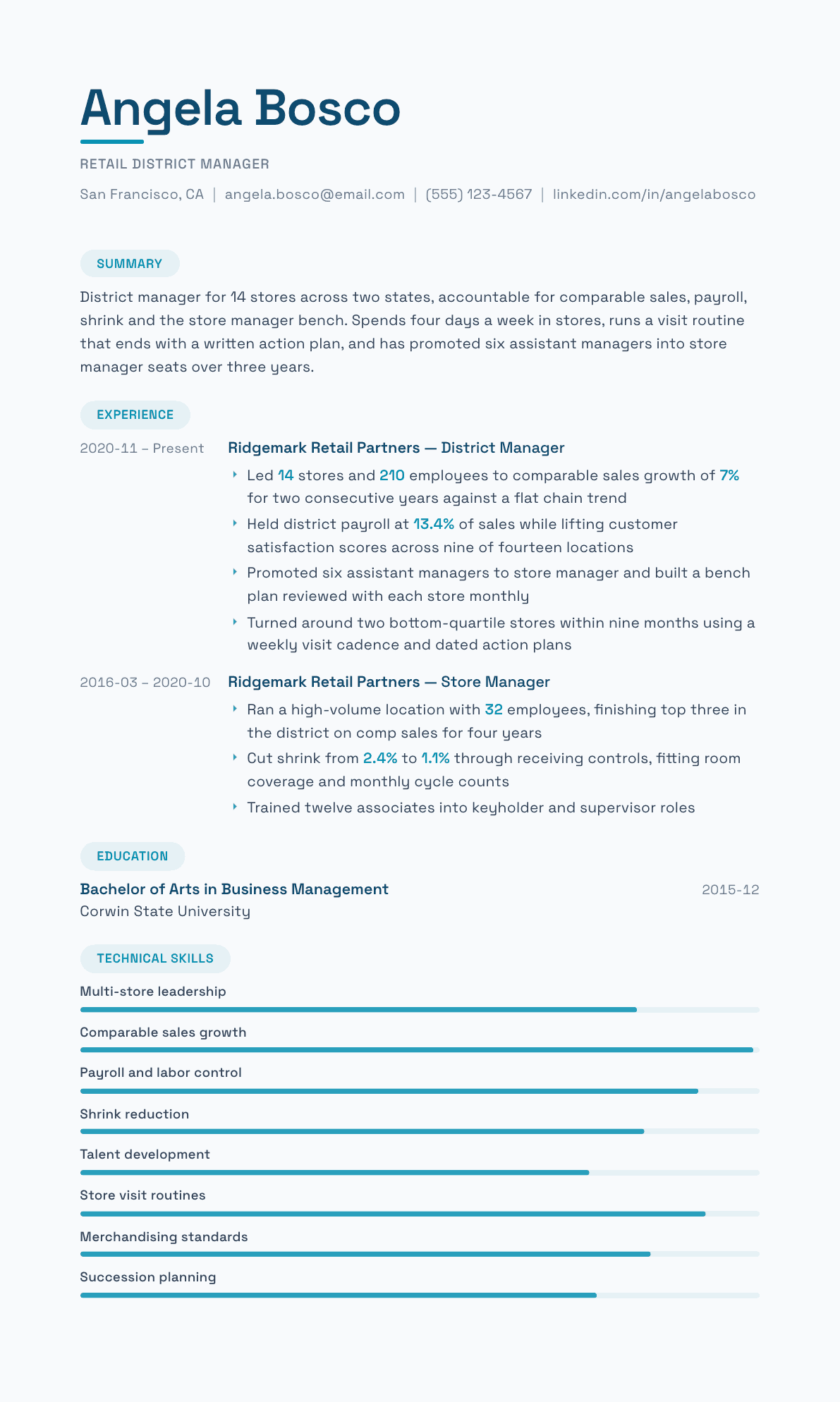
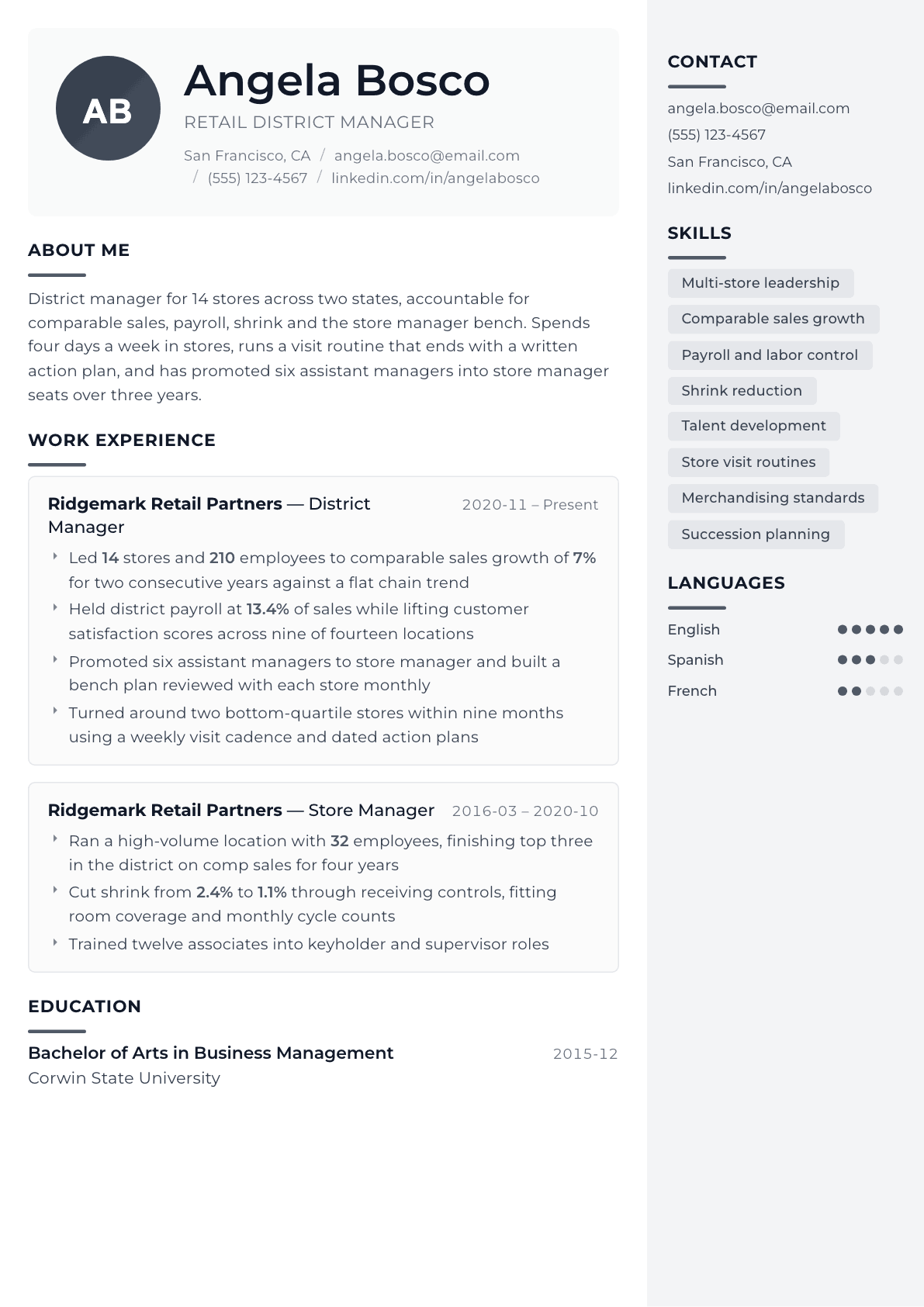
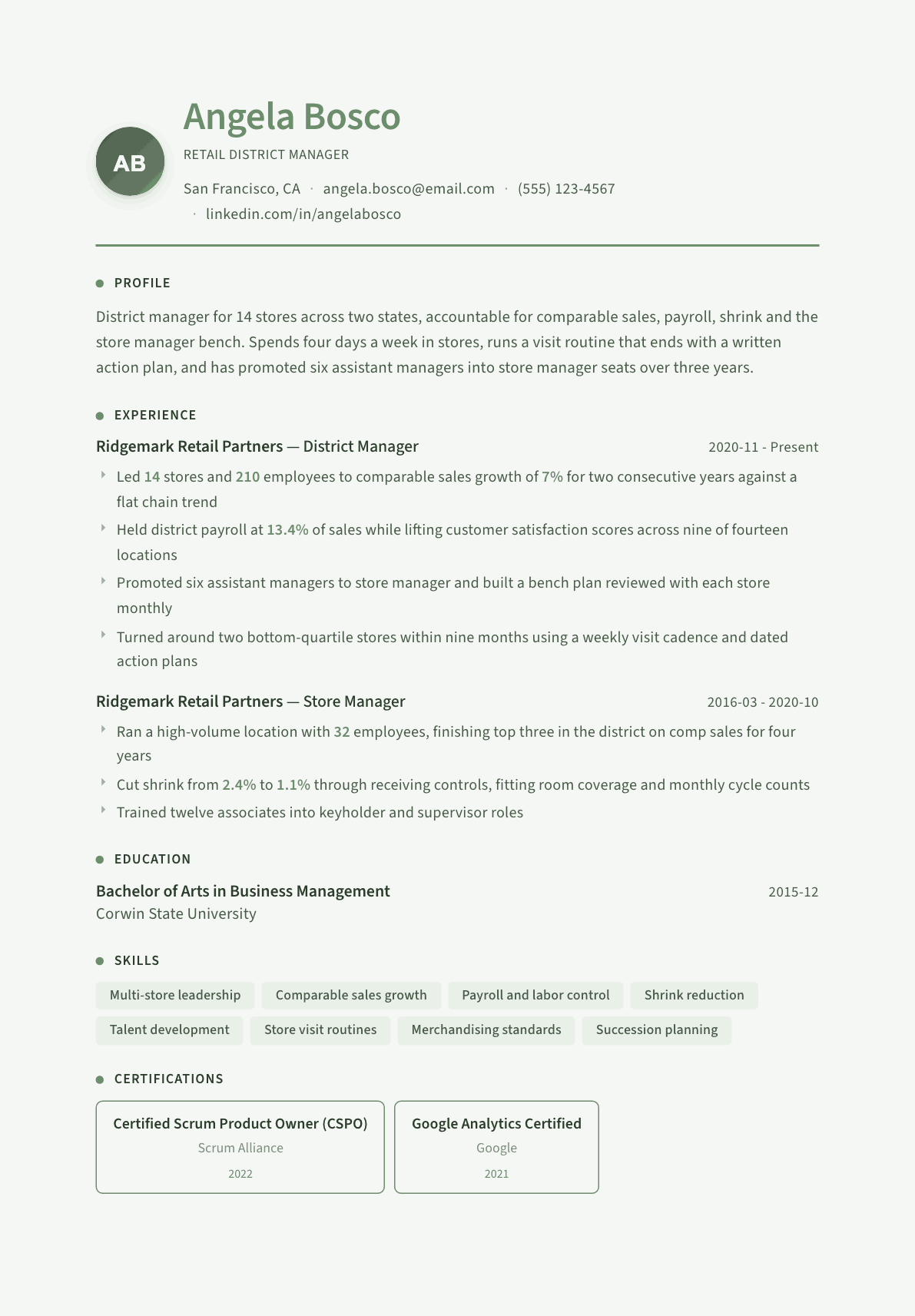
Example Retail District Manager summary
District manager for 14 stores and 210 employees across two states, accountable for comp sales, payroll, shrink and the manager bench. Delivered 7% comp growth two years running, held payroll at 13.4% of sales, and promoted six assistant managers into store manager seats. Seeking a district role in a specialty chain with an active store opening plan.
Skills to list on a Retail District Manager resume
- Multi-unit management
- Comparable sales growth
- Payroll and labor planning
- Shrink and loss prevention
- Store visit audits
- Talent development
- Succession planning
- Performance management
- Merchandising standards
- New store openings
- Customer experience metrics
- Expense and budget control
- Recruiting and hiring
- Action planning
What actually gets this resume read
- Open every district job with the store count, the employee count and the sales volume you carried.
- Report comparable sales against a benchmark, since growth without a chain or market comparison means little.
- Show payroll as a share of sales and shrink as a rate, and name the direction each one moved.
- Prove talent work with promotions: how many assistant managers became store managers under you.
- Describe your visit routine, what you audited, and how findings turned into a dated action plan.
- Include a turnaround story with a store profile, the fix and the timeline rather than a general claim.
How to write a retail district manager resume
A retail district manager resume is read by a regional or vice president who has interviewed dozens of multi-unit leaders and has learned to distrust adjectives. They look for four things in order: how many stores and people you carried, what the comparable sales did against a benchmark, whether payroll and shrink stayed where they belonged, and how many managers you grew.
The trap is writing the district job as if it were a bigger store job. Running one store is about execution. Running fourteen is about diagnosis, prioritization and time, because you cannot be in more than one building at once and the resume should show that you know it.
This guide sets out the format regional leaders expect, how to present comparable sales honestly, how to write the visit routine and the turnaround story, and the questions district managers ask when they move between segments or into a regional seat.
Format: the district profile line under every job
Give each district role a profile line: store count, employee count, annual volume, geography and store formats. A district of fourteen mall stores is a different job from six big-box locations spread across three states, and the reader will not assume in your favor.
Two pages is normal at this level. Use the first page for the district roles and the results, and compress earlier store manager years into short entries with one result each.
- Profile line: stores, employees, volume, states or metros, formats.
- Order: summary, district roles with results, store leadership history, education, credentials.
- Note any districts you inherited in trouble, since turnaround work is a distinct hiring signal.
Comparable sales: always against something
A comp number alone is unreadable. Mid single digit growth during a strong chain year is average; the same figure while the chain sat flat is a hiring reason. Put your result next to the chain, the region or the market so the reader can judge it, and give the period rather than a single lucky quarter.
If the district shrank, deal with it. A district that lost sales while gaining margin, or that absorbed two closures and still beat plan on the remaining stores, is a story worth telling. Silence on a bad year reads worse than a straight explanation.
Payroll, shrink and the rest of the controllables
Give payroll as a share of sales and shrink as a rate, both with direction. Add whatever else you truly controlled: supply expense, repairs, markdown execution, or overtime. These lines tell a regional leader whether you can be given a budget.
Then show the operating discipline behind the numbers. Weekly payroll reviews with each store manager, a shrink action plan for the worst three locations, or an inventory calendar you personally enforced all read as work, while a generic claim about driving results does not.
The visit routine and the turnaround
Describe how you actually spend a week. Days in stores, the sequence of a visit, what you look at first, and how a visit ends. A district manager whose visit closes with a written, dated action plan reviewed at the next visit is describing a management system, and that is exactly what the interviewer wants to hear about.
Then give one turnaround with the profile of the store, the diagnosis, the actions and the timeline. Naming the underlying cause matters: a bottom-quartile store failing on staffing is a different fix from one failing on inventory accuracy, and showing you can tell them apart is the whole skill.
Talent and keywords
Promotions are the cleanest talent evidence there is. Count the assistant managers who became store managers under you and the store managers who moved up or across. Add how you built the bench: a monthly succession review, a defined development plan per store, or a hiring pipeline you kept warm before a vacancy opened.
Multi-unit screens look for district manager, multi-unit, comparable sales, profit and loss, payroll, shrink, succession planning, performance management and store visits. Use them where earned, and put the store count next to them so the phrase carries weight.
Retail District Manager resume summary examples
First district seat
Store manager with six years leading a high-volume location, ready for a district. Finished top three in the district on comp sales for four years, cut shrink from 2.4% to 1.1%, and trained twelve associates into keyholder and supervisor roles across two store openings.
Running a district
District manager for 14 stores and 210 employees across two states, accountable for comp sales, payroll, shrink and the manager bench. Delivered 7% comp growth two years running against a flat chain, held payroll at 13.4% of sales, and promoted six assistant managers into store manager seats.
Regional track
Multi-unit leader with fourteen years in specialty retail, currently overseeing 32 stores through three district managers. Rebuilt the manager hiring pipeline, took two underperforming districts to positive comps within a year, and opened nine locations from site walk to first inventory count.
Work experience bullets: before and after
Before: Oversaw multiple retail locations.
After: Led 14 stores and 210 employees across two states, owning comparable sales, payroll, shrink and store manager development.
Store count, headcount and the specific accountabilities give the reader the scope they need immediately.
Before: Grew sales across the district.
After: Delivered 7% comparable sales growth for two consecutive years while the chain ran flat, with nine of fourteen stores beating plan.
The benchmark and the store-level spread turn a growth figure into something a regional leader can trust.
Before: Managed payroll and controlled costs.
After: Held district payroll at 13.4% of sales through weekly hour reviews with each store manager, without reducing weekend coverage.
It names the routine that produced the number and the line you refused to cross to get it.
Before: Turned around underperforming stores.
After: Took two bottom-quartile stores to district average within nine months by replacing one manager, rebuilding the schedule and fixing receiving accuracy.
A diagnosis and a timeline show judgment, while the phrase turned around shows nothing.
Before: Developed store managers.
After: Promoted six assistant managers into store manager roles over three years and ran a monthly bench review with every location.
Promotion counts plus the routine behind them prove a talent pipeline rather than a good intention.
Hard skills
- Multi-unit retail leadership
- Comparable sales management
- Profit and loss accountability
- Payroll and labor planning
- Shrink and loss prevention
- Store visit audits and action plans
- Succession and bench planning
- Performance management
- New store openings
- Merchandising standards execution
- Recruiting and interviewing
- Expense control
Soft skills
- Diagnosing a store from the numbers
- Coaching managers remotely
- Prioritizing across locations
- Difficult conversations
- Time management across geography
- Consistency of standards
Certifications worth listing
- RISE Up Business of Retail: Operations and Profit (National Retail Federation Foundation)
- Loss Prevention Certified (LPC) (Loss Prevention Foundation)
- Certified Manager (CM) (Institute of Certified Professional Managers)
- SHRM Certified Professional (SHRM-CP) (Society for Human Resource Management)
Mistakes that cost retail district manager candidates the interview
- Giving a comp number with no chain, region or market benchmark next to it.
- Writing the district role as an enlarged store role instead of a management system across locations.
- Leaving out store count and headcount, which are the first two facts a regional leader looks for.
- Claiming turnarounds without the store profile, the diagnosis or the timeline.
- Ignoring a bad year rather than explaining what happened and what you did about it.
- Listing store visits as an activity with no audit content and no action plan attached.
Retail District Manager resume questions
How many stores do I need to have run to apply for a district manager job?
There is no fixed number, and multi-unit experience outside retail can count. What matters is evidence of leading through other managers rather than doing the work yourself, plus results across more than one location that you can explain in detail.
How do I show profit and loss ownership if I only had partial control?
Name the lines you actually controlled, such as payroll, supplies and markdown execution, and say which lines were allocated to you. Precision here builds trust, and a regional leader will assume the worst if the page implies more than you can defend.
Should a district manager resume be one page or two?
Two pages is standard at this level. Keep district roles and their results on the first page, compress earlier store manager years into single-line entries with one result each, and cut anything older than about fifteen years.
What if my district lost sales last year?
Give the context in one line: a closure absorbed, a remodel disruption, a market that moved. Then show what you protected, such as margin, payroll control or manager retention. A candid explanation beats an unexplained gap in your results.
How do I move into a district role from a different retail segment?
Translate the mechanics rather than the merchandise. Labor models, shrink control, visit routines and manager development transfer across segments. Name the format differences you have studied and be ready to discuss the traffic and basket patterns of the new one.