Boutique Manager Resume Examples: the lines they read
Build a Boutique Manager Resume That Shows Small-Store Ownership
By Mustafa Tarabya, founder of CVBooster · Published · Updated
Boutique manager resume example with buying, staffing and sales-per-square-foot bullets, plus a guide to writing single-store leadership.
Sample resumes for a boutique manager
The same boutique manager content laid out in three CVBooster templates, so you can see what the finished document looks like before you write a word.
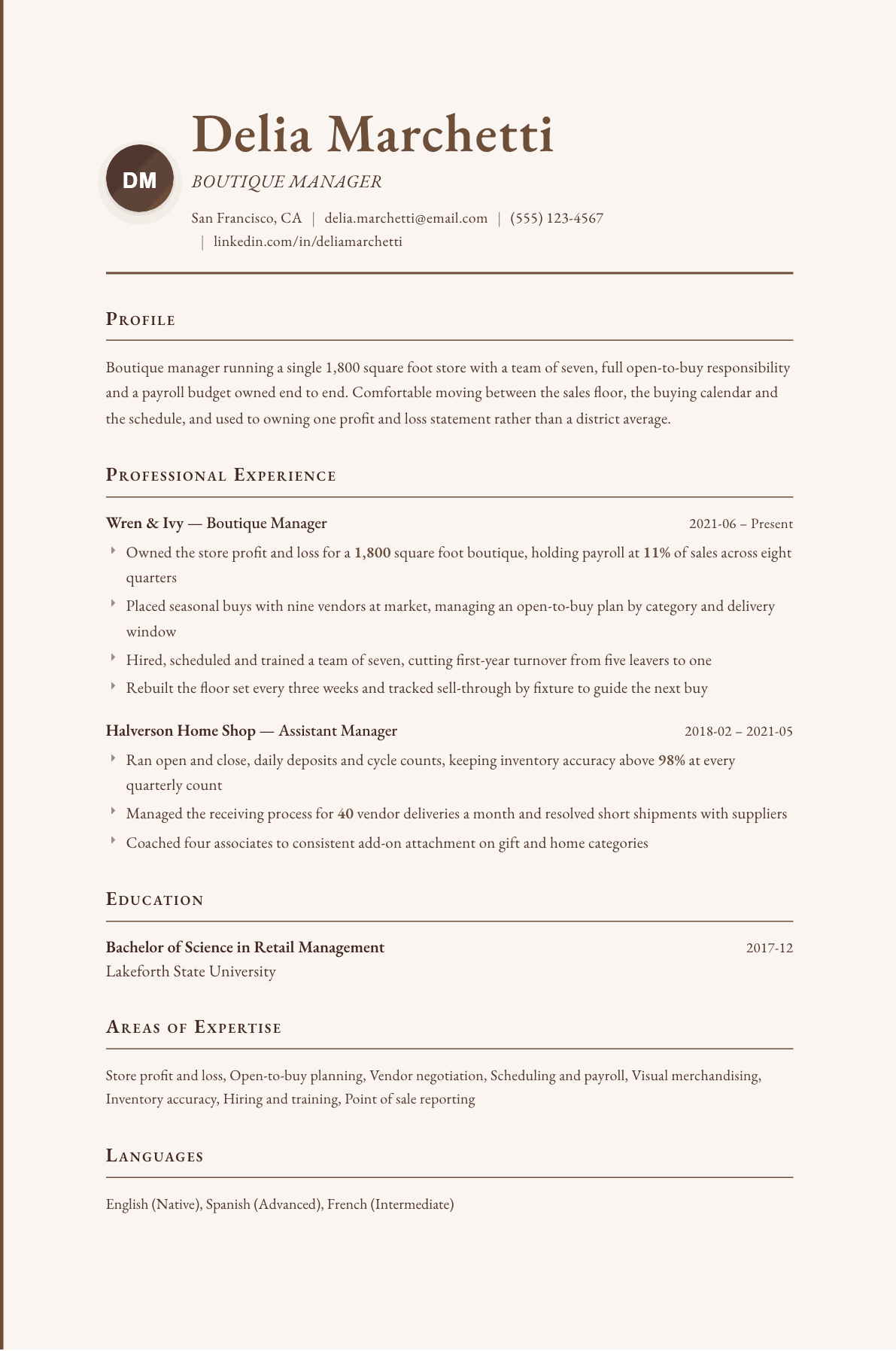
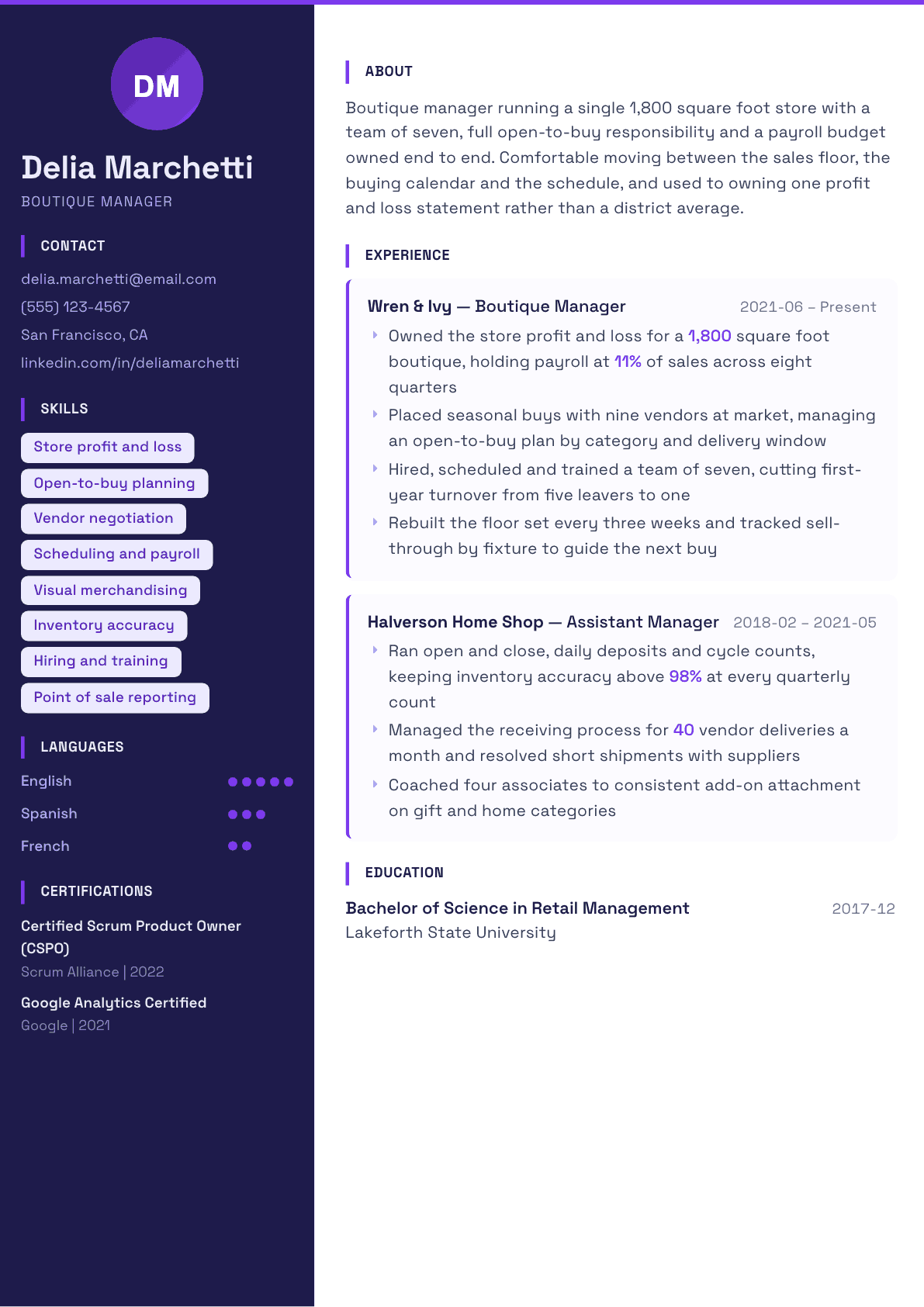
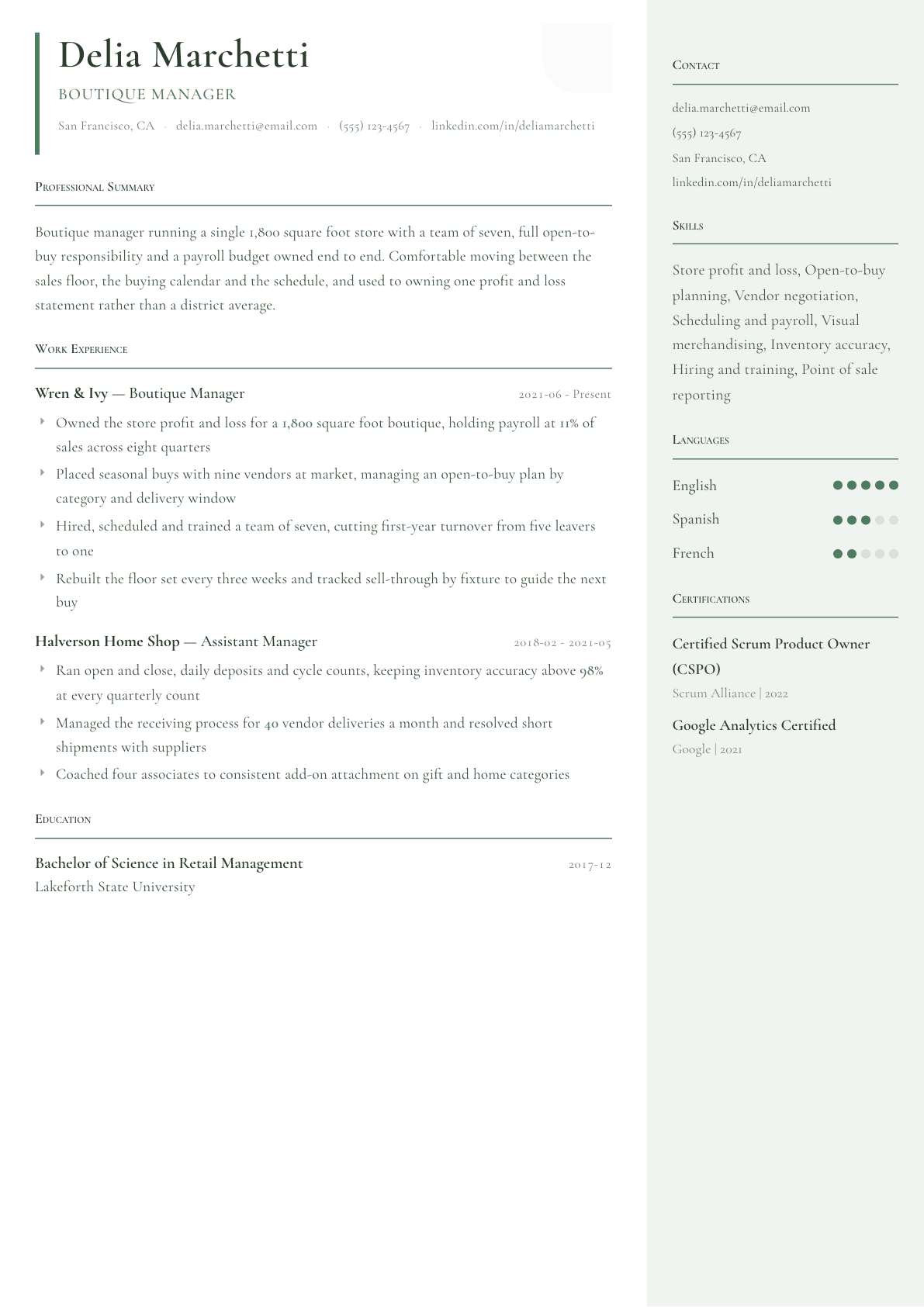
Example Boutique Manager summary
Boutique manager with six years running a single store, including the buy, the schedule and the profit and loss. Holds payroll near 11% of sales, keeps inventory accuracy above 98% at count, and has taken a seven-person team from five leavers a year to one. Seeking a boutique or flagship where the manager still owns the assortment.
Skills to list on a Boutique Manager resume
- Store operations
- Profit and loss ownership
- Open-to-buy planning
- Vendor management
- Visual merchandising
- Staff scheduling
- Payroll control
- Hiring and onboarding
- Inventory management
- Cycle counts
- Loss prevention
- Customer experience
- Lightspeed POS
- Shopify POS
- Sales reporting
What actually gets this resume read
- State the square footage, the headcount and the annual volume of the store so a reader can size the job.
- Say whether you owned the buy, because a boutique manager who buys is doing a different job from one who does not.
- Give payroll as a share of sales and inventory accuracy at count, the two numbers owners check first.
- Show vendor work explicitly: market appointments, terms, reorders and how you handled short deliveries.
- Name your point of sale and inventory system, whether that is Lightspeed, Shopify POS, Heartland or Square.
- Put one bullet on staff retention, since a small store lives or dies on whether the team stays.
How to write a boutique manager resume
Boutique managers get compared against chain store managers, and the comparison usually goes badly unless the resume explains the difference. A chain manager executes a plan built somewhere else. A boutique manager often picks the product, sets the floor, writes the schedule, negotiates with vendors and answers for one profit and loss statement with nowhere to hide. The resume has to make that scope visible in the first six lines.
Owners and small-group operators read these applications personally. They are not scanning for a keyword match, they are working out whether you can be left alone with their store, their money and their team on a Saturday in December.
What follows is the section order that works for a single-store leader, how to write the buying half of the job if you own it, the operating numbers a store owner checks before anything else, and the questions boutique managers ask when they move between independents, franchise stores and flagships.
Format: size the store before you describe the job
Under every employer, put a single context line: square footage, team size, annual volume and product categories. Without it the reader cannot tell a two-person gift shop from a flagship with a stockroom and a shipment schedule, and every bullet after that is guesswork.
One page is enough for most boutique managers. Two pages is defensible only if you have run multiple locations or carry a long buying history worth listing by category.
- Context line under each job: square feet, headcount, annual volume, categories carried.
- Order: summary, experience with context lines, operating results, systems, education.
- Say whether the store was independent, franchised, or part of a small group, since the autonomy differs.
The buy: the fastest way to separate yourself
If you place the orders, say so in the first bullet of the job and give the shape of it: how many vendors, whether you attend market, how the open-to-buy is planned by category and delivery window, and what you do with slow sellers. Buying responsibility moves a candidate into a different pay band, so burying it is an expensive habit.
Back the buying claim with sell-through. A manager who can say what proportion of a seasonal buy sold at full price before markdown is talking the language an owner already speaks. If you assist the buy rather than own it, write that precisely instead of blurring the line, because the interview will find the truth in two questions.
Operating numbers an owner checks first
Three numbers carry most of the weight: payroll as a share of sales, inventory accuracy at physical count, and year over year sales movement for the store you ran. Give all three where you have them, and give the direction as well as the value.
Add the operating routines behind those numbers. Cycle count cadence, receiving checks against the packing slip, register variance procedure, and how markdowns are decided and executed. An owner who has been burned by a shrink problem reads these lines closely.
Do not import chain metrics that do not apply. Conversion rate from a door counter is meaningless if the store never had one. Use what you truly measured.
Team: hiring, training and whether people stay
A small store is fragile to turnover, so retention belongs on the page. Say how many people you hired, how you onboarded them, and how long the team stayed. One line comparing leavers before and after you took over is more persuasive than a paragraph about leadership philosophy.
Include the scheduling reality: how you cover holidays and market trips, who opens when you are away, and whether you developed a keyholder or assistant who could run the store without you. That is the risk an owner is trying to price.
Systems and keywords
Name the point of sale and inventory platform: Lightspeed, Shopify POS, Heartland, Square, Clover or a legacy system. Add the ecommerce channel if the store sold online, along with the fulfillment method for web orders picked from store stock. Small retailers care about this because a manager who already knows the system saves them a month.
The phrases owners and small-group recruiters search for include store operations, open-to-buy, visual merchandising, inventory management, staff scheduling, loss prevention and customer experience. Place each one where it is genuinely earned, then let the numbers do the rest of the work.
Boutique Manager resume summary examples
Stepping up from assistant
Assistant manager with three years in a home and gift boutique, running open and close, deposits, receiving and cycle counts. Held inventory accuracy above 98% at four consecutive counts and coached a team of four on add-on selling. Ready for a first store manager seat in an independent shop.
Running one store
Boutique manager with six years leading a store of 1,800 square feet and a team of seven, owning payroll, scheduling and the profit and loss. Holds payroll near 11% of sales, places seasonal buys with nine vendors, and rebuilds the floor set every three weeks against sell-through by fixture.
Flagship or multi-store
Retail leader with twelve years in independent stores, currently running a flagship and a second location with combined headcount of nineteen. Owns the buy across four categories, negotiates vendor terms directly, and has moved both stores to positive year over year sales for three straight years.
Work experience bullets: before and after
Before: Managed daily store operations.
After: Ran a 1,800 square foot boutique with a team of seven, owning payroll, scheduling, receiving and the store profit and loss.
The rewrite gives the store size, the team size and the exact list of what you were accountable for.
Before: Ordered inventory from vendors.
After: Placed seasonal buys with nine vendors at market against a category-level open-to-buy plan, with 72% of the fall buy selling through at full price.
It shows the buying process and proves the buy worked instead of only saying orders were placed.
Before: Kept payroll under control.
After: Held payroll at 11% of sales across eight quarters while extending Saturday coverage by one associate through a rebuilt shift pattern.
A cost claim gains weight when it holds over time and comes with the tradeoff you actually made.
Before: Reduced inventory losses.
After: Introduced a monthly cycle count and a receiving check against the packing slip, taking inventory accuracy from 94% to above 98% at count.
The reader learns the mechanism and the movement, which is what an owner needs before trusting the number.
Before: Hired and trained new staff.
After: Hired and onboarded seven associates on a two-week training plan, cutting first-year departures from five to one.
Retention stated as a before and after is the clearest evidence of small-store leadership.
Hard skills
- Store profit and loss ownership
- Open-to-buy planning
- Vendor negotiation and terms
- Visual merchandising and floor sets
- Inventory management and cycle counts
- Staff scheduling and payroll control
- Lightspeed and Shopify POS
- Sell-through and markdown analysis
- Loss prevention procedures
- Receiving and stock control
- Ecommerce order fulfillment
- Store event planning
Soft skills
- Working without a head office
- Direct vendor communication
- Coaching on the floor
- Prioritizing under thin cover
- Owner reporting
- Conflict resolution with customers
Certifications worth listing
- RISE Up Business of Retail: Operations and Profit (National Retail Federation Foundation)
- Loss Prevention Qualified (LPQ) (Loss Prevention Foundation)
- Certified Manager (CM) (Institute of Certified Professional Managers)
Mistakes that cost boutique manager candidates the interview
- Describing the job without store size, headcount or volume, which leaves the reader unable to judge scope.
- Staying quiet about buying responsibility when it is the highest-value part of the role.
- Using chain metrics the store never tracked instead of the ones you can defend.
- Writing about visual merchandising in general terms with no floor set cadence or sell-through link.
- Skipping the team retention story, which is the single risk an owner worries about most.
- Sending a two-page resume for a one-store role when everything important fits on one clean page.
Boutique Manager resume questions
How do I show boutique experience is equal to chain store management?
Show the breadth. A chain manager executes a plan; you built one. List the functions you owned end to end, including buying, vendor terms, payroll and the profit and loss, and give the operating numbers that prove each function worked.
What numbers matter most on a boutique manager resume?
Payroll as a share of sales, inventory accuracy at physical count, sales movement year over year, and sell-through on your buy. Those four tell an owner whether the store made money, kept its stock and stayed staffed at the right cost.
Should I include the store owner as a reference?
Do not list references on the resume itself. Have the owner ready as a reference for the interview stage, and if the store has closed or changed hands, note the closure in a short line so a date gap does not read as something hidden.
How do I write a boutique manager resume with no formal retail degree?
Lead with results and keep education to one short line at the bottom. Independent retail hires on whether the store ran well under you. Add any retail credential you hold, and let the operating numbers carry the rest of the page.
What if I only assisted with the buying rather than owning it?
Say that exactly. Write what you contributed, such as pulling sell-through reports, flagging reorders or attending market with the owner. Precision reads as trustworthy, and a hiring conversation will expose an inflated claim within two questions.