Retail Intern Resume Examples: free ATS score and gap list
Build a Retail Intern Resume With No Retail Experience Yet
By Mustafa Tarabya, founder of CVBooster · Published · Updated
Retail intern resume example built from coursework, campus jobs and volunteer work, with a guide to writing applications with no store history.
Sample resumes for a retail intern
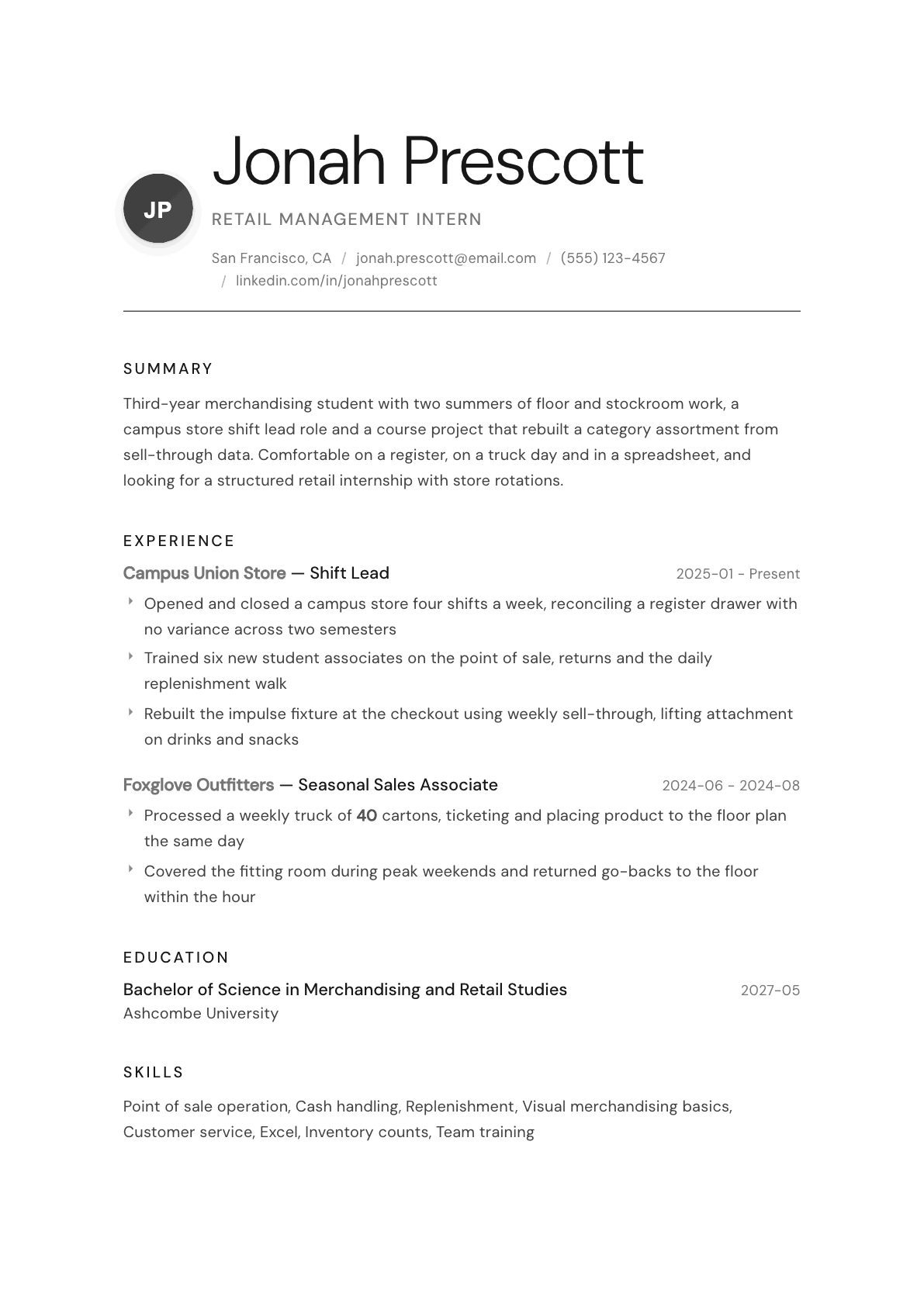
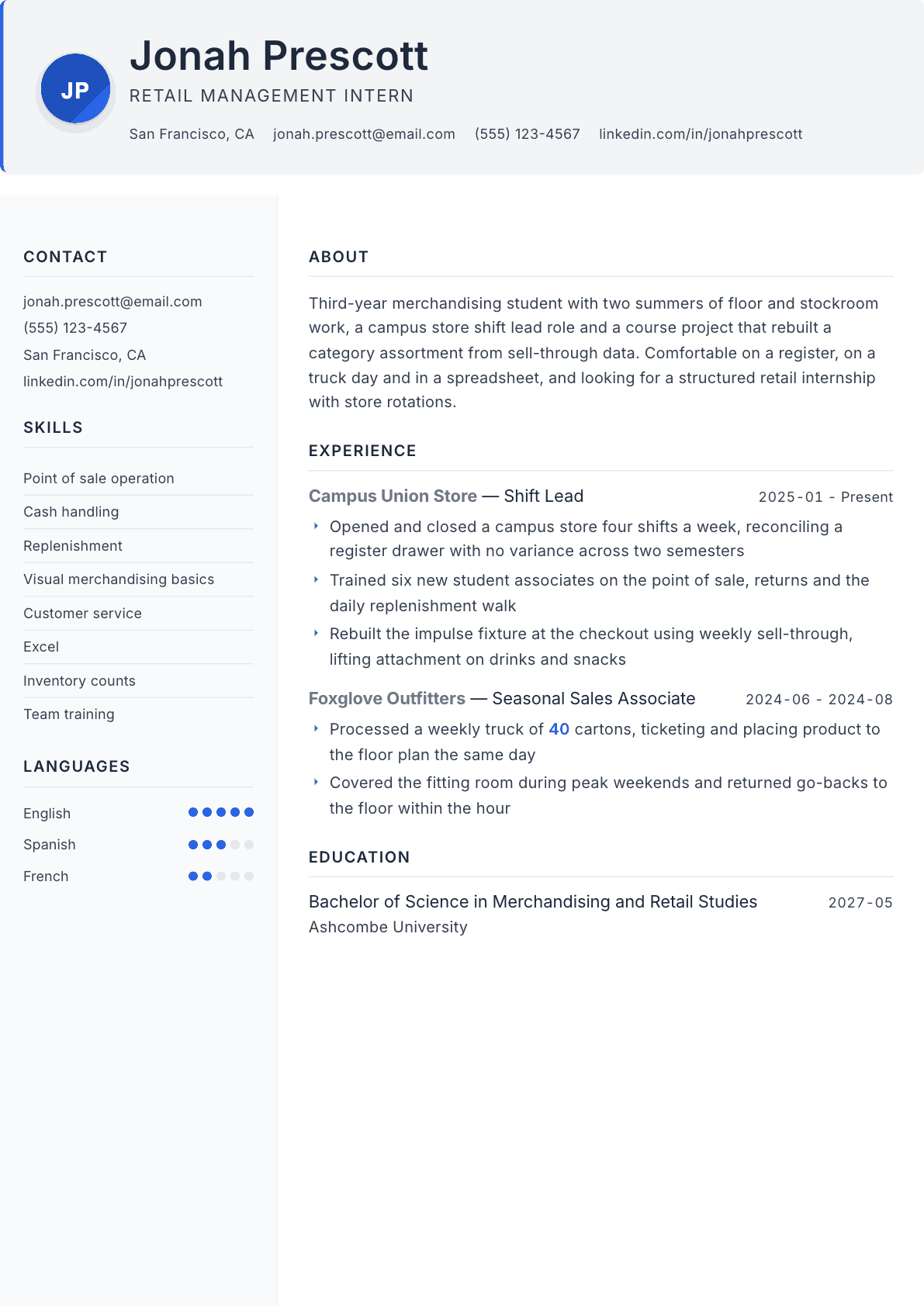
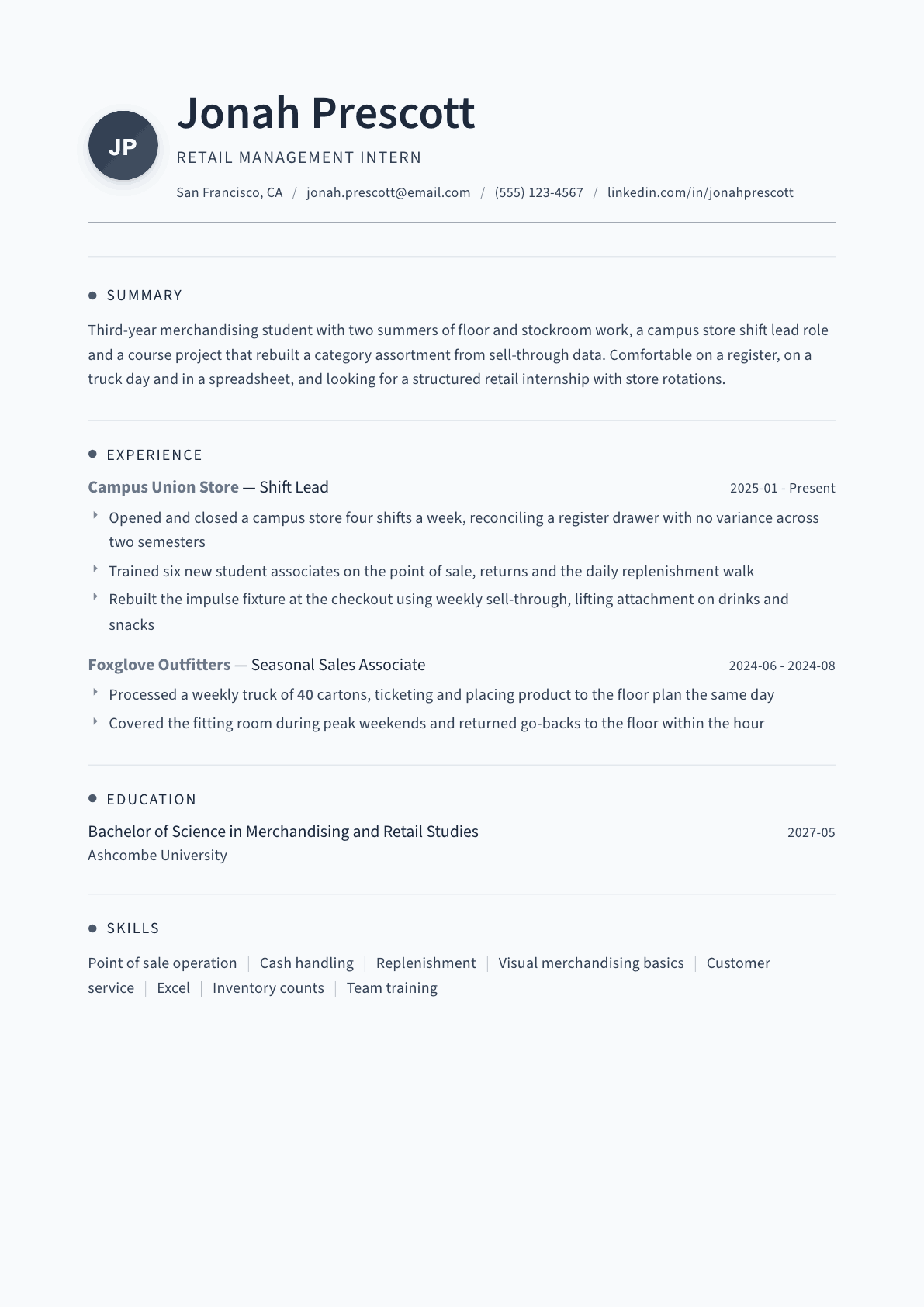
The same retail intern content laid out in three CVBooster templates, so you can see what the finished document looks like before you write a word.
Example Retail Intern summary
Merchandising student in the third year with two summers of store and stockroom work and a shift lead role at the campus store. Handles opening, closing and register reconciliation, trains new associates, and rebuilt a checkout fixture from weekly sell-through. Seeking a retail internship with store rotations and exposure to buying and planning.
Skills to list on a Retail Intern resume
- Point of sale systems
- Cash handling and reconciliation
- Customer service
- Stockroom and receiving
- Replenishment
- Visual merchandising
- Inventory counts
- Microsoft Excel
- Loss prevention awareness
- Team collaboration
- Scheduling availability
- Product knowledge
What actually gets this resume read
- Put education at the top with your major, expected graduation and any retail or merchandising coursework.
- Count every customer-facing job as retail experience, including campus stores, food service and event work.
- Turn a class project into a bullet if it used real assortment, pricing or sell-through data.
- Show availability and weekend flexibility somewhere on the page, because internship programs schedule around store hours.
- Use numbers you actually have: shifts a week, cartons per truck, register variance, associates trained.
- Keep it to one page and skip a skills list of adjectives in favor of systems and tasks you have done.
How to write a retail intern resume
A retail intern resume is written by someone who has not yet held the job they are applying for, and that is fine. Internship programs expect it. The recruiter reading the file is checking three things: whether you can be trusted with customers and a register, whether your availability fits store hours, and whether you have any evidence of curiosity about how a store makes money.
Almost every applicant has a similar transcript, so coursework alone will not separate you. What separates you is the campus job, the summer on a sales floor, the volunteer shift at a thrift shop, or a class project that used real assortment and sell-through data instead of invented numbers.
This guide covers the section order that works when experience is thin, how to turn ordinary jobs into retail evidence, what to do with coursework and projects, and the questions students ask before applying to a store rotation or a corporate merchandising program.
Format: education first, one page, no filler
Put education at the top with your school, major, expected graduation and any retail, merchandising, supply chain or accounting coursework by name. A recruiter for a retail intern program wants to place you into a cohort year, and that line does it.
Keep the whole thing to one page and resist the urge to pad. A short, honest page with three real jobs beats a stretched page carrying a paragraph about being a passionate team player.
- Header: name, phone, school email, city, and a note on relocation if you are open to it.
- Order: education, experience, projects, skills and systems, availability.
- Include your grade point average only if it is strong; leave it off otherwise and nobody will ask.
Experience: every customer-facing job counts
A campus store shift, a summer on a sales floor, a coffee counter, a stadium concession and a summer camp all teach the same core things: handling money, moving fast at peak, and dealing with people who are not at their best. Write them as retail experience rather than apologizing for them.
Use the small numbers you genuinely have. Shifts per week, cartons on a truck day, register variance across a semester, associates you trained, go-backs cleared per hour. Precision at this level reads as maturity, and it is the easiest way to look different from the rest of the cohort.
If you were promoted to shift lead, keyholder or trainer, give that its own line with the date. Early responsibility is the single strongest signal a student resume can carry.
Projects and coursework that earn a place
A project belongs on the page only if it produced something a retailer would recognize: an assortment plan built from sell-through, a pricing analysis, a store layout study with traffic observations, a category review, or a competitive shop with photographs and notes. Write it with the data source, the method and the recommendation.
Case competitions and student retail clubs count too, especially if you held an officer role or presented to judges. Give the scale, such as the number of teams or the size of the audience, so a reader can weigh it.
Skills, systems and availability
Skip the adjectives and list what you can operate: point of sale systems, cash reconciliation, a scheduling app, inventory scanners, Excel with lookups and pivot tables, and any planning or design tools from coursework. Recruiters read this block as a checklist of things they will not need to teach in week one.
Then state availability plainly, including weekends, holidays and how many hours a week you can work during term. Internship coordinators build schedules around store peaks, and a candidate who answers that question on the page saves them a phone call.
Keywords and the application system
Large retailers run intern applications through the same screening tools as full-time roles. The recurring phrases are point of sale, cash handling, customer service, merchandising, replenishment, inventory, stockroom, loss prevention awareness and teamwork. Place each one where it is honestly true.
Mirror the posting language for the program itself, whether it is called a store leadership internship, a merchandising internship or a buying internship, and use that phrase in your summary so a screener matches you to the right track.
Retail Intern resume summary examples
No paid retail yet
Second-year merchandising student with two summers in food service and a volunteer role sorting and pricing donations at a community thrift shop. Comfortable on a register and with peak crowds, and completed a category project analyzing a season of sell-through data. Available full time through the summer.
One retail summer done
Third-year merchandising student and campus store shift lead with a summer as a seasonal sales associate. Opens and closes, reconciles a register drawer with no variance, and trained six new associates. Rebuilt a checkout fixture from weekly sell-through and lifted attachment on drinks and snacks.
Returning intern or final year
Final-year retail studies student returning from a store leadership internship where I covered a department during two truck days a week. Led a floor set with the visual team, ran a competitive shop of four local stores, and presented an assortment recommendation to the store manager and district trainer.
Work experience bullets: before and after
Before: Worked at the campus store.
After: Opened and closed the campus store four shifts a week and reconciled the register drawer with no variance across two semesters.
Shift count and a clean cash record turn a job title into proof you can be trusted alone in a store.
Before: Helped customers on the sales floor.
After: Covered the fitting room through peak weekends and returned go-backs to the floor within the hour to keep sizes shoppable.
It names a specific station and shows you understand why the task exists.
Before: Unloaded shipments and stocked shelves.
After: Processed a weekly truck of 40 cartons, ticketing and placing product to the floor plan the same day it arrived.
Volume and same-day placement show pace, and the floor plan reference shows merchandising awareness.
Before: Did a class project on retail.
After: Rebuilt a category assortment for a class project using a season of sell-through data, recommending four exits and two additions with a margin rationale.
A project is only credible with the data source, the method and a decision at the end.
Before: Trained new team members.
After: Trained six student associates on the point of sale, the returns policy and the daily replenishment walk.
Naming the number and the exact topics shows real responsibility rather than informal help.
Hard skills
- Point of sale operation
- Cash handling and reconciliation
- Customer service
- Stockroom and receiving
- Replenishment and floor recovery
- Visual merchandising basics
- Inventory counts and scanners
- Microsoft Excel
- Sell-through analysis
- Loss prevention awareness
- Scheduling apps
- Product knowledge
Soft skills
- Reliability on posted shifts
- Working through peak
- Coachability
- Team communication
- Curiosity about the numbers
- Handling upset customers
Certifications worth listing
- RISE Up Retail Industry Fundamentals (National Retail Federation Foundation)
- RISE Up Customer Service and Sales (National Retail Federation Foundation)
Mistakes that cost retail intern candidates the interview
- Leaving off food service, campus and volunteer jobs because they were not in a store.
- Filling space with personality adjectives instead of shifts worked, systems used and tasks owned.
- Listing a class project with no data source, method or recommendation attached.
- Hiding availability, which is the practical detail an internship coordinator needs first.
- Sending a two-page resume as a student when everything real fits comfortably on one.
- Using the same file for a store rotation and a corporate buying program without changing the summary.
Retail Intern resume questions
What goes on a retail intern resume with no retail experience?
Any job where you handled money, customers or a schedule, plus coursework and a project built on real data. Volunteer shifts, campus roles and family business work all count, and describing them in store language makes the connection for the reader.
Should I include my grade point average?
Include it when it is strong, and leave it off otherwise. Retail intern programs weigh work history and availability more heavily than transcripts, so the space is usually better spent on a job bullet or a project with a real recommendation.
How do I write a resume for a corporate merchandising internship?
Move analytical evidence up the page. Lead with coursework in merchandising, planning or accounting, then the project where you worked with sell-through or pricing data, then your Excel skills, and keep the store jobs as proof you know the floor.
Is a cover letter needed for a retail internship?
Send one when the application has a field for it. Keep it to three short paragraphs: why this retailer specifically, what your store or campus experience taught you, and your availability. Naming a store you have actually shopped in makes it read as genuine.
How long should a retail intern resume be?
One page, always. If the page looks empty, add a projects section or a short line about the shifts and seasons you are available, rather than stretching the margins or growing the font to fill space.