Sales Engineer Resume Examples: the lines they read
Build a Sales Engineer Resume That Bridges Tech and Sales
By Mustafa Tarabya, founder of CVBooster · Published · Updated
Create a technical sales engineer resume with pre-sales expertise, demo skills, and solution architecture capabilities that SaaS and enterprise tech companies seek.
Sample resumes for a sales engineer
The same sales engineer content laid out in three CVBooster templates, so you can see what the finished document looks like before you write a word.
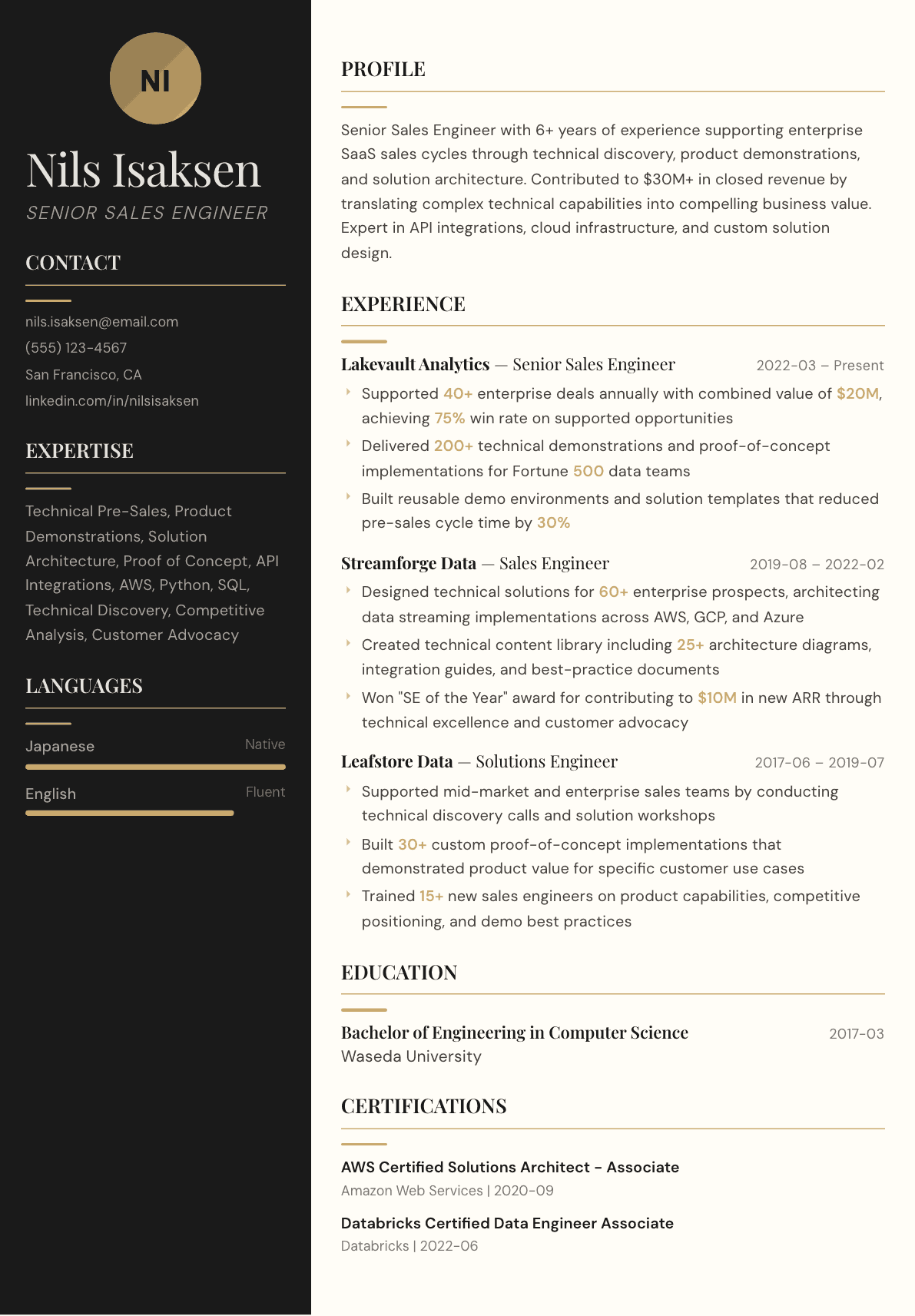
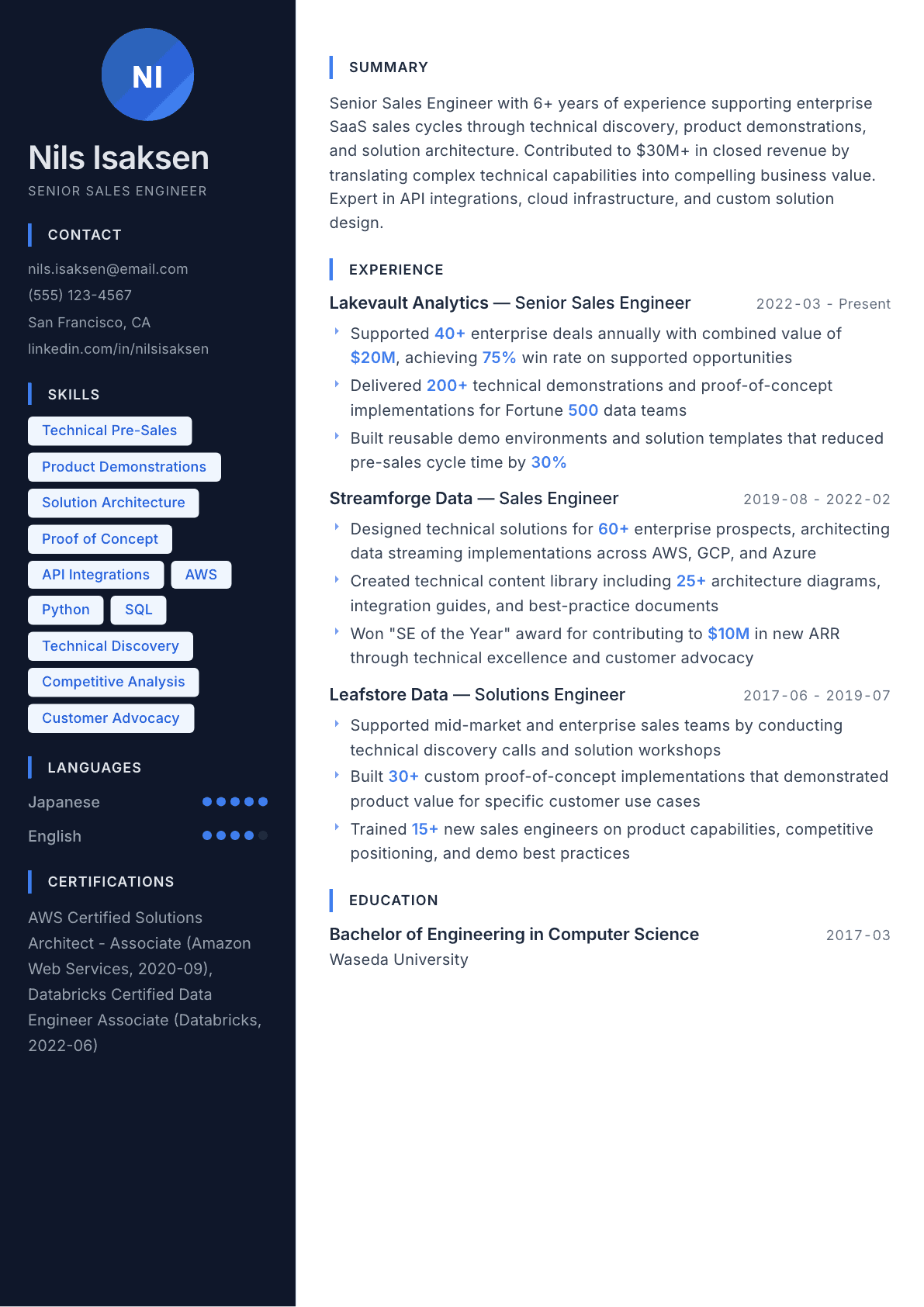
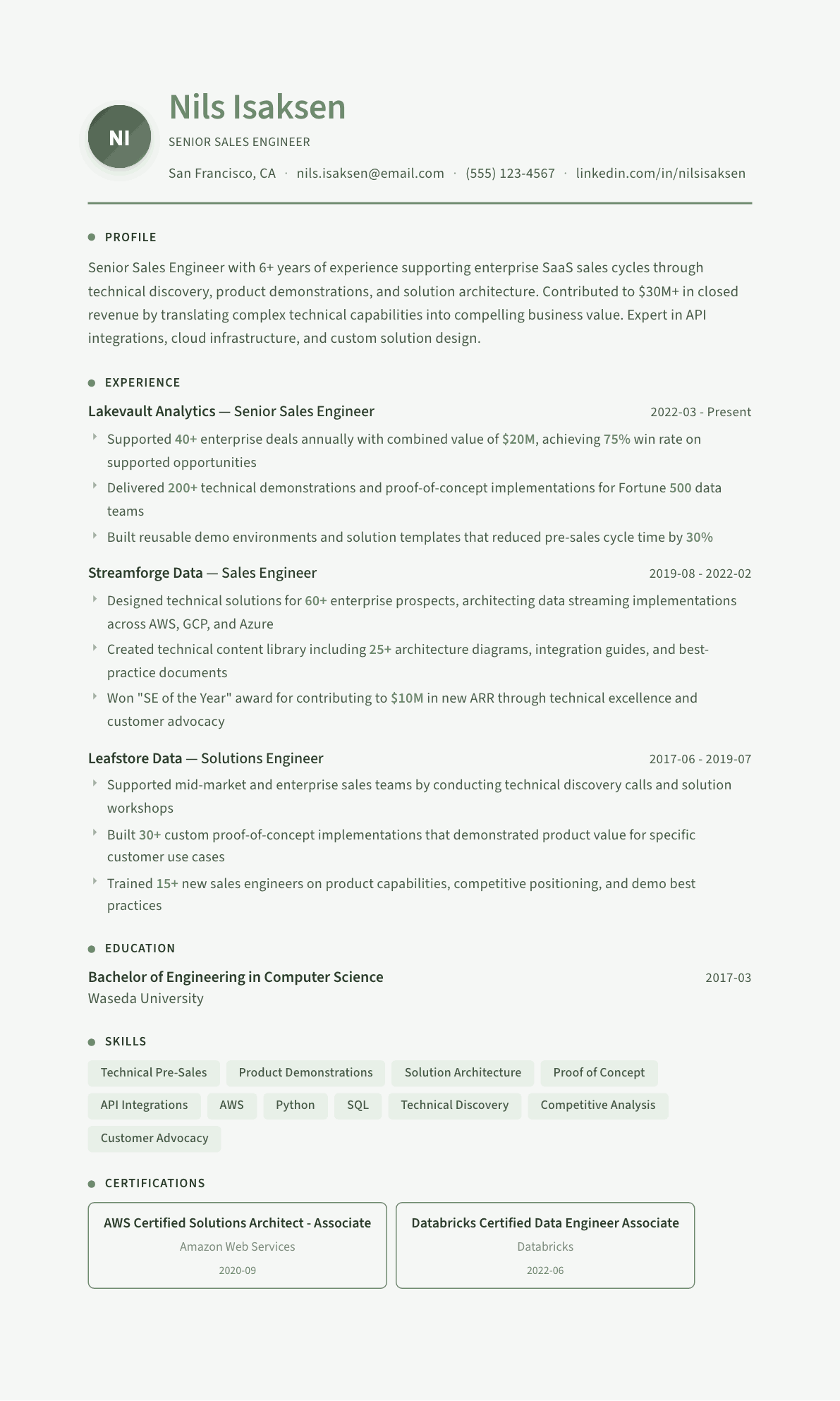
Example Sales Engineer summary
Technical Sales Engineer with 6 years of experience supporting $30M+ in enterprise SaaS deals through expert product demonstrations and solution architecture. Holds a 75% win rate on supported deals at Lakevault Analytics and won SE of the Year at Streamforge Data. Skilled in cloud infrastructure, API integrations, and translating technical capabilities into business value for C-suite buyers.
Skills to list on a Sales Engineer resume
- Sales Engineering
- Technical Pre-Sales
- Product Demonstrations
- Solution Architecture
- Proof of Concept
- API Integration
- AWS
- GCP
- Azure
- Python
- SQL
- Technical Discovery
- RFP Response
- Competitive Analysis
- Customer Training
What actually gets this resume read
- Quantify your deal impact: revenue supported, win rate on your deals, and average deal size.
- Showcase technical depth: list programming languages, cloud platforms, and specific technologies.
- Highlight demo and POC skills -- describe the scale and complexity of demonstrations you deliver.
- Include solution architecture experience: how you design custom implementations for prospects.
- Mention cross-functional collaboration with AEs, product, and engineering teams.
- List certifications in relevant cloud platforms and technologies.
How to write a sales engineer resume
A sales engineer resume has to prove two things that rarely appear together: real technical depth and the ability to influence a commercial outcome. The hiring manager, usually a director of solutions engineering, is checking whether you can run a technical discovery, deliver a demo that survives hard questions, design an architecture that fits the customer environment, and do all of it while an account executive is trying to close a deal to a date.
The mistake most candidates make is writing either a developer resume with a sales job title on it, or a sales resume with no technology in it. Neither passes. The page needs the stack you know, the integration patterns you have designed, the proof of concept work you ran, and the revenue those efforts supported, all on the same page and clearly connected.
This guide covers the structure solutions engineering leaders expect, how to write a summary that names the domain and the technology, how to write bullets about demos and proofs of value, which technical and commercial skills to name, and the questions sales engineers ask when they move from engineering into pre-sales or between product categories.
Format: two pages, technical scope beside deal scope
Two pages is normal once you have a few years in pre-sales, because both the technology and the deal context need room. Open each role with a scope line: what the product was, what technical domain it sat in, the segment and deal size band you supported, how many account executives you paired with, and the volume of opportunities you covered in a year.
Keep a technical skills block that is honest about depth. Group by category rather than listing everything: languages and scripting you actually use, cloud platforms, data and integration technologies, security and identity, and the developer tooling you demo with. A block that lists thirty technologies at equal weight reads as unverified and invites a screening question you will not enjoy.
- Header: name, city and state, phone, email, professional profile link, code or demo portfolio if you keep one.
- Order: summary, technical skills by category, experience with scope lines, certifications, education.
- Scope line: product, technical domain, segment, deal size band, number of account executives supported.
- Say whether you were assigned to accounts, to a region, or pooled across the team.
Summary: domain, stack, deal profile, contribution
Name the technical domain, the stack, the deal profile and what you contributed. A sales engineer supporting data platform deals across cloud environments, running proofs of concept with customer engineering teams in deals that take several months, has described a role a leader can match. A summary about being a technical expert who bridges business and technology is the sentence every pre-sales candidate writes.
If you are moving in from software engineering, implementation or support, say so directly and name what you already do that resembles pre-sales: customer facing troubleshooting, architecture reviews, onboarding sessions, or conference talks. The concern a manager has is whether you can hold a room and handle pressure, so point at the evidence rather than claiming comfort.
Experience: discovery, demo, proof, architecture
Structure your bullets around the four stages of the pre-sales cycle. Technical discovery: the questions you asked, the environment you mapped, the requirements you documented. Demonstration: how many you ran, whether they were tailored or standard, and what you built to make them better. Proof of concept or proof of value: the success criteria you agreed with the customer, who executed it, how long it took, and how many converted. Architecture: the reference designs, integration patterns and migration plans you produced.
Attach a commercial figure where you legitimately can. Win rate on supported opportunities, deals influenced, and technical win rate on proofs of concept are all fair. Be careful with revenue claims, since the account executive closed the deal and an experienced leader will read an inflated attribution as a warning. Saying you supported a set of opportunities and giving the win rate is stronger than claiming the revenue as your own.
Include the work that scales beyond your own deals: demo environments others reuse, technical content and architecture diagrams, competitive battlecards on technical differentiation, request for proposal and security questionnaire responses, and training you delivered to newer sales engineers or to partners. This is what separates a senior sales engineer from a capable one.
- Opportunities supported per year, deal size band, and win rate on those opportunities.
- Demonstrations delivered, and what share were custom built for the account.
- Proofs of concept run, the success criteria used, and conversion to closed business.
- Reference architectures, integration designs and migration plans produced.
- Reusable assets: demo environments, technical content, questionnaire response libraries.
- Field feedback into product: features requested, and any that were built.
Technical depth and how to prove it on paper
Depth is proved by specificity. Naming the databases, message brokers, identity providers, container platforms and cloud services you have configured is more convincing than a list of buzzwords. Describe an integration you designed, including the protocol, the authentication method and the constraint you had to work around, and a reader with a technical background will believe the rest of the page.
Certifications carry real weight in pre-sales because customers and partners see them. Cloud platform certifications, security credentials and vendor product certifications shorten the trust cycle in a technical evaluation. List them with the issuing body and keep them current, since an expired credential on a resume is a small but avoidable signal.
Keywords a solutions engineering leader scans for
Technical discovery, product demonstration, proof of concept, proof of value, solution architecture, integration design, request for proposal response, security questionnaire, competitive positioning, technical win, enablement, and the names of the platforms and protocols. Use the posting language once near the top and again inside a bullet where it is attached to a customer outcome.
Sales Engineer resume summary examples
Moving into pre-sales
Backend engineer with four years building integrations, moving into pre-sales after two years running customer architecture reviews and onboarding sessions alongside the account team. Comfortable with cloud platforms, application programming interfaces and identity protocols, and looking for a solutions engineering seat in developer facing software.
Sales engineer
Sales engineer supporting data platform deals in the mid-market and lower enterprise, paired with three account executives and covering around 45 opportunities a year. Run technical discovery, build tailored demonstrations, and manage proofs of concept against agreed success criteria with customer engineering teams.
Senior solutions engineer
Senior solutions engineer with seven years in streaming data and cloud infrastructure, supporting enterprise deals across three cloud providers. Own the demo environment the team uses, wrote the security questionnaire response library, and mentor two newer engineers through their first customer facing evaluations.
Work experience bullets: before and after
Before: Gave product demos to prospective customers.
After: Delivered around 180 demonstrations a year, roughly a third built against the customer own data model and authentication setup rather than the standard sandbox.
Volume plus the share that were tailored shows the difference between running a script and preparing for a specific account.
Before: Ran proofs of concept for enterprise prospects.
After: Ran 24 proofs of concept against written success criteria agreed with the customer architect up front, completing most within three weeks and converting a strong majority into closed business.
Agreed success criteria and a time box are what separate a controlled evaluation from an open ended technical project.
Before: Designed technical solutions for customers.
After: Designed a streaming integration between a customer order system and a cloud data warehouse using change data capture with a schema registry, working around a network policy that blocked direct outbound connections.
Naming the pattern, the components and the constraint proves the architecture was real rather than a diagram from a slide deck.
Before: Helped the sales team win deals.
After: Supported 45 opportunities a year alongside three account executives, holding a win rate above the regional average on the deals where I led the technical evaluation.
Attributing support and a win rate is credible, where claiming the revenue outright is not since the account executive closed it.
Before: Created documentation and technical content.
After: Built a response library covering 200 recurring security and architecture questions, cutting typical questionnaire turnaround from several days to under one.
A reusable asset with a measured effect on turnaround shows leverage beyond the deals you personally worked.
Hard skills
- Technical discovery
- Custom product demonstrations
- Proof of concept management
- Solution and reference architecture
- API and integration design
- Cloud platforms (AWS, Azure, Google Cloud)
- Identity and access protocols
- SQL and data modeling
- Python and scripting
- Containers and Kubernetes
- Security questionnaire and RFP response
- Competitive technical positioning
Soft skills
- Explaining depth to non-technical buyers
- Composure in hostile demos
- Listening for the real requirement
- Partnership with account executives
- Written clarity
- Saying no to unfit deals
Certifications worth listing
- AWS Certified Solutions Architect, Associate (Amazon Web Services)
- Microsoft Certified: Azure Solutions Architect Expert (Microsoft)
- Google Cloud Professional Cloud Architect (Google Cloud)
- Certified Kubernetes Administrator (CKA) (Cloud Native Computing Foundation)
- CISSP (ISC2)
Mistakes that cost sales engineer candidates the interview
- Writing a pure engineering resume with no deal context, so a pre-sales leader cannot tell whether you have faced a customer under commercial pressure.
- Claiming the full revenue of deals you supported, which reads as inflated attribution to anyone who has run a pre-sales team.
- Listing thirty technologies at equal weight instead of grouping them by real depth.
- Leaving out proof of concept success criteria, when agreeing and controlling them is the core skill of the role.
- Omitting demo volume and how much was tailored, the clearest indicator of how the team actually worked.
- Ignoring reusable assets and enablement, which is what distinguishes a senior sales engineer from a busy one.
- Letting cloud or security certifications expire and leaving them on the page without dates.
Sales Engineer resume questions
How do I move from software engineering into a sales engineer role?
Pull out every customer facing thing you have already done: architecture reviews, onboarding calls, escalation support, conference talks and internal demos. Then name the commercial vocabulary you understand, since the concern a hiring manager has is not your technical ability but whether you can hold a room under pressure.
Should a sales engineer resume include revenue numbers?
Include the opportunities you supported, the deal size band and the win rate on those opportunities rather than claiming the bookings. Pre-sales leaders know the account executive closed the deal, and an honest attribution reads as more senior than an inflated one.
How much code should be on a sales engineer resume?
Enough to prove you can build, not enough to look like an engineering resume. Name the languages you actually script in, one or two integrations or demo environments you built, and any public repository or sample project. Depth in one area beats a long list at shallow depth.
What is the most persuasive metric for a sales engineer?
Proof of concept conversion, because it captures technical skill and commercial control at once. Running an evaluation against agreed success criteria, finishing it inside a time box and converting it into a closed deal is exactly what the role is paid to do.
Do certifications matter for a sales engineer?
They matter more here than in most engineering roles because customers and partners see them during an evaluation and they shorten the trust cycle. A cloud architect certification or a relevant security credential is worth holding current, though it will never substitute for demonstrated evaluation work.