Enterprise Sales Executive Resume Examples: free score
Build an Enterprise Sales Executive Resume That Closes Seven-Figure Deals
By Mustafa Tarabya, founder of CVBooster · Published · Updated
Create a deal-closing enterprise sales executive resume with complex sales cycle management, C-suite selling, and revenue generation that enterprise tech companies demand.
Sample resumes for a enterprise sales executive
The same enterprise sales executive content laid out in three CVBooster templates, so you can see what the finished document looks like before you write a word.
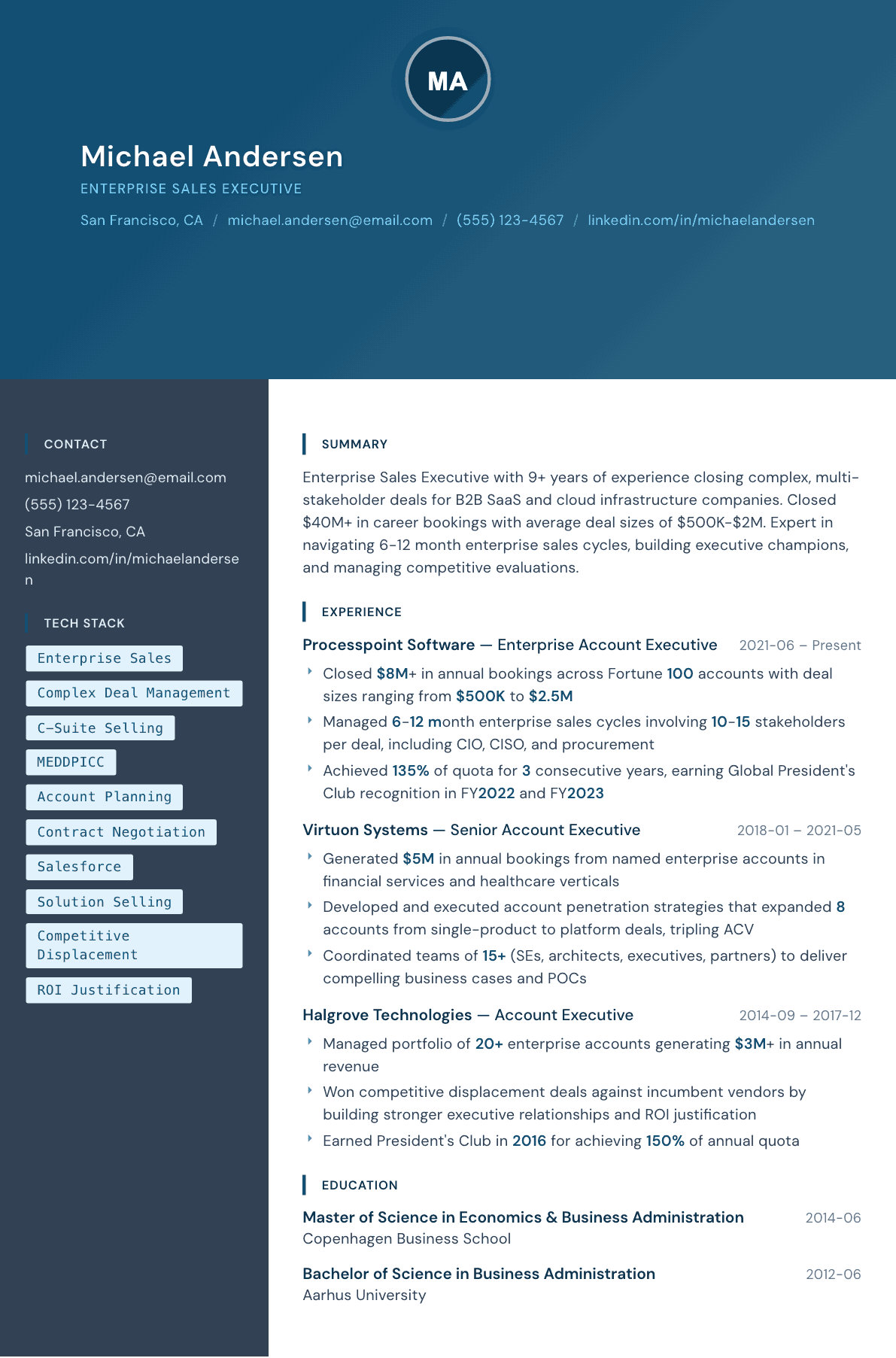
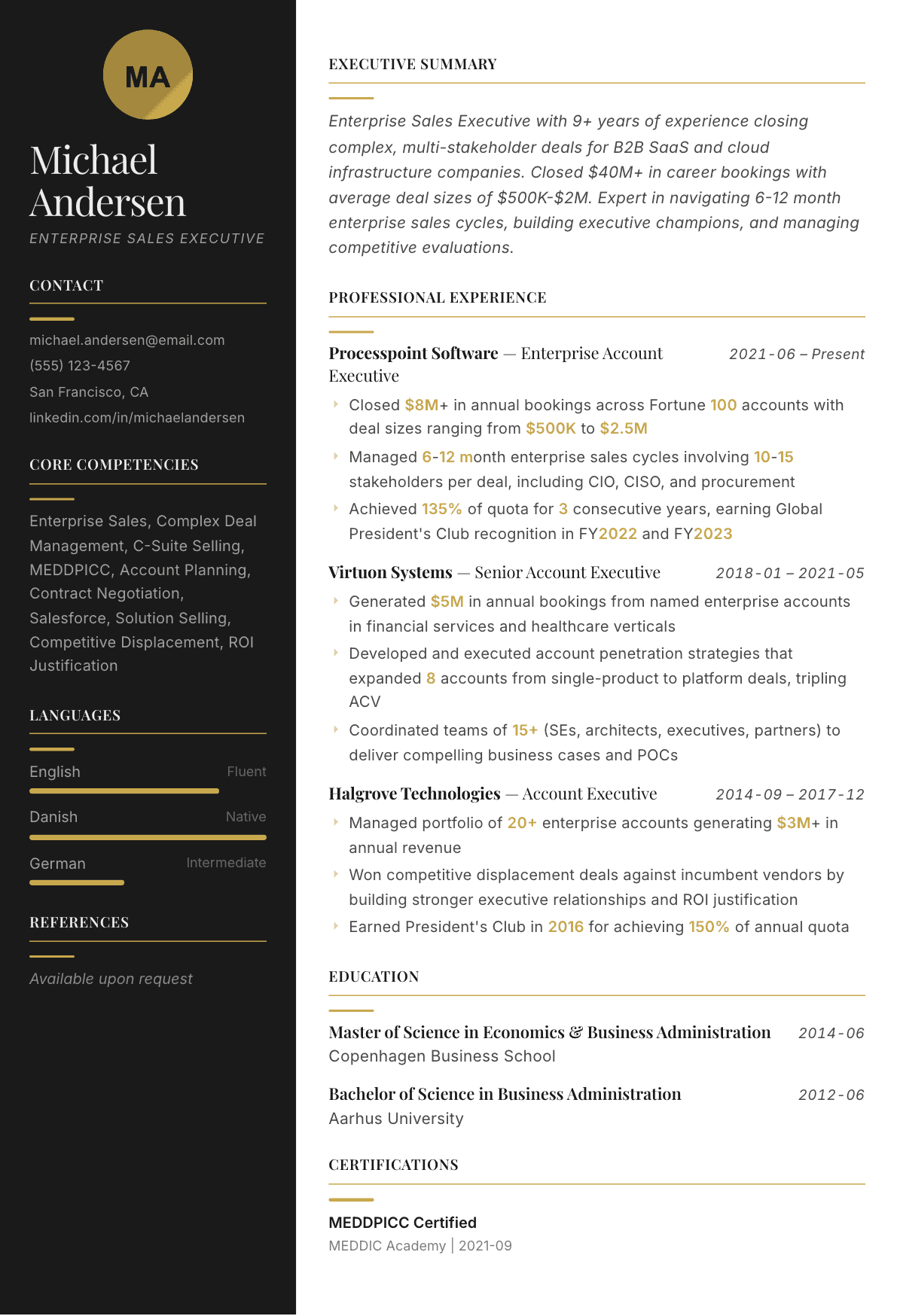
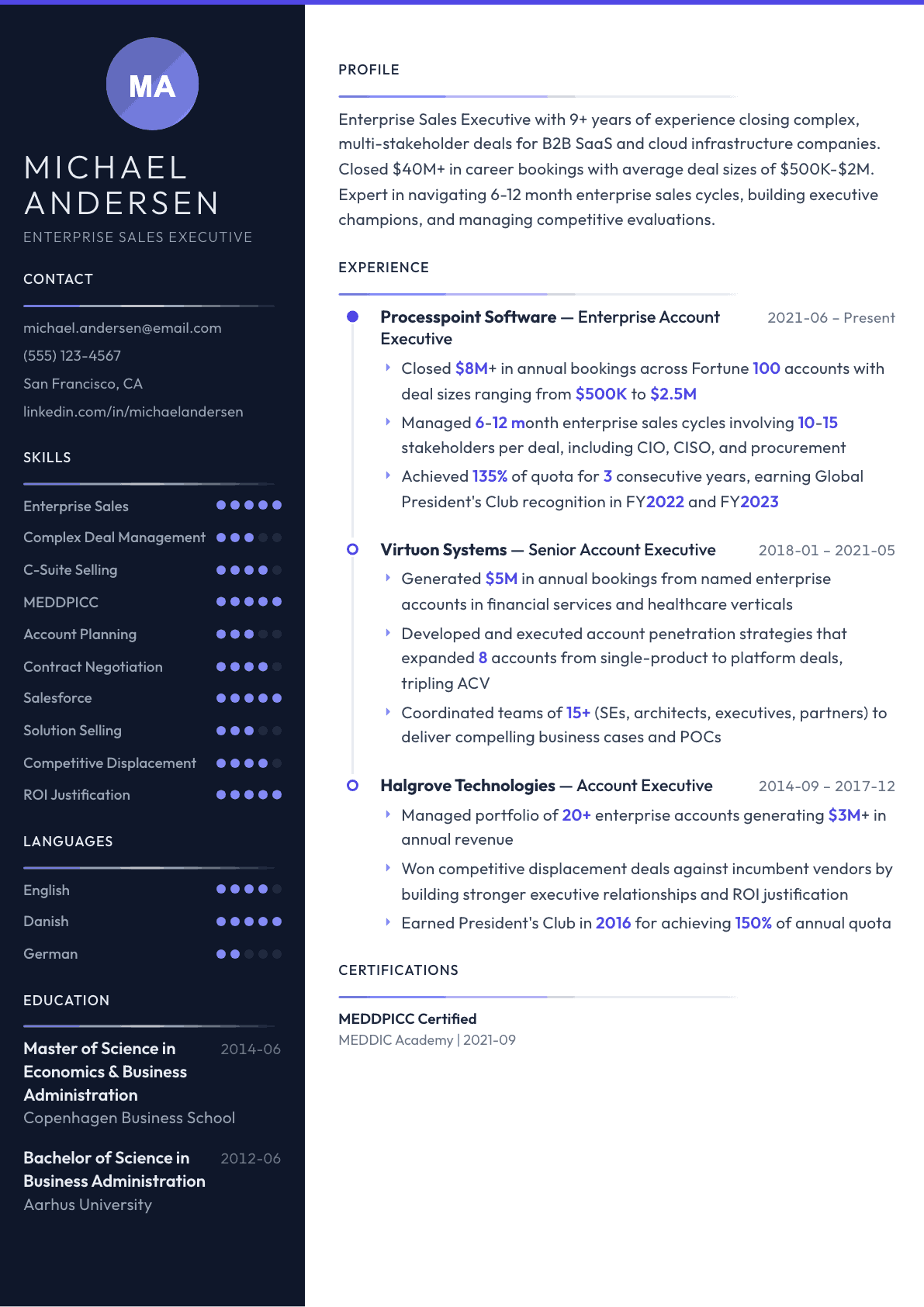
Example Enterprise Sales Executive summary
Top-performing Enterprise Sales Executive with 9 years closing $40M+ in B2B SaaS deals with average sizes of $500K-$2M. Achieved 135% quota attainment for 3 consecutive years at Processpoint Software, earning Global President's Club recognition. Expert in MEDDPICC methodology, C-suite selling, and navigating complex multi-stakeholder evaluations.
Skills to list on a Enterprise Sales Executive resume
- Enterprise Sales
- Complex Deal Management
- C-Suite Selling
- MEDDPICC
- Challenger Sale
- Account Planning
- Contract Negotiation
- Solution Selling
- Competitive Displacement
- ROI Justification
- Salesforce CRM
- Pipeline Management
- Executive Presentation
- Cross-Functional Orchestration
What actually gets this resume read
- Lead with total bookings, average deal size, and quota attainment -- these are the primary enterprise AE metrics.
- Describe deal complexity: number of stakeholders, sales cycle length, and competitive dynamics.
- Highlight executive selling skills: how you build C-suite champions and navigate procurement.
- Showcase sales methodology: MEDDPICC, Challenger, Command of the Message, or Solution Selling.
- Include President's Club or equivalent recognition to validate consistent top performance.
- Mention industry verticals and named accounts (where appropriate) to demonstrate domain expertise.
How to write a enterprise sales executive resume
An enterprise sales executive resume is a case file. The sales leader reading it is trying to work out whether you have genuinely closed complex deals with many stakeholders, or whether you have been carried by an inbound motion and a strong brand. The answer lives in the details: named account count, average contract value, sales cycle length, how many people sat on the buying committee, and what happened when procurement and security got involved.
Quota attainment is the headline, but attainment alone is easy to misread. Two hundred percent of a small quota in a mature territory is a different achievement from a hundred and ten percent of a large one in a new region. The resumes that convert give the quota, the attainment, the ranking and the territory type, so the reader can weigh all four together.
This guide covers the layout enterprise sales leaders expect, how to write a summary that names the deal profile, how to build bullets around a full deal cycle, how to present a year you missed, and the questions enterprise sellers ask when they move up market or change industry.
Format: two pages, deal profile before achievements
Two pages is normal for an experienced enterprise seller and one page usually means the deal detail has been cut. Use a single column with clear job blocks, and open each role with a short scope line: what the company sold, the segment, the territory or named account list, the quota, and the average contract value band. Without that line, every achievement underneath it floats.
Follow the scope line with a quota history. A compact record of quota, attainment and ranking by year is the most efficient block on an enterprise resume, and it lets a leader assess consistency in a few seconds rather than reconstructing it from bullets.
- Header: name, city and state, phone, email, professional profile link.
- Order: summary, quota history, experience with scope lines, methodology and tools, education.
- Scope line: segment, named accounts or territory, quota, average contract value, cycle length.
- Show awards with the year and the population: president club out of how many sellers.
Summary: what you sell, to whom, at what size
Four elements: the category you sell, the buyer you sell to, the deal size band, and the cycle length. An executive who sells data platform software to chief information officers and security leaders in regulated industries, in deals that run six to twelve months across a dozen stakeholders, has described a specific job that a hiring leader can match against their own.
When you are moving up market from mid-market, do not hide it. State the move and point at the evidence: the largest deals you closed, multi-department buying groups, procurement negotiations, or a security review you survived. A leader will discover the gap in the first screen anyway, and candidates who frame it themselves keep control of the conversation.
Experience: whole deals, not activity
At the enterprise level, the strongest bullets narrate a deal or a pattern of deals. Name the entry point, the champion you built, the stakeholders you had to bring along, the competitive situation, the business case you constructed, and the commercial structure that closed it. A single well told displacement of an incumbent vendor tells a leader more than five lines of generic pipeline language.
Expansion belongs on the page as much as new logo work. Land and expand is the core enterprise motion, so show accounts that went from a single department to an organization wide agreement, and say what you did to make it happen: an executive business review, an internal reference program, a usage based proof of value, a multi year commitment negotiated with procurement.
Do not leave the team out. Enterprise deals are sold with solution engineers, professional services, legal, partners and executive sponsors, and a resume that reads as if one person did all of it makes an experienced leader suspicious. Name the size of the pursuit team you coordinated on your largest deals.
- Deal shape: average contract value, largest deal closed, cycle length, stakeholders per deal.
- New logo versus expansion split, so the reader knows which motion you are strong in.
- Win rate on qualified opportunities, and the competitive vendors you displaced.
- Pursuit team size and the internal functions you coordinated.
- Quota, attainment and ranking with the denominator, by year.
Methodology, forecasting and the systems around them
Name the sales methodology you were trained in and actually ran: MEDDIC, MEDDPICC, Command of the Message, Challenger, Force Management or Value Selling. Enterprise leaders hire partly on shared vocabulary, because a team running MEDDPICC needs sellers who can articulate economic buyer, decision criteria and paper process without translation.
Forecast accuracy is a quiet differentiator. A seller whose commit call lands close to actual every quarter is valuable in a way that is rarely written down, so if you have that record, say it plainly and give the basis. Name the customer relationship system, the forecasting tool, and the conversation intelligence platform your calls ran through.
Keywords an enterprise sales leader scans for
Complex sales cycle, buying committee, economic buyer, executive sponsorship, business case, return on investment justification, proof of concept, competitive displacement, procurement negotiation, master service agreement, multi year commitment, annual recurring revenue, expansion, quota attainment, forecast accuracy, and the methodology name. Place each where it is attached to a deal rather than in a keyword list, since the second reader is a leader who has closed these deals themselves.
Enterprise Sales Executive resume summary examples
Moving up market
Mid-market account executive with four years selling workflow software, now closing the largest deals on the team across multi-department buying groups and full security reviews. Trained in MEDDIC, comfortable building business cases with finance stakeholders, and moving into an enterprise seat in regulated industries.
Enterprise AE
Enterprise Account Executive selling data platform software into 25 named accounts in financial services, with deals running six to nine months across ten or more stakeholders including security and procurement. Finished the last two years at 118% and 134% of quota, both new logo and expansion.
Strategic accounts
Strategic account executive with eleven years in enterprise infrastructure, carrying six global accounts and the largest deals in the region. Led pursuit teams of fifteen across solution engineering, services and legal, displaced two incumbent vendors, and closed multi year agreements negotiated directly with procurement.
Work experience bullets: before and after
Before: Sold enterprise software to large companies and exceeded quota.
After: Carried 25 named accounts in financial services against an annual new business quota, finishing at 134% with an average contract value in the mid six figure band and a nine month median cycle.
Account count, industry, quota type, attainment, deal band and cycle length let a leader judge the achievement instead of guessing at it.
Before: Managed complex sales cycles with multiple stakeholders.
After: Ran a twelve month evaluation across fifteen stakeholders including the chief information security officer, built the business case with the finance team, and closed a three year agreement after a competitive proof of concept.
Naming the stakeholders, the artifact you built and the commercial outcome turns a category description into a deal you can be questioned about.
Before: Grew existing accounts through upselling.
After: Expanded a single department pilot into an organization wide agreement across four business units in eighteen months, using quarterly executive business reviews and a documented usage baseline to justify the commitment.
The path from pilot to enterprise agreement, with the mechanism, is the expansion story a leader wants to hear.
Before: Won deals against competitors.
After: Displaced an incumbent vendor in three accounts by mapping renewal dates a year ahead, building a migration plan with solution engineering and covering the switching cost inside a longer term.
Displacement is credible only when the resume shows the timing, the technical plan and the commercial concession that made it possible.
Before: Accurate forecasting and pipeline management.
After: Held commit forecast within 10% of actual bookings across eight consecutive quarters by qualifying on MEDDPICC and removing deals with no documented paper process.
A forecast claim needs a tolerance, a run of quarters and the discipline behind it, otherwise it is an assertion.
Hard skills
- Complex sales cycle management
- MEDDIC and MEDDPICC qualification
- Executive stakeholder mapping
- Business case and value justification
- Competitive displacement
- Proof of concept management
- Procurement and contract negotiation
- Territory and account planning
- Pipeline and forecast management
- Salesforce and Clari
- Multi-year commercial structuring
- Partner co-selling
Soft skills
- Executive presence
- Patience across long cycles
- Internal orchestration
- Commercial judgment
- Written business communication
- Champion coaching
Certifications worth listing
- Salesforce Certified Administrator (Salesforce)
- AWS Certified Cloud Practitioner (Amazon Web Services)
- Certified Professional Sales Person (CPSP) (National Association of Sales Professionals)
Mistakes that cost enterprise sales executive candidates the interview
- Giving attainment without the quota, which makes a strong percentage impossible to weigh against a large territory.
- Listing bookings totals with no average contract value, so the reader cannot tell forty small deals from four large ones.
- Writing every deal as a solo effort, when an experienced leader knows enterprise deals close with a pursuit team.
- Leaving out cycle length and stakeholder count, the two details that prove the deals were genuinely enterprise.
- Ignoring a down year entirely instead of showing it with context such as a territory change or a product transition.
- Naming a methodology you were trained on but never used, which collapses under two follow up questions in the first screen.
- Padding the page with inbound sourced deals while calling the role a hunting seat.
Enterprise Sales Executive resume questions
Should I put my quota number on an enterprise sales resume?
Yes. Attainment is meaningless without it, and leaving it off makes a reader assume the quota was small. Give the annual number as a band if your employer treats exact figures as confidential, and pair it with the attainment percentage and your ranking on the team.
How do I handle a year where I missed quota?
Show it with the reason attached: a territory rebuild, a product sunset, a long procurement freeze at two large accounts, or a maternity or medical leave. A leader who sees one explained miss inside several strong years reads honesty, while a resume that shows only the good years invites doubt about the rest.
How do I show enterprise experience when my deals were mid-market?
Lead with your largest and most complex deals rather than your average one. Highlight buying committees, security questionnaires, legal redlines and multi year terms, since those are the mechanics of enterprise selling and they can appear in a large mid-market deal.
Do awards like president club belong on the resume?
They do, as long as you attach the year and the population it was drawn from. Earning it twice out of a sales organization of two hundred means something specific, while the words award winning on their own read as decoration to a hiring leader.
How much detail should I give about a single large deal?
Two or three lines at most on the resume: the entry point, the stakeholders, the competitive situation and the structure that closed it. Keep the full narrative for the interview, where you will be asked to walk through it stage by stage and the depth actually earns you something.