Pre-Sales Consultant Resume Examples: what gets the call
Build a Pre-Sales Consultant Resume Around Demos and Discovery
By Mustafa Tarabya, founder of CVBooster · Published · Updated
Pre-Sales Consultant resume example and guide: discovery, demos, proof of concept work, technical qualification, ATS keywords and a summary to adapt.
Sample resumes for a pre-sales consultant
The same pre-sales consultant content laid out in three CVBooster templates, so you can see what the finished document looks like before you write a word.
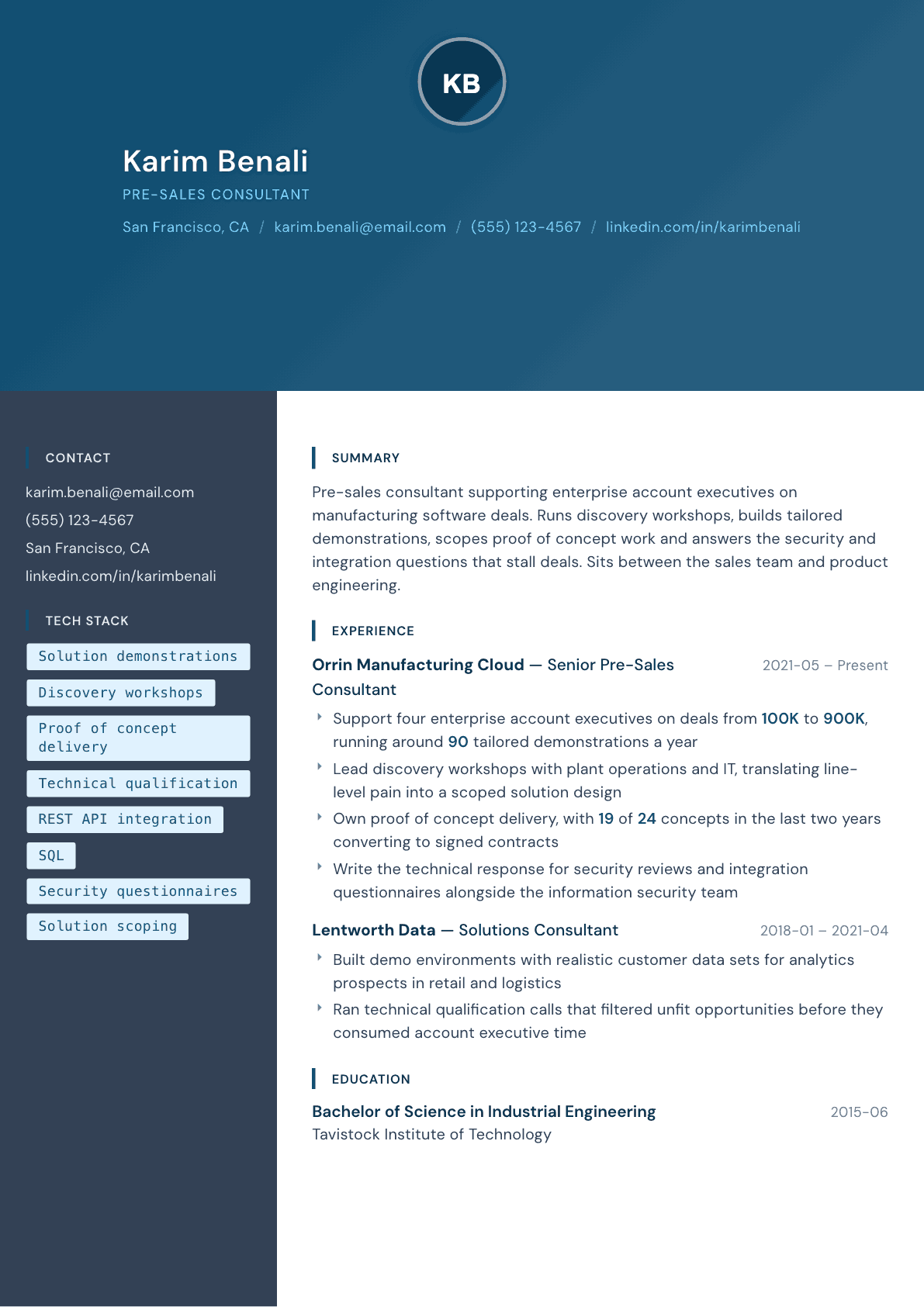
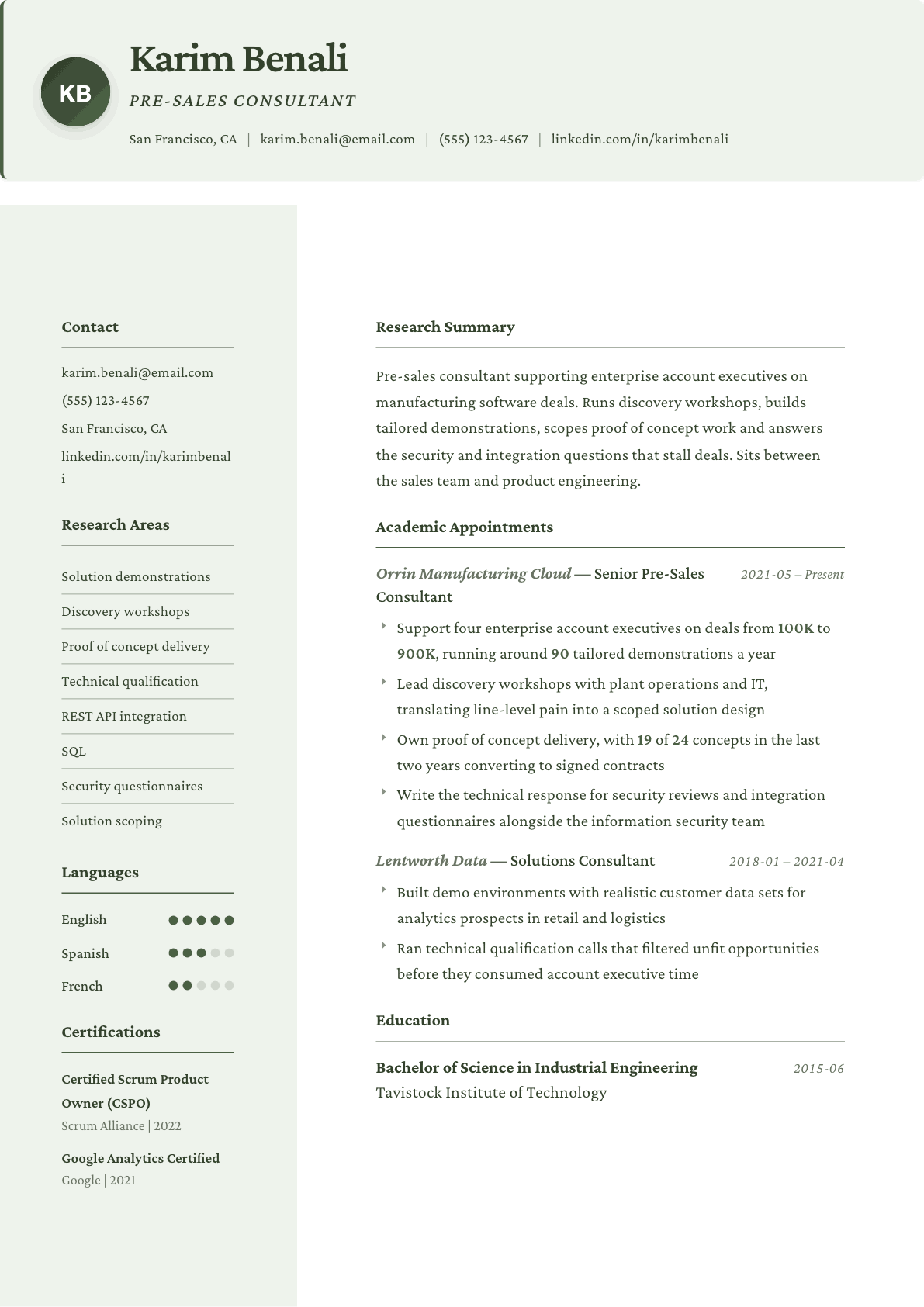
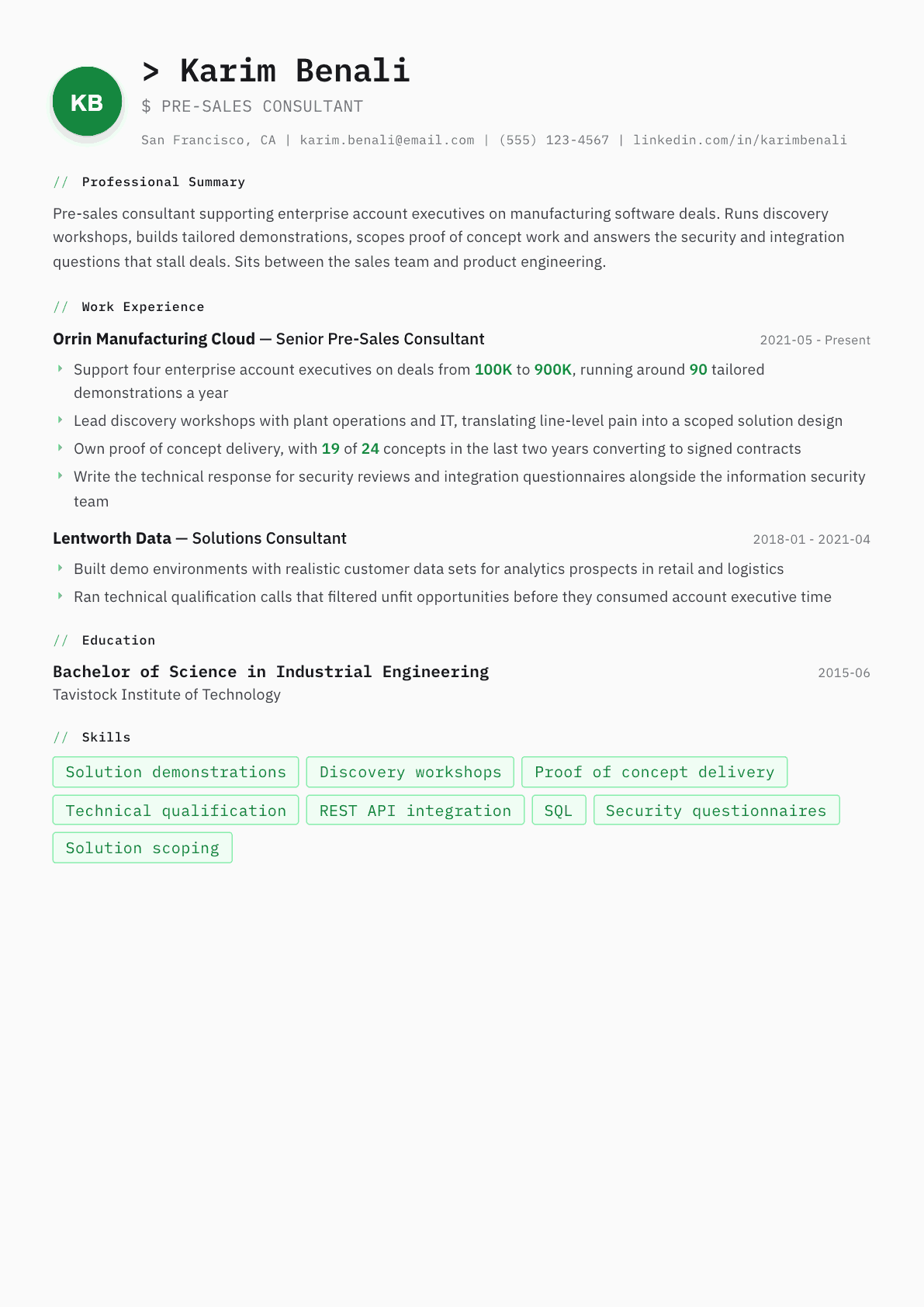
Example Pre-Sales Consultant summary
Pre-sales consultant with eight years supporting enterprise software deals, currently working with four account executives on manufacturing opportunities from 100K to 900K. Runs roughly 90 tailored demonstrations a year, leads plant-floor discovery workshops, and converted 19 of 24 proof of concept engagements into signed contracts. Handles security and integration questions directly. Seeking a senior pre-sales role with regional scope.
Skills to list on a Pre-Sales Consultant resume
- Solution demonstrations
- Discovery workshops
- Proof of concept delivery
- Technical qualification
- Solution architecture basics
- REST API integration
- SQL
- Security questionnaire response
- Demo environment build
- Requirements gathering
- Value and business case modeling
- Objection handling
- Salesforce
- Customer workshop facilitation
What actually gets this resume read
- Pair every technical claim with a commercial one: demos given, concepts converted, and the deal sizes supported.
- Name the product domain and the buyer, because pre-sales credibility comes from knowing that specific customer.
- Show discovery work, not just demo delivery, since the discovery is what makes the demonstration land.
- Give proof of concept results as a ratio of concepts run to deals won, which is the number a manager tracks.
- List the integration and security work you handle, as that is where enterprise deals usually stall.
- Include the demo environment building you do, with the tooling and the data sets you prepare.
How to write a pre-sales consultant resume
A pre-sales consultant resume is graded on a balance most technical resumes get wrong. Too technical and it reads as an engineer who will lecture a prospect. Too commercial and it reads as an account executive who cannot answer a hard integration question. The hiring manager wants proof that you can hold both sides in the same conversation.
The measurable part of this job is easy to miss. Demonstrations delivered, discovery workshops run, proof of concept engagements converted, security questionnaires cleared and deal sizes supported are all countable, and almost every applicant leaves them out. Putting them in immediately separates your resume from the pile.
This guide covers the layout, how to pair technical depth with commercial results, the discovery and proof of concept evidence a pre-sales leader tests in interviews, three summaries across the career, before-and-after bullets and the questions engineers ask when they move into a customer-facing role.
Format: two pages, deal context under every role
Two pages once you have more than a few years, because the product domains, integrations and deal contexts all need naming. Reverse chronological. Under each title, add a context line: how many account executives you support, the deal size band, the segment and the product area.
Keep the technology stack in one clear block rather than sprinkled through the bullets. A pre-sales hiring manager scans that block first to check whether you can talk to their customers about databases, cloud deployment or line-of-business integrations.
- Header: name, city, phone, email, professional profile link.
- Section order: summary, pre-sales experience with context lines, technical stack, delivery or engineering background, education, certifications.
- Context line: sellers supported, deal size band, segment, product domain.
Summary: who you support, on what deals, with what depth
Three or four lines. Name the number of sellers you partner with, the deal band, the product domain and the buyer, and the technical depth you bring: integrations, data modeling, security architecture or industry process knowledge.
Add the industry, because pre-sales credibility is largely domain credibility. A consultant who has walked a factory floor and can talk about line downtime is not interchangeable with one who has only demonstrated to marketing teams, and hiring managers filter accordingly.
Experience: discovery first, demo second
Weak resumes for this role are a list of demonstrations delivered. Strong ones start with discovery, because the discovery determines whether the demonstration lands. Describe the workshop format, who is in the room, the questions you use to reach the operational pain, and the artifact you produce afterward, such as a solution outline or a current-state map.
Then the demonstration work. Say how many you run in a year, whether they are tailored or standard, and how you build the environment: customer data sets, sandbox configuration and integration mocks all take real effort and show up as a stronger demo.
Then the proof of concept. This is the highest-leverage number available to you, so give it as a ratio: concepts run against deals won. Add the success criteria discipline, meaning that you agree written exit criteria with the customer before the concept starts, since that is what separates a controlled evaluation from an open-ended engineering favor.
- Demonstrations delivered per year, tailored versus standard.
- Discovery workshops run, with the roles in the room.
- Proof of concept engagements, success criteria agreed, and conversion to closed deals.
- Security and integration questionnaires completed, and the review outcomes.
Technical depth: name it precisely and honestly
List the specific technologies you can defend in a customer conversation: query languages, integration patterns, identity and access standards, cloud deployment models, data pipeline concepts and any industry protocols. Overstating this section is dangerous, because a customer architect will find the ceiling in ten minutes and the account executive will remember.
Include the engineering or delivery background if you have one. Time spent implementing the product, running support escalations or building integrations is a genuine advantage in pre-sales and should be visible, compressed into a short block if it was several years ago.
Keywords that match pre-sales postings
Postings reuse a consistent set: solution consultant, sales engineer, technical pre-sales, discovery, demonstration, proof of concept, proof of value, request for proposal support, technical qualification, solution design, business case, value engineering, security review and integration architecture.
Add the commercial language too, since this is a revenue role. Pipeline support, deal strategy, qualification framework, close plan and executive alignment all belong on the page when you genuinely take part in them.
Pre-Sales Consultant resume summary examples
Moving in from implementation
Implementation consultant with three years deploying manufacturing software on customer sites, including integration work and end-user training. Ran the technical portion of six sales demonstrations in 2024 at the account team's request. Moving into a dedicated pre-sales role with a strong delivery grounding.
Pre-sales consultant on enterprise deals
Pre-sales consultant supporting four enterprise account executives on manufacturing software deals from 100K to 900K. Runs around 90 tailored demonstrations a year, leads plant-floor discovery workshops with operations and IT, and converted 19 of 24 proof of concept engagements into signed contracts.
Principal or team lead
Principal solutions consultant with eleven years in industrial software, leading a team of five across two regions. Owns the demonstration standard, the proof of concept exit criteria template and the security response playbook, and personally supports the three largest opportunities in each quarter.
Work experience bullets: before and after
Before: Delivered product demos to prospective customers.
After: Run around 90 tailored demonstrations a year, each built on a sandbox loaded with the prospect's own process data and configured to the two workflows identified in discovery.
Volume plus how the demo is prepared shows tailoring rather than a repeated standard presentation.
Before: Gathered customer requirements before demos.
After: Lead half-day discovery workshops with plant operations, maintenance and IT, and produce a current-state process map with three quantified pain points that becomes the demonstration script.
Naming the format, the attendees and the artifact proves discovery is a structured method, not a phone call.
Before: Supported proof of concept projects.
After: Own proof of concept delivery end to end, agreeing written success criteria with the customer before kickoff, with 19 of 24 concepts over two years converting to signed contracts.
Exit criteria plus a conversion ratio show a controlled evaluation process and the commercial result it produced.
Before: Answered technical questions from customers.
After: Write the technical response for security reviews and integration questionnaires with the information security team, clearing reviews at three regulated customers without an external audit exception.
The specific artifact and a clean review outcome are what enterprise buyers and hiring managers actually care about.
Before: Worked closely with the sales team on deals.
After: Partner with four account executives on deal strategy, run technical qualification calls that disqualified unfit opportunities early, and contribute the technical sections of every close plan above 250K.
Disqualification and close plan ownership show commercial judgment rather than passive support on request.
Hard skills
- Solution demonstrations
- Discovery workshop facilitation
- Proof of concept design and delivery
- Technical qualification
- Solution architecture fundamentals
- REST API and integration patterns
- SQL and data modeling
- Identity and access standards
- Security questionnaire response
- Demo environment configuration
- Business case and value modeling
- Request for proposal technical response
Soft skills
- Explaining depth without condescension
- Reading a room of mixed technical levels
- Saying no to an unfit requirement
- Partnership with account executives
- Question discipline in discovery
- Composure in a hostile technical review
Certifications worth listing
- AWS Certified Solutions Architect, Associate (Amazon Web Services)
- Microsoft Certified: Azure Solutions Architect Expert (Microsoft)
- Salesforce Certified Administrator (Salesforce)
Mistakes that cost pre-sales consultant candidates the interview
- Listing demonstrations without discovery, which suggests you present the product rather than diagnose the customer.
- Omitting proof of concept conversion, the single strongest number a pre-sales consultant can put on a page.
- Overstating technical depth, which a customer architect exposes quickly and an account executive never forgets.
- Leaving out deal sizes and the number of sellers supported, so a manager cannot judge the scale you operate at.
- Writing a pure engineering resume with no commercial outcomes, when this is a revenue-facing role.
- Hiding an implementation or support background that would give you real credibility with a technical buyer.
Pre-Sales Consultant resume questions
What is the difference between a pre-sales consultant and a sales engineer?
Mostly regional and company convention: both support sellers with discovery, demonstrations and technical validation. Sales engineer tends to carry more hands-on configuration, while pre-sales consultant leans toward process and business case work. Use the title of the job you are targeting in your summary.
Do pre-sales consultants carry a quota?
Usually a shared one tied to the territory or the account executives you support, sometimes with a component for proof of concept conversion. Say which model you worked under, because it tells a hiring manager how commercially accountable you have been.
How technical does this role need to be?
Deep enough to design a credible solution and survive a customer architecture review, not deep enough to build the product. Be precise about where your ceiling sits: comfortable with integration patterns and query languages, for example, while relying on engineering for performance tuning.
How do I move from engineering into pre-sales?
Volunteer for customer-facing work first: escalations, onboarding sessions, technical portions of demonstrations. Then rewrite your resume around customer outcomes rather than tickets closed, and name the deals or accounts your technical work helped win or retain.
Should I list certifications for cloud platforms?
Yes when they match the stack your prospects run on, because they shorten the credibility conversation with a customer architect. Keep them in a short section near the end, and drop any that have lapsed rather than leaving an outdated credential on the page.