Sales Executive Resume Examples: the lines they read
Executive Sales Resume Examples That Lead With Quota
By Mustafa Tarabya, founder of CVBooster · Published · Updated
Executive sales resume examples from sales executive to sales director, with quota attainment, deal size and pipeline bullets, keywords and a full guide.
Sample resumes for a sales executive
The same sales executive content laid out in three CVBooster templates, so you can see what the finished document looks like before you write a word.
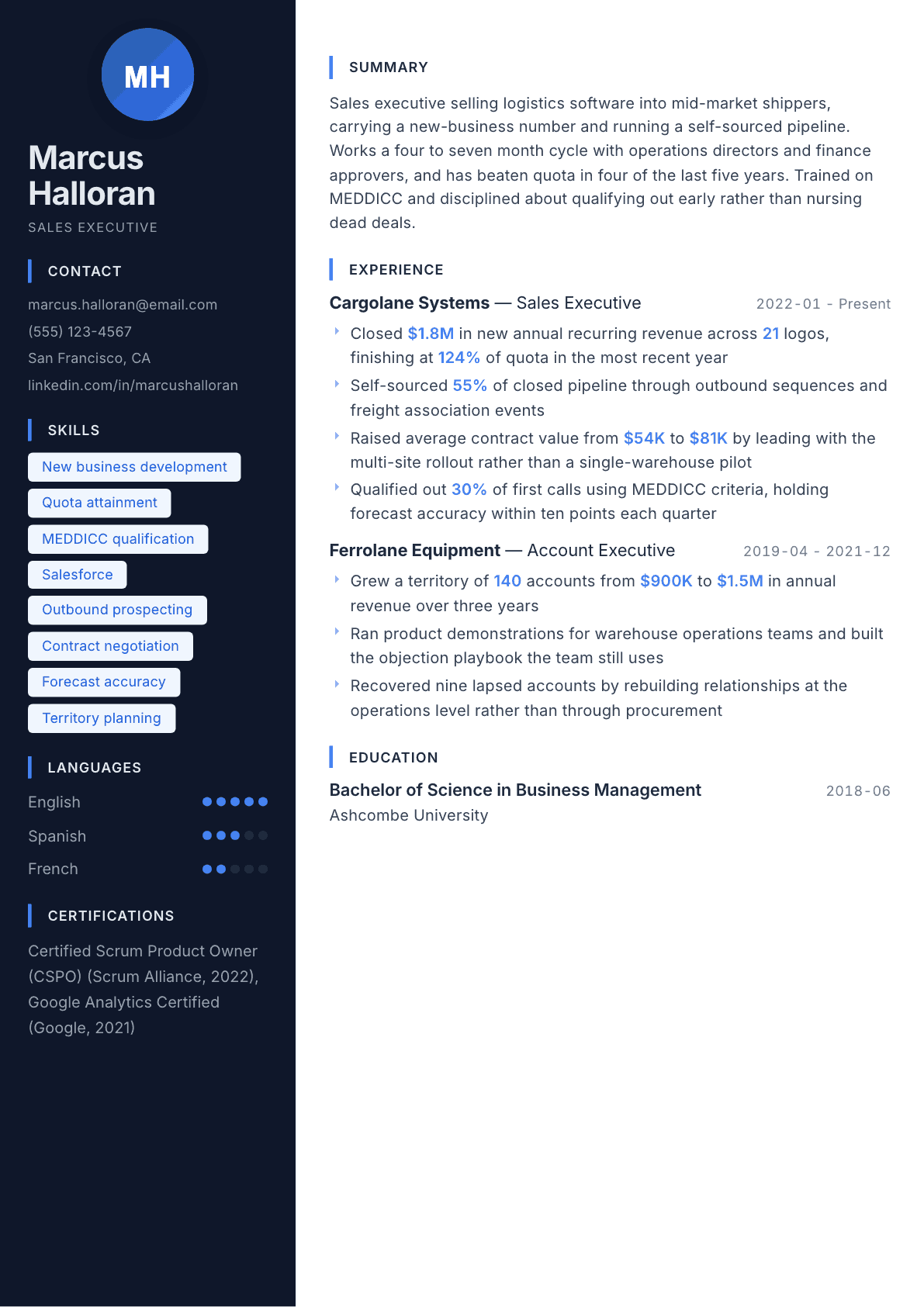
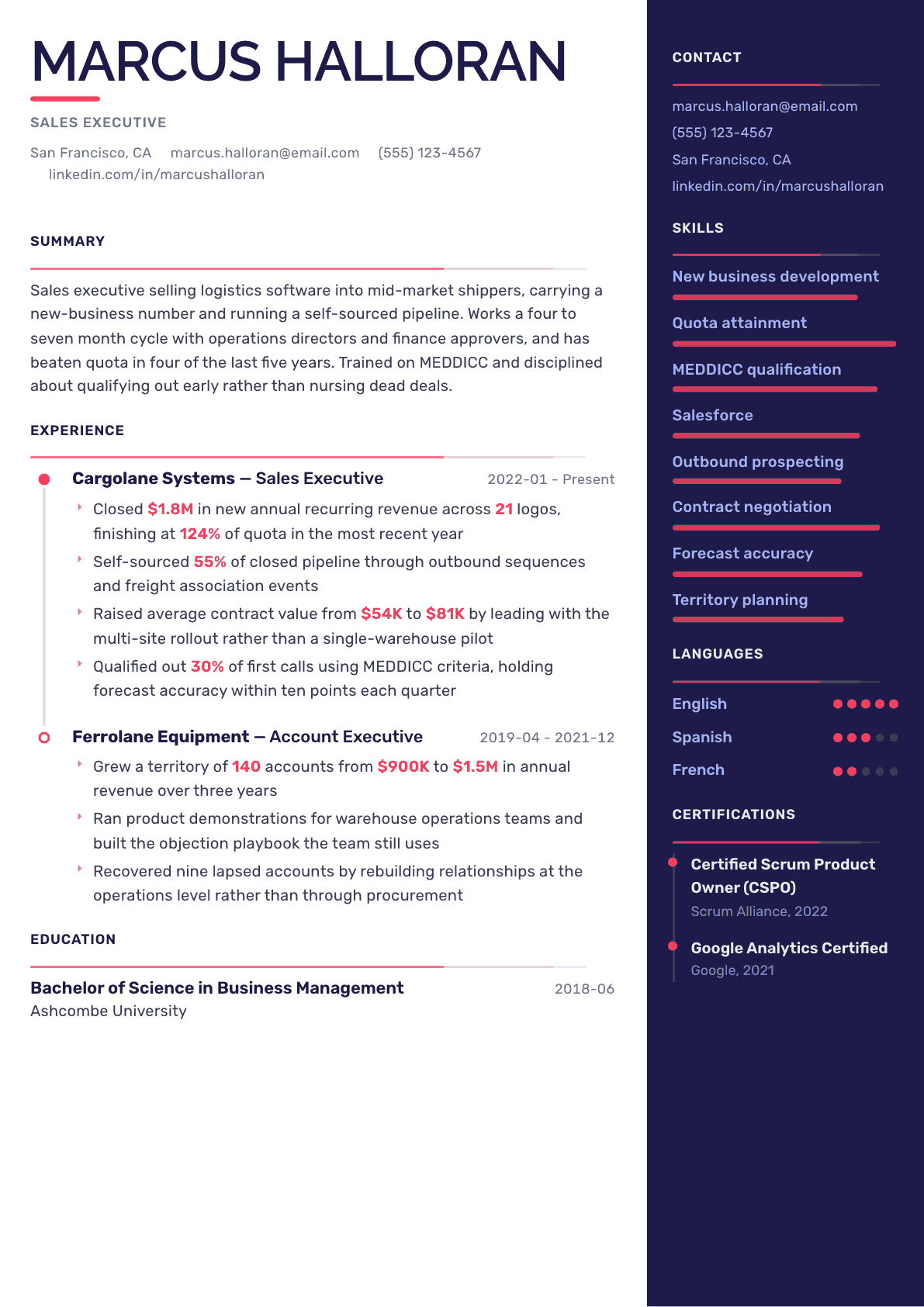
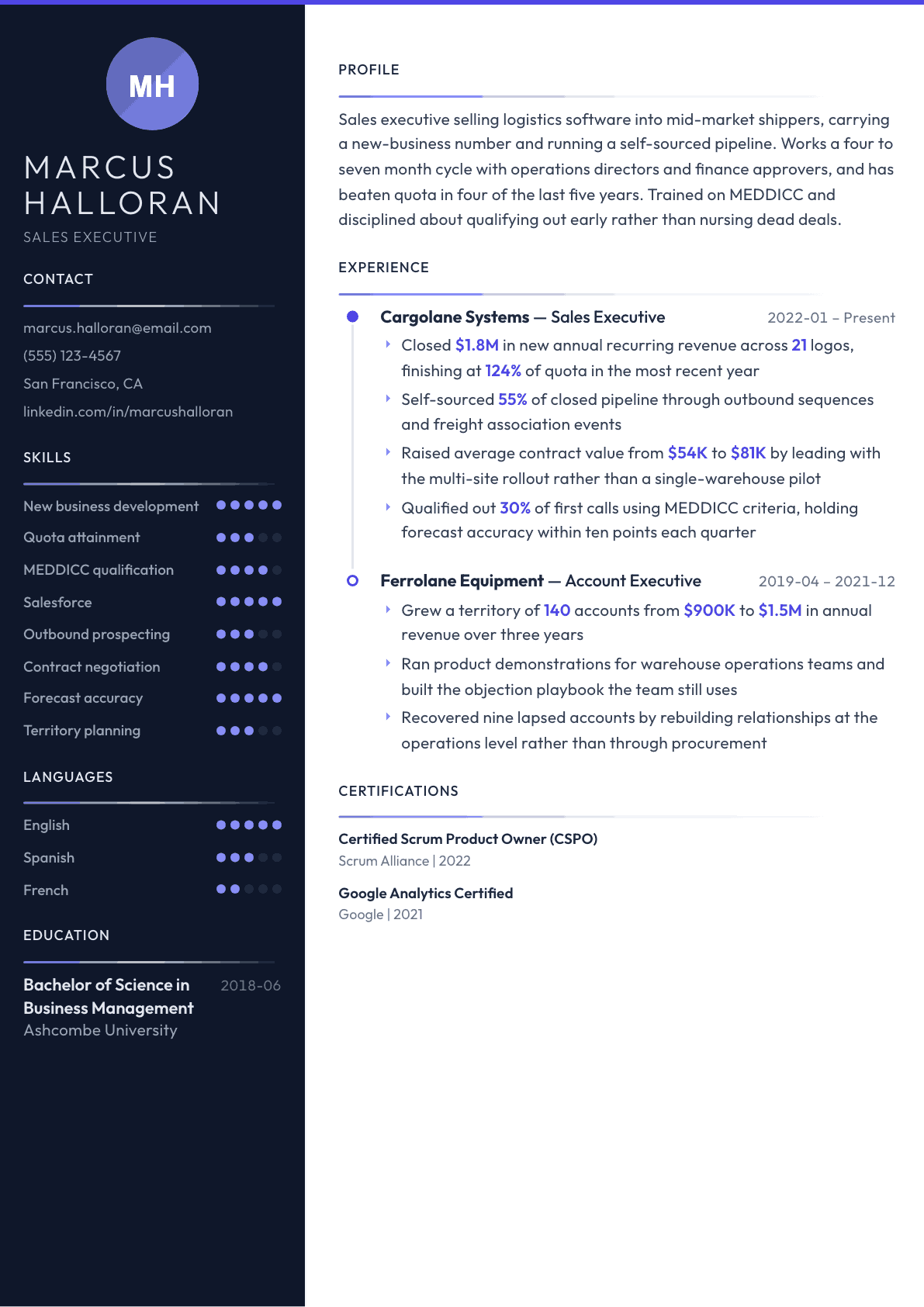
Example Sales Executive summary
Sales executive with six years selling logistics software and equipment into mid-market accounts, most recently closing $1.8M in new annual recurring revenue across 21 logos at 124% of quota. Self-sources more than half of closed pipeline, sells to operations directors and finance approvers on a four to seven month cycle, and holds forecast accuracy within ten points every quarter.
Skills to list on a Sales Executive resume
- New business development
- Quota attainment
- Pipeline generation
- MEDDICC
- Solution selling
- Outbound prospecting
- Discovery and qualification
- Contract negotiation
- Salesforce
- Territory planning
- Forecast accuracy
- Executive stakeholder management
- Product demonstration
- Annual recurring revenue growth
What actually gets this resume read
- Open with a number line under your title: quota, attainment, average deal size and cycle length in one row.
- Give attainment for every year you sold, because a single strong year without context reads as a fluke to a sales director.
- Separate new business from renewal and expansion revenue, since hiring managers pay for the motion they need.
- Name the qualification framework you were trained on, whether MEDDICC, SPIN, Challenger or Sandler, and show it in a bullet.
- Describe the buyer titles you sell to and the size of the buying committee, not just the industry vertical.
- Include forecast accuracy or pipeline coverage if you can, because those separate a disciplined seller from a lucky one.
How to write a sales executive resume
A sales director hiring a sales executive is doing arithmetic. She has a number to make next year, a headcount to fill, and roughly ninety seconds per resume to decide whether you can carry a piece of that number. Everything she needs is quantitative: what you carried, what you delivered against it, how big your deals were, how long they took, and how much of the pipeline you created yourself.
Most sales executive resumes bury that arithmetic under adjectives. Dynamic, results-driven, passionate about exceeding expectations. None of it survives contact with a sales leader who has read a thousand of them. The resumes that convert put the numbers in the first block on the page and spend the rest of the document explaining how those numbers were produced.
This guide covers the number line under your title, three executive sales resume examples from seller to director, how to present attainment across several years, how to write about self-sourced pipeline and forecast discipline, and how to handle the parts of the record that are awkward: a short tenure, a missed year, a territory that was cut underneath you.
Put the number line directly under your title
Before the summary, or as its first sentence, give the operating facts of your last role in one row: quota carried, attainment, average contract value, cycle length and the split between new business and expansion. A sales leader can size you from that row alone, and everything below it becomes evidence rather than assertion.
Then name the market. Mid-market logistics software sold to operations directors is a specific motion. Enterprise infrastructure sold through procurement is another. Small business sold in a single call is a third. The closer your last motion is to hers, the shorter your ramp, and ramp is what she is really pricing.
- Quota, attainment and the currency-free ratio between them.
- Average contract value and cycle length in months.
- New business against renewal and expansion.
- Buyer titles and the number of people in a typical buying group.
Attainment: show the whole record
Give attainment for every selling year, not just the good one. A row per year inside each job entry works well and takes three lines. A candidate who shows four years of attainment reads as a professional who tracks their own performance. A candidate who shows one reads as somebody hoping the rest is not asked about.
When a year fell short, say why in a single clause and say what changed. Territory splits, a product gap, a segment that stopped buying, a long ramp after a move upmarket. Sales leaders have lived through every one of those. What they cannot forgive is discovering the miss in a reference call.
Rank yourself against the team when the ranking is favorable. Finishing third of twenty-two in a hard year says more than an absolute figure, because it holds the conditions constant.
Self-sourced pipeline is the differentiator
Almost every posting for this role asks for hunters and almost every applicant claims to be one. The proof is the share of closed revenue that started from your own outbound rather than from marketing or an inbound queue. Give that share as a figure, and describe the mechanism: the sequences you ran, the events you worked, the partner introductions, the account research that opened the first conversation.
Pipeline coverage belongs here too. Carrying three times coverage entering each quarter and saying how you built it tells a manager you will not arrive in week ten with nothing to forecast.
Qualification and forecast discipline
Name the qualification framework you were trained on and then show it working: MEDDICC, SPIN, Challenger, Sandler, Command of the Message. The framework name alone is a keyword. The bullet that says you qualified out a third of first calls against explicit criteria is the evidence.
Forecast accuracy is the most underused metric on sales resumes. If you can say your commit landed within a stated band each quarter, put it on the page. Directors are judged on their forecast, so a seller whose numbers can be trusted is worth more than a seller who occasionally overdelivers by surprise.
Deal reviews, mutual action plans and close plans are worth a line if you used them. They show a seller who runs a process rather than one who hopes.
Awkward history: short tenures and territory changes
Short stints are common in sales and a leader will ask about them. Handle it on the page with a bracketed clause: role eliminated in a restructure, territory merged, company acquired, product sunset. One clause removes the suspicion that would otherwise fill the gap.
If you moved between segments or industries, add half a sentence on what transferred. Sellers are hired for a motion, and showing you understand which parts of yours are portable is itself a signal of judgment.
Executive sales resume examples: three samples by level
Executive sales resumes all lead with the same proof, the number, but the number changes with the seat. A sales executive carries a personal quota, a senior or enterprise seller shows deal size and buying group complexity, and a sales director or vice president shows the team number and how it was built. The samples below are invented; keep the structure and use your own figures.
- Sales executive, mid market software: Headline: Sales Executive, mid market HR software, above quota in each of the last three years. Summary: Closes new business with companies of 200 to 1,000 staff, five figure annual contracts, half of pipeline self sourced. Best bullet: Won the largest new logo in the region in year two after a six month cycle with finance, HR and IT.
- Senior sales executive, industrial equipment: Headline: Senior Sales Executive, capital equipment, territory of 60 accounts. Summary: Sells packaging lines to food and beverage plants with cycles of 9 to 18 months and buying groups of plant managers, engineers and procurement. Best bullet: Grew the territory from 3.1 million to 4.6 million in annual bookings over two years by winning two multi site agreements.
- Sales director, executive level: Headline: Director of Sales, 14 sellers across two regions, team above plan two years running. Summary: Builds and runs field teams, owns the regional forecast and hiring, and reports to the vice president of sales. Best bullet: Took over a team that had missed plan for two years, hired six of fourteen sellers, and brought the regional forecast back in line with results by the third quarter.
- At every level, the first line under your name should carry one number a sales leader can check in a reference call.
Sales Executive resume summary examples
First quota-carrying role
Sales executive promoted from development after four quarters over target, now carrying a new business number in a small business segment. Closed 41 logos in the first year at 96% of quota on a six-week cycle, self-sourcing most opportunities through outbound sequences and territory research.
Five years, mid-market
Sales executive selling logistics software to mid-market shippers on a four to seven month cycle. Closed 21 logos at 124% of quota in the most recent year, self-sourced 55% of closed pipeline, and lifted average contract value by leading with multi-site rollouts instead of single-site pilots.
Senior executive on complex deals
Senior sales executive running multi-stakeholder deals through operations, finance and procurement, with an average cycle near nine months. Beat quota in four of the last five years, held forecast commit within ten points every quarter, and mentors two newer executives on qualification and close planning.
Work experience bullets: before and after
Before: Consistently exceeded sales targets.
After: Finished at 124% of quota on 21 new logos in the most recent year, after 108% and 91% in the two prior years, with the shortfall coming from a mid-year territory split.
A multi-year record with the weak year explained is far more credible than an unqualified claim of consistency.
Before: Generated my own leads through prospecting.
After: Self-sourced 55% of closed pipeline through outbound sequences into operations directors and by working two freight association events each year rather than waiting on marketing.
The share and the mechanism turn a hunter claim into something a sales leader can verify in a reference call.
Before: Increased the size of deals I closed.
After: Raised average contract value by leading with a multi-site rollout business case instead of a single-warehouse pilot, which also removed the pilot-to-production renegotiation from the cycle.
The tactic and its second-order effect show a deliberate change in how the deal was framed.
Before: Used MEDDICC in my sales process.
After: Qualified out roughly 30% of first calls against explicit MEDDICC criteria, which kept the pipeline honest and held forecast commit within ten points of actual every quarter.
Disqualification with a resulting forecast band proves the framework was applied rather than merely attended.
Before: Grew my territory over three years.
After: Grew a territory of 140 accounts by roughly two thirds over three years, recovering nine lapsed accounts by rebuilding relationships at the operations level rather than through procurement.
The account count, the growth and the specific recovery tactic show how the territory was worked.
Hard skills
- New business development
- Quota and territory management
- Pipeline generation
- MEDDICC qualification
- Solution and value selling
- Outbound prospecting sequences
- Discovery and demonstration
- Commercial negotiation and closing
- Forecast accuracy and pipeline coverage
- Salesforce
- Outreach and Salesloft
- Close plans and mutual action plans
Soft skills
- Resilience through a slow quarter
- Executive presence in the room
- Curiosity about the buyer business
- Honesty in the forecast call
- Coaching newer sellers
- Persistence without pestering
Certifications worth listing
- Certified Professional Sales Person (CPSP) (National Association of Sales Professionals)
- Salesforce Certified Administrator (Salesforce)
- MEDDICC Certified (MEDDICC)
Mistakes that cost sales executive candidates the interview
- Opening with adjectives when the reader is looking for a quota, an attainment figure and a cycle length.
- Showing a single strong year and hiding the rest of the selling record.
- Claiming to be a hunter without stating what share of closed revenue you sourced yourself.
- Leaving average deal size off the page, which makes every revenue figure impossible to interpret.
- Ignoring short tenures instead of adding the one clause that explains them.
- Listing product names you sold without naming the buyer titles who signed.
- Omitting forecast accuracy, the metric a sales director is personally measured on.
Sales Executive resume questions
What metrics belong on a sales executive resume?
Quota and attainment for every selling year, average contract value, cycle length, the new business versus expansion split, the share of self-sourced pipeline, win rate and forecast accuracy. Those seven let a sales leader model your contribution without an interview.
Is sales executive the same as account executive?
The two overlap heavily and often mean an individual quota-carrying seller. In some markets sales executive implies a more senior or field-based role, and in others it is the entry title. Judge the seniority by the quota and buyer titles the posting describes.
How do I explain a missed quota year on a resume?
State the attainment, add one clause of cause such as a territory split, a product gap or a segment that stopped buying, and follow it with what you changed afterward. Hiding a weak year costs you more in the reference check than disclosing it costs on the page.
What should an executive level sales resume show?
The team number and how you built it: team size, attainment against plan, forecast accuracy, hiring and the deals you personally helped close. A sales director or vice president resume still needs a personal selling record, so keep one line on your own best year. Name account types rather than client names, so you never imply you could bring their business with you.
How do I move from mid-market to enterprise selling?
Show the deals with the largest buying groups first, highlight work with procurement, legal and security reviews, and describe any multi-site or multi-year agreement you negotiated. Enterprise leaders hire for stakeholder complexity more than for revenue size.