Sales Support Specialist Resume Examples: free ATS score
Write a Sales Support Specialist Resume That Shows Order Accuracy
By Mustafa Tarabya, founder of CVBooster · Published · Updated
Sales Support Specialist resume example and guide: quoting, order entry, CRM hygiene and customer follow-up, with ATS keywords and a summary to adapt.
Sample resumes for a sales support specialist
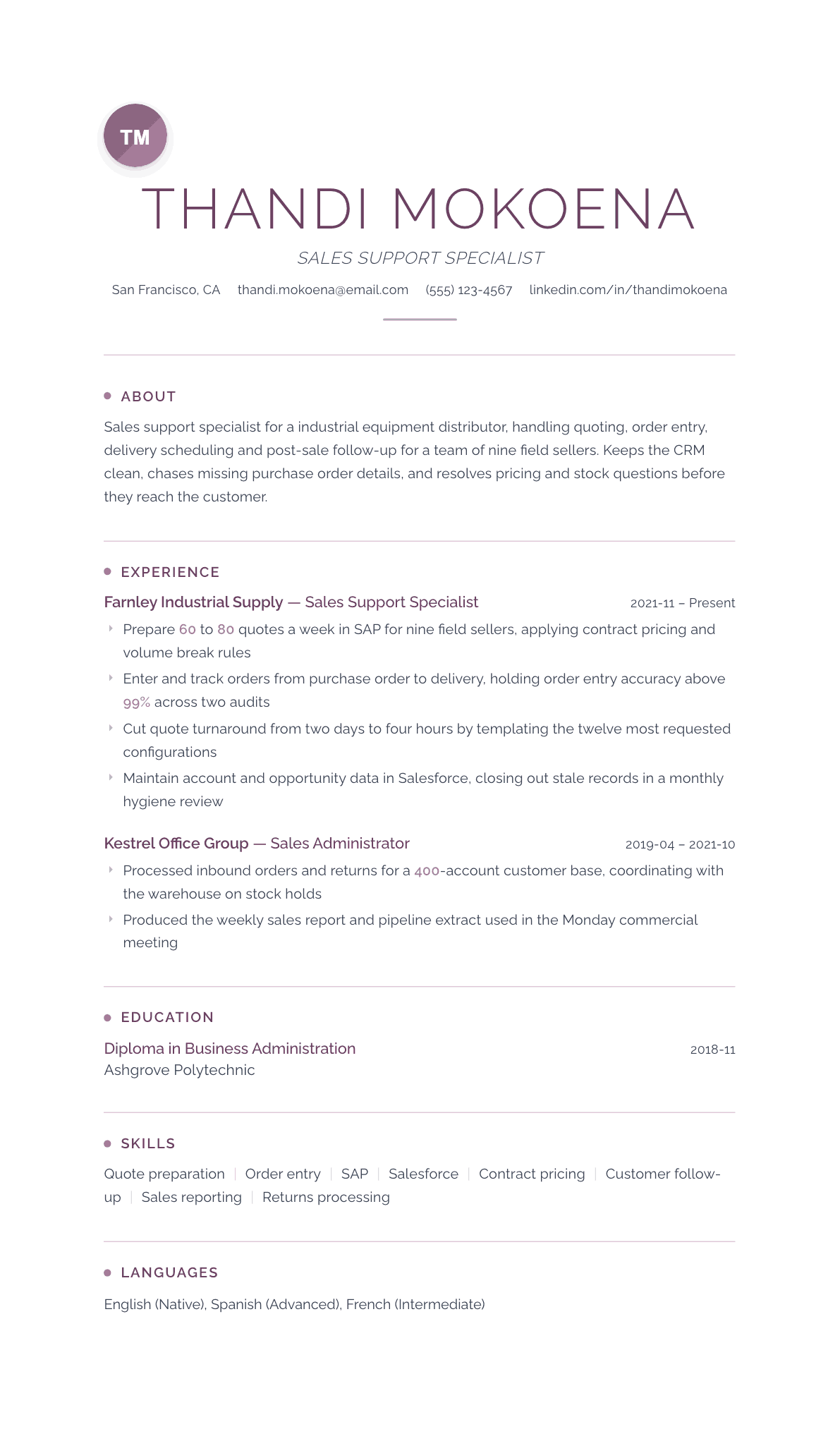
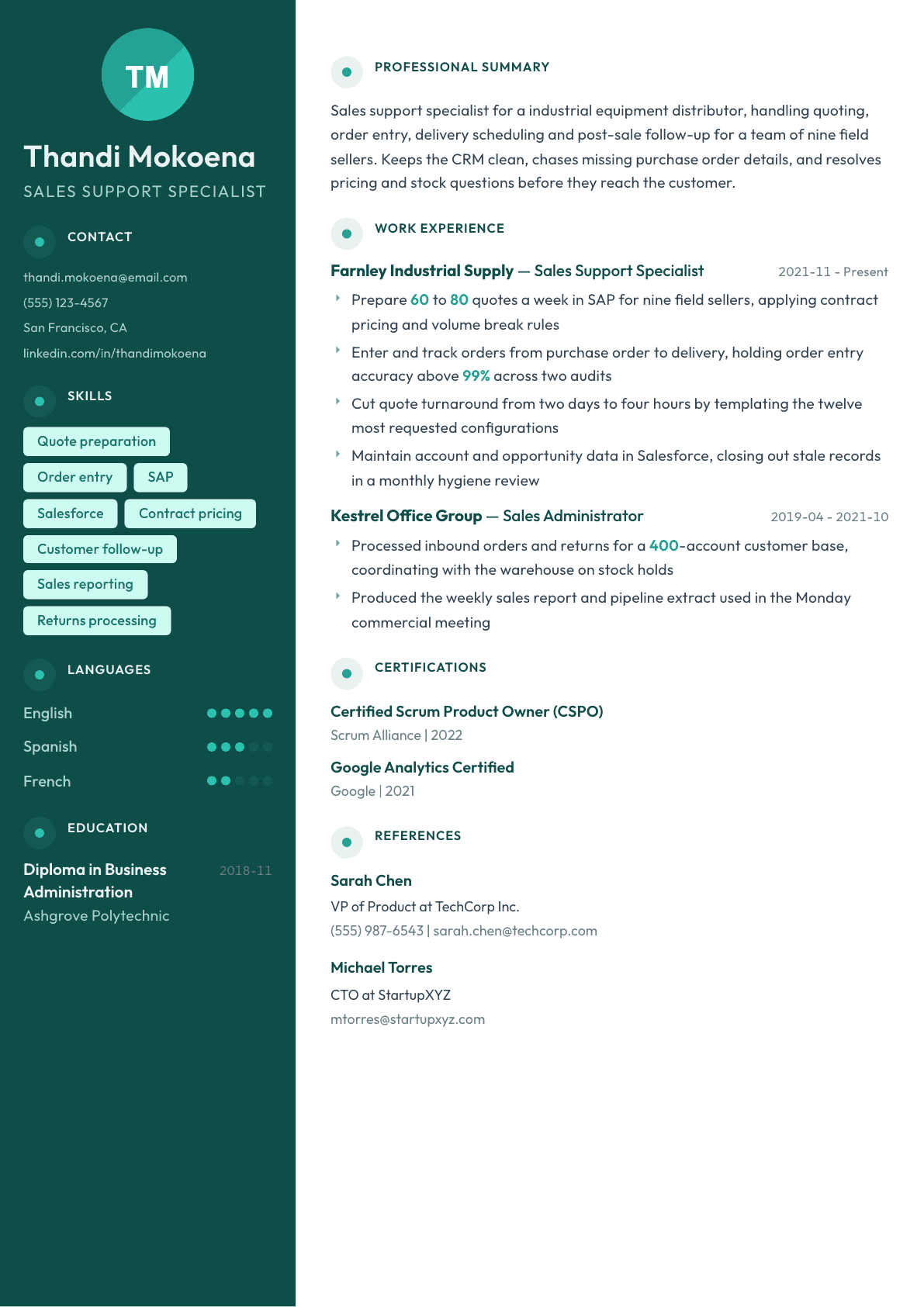
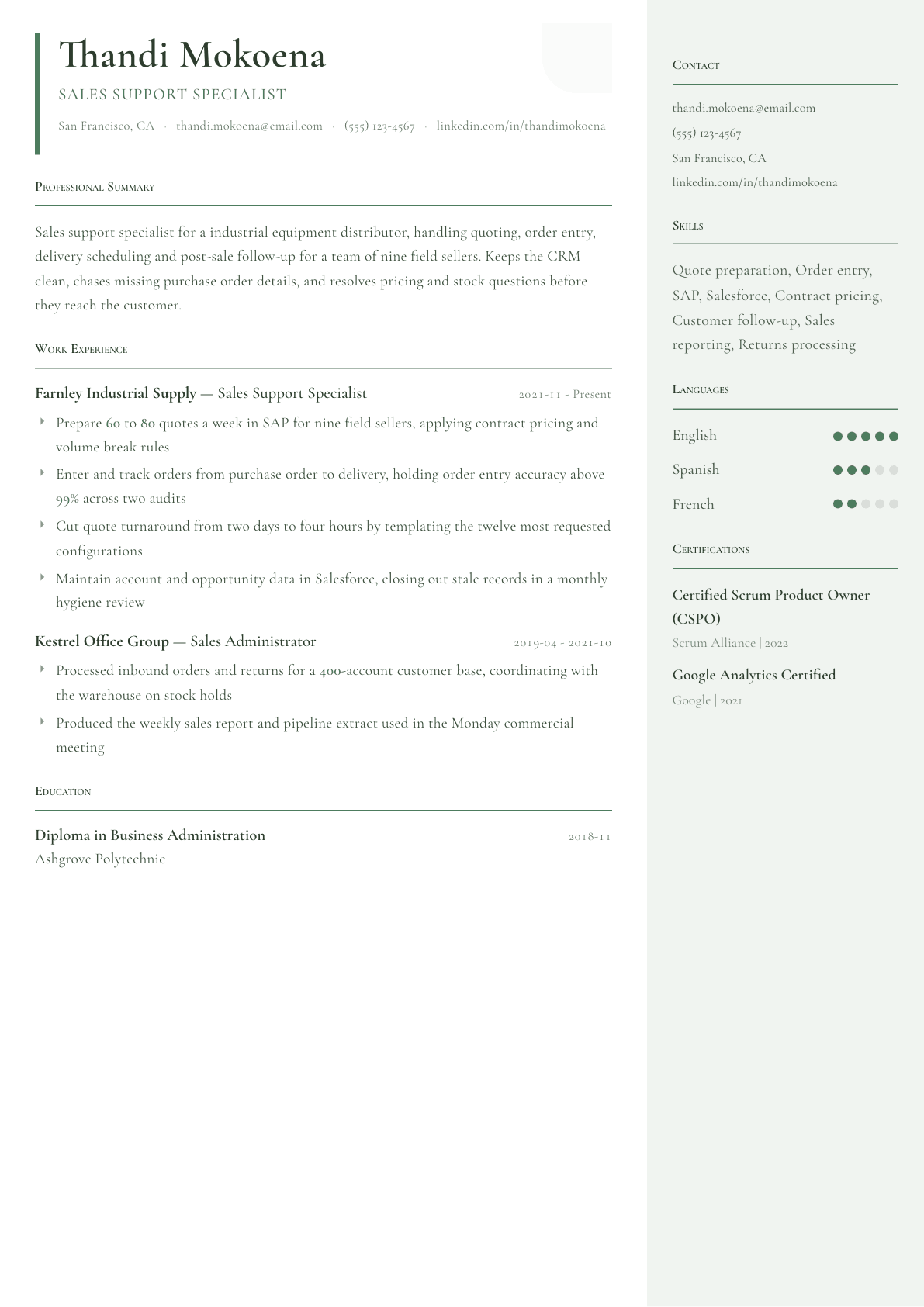
The same sales support specialist content laid out in three CVBooster templates, so you can see what the finished document looks like before you write a word.
Example Sales Support Specialist summary
Sales support specialist with six years in distribution, currently producing up to 80 quotes a week in SAP for nine field sellers and holding order entry accuracy above 99% across two internal audits. Cut quote turnaround from two days to four hours by templating the most requested configurations. Looking for a sales support role where quoting, pricing rules and CRM discipline sit with one owner.
Skills to list on a Sales Support Specialist resume
- Quote preparation
- Order entry and processing
- CRM data hygiene
- SAP
- Salesforce
- Contract and volume pricing
- Sales reporting
- Customer correspondence
- Returns and credit notes
- Delivery scheduling
- Purchase order validation
- Excel and pivot tables
- Tender and bid documentation support
What actually gets this resume read
- Show volume: quotes per week, orders per month, and the number of sellers or accounts you support.
- Report accuracy, because order entry errors cost money and every hiring manager in this role asks about them.
- Name the systems precisely: the ERP, the CRM, the quoting tool and any customer portal you worked inside.
- Include turnaround times for quotes and order confirmations, since speed is what the sales team feels.
- Describe the coordination part: warehouse, credit control, logistics and the handoffs you own between them.
- Add any pricing authority you held, such as applying contract rates or approving discounts up to a set level.
How to write a sales support specialist resume
A sales support specialist resume is read by someone who has just lost a week to a mispriced quote or an order entered against the wrong ship-to address. They are hiring for accuracy under volume, and every line of your resume should answer that concern before it tries to be impressive.
This role sits behind the sellers and in front of the systems. You produce quotes, enter and track orders, keep the CRM honest, chase missing purchase order details, and answer the customer questions the field team does not have time for. The resume that gets shortlisted proves three things: how much work you handle, how accurately, and in which systems.
This guide covers the format, how to quantify quoting and order volume, the systems detail that gets you filtered in, three summaries across the career, before-and-after bullets, and the questions people ask when they move from general administration into a commercial support role.
Format: one page, volume and systems near the top
One page, reverse chronological, plain single-column layout. Applicant tracking systems used by distributors and manufacturers are often older and read columns badly, so keep the structure simple and avoid tables, icons and text boxes.
Add a short scope line under each job: how many sellers or accounts you supported, the order and quote volume, and the systems you worked in. A hiring manager can size your experience from that line, and it is the part they will read twice.
- Header: name, city, phone, email, and languages if you support export or multilingual accounts.
- Section order: summary, experience with volume lines, systems, education, training.
- Include the industry: distribution, manufacturing, medical devices, software, construction supply.
Summary: who you support, what you produce, how accurately
Three lines. Name the number of sellers or the account base you support, the volume of quotes and orders you handle, the core systems, and an accuracy or turnaround figure. Accuracy is the single strongest claim available to this role and most candidates never make it.
Include the industry and product type, because pricing rules differ hugely. Applying contract pricing on industrial spares with volume breaks is a different discipline from quoting configured software subscriptions with term uplifts.
Experience: quoting, order flow and the handoffs you own
Write the quoting bullet first. Say how many quotes you build a week, what pricing rules you apply, whether you configure products, and what your turnaround is. If you templated common configurations or built a quoting workbook, that is process improvement and belongs on the page with the time it saved.
Then the order flow. From purchase order receipt to entry, credit check, stock allocation, delivery scheduling, invoicing and returns, name the steps you own and the ones you coordinate. Order entry accuracy against an audit is the number to lead with.
Then the coordination. Warehouse, credit control, logistics, product management and the customer are all people you chase. Describe one recurring problem you removed, such as incomplete purchase order details or repeated stock holds, and what you changed to stop it.
- Quotes produced per week and the average turnaround time.
- Orders processed per month and the entry accuracy rate.
- Number of field sellers or accounts supported.
- Reporting you own: weekly sales report, pipeline extract, backorder list.
Systems: name the exact stack
Be precise. The ERP matters most, so name it and the modules you work in, whether that is sales orders, pricing conditions or delivery documents. Then the CRM, the quoting or configuration tool, the customer portal and the reporting layer. Add your spreadsheet level honestly, since lookups and pivot tables are used daily in this job.
If you have taken part in a system migration or a data cleanup, put it in. Companies moving from a legacy order system to a new ERP look specifically for support staff who have survived one.
Keywords that get this resume past the filter
Postings for this role reuse the same terms: quotations, order processing, order entry, sales administration, CRM maintenance, pricing, contract pricing, purchase orders, delivery scheduling, credit notes, returns, backorders, customer correspondence and sales reporting. Mirror the ones you have actually done.
Add the customer-facing element, because many of these roles are half service. Handling inbound customer email and calls, chasing delivery dates and resolving invoice queries are real duties that hiring managers search for.
Sales Support Specialist resume summary examples
Moving in from administration
Office administrator with two years handling inbound customer email, order entry and filing for a wholesale supplier. Comfortable in a stock system and confident with spreadsheet lookups. Looking to move into a dedicated sales support role where quoting and order accuracy are the main measure.
Supporting a field sales team
Sales support specialist producing 60 to 80 quotes a week in SAP for nine field sellers, applying contract pricing and volume break rules. Holds order entry accuracy above 99% across two internal audits and cut quote turnaround from two days to four hours by templating common configurations.
Senior or team lead
Senior sales support specialist with eight years in industrial distribution, now leading a three-person support desk covering quoting, order entry and returns for a 400-account base. Owns the pricing condition setup, trains new administrators, and runs the weekly backorder review with the warehouse.
Work experience bullets: before and after
Before: Prepared quotations for the sales team.
After: Prepare 60 to 80 quotes a week in SAP for nine field sellers, applying customer contract pricing, volume break rules and freight terms before release.
Volume, system, team size and the pricing rules applied make the quoting work sizable and specific.
Before: Entered orders accurately into the system.
After: Enter and track orders from purchase order receipt through delivery confirmation, holding order entry accuracy above 99% across two internal audits covering roughly 300 orders a month.
An audited accuracy figure with the volume behind it is the strongest claim this role can make.
Before: Kept the CRM up to date.
After: Maintain account, contact and opportunity records in Salesforce, running a monthly hygiene review that closes stale opportunities and corrects duplicate accounts before the pipeline report is issued.
Naming the cadence and the specific corrections shows CRM ownership rather than passive data entry.
Before: Worked with the warehouse on deliveries.
After: Run a weekly backorder review with the warehouse and logistics teams, releasing part shipments where the customer accepts them and giving sellers a confirmed date for every held line.
A named recurring meeting with a defined output shows you manage the handoff instead of forwarding emails.
Before: Improved the quoting process.
After: Cut quote turnaround from two days to four hours by building templates for the twelve most requested configurations and pre-loading their pricing conditions.
The before and after time plus the mechanism turns a vague improvement claim into a documented change.
Hard skills
- Quote preparation and configuration
- Order entry and tracking
- SAP sales and distribution
- Salesforce administration
- Contract and volume pricing
- Purchase order validation
- Credit notes and returns processing
- Delivery scheduling
- Sales reporting and pipeline extracts
- Excel lookups and pivot tables
- Customer correspondence
- Tender and bid documentation support
Soft skills
- Accuracy under volume
- Prioritizing competing seller requests
- Clear written communication
- Chasing without irritating
- Patience with incomplete information
- Working to a month-end deadline
Mistakes that cost sales support specialist candidates the interview
- Listing duties with no volume, so a manager cannot tell whether you handled five quotes a week or eighty.
- Leaving accuracy off the page when it is the exact quality this role is hired for.
- Naming systems generically as an ERP or a CRM instead of the specific products and modules you worked in.
- Ignoring the customer-facing half of the job, which in many companies is most of the working day.
- Using a two-column template that older distribution applicant tracking systems parse out of order.
- Describing yourself only as an administrator, which hides the commercial pricing and quoting judgment you apply daily.
Sales Support Specialist resume questions
What is the difference between a sales support specialist and a sales coordinator?
The titles overlap and vary by employer. Support usually leans toward quoting, pricing and order accuracy, while coordination leans toward scheduling, events and internal communication. Describe the duties you actually held so a reader is not relying on the title alone.
How do I show accuracy on a resume?
Quote an audited or measured figure with the volume behind it, such as fewer than three entry errors across roughly 300 orders a month. If nothing was formally measured, describe the checking step you built, like a second-eye review on any order above a set value.
Do I need ERP experience to get hired?
It helps a great deal, especially SAP, Microsoft Dynamics or a sector-specific system. If you have none, lead with your order volume, your accuracy habits and your spreadsheet skill, and name any stock or ordering system you have used so a trainer can gauge the ramp.
Should I list the number of sellers I support?
Yes, because it is the clearest measure of load in this job. Supporting nine field sellers with a shared inbox is a very different week from supporting two, and hiring managers use that number to judge whether you can handle their team.
How do I move from sales support into a selling role?
Start collecting evidence of commercial judgment: quotes you shaped, customers you saved, upsell opportunities you spotted in the order book. Ask to carry a small account set or handle inbound enquiries end to end, then put those results at the top of your resume.