Wholesale Account Manager Resume Examples: free score
Build a Wholesale Account Manager Resume That Moves Product
By Mustafa Tarabya, founder of CVBooster · Published · Updated
Create a relationship-driven wholesale account manager resume with B2B sales expertise, inventory planning, and distributor management skills that wholesale companies need.
Sample resumes for a wholesale account manager
The same wholesale account manager content laid out in three CVBooster templates, so you can see what the finished document looks like before you write a word.
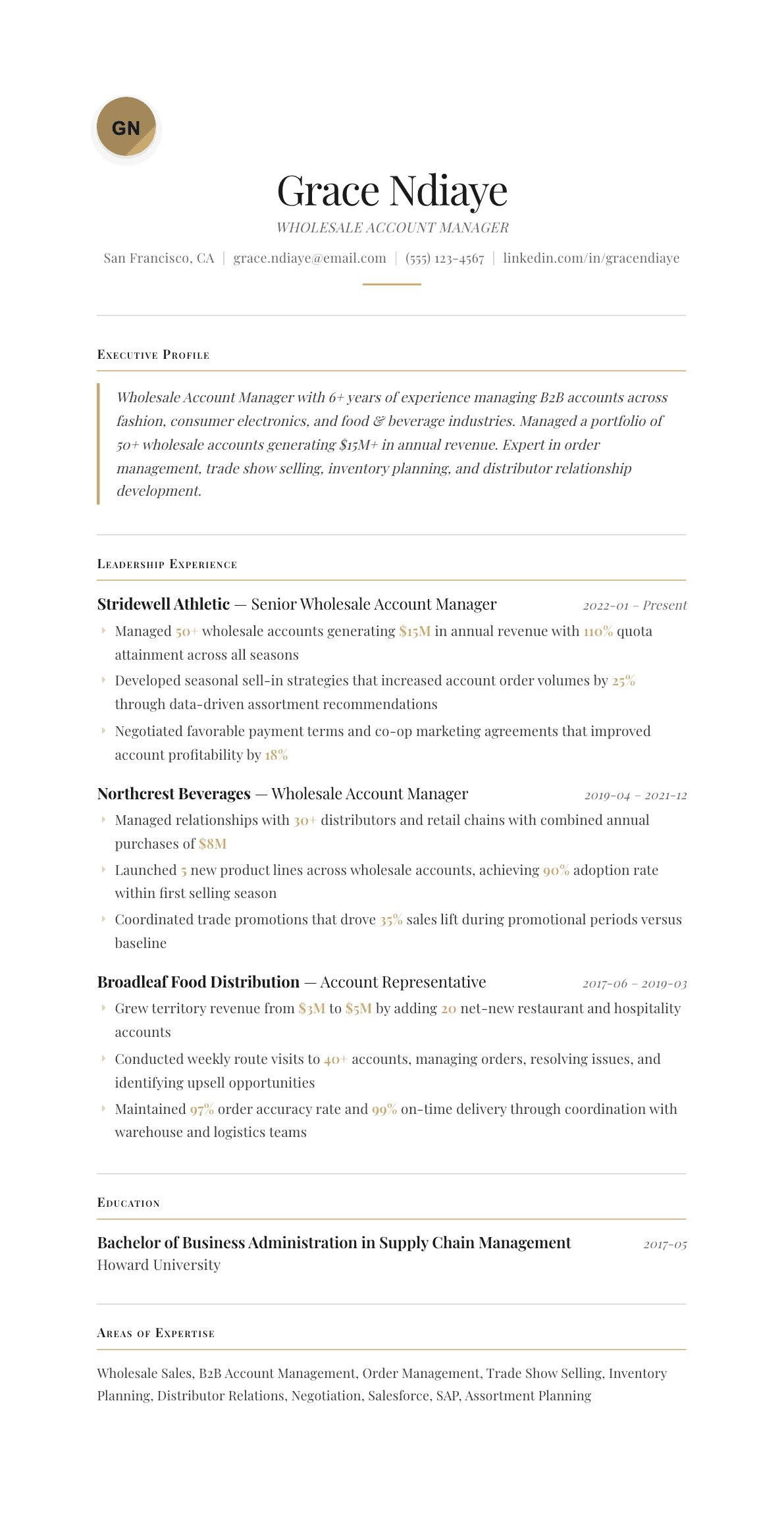
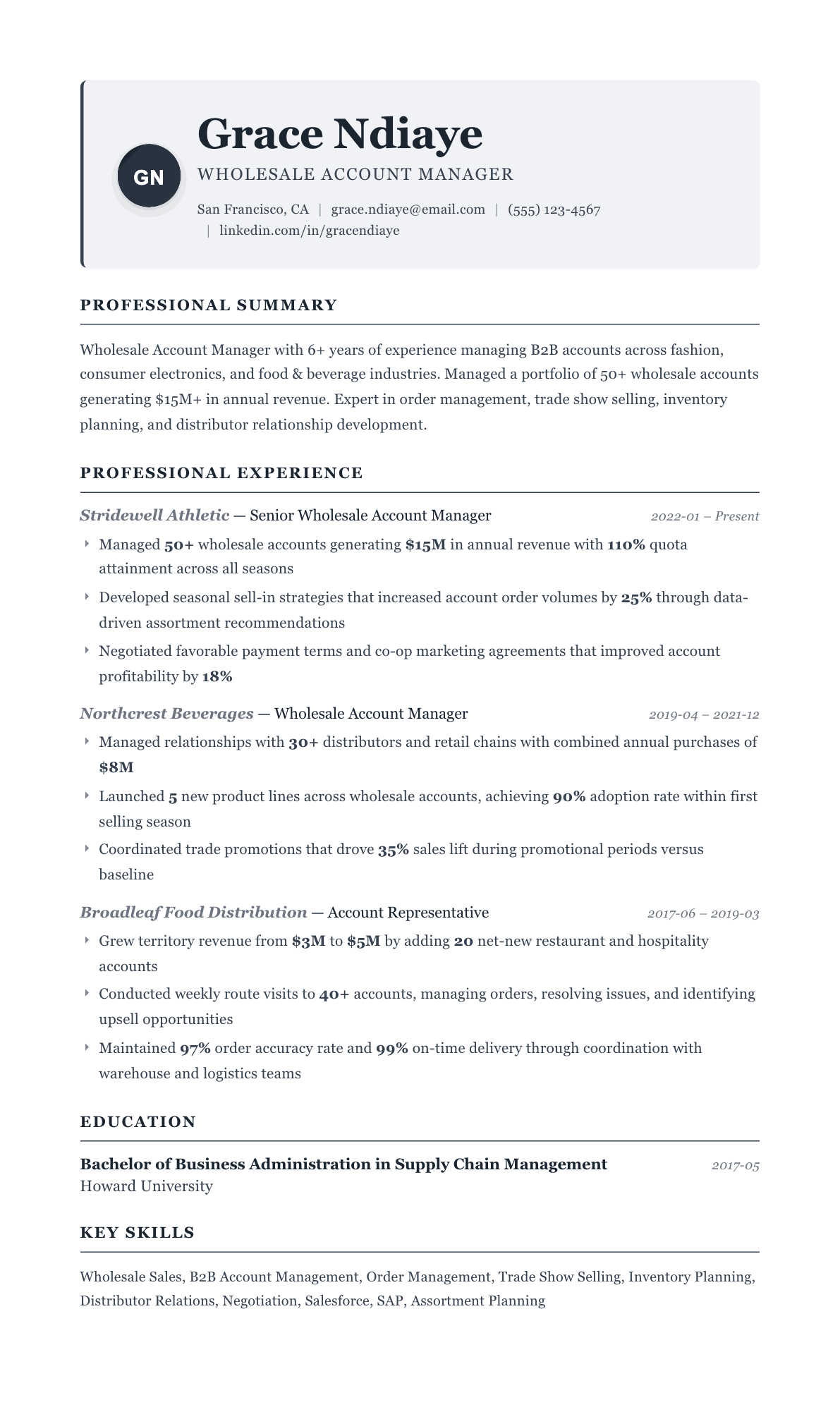
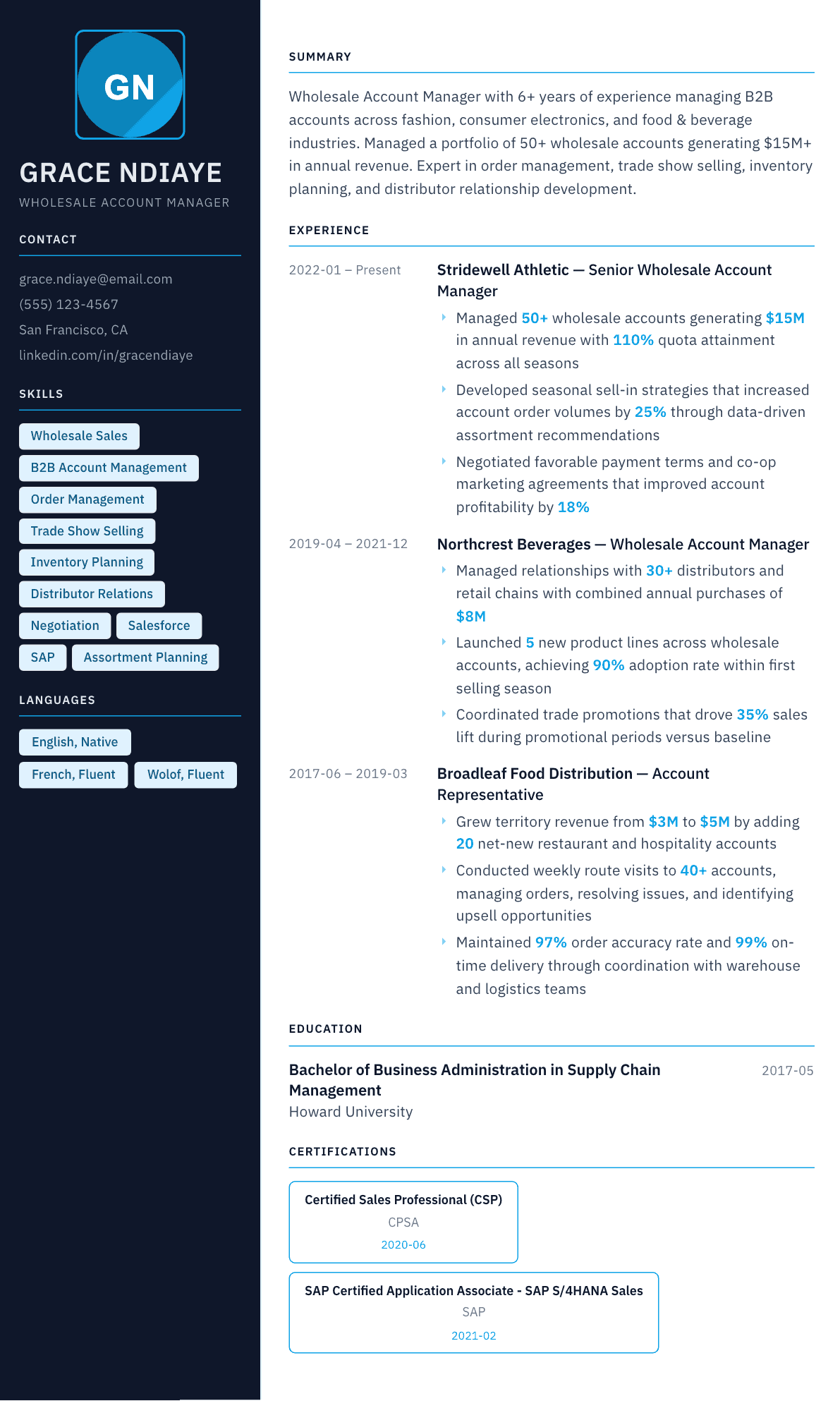
Example Wholesale Account Manager summary
Wholesale Account Manager with 6 years handling 50+ B2B accounts worth $15M+ in annual revenue. Grew account order volumes 25% at Stridewell Athletic through data-led assortment planning, and negotiated co-op terms that improved account profitability by 18%. Strong in distributor relations, trade show sell-in, and seasonal planning.
Skills to list on a Wholesale Account Manager resume
- Wholesale Sales
- B2B Account Management
- Order Management
- Trade Shows
- Inventory Planning
- Distributor Management
- Negotiation
- Assortment Planning
- Category Management
- Salesforce CRM
- SAP
- Trade Promotions
- Forecasting
- Territory Management
What actually gets this resume read
- Quantify your account portfolio: number of accounts, total revenue managed, and growth achieved.
- Highlight B2B relationship management: distributor partnerships, retail chain relationships, and trade show experience.
- Showcase assortment and inventory planning skills that demonstrate commercial acumen beyond pure selling.
- Include negotiation wins: payment terms, co-op agreements, and margin improvements.
- Mention industry-specific knowledge: seasonal buying cycles, trade promotions, and category management.
How to write a wholesale account manager resume
Wholesale account management is a seasonal business, and the resume that wins is written by someone who clearly knows that. The hiring manager, usually a wholesale director or head of sales at a brand, is looking for a candidate who can carry a book of buyers through market appointments, sell in a line, then manage the reorders, chargebacks and markdowns that decide whether the season was actually profitable.
The screening facts are the size of the book and the type of doors. Fifty independent boutiques is a different job from three national chains, and a department store account with an electronic data interchange requirement and vendor compliance manual is different again. Say which one you have carried, name the retailers by category if not by name, and give the volume the book produced.
This guide covers the section order wholesale hiring managers expect, three summaries from a sales coordinator to a national account lead, before-and-after bullets that show sell-in and sell-through, and the questions that come up when a seasonal calendar has to fit on one page.
Format: the book comes before the bullets
One page for most wholesale careers, two once you have carried national accounts across several brands. Reverse chronological, and keep the layout plain so an applicant tracking system reads the dates correctly.
Under every job title, open with a book line: number of accounts, the door types, the categories you sold, and the annual volume. A line reading "50 wholesale accounts across specialty boutiques and two regional chains, 15M annual" answers the size question that decides whether you continue in the process.
- Header: name, city and state, phone, email, and the categories you sell.
- Order: summary, account portfolio, experience, systems and skills, education.
- Note the trade shows and market weeks you have worked, since those are the calendar the job runs on.
Summary: categories, doors, volume, seasons
Three or four lines. Name the categories you have sold, the type of retailer, the volume of the book, and your attainment across seasons rather than one strong quarter. Wholesale is judged season to season, so a run of consecutive seasons at plan carries far more weight than a single record market week.
If you are moving up from a wholesale coordinator or customer service seat, lead with the operational depth: order entry accuracy, allocation work, chargeback resolution. Brands promote coordinators into account roles precisely because they already know where the money leaks.
Experience: sell-in, sell-through, and the money after the invoice
Split the story into three parts. Sell-in is the seasonal order: the volume booked, the assortment you recommended, the doors added, the categories expanded. Sell-through is what happened at retail: reorder rate, weeks of supply, markdown exposure, and how you used the retailer data to shape the next buy.
The third part is the part most candidates skip and every wholesale director cares about: terms, chargebacks, returns and returns authorization, on-time in-full delivery, and margin after allowances. An account manager who can show a chargeback reduction or a cleaner allowance structure is protecting real profit, not just booking orders.
Give trade shows and market weeks their own bullets. The show, the appointments held, the orders written, the new doors opened. That is the compressed selling season for the whole category, and hiring managers read it as a proxy for how you perform under pressure.
Systems, terms and retail math
Name the systems: the enterprise resource planning platform for orders and inventory, the business to business ordering portal buyers use, the electronic data interchange setup for chain accounts, the retailer portals you pulled sell-through data from, and the CRM. SAP, NetSuite, Salesforce and retailer vendor portals all appear by name in these postings.
Show that you speak retail math. Initial markup, maintained margin, weeks of supply, open to buy, reorder rate and sell-through percentage are the vocabulary a buyer uses in the appointment. A candidate who can hold that conversation is worth more than one who can only present the line.
Keywords wholesale postings repeat
The recurring terms are wholesale account management, sell-in, sell-through, assortment planning, open to buy, door count, key accounts, distributor relations, trade shows, market week, order management, allowances and chargebacks, and on-time delivery. Put the posting words into the summary once and into a bullet with a result once. Wholesale directors read fast and know instantly whether a phrase came from experience or from the job advertisement.
Wholesale Account Manager resume summary examples
Wholesale coordinator stepping up
Wholesale coordinator supporting a 60-door specialty book: order entry, allocation, and chargeback resolution that cut deductions by a third in two seasons. Fluent in NetSuite and the retailer portals, and ready to carry a small account list through market week.
Six years in wholesale
Wholesale Account Manager carrying 50 accounts worth 15M across specialty boutiques and two regional chains. Delivered 110% of plan across the last four seasons, grew average order volume 25% through data-driven assortment recommendations, and opened 12 new doors last year.
National account lead
National account lead for a footwear brand owning three department store chains and a national specialty group. Rebuilt the allowance and markdown structure to protect maintained margin, launched five product lines with 90% adoption in the first selling season, and manages two junior account managers.
Work experience bullets: before and after
Before: Managed wholesale accounts and grew sales.
After: Carried 50 wholesale accounts worth 15M across specialty and regional chain doors, finishing four consecutive seasons at 110% of plan.
Door count, volume and a run of seasons show a book that was held, not a single good market week.
Before: Worked with buyers on seasonal orders.
After: Ran market week appointments with 28 buyers, using prior-season sell-through by door to rebuild the assortment and lifting average order volume 25%.
The appointment count and the use of sell-through data turn an order-taking line into evidence of selling with retail math.
Before: Handled issues with orders and shipments.
After: Cut chargebacks by tightening routing guide compliance and pre-ticketing with the warehouse, and held on-time in-full delivery at 99% across the season.
Compliance work and the service level are where wholesale margin is actually won or lost, and few candidates name it.
Before: Attended trade shows to promote the product line.
After: Worked three trade shows a year, holding 40 appointments per show and writing orders that opened 20 net-new doors over two seasons.
Appointment volume and doors opened make the show a measured selling event rather than an attendance line.
Before: Launched new products with existing customers.
After: Launched five product lines into the wholesale book with tiered sample allocation and buyer training, reaching 90% account adoption within the first selling season.
The launch mechanism plus the adoption rate shows you can move a new category through a book, which is what a brand hires for.
Hard skills
- Wholesale account management
- Seasonal sell-in planning
- Sell-through analysis and reorder management
- Assortment and door-level planning
- Open to buy and margin math
- Trade show and market week selling
- Order management and allocation
- Chargeback and allowance resolution
- Distributor and buying group relations
- Electronic data interchange order flow
- SAP and NetSuite
- Salesforce CRM
- Inventory and replenishment planning
Soft skills
- Negotiating terms without losing the door
- Reading a buyer in an appointment
- Coordinating with warehouse and logistics
- Composure during market week
- Long-horizon relationship building
Certifications worth listing
- Certified Professional in Supply Management (CPSM) (Institute for Supply Management)
- Certified Supply Chain Professional (CSCP) (Association for Supply Chain Management)
- Certified Sales Executive (CSE) (Sales and Marketing Executives International)
- Salesforce Certified Administrator (Salesforce)
Mistakes that cost wholesale account manager candidates the interview
- Reporting only booked orders and never reporting sell-through, which tells a brand nothing about whether the product actually moved at retail.
- Leaving out door count and account type, so the reader cannot separate independent boutiques from national chain business.
- Skipping chargebacks, allowances and delivery performance, the operational half where wholesale margin quietly disappears.
- Describing market week as attendance rather than as appointments held and orders written.
- Using the word customers throughout instead of naming buyers, doors, chains and distributors, which is the language of the trade.
- Presenting one exceptional season without the seasons around it, when this business is judged on consistency across a calendar.
Wholesale Account Manager resume questions
Should I name the retailers I sold to?
Name chains and groups when the relationship is a genuine selling point and the information is not confidential. When it is sensitive, describe the door type and volume instead, because a wholesale director cares about the account profile more than the specific logo.
How do I show performance when the season was decided before I arrived?
Report the book as you inherited it and what changed on your watch: reorder rate, doors added, markdown exposure reduced, chargebacks cleaned up. Those measures are yours even when the initial buy was written by your predecessor.
How much retail math belongs on a wholesale resume?
Enough to prove you can sit across from a buyer: maintained margin, weeks of supply, open to buy and sell-through should each appear at least once, attached to a decision you made. A resume without any of that language reads as an order administrator.
Do I need experience in the same product category to be hired?
It helps and often decides a shortlist, because buyer relationships and seasonal calendars are category-specific. If you are moving categories, lead with the transferable machinery: door management, sell-through analysis, allowance negotiation and delivery compliance work the same way everywhere.
What belongs in the skills section for a wholesale account manager?
The systems you actually worked in, the planning vocabulary, and the operational areas you owned. Keep it to order management, assortment planning, sell-through analysis, chargeback resolution and the specific platforms, rather than a list of generic sales adjectives.