Student Teacher Resume Examples: the lines they read
Build a Student Teacher Resume From Your Placement Evidence
By Mustafa Tarabya, founder of CVBooster · Published · Updated
Student teacher resume example showing how to turn clinical placements, cooperating teacher feedback and edTPA work into hiring evidence.
Sample resumes for a student teacher
The same student teacher content laid out in three CVBooster templates, so you can see what the finished document looks like before you write a word.
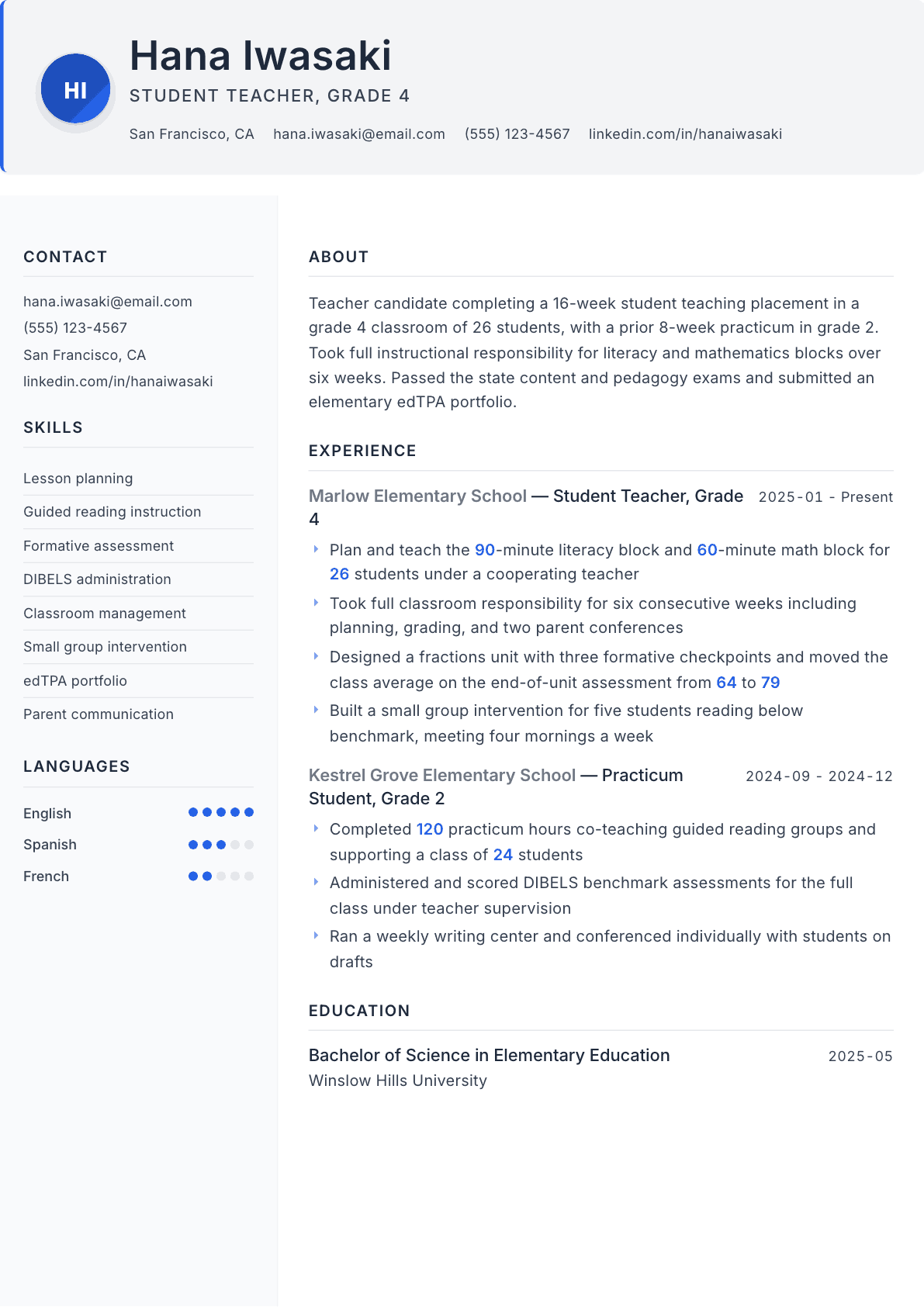
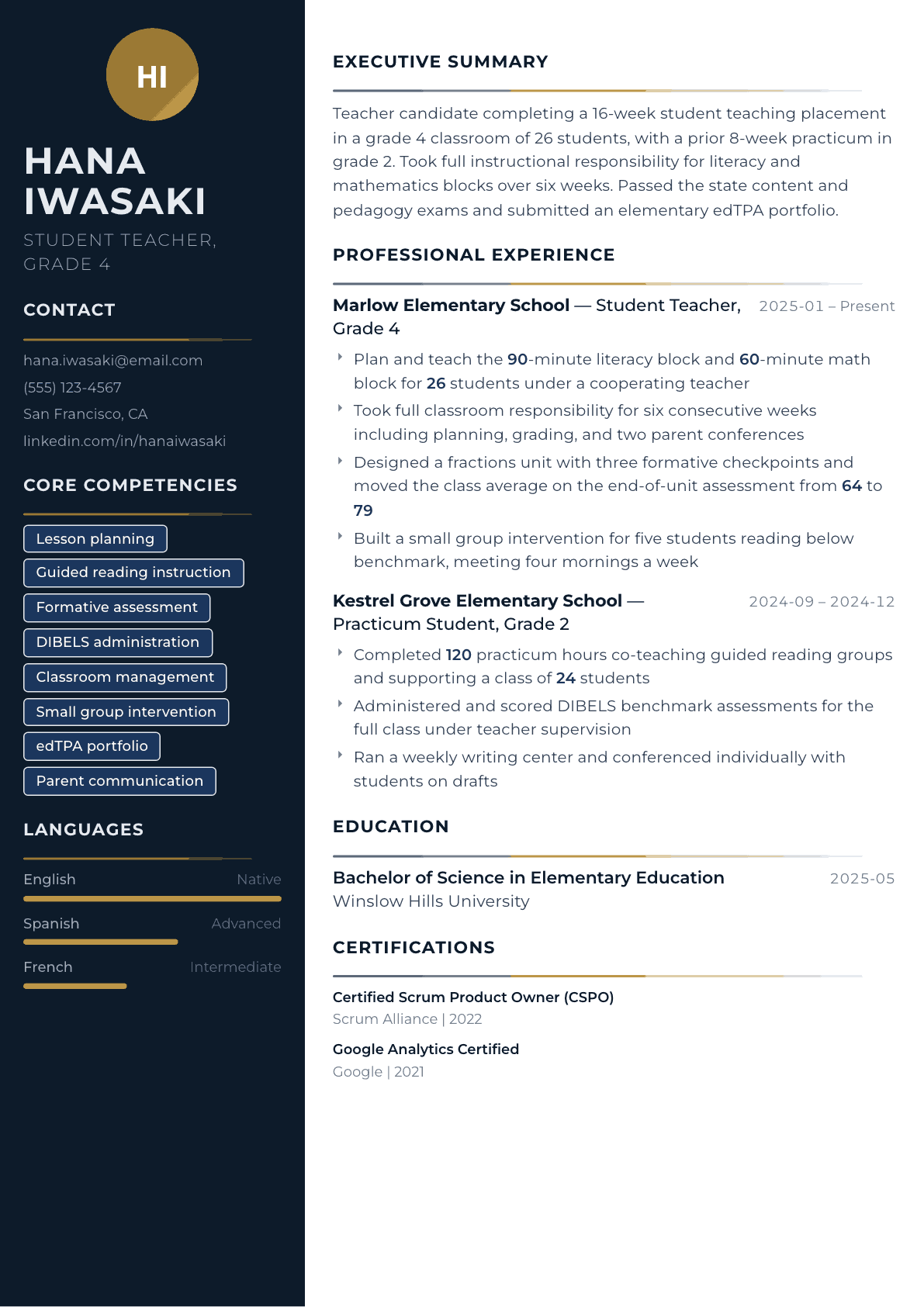
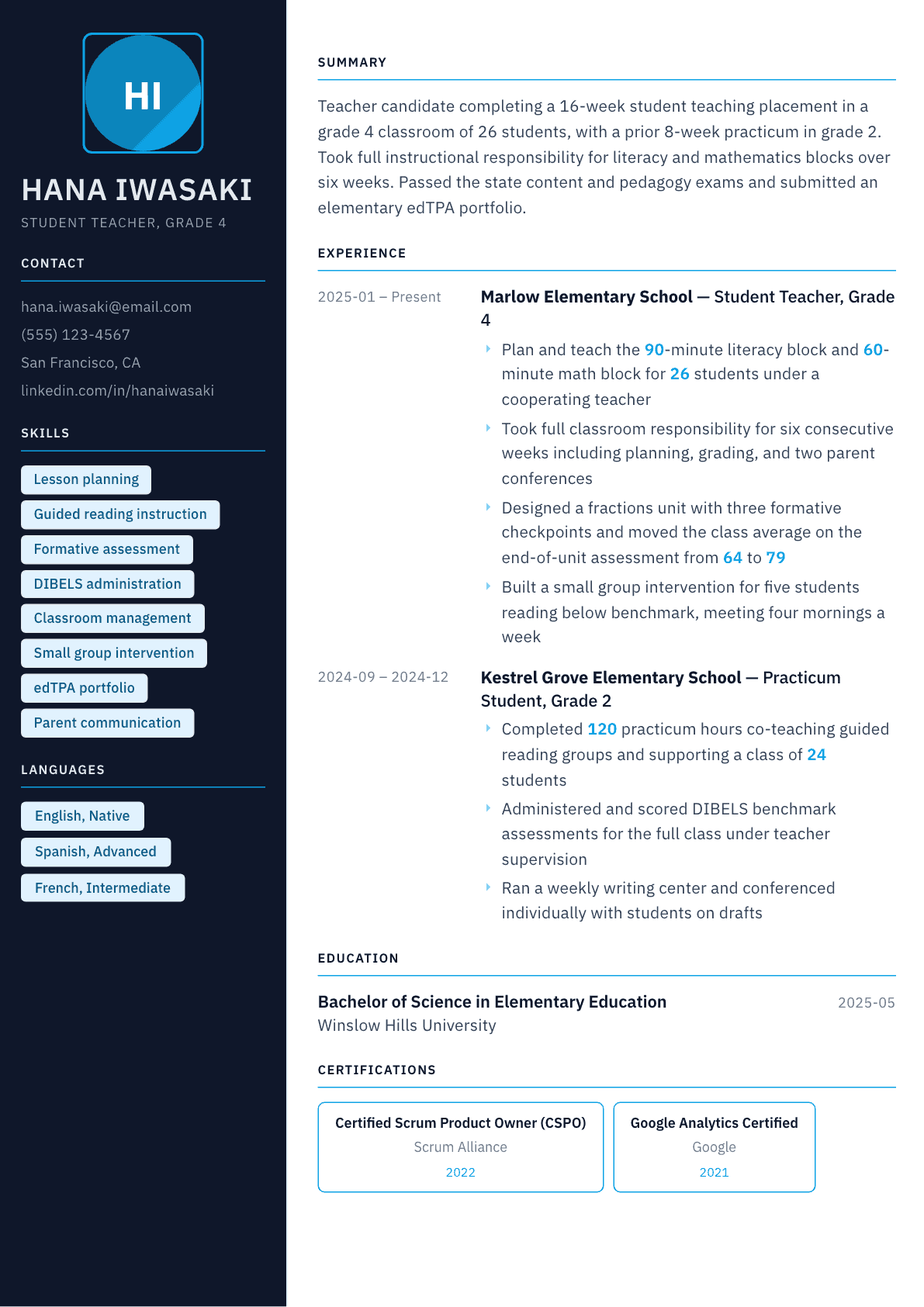
Example Student Teacher summary
Teacher candidate finishing a 16-week grade 4 student teaching placement in a class of 26, following an 8-week grade 2 practicum. Held full instructional responsibility for six weeks across the literacy and mathematics blocks, ran a small group reading intervention, and moved a fractions unit average from 64 to 79. Passed both state exams with certification pending. Seeking an elementary classroom for the coming year.
Skills to list on a Student Teacher resume
- Lesson planning
- Guided reading instruction
- Small group intervention
- Formative assessment
- DIBELS administration
- Classroom management
- Differentiated instruction
- edTPA portfolio development
- Behavior support plans
- Parent and family communication
- Google Classroom
- Standards alignment
- Data-driven grouping
- Co-teaching with a cooperating teacher
What actually gets this resume read
- Treat each placement like a job entry with the school, grade, class size and the weeks you led instruction.
- State clearly how many weeks you held full instructional responsibility, because that is the question every principal asks.
- Include the assessments you administered by name, such as DIBELS, NWEA MAP or a district benchmark.
- Put certification status on the resume even if it is pending, with the exams passed and the expected issue date.
- Reference a unit you planned and the growth it produced, so the reader sees your planning and not just your attendance.
- Add tutoring, camp counseling, coaching or paraprofessional work, since it shows classroom time beyond the program.
How to write a student teacher resume
A student teacher resume has one job: convert a placement into evidence. You do not yet have years of service or a room of your own, so everything a principal needs to judge you by exists inside the weeks you spent under a cooperating teacher. Most candidates undersell that badly, writing three lines about assisting with instruction when they in fact planned, taught, assessed and conferenced with families for a month and a half.
The reader is usually a building principal filling a vacancy in April or May, holding a stack of files from the same preparation program with nearly identical coursework. What separates them is specificity: how many weeks you led alone, what you planned, what the assessment showed, and what you did about the students who were not learning.
This guide covers how to write a placement like a job entry, how to present certification that is still pending, how to use your edTPA or program portfolio without dumping it on the page, three example summaries, before and after bullets, and the questions candidates ask in their final semester.
Format: education first, placements as jobs
One page, no exceptions, and no objective statement. Reverse chronological, single column. As a student teacher you invert the usual order: education and certification status go near the top, because they are the qualifying facts, and your placements follow as full experience entries with the school, grade, subject and dates.
Do not label the section volunteer work or field experience. Call it clinical experience or teaching experience, because those are the words the reader is scanning for, and the work you did was teaching.
- Header: name, city and state, phone, email, and certification area with status.
- Order: summary, education with expected graduation, certification status, clinical experience, related work, skills.
- Each placement gets school, grade, subject, class size and the weeks you held full responsibility.
Summary: weeks led, grade, and one result
Three lines. The placement grade and subject, the class size, how many weeks you took full instructional responsibility, and one result. That single number of solo weeks is the fact every principal asks about, so putting it in the summary saves them the search and signals that you know what matters.
Add your certification status with the exams already passed. A candidate who says the content and pedagogy exams are passed and the certificate is pending has removed the reader's main worry about hiring someone still in a program.
Turning a placement into experience bullets
Write the placement the way a teacher writes a job. Lead with the instructional load: which blocks you taught, how long each ran, how many students. Then the planning you owned, the assessments you built or administered, the intervention groups you ran, and the family communication you handled.
Give one bullet to a unit you designed with the checkpoints inside it and the growth it produced on the end-of-unit assessment. Give another to something you did about students who were behind, such as a small group meeting four mornings a week. Those two bullets do more than any description of your teaching philosophy, because they show planning and response, which is the whole job.
Name the assessments by their real names. DIBELS, NWEA MAP, running records, a district benchmark or a state interim assessment tell a principal you have already handled the data routines their building runs on.
Certification, exams and the program portfolio
State the certification area, the grade band, and the status: exams passed, application submitted, expected issue date. Never leave it implied. HR cannot forward a file that does not say where the credential stands, and a principal who wants you still needs that line to move you forward.
Your program portfolio is worth one line, not a section. Mention the edTPA or equivalent performance assessment by name and leave it there. What the reader actually wants from that work is the unit and the evidence, both of which belong in your placement bullets.
Related work, skills and what to cut
Tutoring, camp counseling, coaching, paraprofessional and after-school program work all count and should be listed with student numbers and duration. They show classroom time beyond the program and they are frequently the difference between two otherwise identical candidates.
Cut unrelated jobs older than your preparation program unless you need them to explain a gap or they carry supervisory responsibility. Cut the objective statement, the high school listing, and the line about being a lifelong learner. Keep the skills list concrete: lesson planning, guided reading, formative assessment, behavior support routines, the learning platform and the assessment tools you have actually used.
- Keep: tutoring, camps, coaching, paraprofessional and after-school work with numbers and dates.
- Cut: objective statements, high school, unrelated jobs older than the program, generic personal traits.
- Skills: planning, assessment names, intervention routines, platform and data tools.
Student Teacher resume summary examples
Mid-placement
Teacher candidate in week nine of a 16-week grade 4 placement, teaching the literacy and mathematics blocks for 26 students under a cooperating teacher. Passed the state content exam and expects elementary certification at graduation. Seeking an elementary classroom for the coming school year.
Placement complete
Teacher candidate completing a 16-week grade 4 placement after an 8-week grade 2 practicum. Held full instructional responsibility for six weeks, designed a fractions unit that moved the class assessment average from 64 to 79, and ran a daily small group for five students below benchmark.
Two placements plus paraprofessional years
Teacher candidate with two clinical placements in grades 2 and 4 and three prior years as a special education paraprofessional across grades K to 5. Experienced with behavior support plans, running records and DIBELS administration. Both state exams passed and certification pending at graduation.
Work experience bullets: before and after
Before: Assisted the classroom teacher with daily instruction.
After: Planned and taught the 90-minute literacy block and 60-minute math block for 26 students under a cooperating teacher.
Block lengths and class size show a teaching load rather than an assisting role.
Before: Took over the class for part of the semester.
After: Took full classroom responsibility for six consecutive weeks including planning, grading and two parent conferences.
The number of solo weeks is the first question a principal asks, and the duties prove it was genuine.
Before: Created lessons that students enjoyed.
After: Designed a fractions unit with three formative checkpoints and moved the end-of-unit class average from 64 to 79.
A unit with checkpoints plus measured movement demonstrates planning and assessment together.
Before: Helped struggling readers.
After: Built a small group intervention for five students reading below benchmark, meeting four mornings a week before the literacy block.
Group size, criterion and frequency show a response to data instead of general goodwill.
Before: Gave students tests and recorded scores.
After: Administered and scored DIBELS benchmark assessments for a class of 24 under teacher supervision and used results to regroup readers.
Naming the assessment and the decision it drove proves you can work the data routine a school already runs.
Hard skills
- Lesson planning and unit design
- Guided reading instruction
- Small group intervention
- Formative and benchmark assessment
- DIBELS administration
- Running records
- Behavior support routines
- Differentiated instruction
- Google Classroom
- Standards alignment
- Data-driven student grouping
- Parent conferencing
Soft skills
- Acting on cooperating teacher feedback
- Classroom presence with young students
- Collaboration with paraprofessionals
- Reflection and self-assessment
- Organization across two placements
- Family communication
Certifications worth listing
- edTPA Performance Assessment (Pearson)
- Praxis Elementary Education: Multiple Subjects (Educational Testing Service)
- Praxis Principles of Learning and Teaching (Educational Testing Service)
- Adult and Pediatric First Aid and CPR (American Red Cross)
Mistakes that cost student teacher candidates the interview
- Calling a placement field experience or volunteer work instead of clinical teaching experience.
- Never stating how many weeks you held full instructional responsibility, which is the first thing a principal asks.
- Leaving certification status unwritten, so HR cannot move the file even when the principal wants you.
- Describing lessons as engaging rather than naming a unit, its checkpoints and the growth it produced.
- Keeping an objective statement and unrelated old jobs that push the placement details onto a second page.
- Listing the program portfolio as a section when the reader wants the unit and evidence inside your bullets.
Student Teacher resume questions
How do I write a student teacher resume with no paid teaching experience?
Treat each placement as a job entry with school, grade, subject, class size, dates and the weeks you led alone. Then add tutoring, camp, coaching or paraprofessional work with student numbers, since that is real classroom time a principal counts.
Should I list my cooperating teacher as a reference?
Yes, and ask before you submit. A cooperating teacher who supervised you daily for a full placement gives the most credible reference available to a candidate, more useful than a professor who observed you three times.
How do I present certification that has not been issued yet?
Give the certification area, the grade band, the exams you have already passed and the expected issue date. That combination tells HR the file can move forward and removes the main hesitation a principal has about hiring from a program.
Does my edTPA or program portfolio belong on the resume?
Mention it by name in one line under certification and stop there. The substance a reader wants from that work is the unit you planned and the evidence of learning, both of which carry far more weight inside your placement bullets.
How long should a student teacher resume be?
One page. If it is running longer, the extra length is almost always old unrelated jobs, an objective statement or coursework lists. Cut those and use the space for placement detail, assessment names and intervention work.