Science Teacher Resume Examples: the lines they read
Craft a Science Teacher Resume Built on Lab Evidence
By Mustafa Tarabya, founder of CVBooster · Published · Updated
Science teacher resume example plus a guide to lab safety, NGSS phenomena, certification areas and the keywords school screeners look for.
Sample resumes for a science teacher
The same science teacher content laid out in three CVBooster templates, so you can see what the finished document looks like before you write a word.
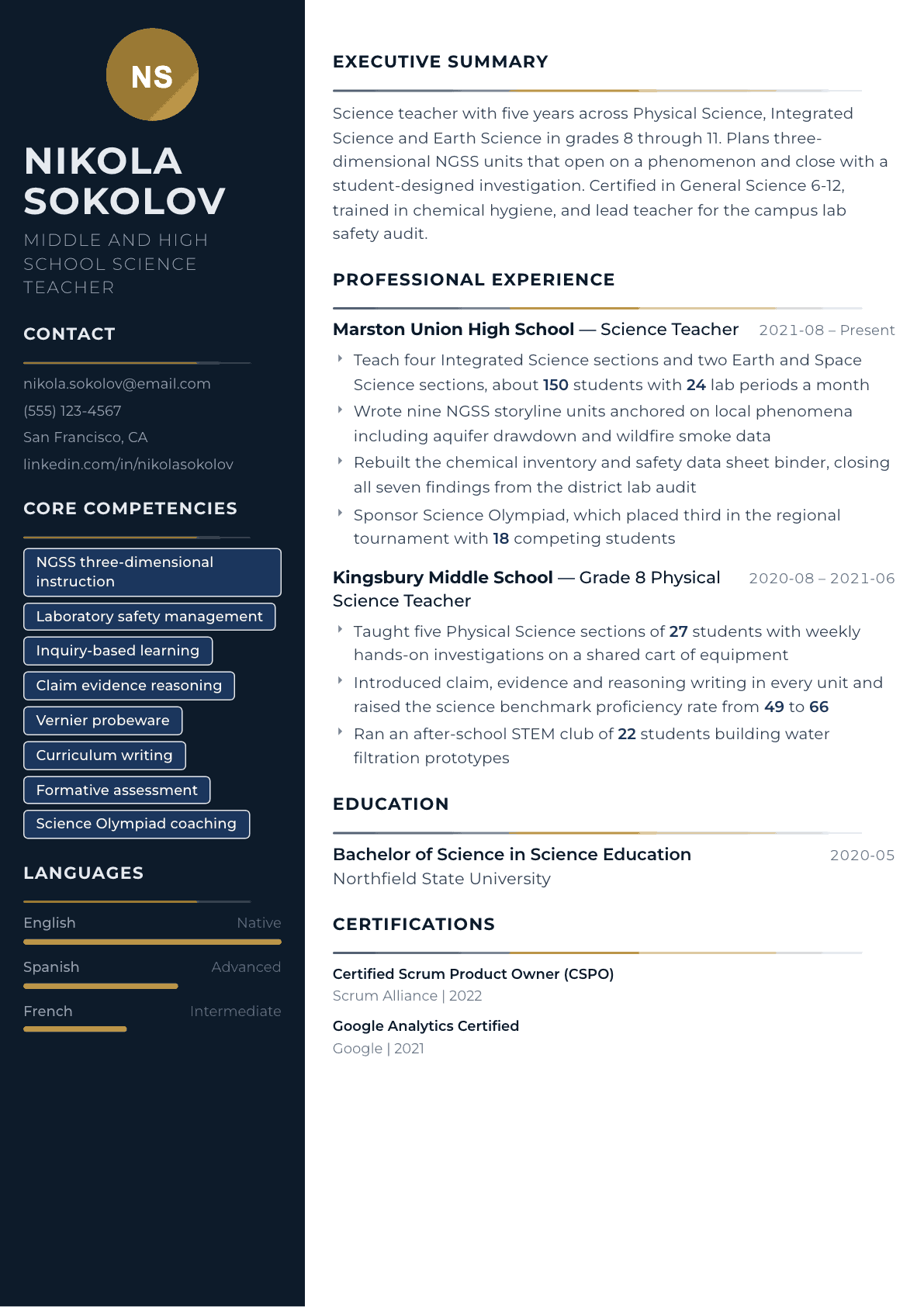
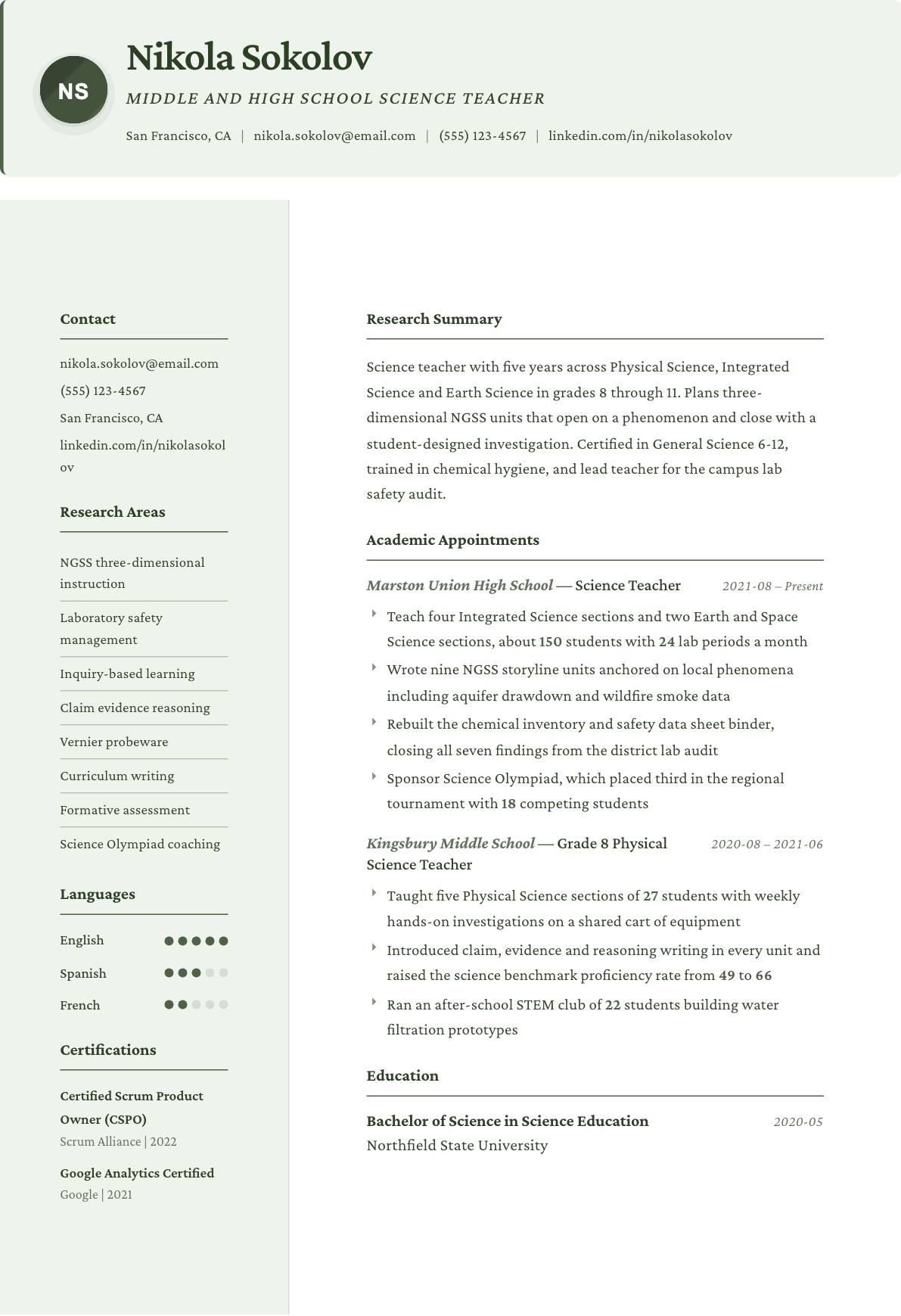
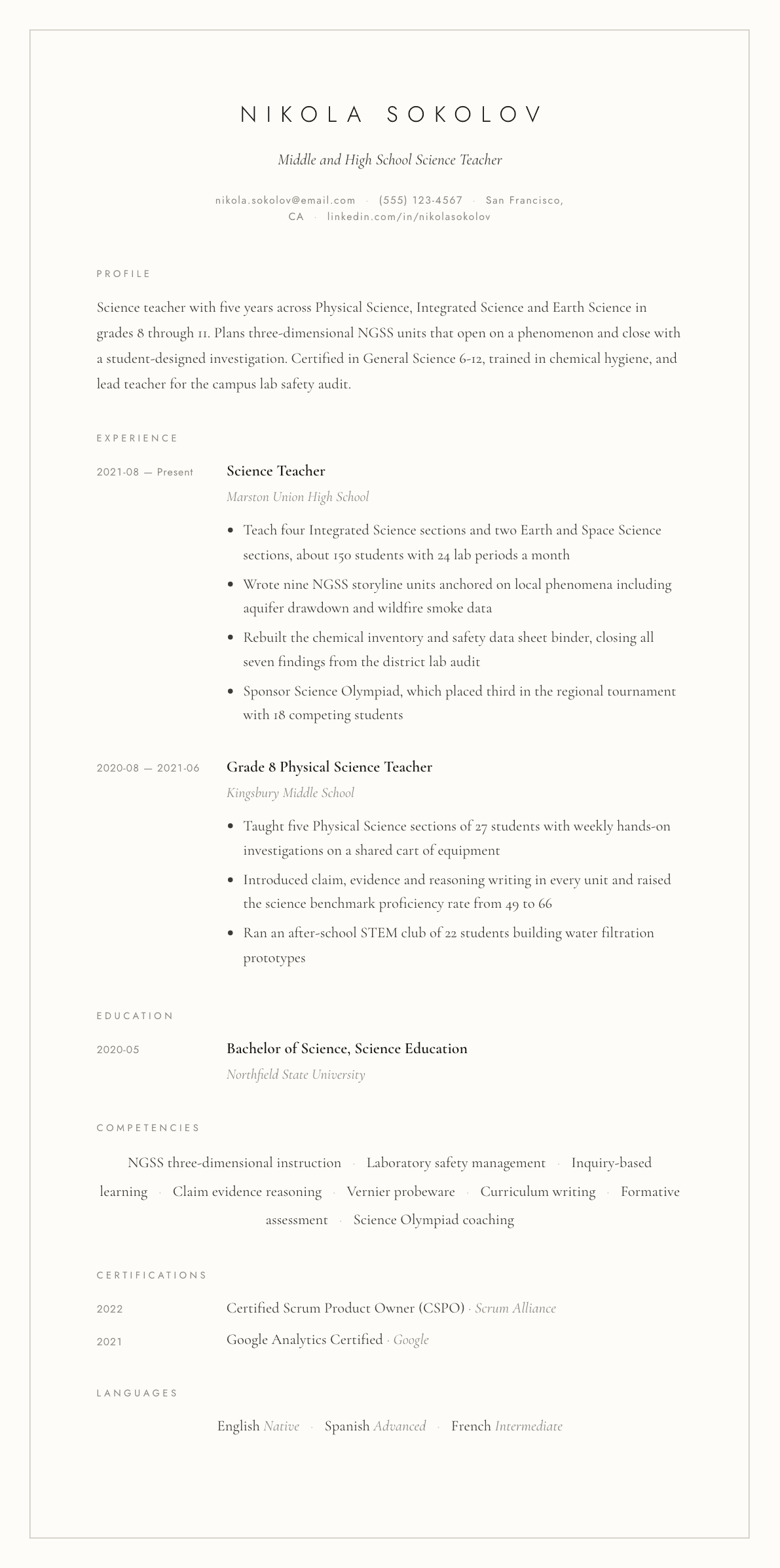
Example Science Teacher summary
Certified science teacher with five years teaching Physical Science, Integrated Science and Earth and Space Science in grades 8 through 11. Wrote nine NGSS storyline units anchored on local phenomena and led the campus lab safety rebuild that cleared all seven audit findings. Coaches Science Olympiad and mentors first-year teachers. Seeking a secondary science role with lab-heavy course assignments.
Skills to list on a Science Teacher resume
- NGSS curriculum design
- Inquiry-based instruction
- Laboratory safety and chemical hygiene
- Claim evidence reasoning writing
- Physical Science instruction
- Earth and Space Science instruction
- Vernier probeware
- PhET simulations
- Data analysis with students
- Engineering design process
- Differentiated instruction
- Science Olympiad coaching
- Formative assessment
- Standards-based grading
- Google Classroom
What actually gets this resume read
- State every science subject you are certified to teach, because a small school needs one hire to cover several.
- Put lab safety on the resume: chemical inventory, safety data sheets, eyewash checks and student safety contracts.
- Describe a storyline unit you wrote and the phenomenon it opened on, not that you use inquiry-based learning.
- Name the probeware and lab technology you actually run, such as Vernier or PASCO sensors and simulation tools.
- Include club coaching like Science Olympiad, robotics or science fair judging, since departments hire for that coverage.
- Give the assessment name behind any growth figure so the reader can weigh it against their own data.
How to write a science teacher resume
A science teacher vacancy is rarely a vacancy for one course. Departments hire someone who can hold Physical Science this year, pick up Earth and Space Science when a colleague retires, and keep the prep room from becoming a compliance problem. So the file that wins is the one that answers three questions fast: what can you teach, can you run a lab safely, and does your instruction produce evidence.
That third question is where most applicants lose ground. They write that they use hands-on, inquiry-based learning, which every science teacher writes. A department head wants the phenomenon a unit opened on, the investigation students designed, and the benchmark that moved.
This guide covers the order a science hiring team reads in, how to put lab safety on the page without sounding like a policy manual, summaries for three stages of a career, before and after bullets, and the questions science teachers ask when a posting lands mid-year.
Format and the coverage line that goes first
One page under five years, two pages once you carry advanced courses, safety duties or curriculum authorship. Reverse chronological, single column, plain fonts. Directly under the header, put a coverage line: the science courses you are certified and experienced to teach. That single line answers the staffing question before the reader reaches your first job.
Do not spread the same course across three entries with different titles. A reader building a schedule needs to see Physical Science, Biology, Chemistry, Earth and Space Science or Integrated Science named consistently.
- Header: name, city and state, contact, certification title with grade band.
- Coverage line: every science course you can hold, separated by commas.
- Then summary, certification, teaching experience, education, lab and safety, skills, sponsorships.
Summary: subjects, standards framework, and one unit you built
Say the grade band, the subjects, the certification, and how you build a unit. If your state has adopted the Next Generation Science Standards or a framework derived from them, say so and describe your planning in three-dimensional terms: a phenomenon, a set of practices, a crosscutting concept.
Close with the artifact. A storyline unit anchored on a local phenomenon, a lab sequence you wrote, or a claim, evidence and reasoning routine you rolled out to the department is a concrete thing a reader can picture on a shelf.
Experience: labs run, investigations designed, benchmarks moved
Head each entry with school, title, courses and student load, then give the lab cadence. A line such as four sections with 24 lab periods a month tells a chair whether you are a worksheet teacher or a lab teacher without you having to claim it.
Follow with instruction and evidence. Name the units you wrote and the phenomenon each opened on. Say how students record and defend a claim. Then attach movement on a named assessment: the state science end-of-course test, a district benchmark, or a growth measure the reader will recognize.
Leave out bullets about maintaining a positive learning environment or using a variety of teaching strategies. They are unfalsifiable, so a screener discounts them and you lose the line.
Lab safety as a hiring qualification
Safety is the duty that quietly follows every science position, and very few applicants put it on the page. Give it two or three lines: chemical inventory and safety data sheet upkeep, storage by compatibility rather than alphabet, waste segregation and disposal, fume hood and eyewash checks, student safety contracts, and how you handle live specimens or sharps.
If you have closed findings from a district or state lab audit, say how many and that they are closed. If you have trained colleagues on spill response or safety data sheets, say how many staff and in what setting. Those are the sentences a principal remembers.
Skills, equipment and the keywords a district screener matches
Name the equipment you actually run: probeware brands, microscopes, spectrophotometers, simulation libraries and the data tools students use to graph results. Equipment sitting unused in a closet is a real problem in science departments, so a candidate who names the gear reads as someone who will use it.
Then mirror the posting language once each in skills and in a bullet: three-dimensional learning, science and engineering practices, crosscutting concepts, engineering design process, laboratory safety, differentiated instruction and data-driven instruction.
- Instruction: storyline units, phenomenon-based openers, claim evidence and reasoning, engineering design challenges.
- Equipment: Vernier or PASCO probeware, microscopes, simulation libraries, data logging tools.
- Sponsorships: Science Olympiad, robotics, science fair, environmental club, STEM camp.
Science Teacher resume summary examples
First classroom
Newly certified general science teacher, grades 6 to 12, with a 16-week placement teaching four Physical Science sections and a summer STEM camp of 30 students. Wrote three phenomenon-anchored units and ran weekly investigations. Seeking a middle or high school science position with lab facilities.
Five years in
Science teacher with five years across Physical Science, Integrated Science and Earth and Space Science in grades 8 to 11. Wrote nine standards-aligned storyline units on local phenomena and led the campus lab safety rebuild that closed all seven audit findings. Coaches Science Olympiad.
Science department lead
Science department lead with eleven years teaching Physical Science, Biology and Environmental Science, and four years supervising six teachers, the prep rooms and the chemical hygiene plan. Built the district vertical science map from grade 6 through grade 11 and trains new science hires each August.
Work experience bullets: before and after
Before: Taught science using hands-on activities.
After: Taught four Integrated Science and two Earth and Space Science sections, about 150 students, running 24 lab periods a month.
Lab cadence and student load prove hands-on teaching instead of asserting it.
Before: Created lesson plans aligned to standards.
After: Wrote nine three-dimensional storyline units anchored on local phenomena including aquifer drawdown and wildfire smoke data.
The count and the actual phenomena show a reader the units exist and are locally grounded.
Before: Maintained a safe laboratory environment.
After: Rebuilt the chemical inventory and safety data sheet binder and closed all seven findings from the district lab audit.
An audit with a closed finding count is verifiable, while a safe environment is a claim anyone can make.
Before: Helped students improve their science scores.
After: Introduced claim, evidence and reasoning writing in every unit and raised benchmark proficiency from 49 to 66 on the district science assessment.
Naming the instructional change and the assessment lets the reader judge whether it transfers.
Before: Ran an after-school science club.
After: Coached Science Olympiad to a third place regional finish with 18 competing students across 12 events.
Scale, event count and result turn a club line into an argument for coverage the department needs.
Hard skills
- Three-dimensional science instruction
- Storyline and phenomenon-based unit design
- Laboratory safety and chemical hygiene
- Claim evidence and reasoning writing
- Physical Science instruction
- Earth and Space Science instruction
- Engineering design process
- Vernier and PASCO probeware
- PhET and simulation-based labs
- Benchmark data analysis
- Differentiated instruction
- Science Olympiad coaching
Soft skills
- Questioning that keeps students reasoning
- Lab group management
- Vertical team collaboration
- Calm response under lab incidents
- Mentoring student researchers
- Family communication about grades
Certifications worth listing
- National Board Certification, Science (National Board for Professional Teaching Standards)
- Praxis General Science: Content Knowledge (Educational Testing Service)
- Project Lead The Way Core Training, Biomedical or Engineering (Project Lead The Way)
- Certified Chemical Hygiene Officer (National Registry of Certified Chemists)
Mistakes that cost science teacher candidates the interview
- Writing that you use inquiry and hands-on learning without naming one investigation, phenomenon or unit you designed.
- Omitting the coverage line, so a chair cannot tell whether you can hold Earth Science when a colleague retires.
- Leaving lab safety off the page entirely when it is a standing duty attached to the position.
- Reporting growth with no assessment name, which makes the reader assume the number came from nowhere.
- Listing equipment you have only seen demonstrated, which collapses in the first interview question about it.
- Padding the file with generic classroom management phrases instead of the club coaching the department needs covered.
Science Teacher resume questions
How do I write a science teacher resume when I am certified in general science but want a specialized role?
Put the general certification exactly as your state titles it, then lead the coverage line with the specialization you want and back it with the courses, labs and coursework closest to it. Departments hire on evidence of teaching that subject, not the label alone.
Does laboratory safety experience really belong on a teaching resume?
Yes, and it is one of the quickest ways to stand out. Chemical inventory, storage compatibility, waste segregation, eyewash and fume hood checks, and student safety contracts are duties the position carries whether or not the posting mentions them.
Should I list every unit I have written?
No. Give a count and two or three examples with the phenomenon each opened on. A reader wants proof that you build curriculum, not a table of contents, and the space is better spent on assessment evidence and safety work.
What if my school has almost no lab equipment?
Say what you did with what existed: a shared cart, household materials, simulation libraries, or field study on campus grounds. Resourcefulness under constraint reads well, and it tells a hiring team you will not stall waiting on a purchase order.
How much of my resume should club and camp coaching take?
A short block near the end with the activity, your role, participant counts and any results. Science Olympiad, robotics and science fair coaching are frequently the unstated reason a science vacancy exists in the first place.