Biology Teacher Resume Examples: the lines they read
Write a Biology Teacher Resume That Proves Lab Depth
By Mustafa Tarabya, founder of CVBooster · Published · Updated
Biology teacher resume example with course loads, dissection and biotech lab detail, certification placement and the terms hiring committees search.
Sample resumes for a biology teacher
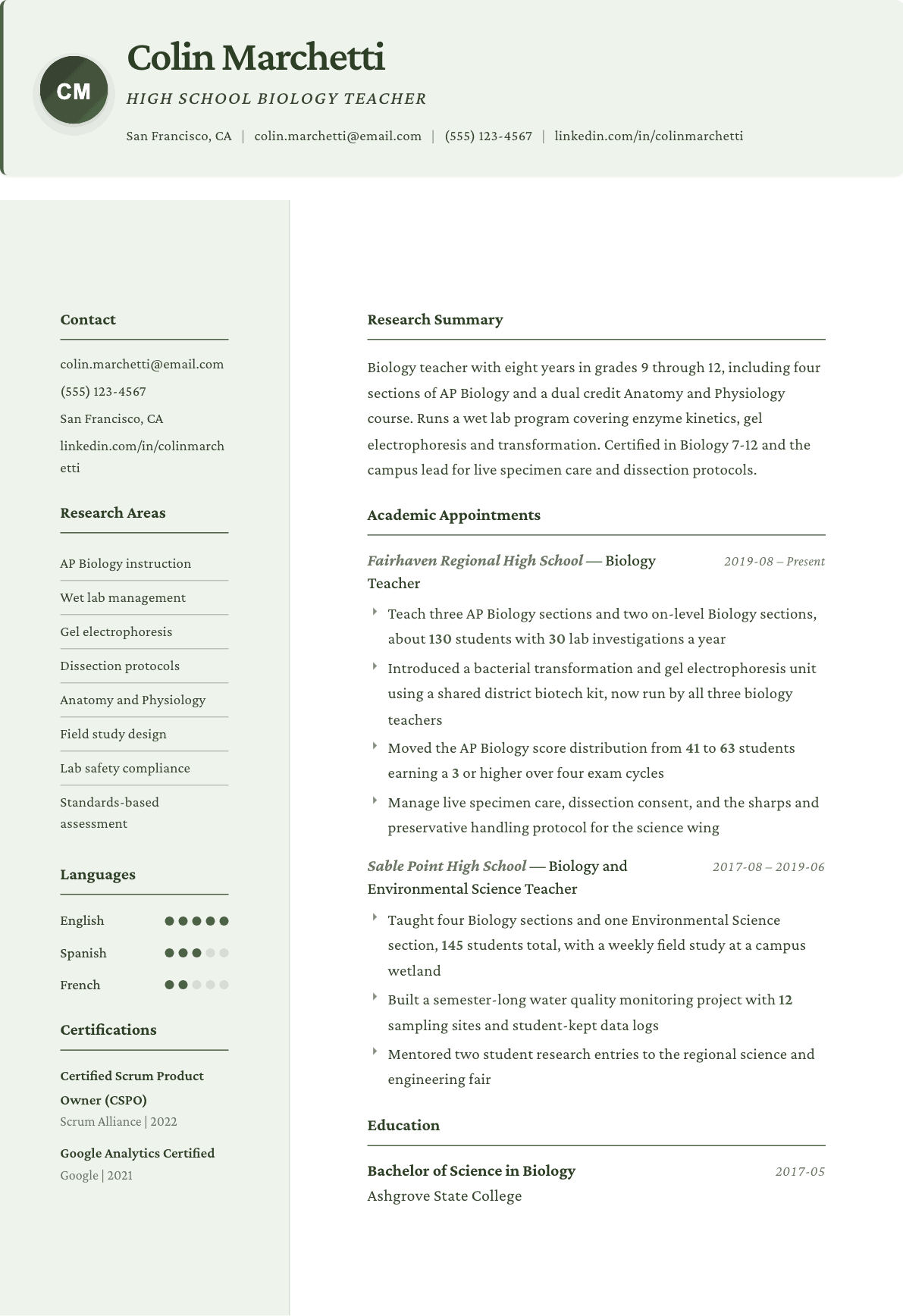
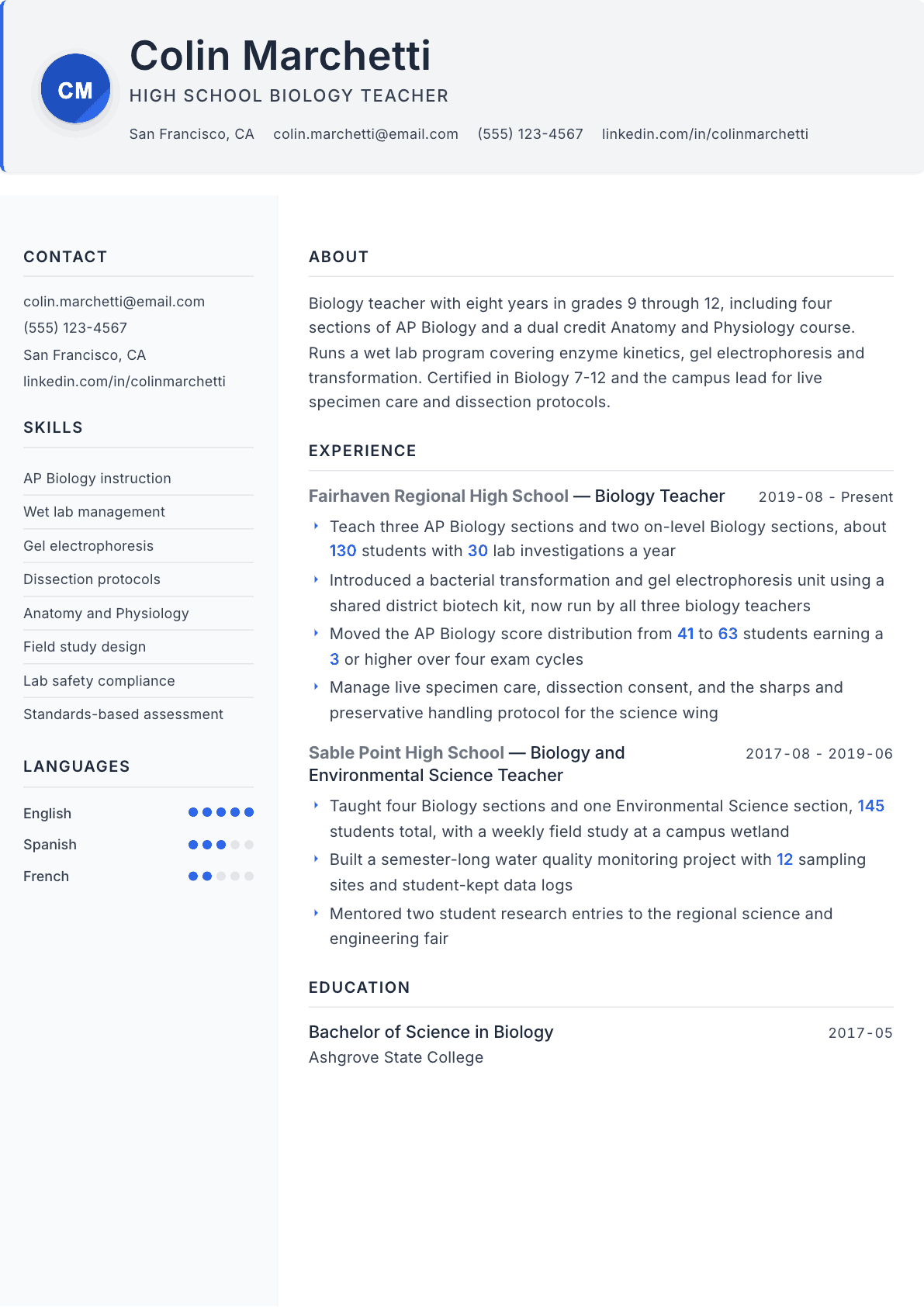
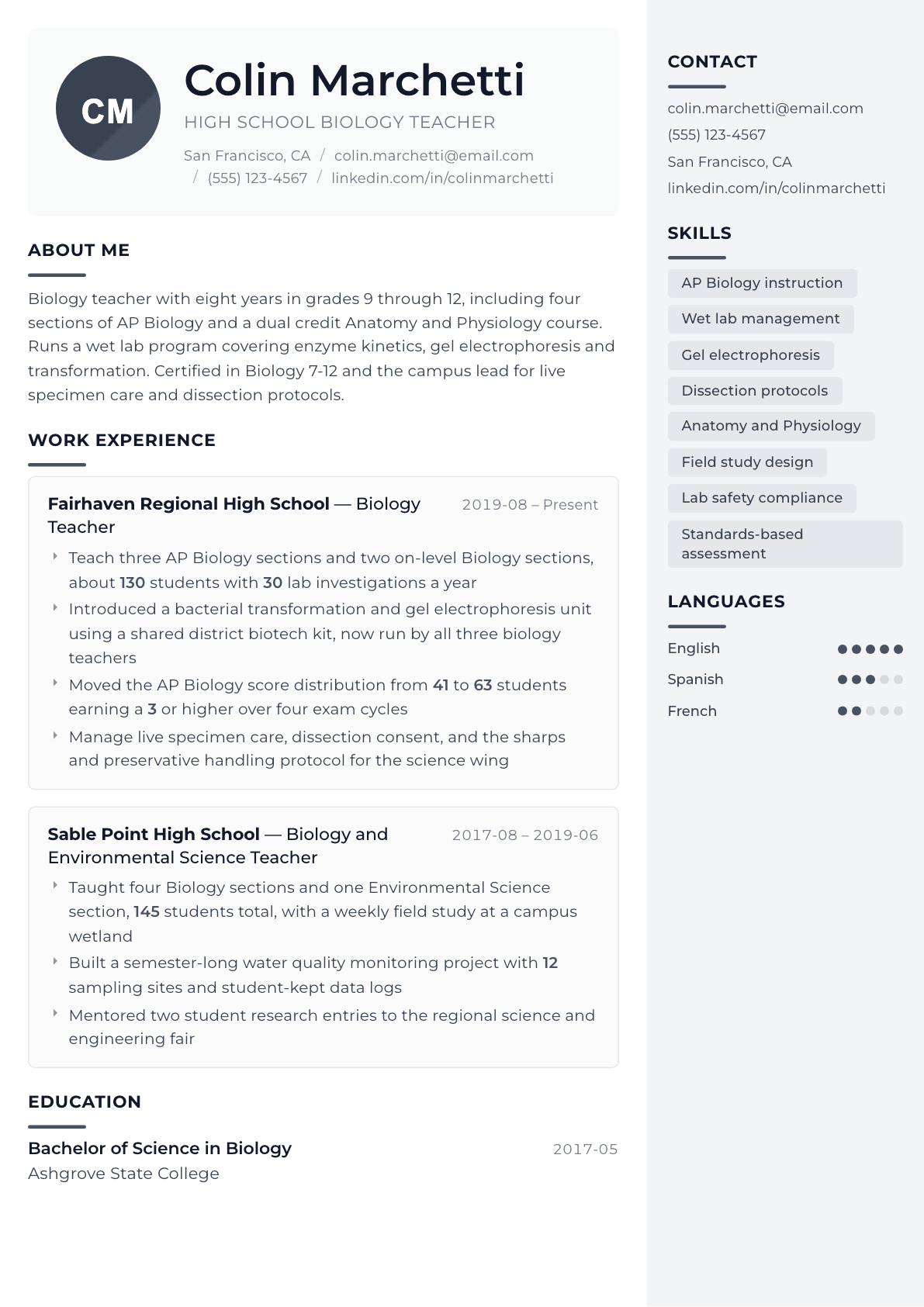
The same biology teacher content laid out in three CVBooster templates, so you can see what the finished document looks like before you write a word.
Example Biology Teacher summary
Biology teacher with eight years in grades 9 through 12, teaching AP Biology, on-level Biology and dual credit Anatomy and Physiology. Runs a wet lab program covering enzyme kinetics, transformation and electrophoresis, and moved the AP qualifying score count from 41 to 63 students. Certified Biology 7-12 and campus lead for specimen and dissection safety. Seeking a science department with an AP load.
Skills to list on a Biology Teacher resume
- AP Biology curriculum
- Cell biology instruction
- Genetics instruction
- Anatomy and Physiology
- Environmental Science
- Wet lab management
- Gel electrophoresis
- Microscopy instruction
- Dissection and specimen handling
- Lab safety compliance
- Field study design
- Science fair mentoring
- Data analysis with students
- Standards-based assessment
- Differentiated instruction
What actually gets this resume read
- Separate AP Biology, on-level Biology, Anatomy and Physiology and Environmental Science so the reader sees your full range.
- List the specific labs you run, since biology hiring committees want to know if the equipment will be used.
- Report AP outcomes as counts of students earning a qualifying score across exam cycles rather than a single year.
- Show that you handle specimen care, dissection consent and preservative safety, because that duty follows the position.
- Add science fair mentoring or research supervision with the level students reached, from campus to regional.
- Keep a short line for the content knowledge exam you passed and your certification area with its grade band.
How to write a biology teacher resume
Biology is the course almost every high school student takes, which means a biology teacher position is judged on volume as much as depth. A department chair filling one is thinking about five sections of thirty students, a prep room full of preserved specimens, an AP roster that has to hold up on exam day, and whether the microscopes get used or stay in the cabinet.
Most applicant files answer none of that. They say the candidate is passionate about the life sciences and skilled at engaging students. The files that get interviews name the courses, the labs, the specimen and dissection duties, and the exam outcomes across more than one cycle.
This guide walks through what a biology hiring team looks for, section by section, with example summaries for a new teacher, a mid-career teacher and a department lead, before and after bullets drawn from real biology classrooms, and the questions that come up when a science vacancy is posted in June.
Format and the course breakdown that goes near the top
One page for candidates under five years, two once you carry AP sections or department duties. Reverse chronological, single column. Immediately after the header, break out the biology courses you have taught by level: AP Biology, on-level Biology, honors Biology, Anatomy and Physiology, Environmental Science, dual credit variants. Those are separate hiring needs and blending them into one line costs you consideration.
Keep undergraduate research to one line under education unless it produced a classroom protocol. A summer in a molecular lab matters here mainly because it means you can run transformation and electrophoresis with students.
- Header: name, city and state, contact, certification title with grade band.
- Course breakdown by level, so a chair can slot you into the master schedule.
- Then summary, certification, teaching experience, education, lab and specimen duties, skills.
Summary: level, load, and the lab program you run
Three lines. Grade band, courses by level, certification, and the wet lab program you run. Naming the labs is what makes a biology summary specific: enzyme kinetics, bacterial transformation, gel electrophoresis, osmosis and diffusion, population sampling, microscopy of prepared and wet mount slides.
Add one clause on scale. A biology teacher handling 130 students across five sections with thirty lab investigations a year has said more about their working life than any adjective could.
Experience: courses, investigations, and exam outcomes
Head each entry with school, title, the courses with levels, and the student count. Then bullets that only a biology teacher could write. Name the investigation sequence and the equipment behind it. Say whether students design their own procedure or follow one. Say what they produce: a formal lab report, a poster, a data set they defend.
For AP, report outcomes as counts of students earning a qualifying score, and cover several exam cycles rather than a single good year. Enrollment growth belongs here too, because filling an AP section is a problem principals are trying to solve.
Field and outdoor work is a differentiator many biology teachers forget. A wetland study, a water quality monitoring project, a campus biodiversity survey or a partnership with a nature center distinguishes your file immediately.
Specimen care, dissection and the duties attached to the room
Biology carries duties no other science course does: live specimen care over breaks, dissection consent and alternatives, preservative handling and ventilation, sharps disposal, and the biological waste stream. Very few applicants mention any of it, and a chair who has spent a summer chasing a dead colony reads that block with relief.
Give it three or four concrete lines. Name the protocol you wrote or maintained, the consent process you run with families, and how you handle students who opt out of dissection. Being the person who solved that is a hiring argument.
Skills, keywords and student research supervision
Mirror posting language once in skills and once inside a bullet: laboratory safety, inquiry-based instruction, science and engineering practices, data analysis, differentiated instruction, standards alignment and the course names. Then name the equipment: compound and stereo microscopes, micropipettes, electrophoresis chambers, incubators, spectrophotometers and the probeware brand.
If you have mentored student research to a fair or symposium, give the level reached and how many students. Research supervision is scarce, and departments that want a science fair presence hire for it directly.
- Instruction: inquiry lab design, formal lab reports, data analysis, dissection and microscopy sequences.
- Equipment: micropipettes, electrophoresis chambers, incubators, compound and stereo microscopes.
- Beyond the classroom: science fair mentoring, field study partnerships, Science Olympiad, HOSA sponsorship.
Biology Teacher resume summary examples
First classroom
Newly certified biology teacher, grades 7 to 12, with a 16-week placement teaching four on-level Biology sections and two years as an undergraduate teaching assistant in a genetics lab. Comfortable with microscopy, dissection protocols and electrophoresis. Seeking a high school biology position with wet lab facilities.
Eight years in
Biology teacher with eight years in grades 9 to 12 teaching AP Biology, on-level Biology and dual credit Anatomy and Physiology. Runs a wet lab program covering enzyme kinetics, transformation and gel electrophoresis, and moved AP qualifying scores from 41 to 63 students across four cycles.
Science department lead
Science lead with fourteen years teaching Biology and Anatomy and Physiology, and six years supervising a department of eight, the prep rooms and the biological waste plan. Built the district biology scope and sequence and mentors two student research teams to the regional fair each year.
Work experience bullets: before and after
Before: Taught biology to high school students.
After: Taught three AP Biology and two on-level Biology sections, about 130 students, running 30 lab investigations a year.
Level breakdown, student count and lab volume place you on a schedule in one sentence.
Before: Introduced new lab activities.
After: Introduced a bacterial transformation and gel electrophoresis unit using a shared district biotech kit, now run by all three biology teachers.
A named technique that spread to colleagues shows you built something the department kept.
Before: Students did well on the AP exam.
After: Moved the AP Biology score distribution from 41 to 63 students earning a 3 or higher across four exam cycles.
Counts across multiple cycles read as a trend rather than one lucky roster.
Before: Took care of classroom animals and lab materials.
After: Manage live specimen care, dissection consent and alternatives, and the sharps and preservative handling protocol for the science wing.
These are duties the position carries, and naming them tells a chair one recurring headache is covered.
Before: Did an environmental project with students.
After: Built a semester-long water quality monitoring project across 12 sampling sites with student-kept data logs and a final presentation.
Site count, duration and student output turn a project mention into a program a school can inherit.
Hard skills
- AP Biology curriculum
- Cell biology and genetics instruction
- Anatomy and Physiology instruction
- Environmental Science instruction
- Wet lab design and management
- Gel electrophoresis and transformation
- Microscopy instruction
- Dissection and specimen handling
- Biological waste and sharps protocols
- Field study design
- Formal lab report assessment
- Science fair research mentoring
Soft skills
- Lab group supervision
- Guiding students through failed experiments
- Family communication about dissection choices
- Department collaboration on shared kits
- Mentoring student researchers
- Time management across five sections
Certifications worth listing
- National Board Certification, Science Adolescence and Young Adulthood (National Board for Professional Teaching Standards)
- AP Course Audit Approval, Biology (College Board)
- Praxis Biology: Content Knowledge (Educational Testing Service)
- Project Lead The Way Core Training, Principles of Biomedical Science (Project Lead The Way)
Mistakes that cost biology teacher candidates the interview
- Merging AP, honors and on-level Biology into a single line, which hides the exact experience the vacancy needs.
- Describing yourself as passionate about the life sciences, a phrase carried by most files in the pile.
- Reporting a single strong AP year instead of the trend across several exam cycles.
- Skipping specimen care, dissection consent and waste handling, which are standing duties of the room.
- Naming equipment you have not personally set up, which fails at the first specific interview question.
- Writing lab activities without saying whether students design procedures or follow a printed one.
Biology Teacher resume questions
How do I write a biology teacher resume with no AP experience?
Lead with the honors or dual credit sections you have taught and the college-level labs you run, then say plainly that you are seeking an AP assignment. Add any AP Summer Institute attendance or course audit approval you already hold.
Should I list every lab I teach?
List the six or eight that show range and equipment competence, grouped by skill: microscopy, molecular techniques, physiology, ecology sampling. A complete catalog wastes space that belongs to exam outcomes and specimen duties.
Does undergraduate research help a biology teaching application?
It helps when you connect it to the classroom. One line under education is enough unless the techniques became student labs, in which case move it into the experience section as the origin of a protocol you now teach.
How do I handle dissection on a resume when families object?
Describe the consent process you run and the alternative assignment you offer. Showing that you manage the conversation with families rather than avoid it is exactly what a principal wants to see from a biology hire.
What if I am certified in general science but applying for a biology opening?
State the certification exactly as your state issues it, then use the course breakdown and lab program to prove biology depth. HR verifies the certificate wording, so matching it prevents an early screen out, while the labs win the interview.