English Teacher Resume Examples: the lines they read
Write an English Teacher Resume Principals Read Twice
By Mustafa Tarabya, founder of CVBooster · Published · Updated
English teacher resume examples, grade-level keywords, and a writing guide covering certification, reading data, and literature units.
Sample resumes for a english teacher
The same english teacher content laid out in three CVBooster templates, so you can see what the finished document looks like before you write a word.
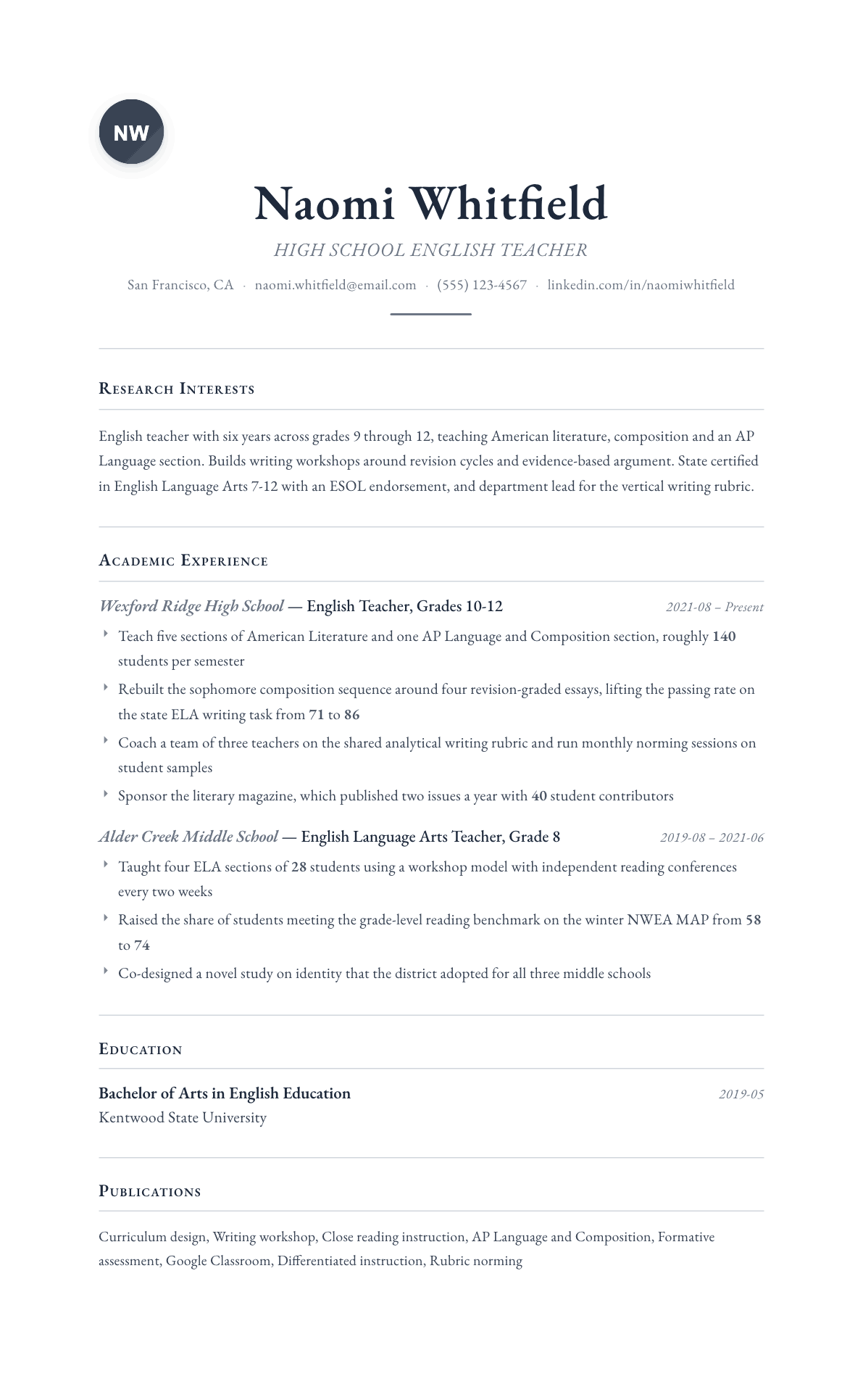
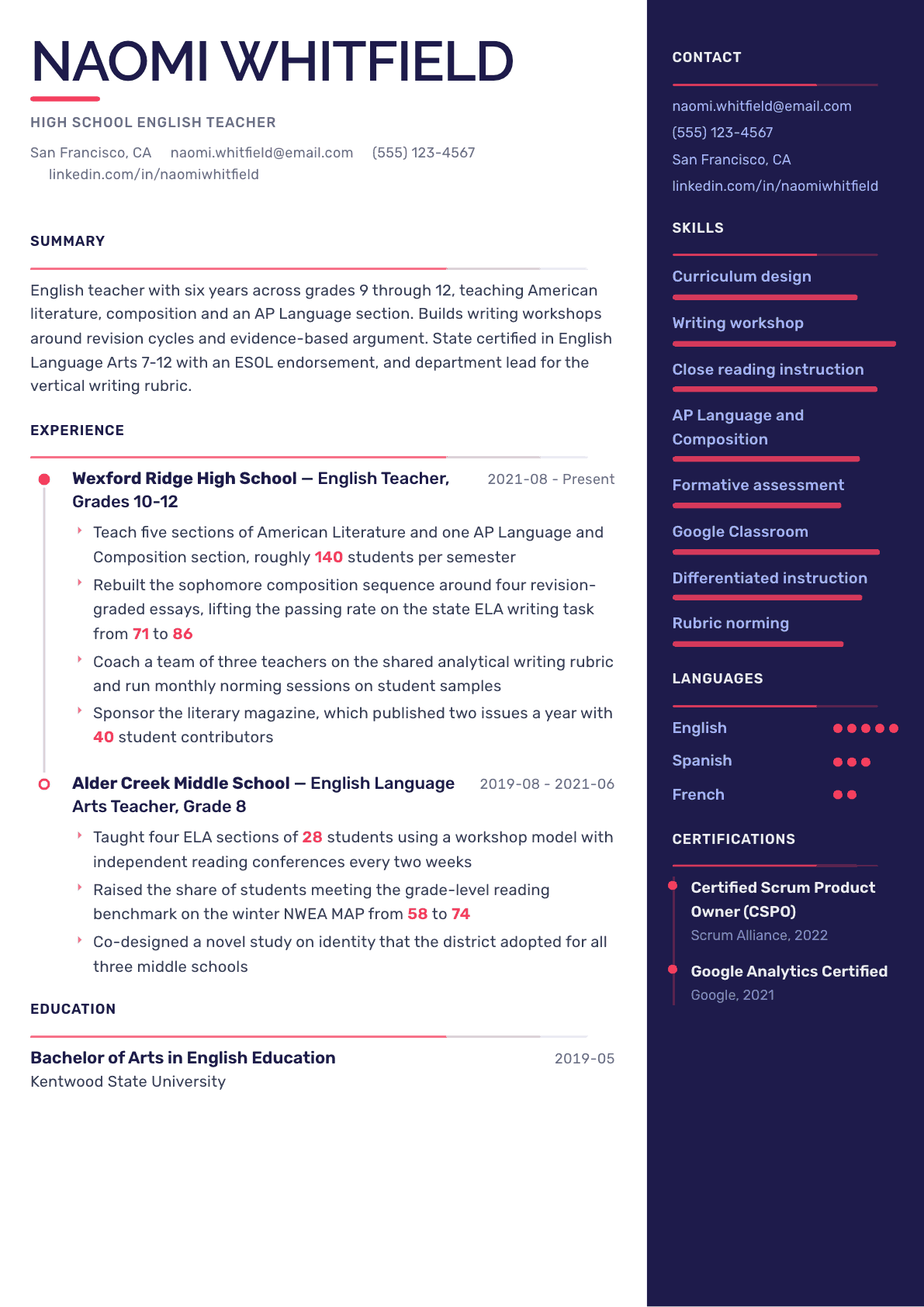
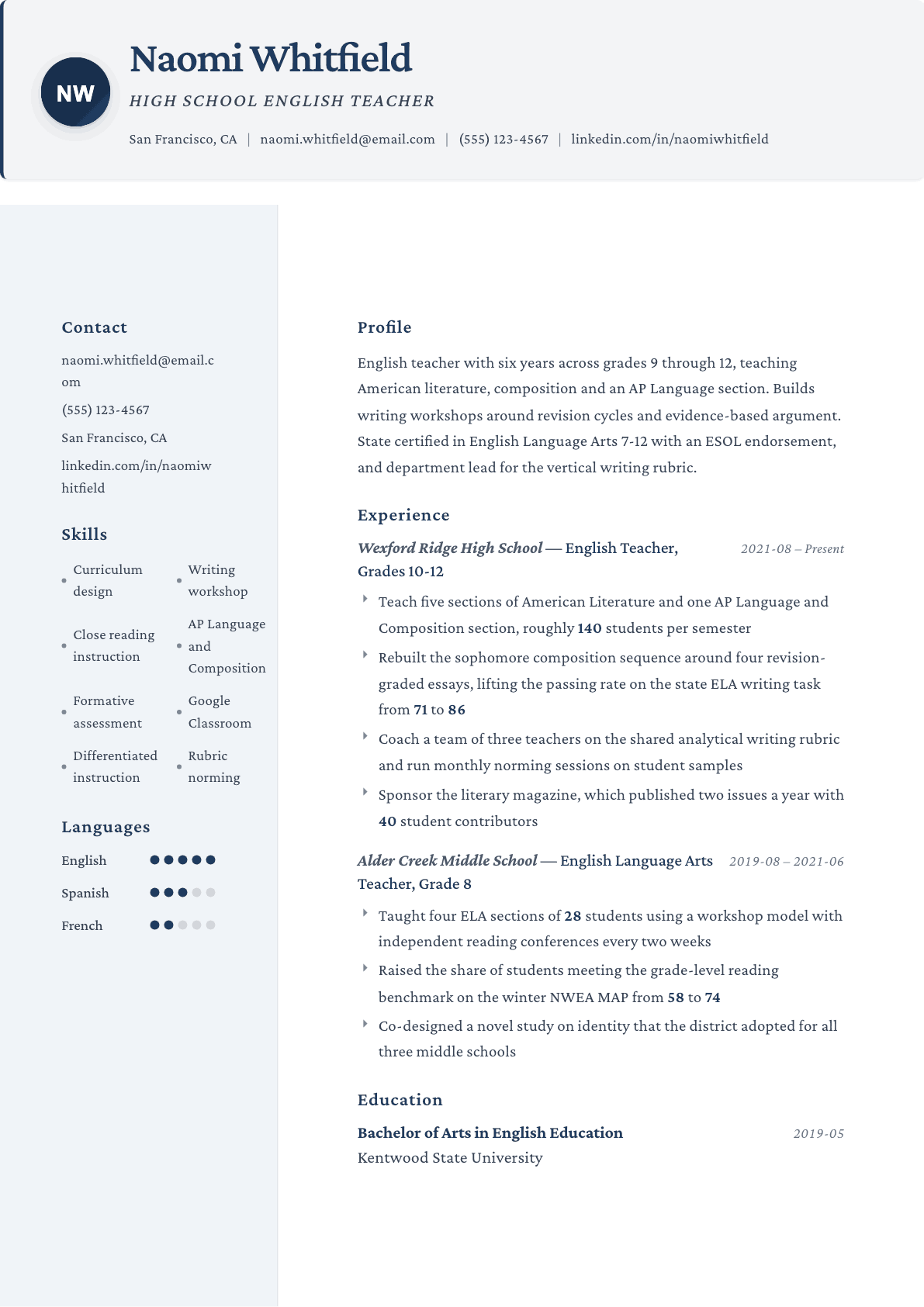
Example English Teacher summary
Certified English teacher with six years in grades 8 through 12, teaching composition, American literature and one AP Language section. Redesigned a sophomore writing sequence around graded revision and moved the state writing pass rate up 15 points. ESOL endorsed, experienced with co-taught inclusion classes, and looking for a high school English position with department leadership scope.
Skills to list on a English Teacher resume
- English Language Arts curriculum
- Writing workshop instruction
- Close reading and textual analysis
- AP Language and Composition
- Grammar and usage instruction
- Standards-based grading
- Formative assessment design
- Differentiated instruction
- Reading intervention
- Google Classroom
- Canvas LMS
- Socratic seminar facilitation
- Vocabulary instruction
- Parent conferencing
- Co-teaching and inclusion support
What actually gets this resume read
- Name the grade bands and courses you have taught, because a principal filling an AP section screens for that first.
- Put your state certification, endorsement areas and expiration on the first page where an HR screener can find them.
- Show reading and writing growth with the assessment your district actually uses, such as NWEA MAP or the state ELA task.
- Describe the texts and units you built rather than saying you taught literature, since every applicant taught literature.
- List the learning platforms you run daily, for example Google Classroom, Canvas or Schoology, in a tools line.
- Add club sponsorship, yearbook, debate or literary magazine work, because small schools hire for coverage beyond the classroom.
How to write a english teacher resume
An english teacher resume gets sorted twice before anyone reads it properly. A district HR clerk checks that your certification area covers the vacancy, that the grade band matches, and that your fingerprint clearance and content exam are on file. Only then does the building principal or the ELA department chair open the file, and that reader has one question: can this person take five sections of composition in August without the department rewriting the units for them?
Almost every applicant writes that they foster a love of reading. That sentence has never moved a resume forward. What moves it is the course list, the texts you have taught, the writing sequence you built, and a growth number tied to an assessment the reader recognizes.
This guide covers the section order an ELA hiring team expects, how to write the summary when you are moving between grade bands, three example summaries at different career stages, before and after bullets, and the questions english teachers ask when the posting closes in a week.
Format and section order for a teaching file
One page for candidates with fewer than five years in the classroom, two pages once you carry AP sections, department duties or curriculum authorship. Reverse chronological, single column, no icons. District application portals parse uploaded files, and a two column layout often scrambles the dates that HR uses to verify your years of service for placement on the salary schedule.
Put certification directly under the header, not at the bottom. A principal filling a grade 11 English vacancy stops reading a resume that has not told them by line four whether you can legally hold that room.
- Header: name, city and state, phone, email, and the state certification area with grade band.
- Then: summary, certification and endorsements, teaching experience, education, skills, and activities or sponsorships.
- Candidates finishing a program move education and student teaching above other work.
Summary: courses, grade band, and the thing you built
Three lines. Name the grade band, the courses, the certification, and one artifact you created that outlived a single year: a writing sequence, a vertical rubric, a novel unit the department adopted. That last clause is what separates you from the other forty applicants who also taught tenth grade English.
If you are moving from middle school ELA to high school, or from on-level to AP, say the move in the summary and name the bridge. A reader who has to guess whether you can handle AP Literature will assume you cannot.
Experience: sections taught, texts, and the writing sequence
Head each job with the school, your title, and the exact courses and grade levels. A line such as "English Teacher, Grades 10 to 12: American Literature, Composition, AP Language" tells the reader more than three bullets of adjectives.
Then three to five bullets. Lead with instruction: the units you designed, the anchor texts, the revision cycle, the seminar structure, how independent reading is tracked. Follow with evidence: movement on the state ELA writing task, a district benchmark, or the share of students meeting a reading growth target. Name the assessment, because unattached growth numbers read as decoration.
Cut the bullets that describe teaching itself. Taking attendance, grading essays and communicating with parents are true of every english teacher, and each one costs you a line you needed for something real.
Certification, endorsements, and what HR verifies
Give the state, the certification title, the grade band, and the expiration. Then list endorsements separately: ESOL, reading, gifted, journalism, speech and debate. Endorsements decide staffing puzzles, and a principal who can cover a journalism elective with an existing hire will read your file again.
If your license is from another state, say whether you have applied for reciprocity and where that application stands. Silence there reads as an obstacle, and an obstacle at the bottom of a stack does not get a phone call.
Skills and keywords the district screener matches
ELA postings recycle the same phrases: standards-based grading, close reading, text-dependent questions, writing workshop, differentiated instruction, formative assessment, data driven instruction, and the learning platform. Mirror the posting once in your skills block and once inside a bullet where it is demonstrated. A skills list that claims nothing the experience section proves is padding a chair will notice.
Name your tools plainly: the learning platform, the plagiarism and feedback tool, and the assessment system. Google Classroom, Canvas, Schoology, NWEA MAP and the state ELA task are the words a screener is looking for.
- Instructional: writing workshop, close reading, Socratic seminar, independent reading conferences, vocabulary routines.
- Assessment: rubric norming, formative checks, benchmark analysis, standards-based grading.
- Coverage: AP Language, AP Literature, dual credit composition, yearbook, journalism, debate.
English Teacher resume summary examples
First classroom
Newly certified English Language Arts teacher, grades 7 to 12, with a 16-week placement teaching four sections of grade 9 English and a semester of after-school writing support. Built a five-week argument unit with a shared rubric. Seeking a secondary English position with a composition load.
Six years in
English teacher with six years in grades 8 to 12 covering American Literature, Composition and one AP Language section. Rebuilt the sophomore writing sequence around graded revision and moved the state ELA writing pass rate from 71 to 86. ESOL endorsed and experienced in co-taught inclusion classes.
Department chair
ELA department chair with twelve years teaching grades 9 to 12, including AP Language and AP Literature. Leads nine teachers through observation cycles, vertical rubric norming and curriculum adoption. Wrote the district grade 9 to 12 writing continuum now used across four high schools. Certified English 7-12.
Work experience bullets: before and after
Before: Taught English to high school students.
After: Taught five sections of American Literature and one AP Language section, roughly 140 students per semester across a six-period day.
Course names, section count and student load tell a principal exactly what schedule you can absorb.
Before: Improved student writing.
After: Rebuilt the sophomore composition sequence around four revision-graded essays and lifted the state ELA writing pass rate from 71 to 86.
The change is named, the assessment is named, and the movement is attached to both.
Before: Used technology in the classroom.
After: Ran all drafting, peer review and feedback cycles through Google Classroom with comment-based conferencing on every major essay.
A tool plus the instructional routine it supports is evidence, while a claim about technology is not.
Before: Worked with other teachers on curriculum.
After: Coached three colleagues on the shared analytical writing rubric and ran monthly norming sessions on anonymized student samples.
Specific collaboration work reads as informal leadership, which is what department chairs are chosen from.
Before: Sponsored school clubs.
After: Sponsored the literary magazine, publishing two issues a year with 40 student contributors and a student editorial board.
Sponsorship with scale and structure tells a small school you can cover duties beyond the classroom.
Hard skills
- English Language Arts curriculum design
- Writing workshop instruction
- Close reading and textual analysis
- AP Language and Composition
- AP Literature and Composition
- Standards-based grading
- Rubric design and norming
- Reading intervention
- Formative assessment
- Google Classroom
- Canvas LMS
- Independent reading conferences
Soft skills
- Conferencing with student writers
- Parent communication
- Co-teaching partnership
- Feedback that students act on
- Curriculum collaboration
- Pacing under a testing calendar
Certifications worth listing
- National Board Certification, English Language Arts (National Board for Professional Teaching Standards)
- AP Course Audit Approval, English Language and Composition (College Board)
- Praxis English Language Arts: Content Knowledge (Educational Testing Service)
- TESOL Certificate (TESOL International Association)
Mistakes that cost english teacher candidates the interview
- Listing a love of reading and literature as a qualification instead of the courses and units you have actually taught.
- Burying state certification and grade band on page two, where an HR screener filling one vacancy will not look.
- Naming growth without naming the assessment behind it, which makes the number read as invented.
- Filling bullets with universal duties such as grading essays and contacting parents rather than what you built.
- Using a two-column template with icons that district application portals parse out of order.
- Sending the same file to an AP Literature posting and a middle school ELA posting without changing the summary line.
English Teacher resume questions
How long should an english teacher resume be?
One page while you have fewer than five years in the classroom. Two pages once you carry AP sections, department leadership, curriculum authorship or multiple endorsements. Anything longer gets skimmed, and the parts you cared about are the parts that get skipped.
Should I list the novels and texts I have taught?
List anchor texts only when they show range or match the posting, and keep it to a short line inside a job entry. A full reading list eats space that belongs to your writing sequence, your assessment evidence and your certification.
How do I show AP experience if I have never taught an AP section?
Name the closest evidence you have: honors or dual credit sections, an AP Summer Institute you attended, reading experience with the College Board, or the analytical writing rubric you built. State plainly that you are seeking an AP assignment so the reader knows your intent.
Do I include student teaching once I have real classroom years?
Keep it for your first two or three years, then drop it. Once you have led your own sections through full school years, the placement adds nothing and the space is better spent on the units and results from those years.
What do I write if I am moving from middle school ELA to high school?
Say the move in the summary and name the bridge: grade 8 argument writing, a high school aligned rubric, a vertical team you sat on, or a dual credit course you observed. Then lead each job with the bullets closest to secondary composition work.