STEM Educator Resume Examples: free ATS score and gap list
Inspire the Next Generation with a STEM Educator Resume
By Mustafa Tarabya, founder of CVBooster · Published · Updated
Create a STEM educator resume showcasing your hands-on science and technology instruction, robotics program leadership, and ability to make STEM accessible and exciting.
Sample resumes for a stem educator
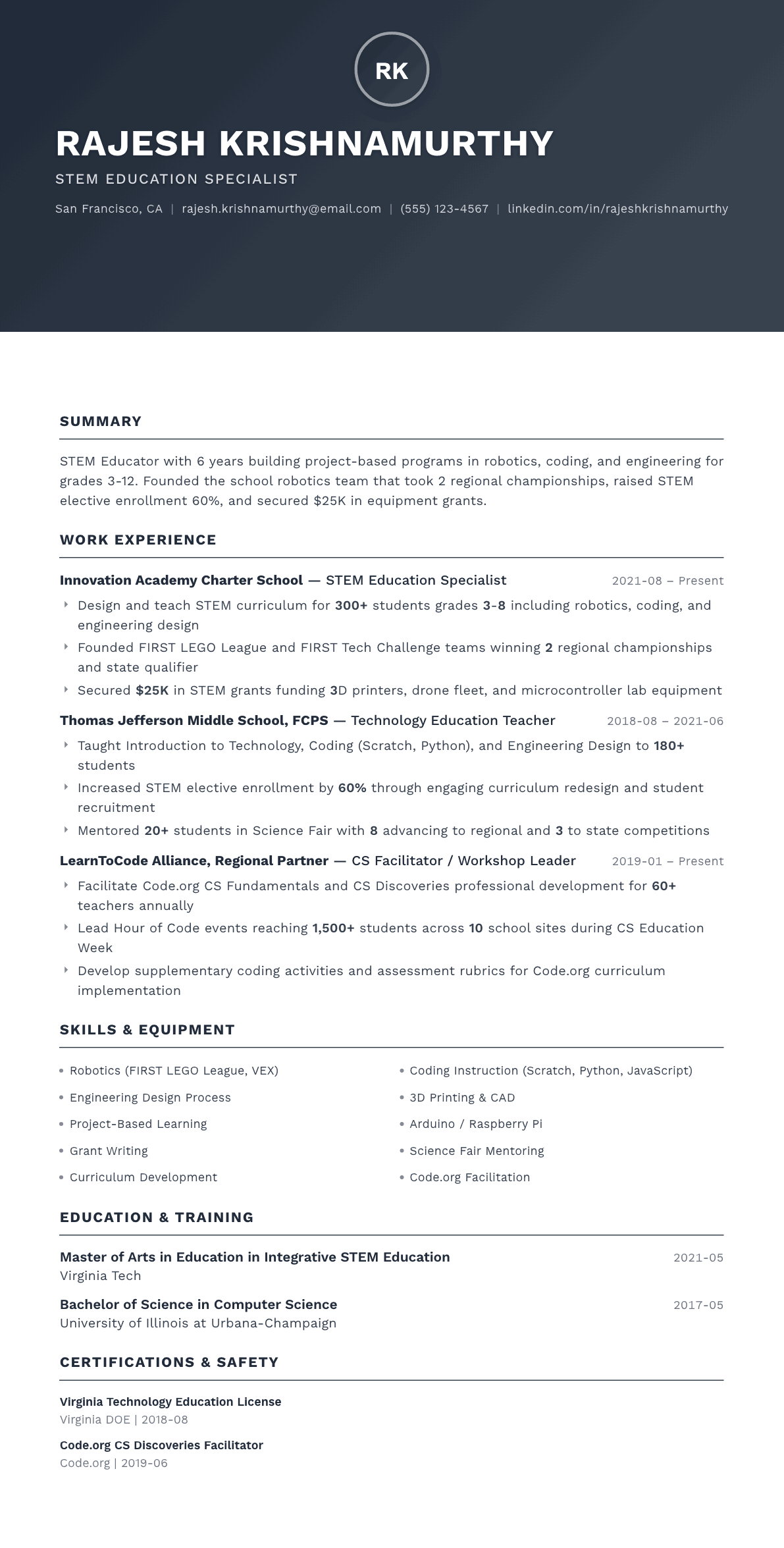
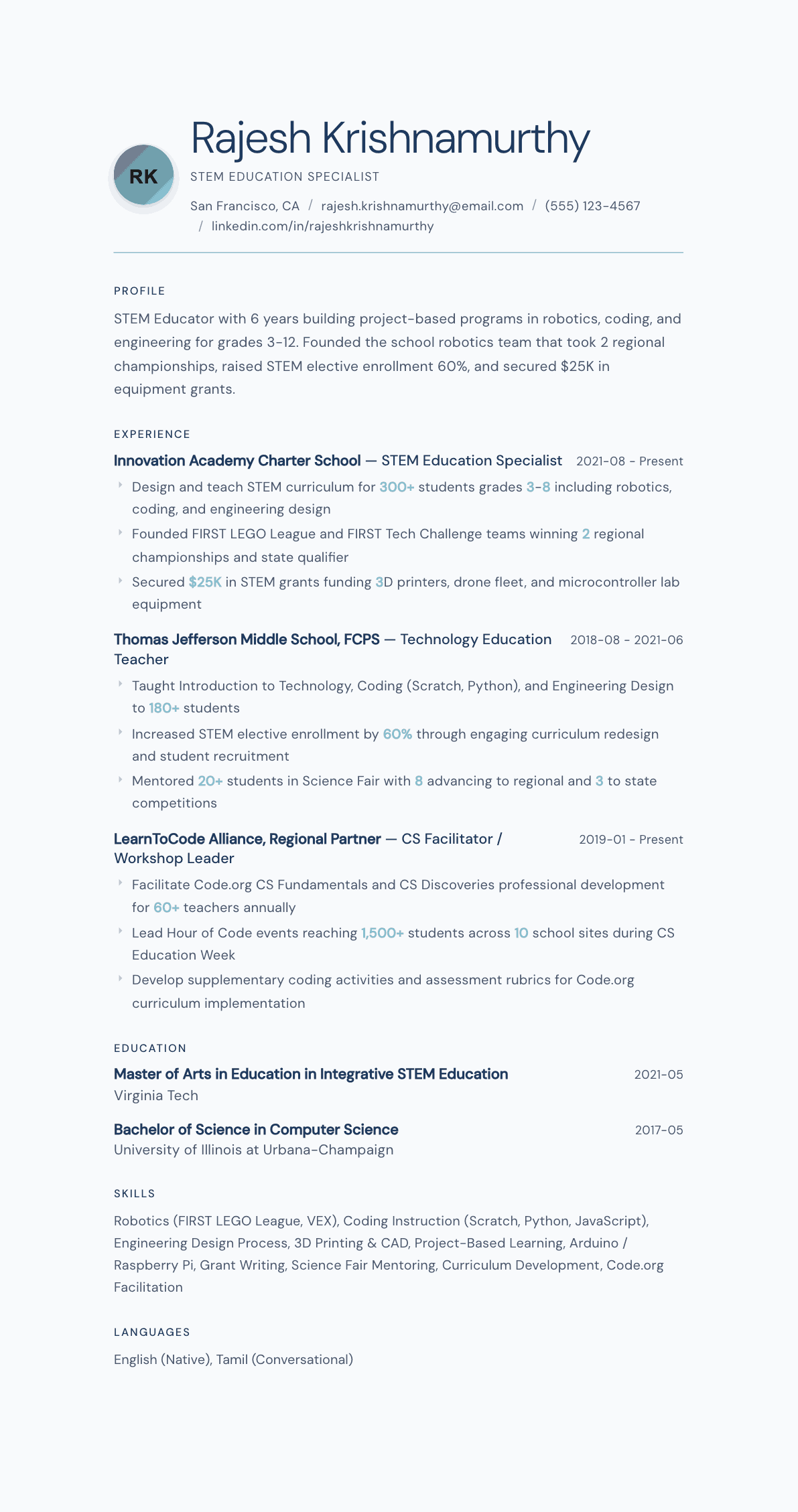
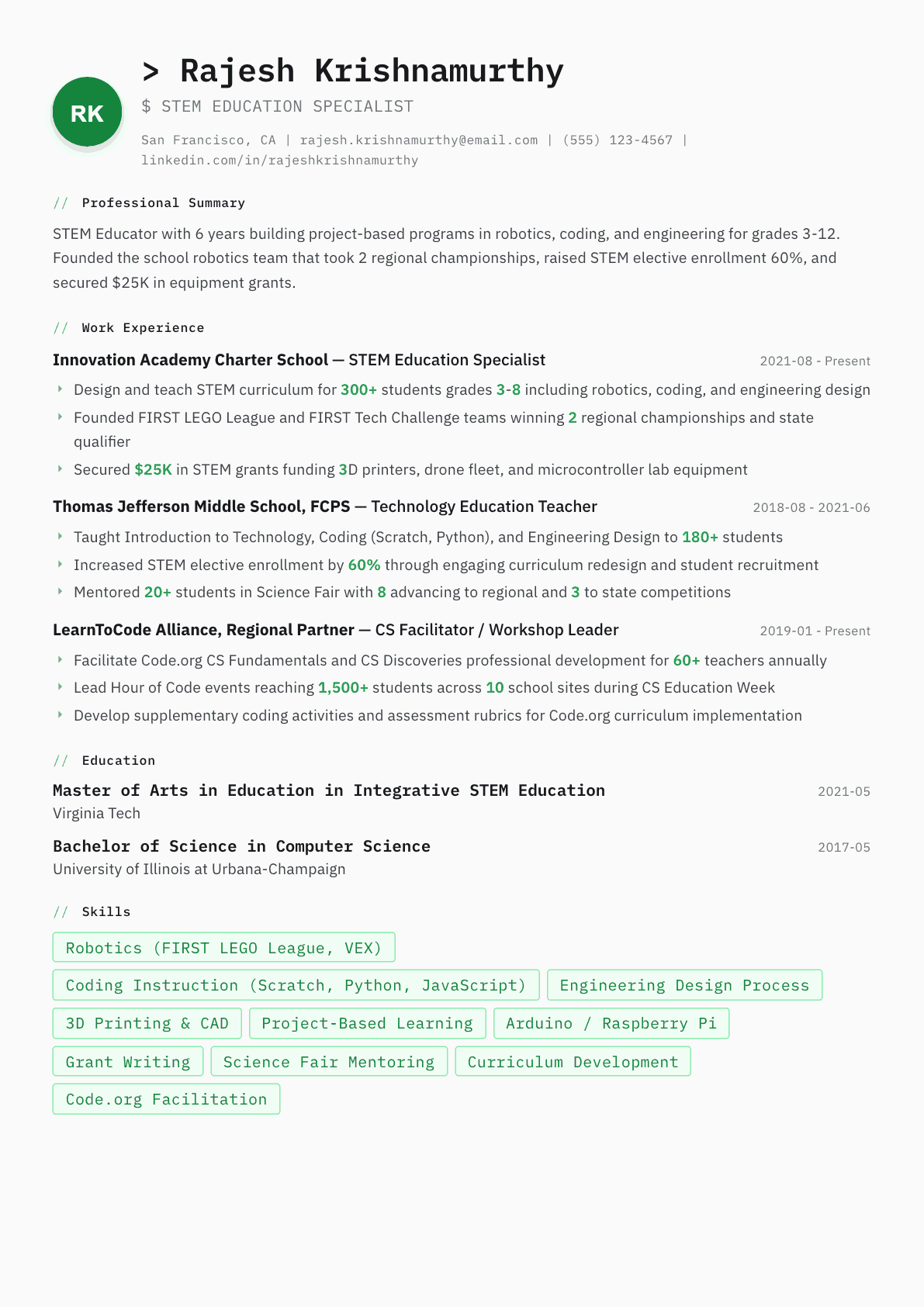
The same stem educator content laid out in three CVBooster templates, so you can see what the finished document looks like before you write a word.
Example STEM Educator summary
STEM Educator with 6 years of experience teaching robotics, coding, and engineering to K-12 students. Founded robotics team winning 2 regional FIRST championships, secured $25K in grants, and increased STEM enrollment by 60%.
Skills to list on a STEM Educator resume
- Robotics (FIRST, VEX)
- Coding (Scratch, Python, JavaScript)
- Engineering Design Process
- 3D Printing / CAD
- Project-Based Learning
- Arduino / Raspberry Pi
- Drone Technology
- Grant Writing & Fundraising
- Science Fair Coordination
- Curriculum Design
- Code.org / CS Education
- Maker Space Management
What actually gets this resume read
- Highlight robotics competition results and STEM club/team achievements with specific awards.
- List programming languages and platforms: Scratch, Python, JavaScript, Arduino, Raspberry Pi.
- Include grant funding secured for STEM equipment. It shows initiative and resourcefulness.
- Mention professional development you have led or facilitated for other educators.
- Show enrollment growth or participation increases to demonstrate program building ability.
How to write a stem educator resume
A STEM educator resume is unusual because the job title covers at least four different roles. One posting wants a certified science teacher who also runs robotics. Another wants a district STEM coach with no roster of her own who spends the week modeling lessons for other teachers. A third is a makerspace coordinator inside a library or museum. A fourth is a computer science teacher in everything but name. The principal reading your file is trying to work out which of those you actually are.
That means the resume has to declare the model in the first three lines: the grade band, whether you hold a classroom of your own or coach adults, and which of the four letters you are strongest in. STEM educators who write only about inspiring curiosity get filed with everyone else who wrote the same thing.
This guide covers how to present curriculum design, competition team leadership, grant work and professional development delivery, with summaries for a career switcher out of industry, a classroom STEM specialist and a district coordinator.
Format: lead with certification status and the grade band
Districts still hire against a licensure grid. If you hold a state teaching license, put the subject area and grade span directly under your name, and add any endorsement in computer science, technology education or integrated STEM. If you came from engineering or software and are on an alternative route, say the route and the completion date band so HR does not have to call to find out.
Use one column. Grant amounts, competition placements and enrollment numbers are what a principal scans for, and they read faster in a plain reverse-chronological list than in a two-column layout with icons and rating bars.
- Header: name, license and endorsement areas, grade band, city, phone, email.
- Sections in order: summary, certifications and endorsements, teaching and program experience, education, technical skills, grants and competition record.
- Career switchers add a short industry experience block below teaching and label it clearly.
Summary: which letters, which grades, which model
Say the grade band, the disciplines you teach directly and the delivery model. A middle school teacher running robotics as an elective and a K-5 STEM specialist who sees every class in the building on a rotation have almost nothing in common day to day, and a principal who cannot tell which one you are will move on.
If you came from industry, name what you built before you taught. A former mechanical engineer teaching engineering design has credibility that no coursework replaces, and it belongs in the summary rather than buried at the bottom of the page.
Experience: program building is the differentiator
Anyone can say they taught STEM. What separates files is program building: founding a competition team, writing a course that did not exist, securing equipment, and getting other teachers to adopt something. Give each program its scale and its life. A robotics team that ran three seasons with growing membership reads very differently from one that existed for a semester.
Name the competitions and platforms exactly. FIRST LEGO League, FIRST Tech Challenge, VEX, Science Olympiad, Destination Imagination, Technology Student Association and regional science fairs each imply a different commitment of weekends and a different set of skills. Add the outcome level: regional qualifier, state, judged awards.
For coaching and specialist roles, the metric is adult reach and adoption, not student test scores. Say how many teachers you trained, across how many buildings, on what curriculum, and what changed in their classrooms afterward.
Equipment, tools and curriculum: be specific or be generic
A STEM posting lists hardware, and the reader checks whether you have touched it. Say which microcontrollers and boards you teach on, whether that is micro:bit, Arduino or Raspberry Pi, which CAD tool your students model in, whether Tinkercad, Fusion or Onshape, and which printers and cutters you have maintained. Maintaining a printer fleet is a real job that a hiring principal knows will otherwise fall to her.
Do the same for curriculum. Project Lead The Way, Engineering is Elementary, Code.org CS Fundamentals and CS Discoveries, CS50 for high school, Scratch, Python and the Next Generation Science Standards engineering practices are all named things. Saying you use project-based learning without naming the projects tells a reader nothing.
- Hardware you can set up and repair, not only demonstrate.
- Programming languages by student level, from block-based to text.
- Standards you plan against, including the engineering design practices.
- Safety training for shop tools, lasers and soldering if the role includes a lab.
Grants, partnerships and the parts principals quietly value
STEM programs cost money that most schools do not have, so a candidate who has written a successful grant or brought in a corporate partner is worth more than one who has not. Describe the funder type, the equipment it bought and how many students used it, without turning the bullet into a budget line.
Partnerships count too: a local engineering firm sending mentors, a university outreach lab, a maker space that hosts your students. These are the things a principal cannot create by hiring, and they belong on the resume rather than in the cover letter alone.
STEM Educator resume summary examples
Career switcher from industry
Mechanical engineer with 4 years in product design, now completing an alternative certification route in secondary science and technology education. Taught 2 semesters of engineering design as a long-term substitute and coached a FIRST LEGO League team to a regional qualifier in the first season.
Classroom STEM specialist
K-5 STEM specialist with 6 years teaching every class in a 550-student building on a weekly rotation, running engineering design challenges, Scratch coding and a 3D printing lab. Founded the school science fair and grew participation from 20 to 90 students in 3 years.
District STEM coordinator
District STEM coordinator supporting 11 schools and 140 teachers, responsible for K-8 integrated STEM curriculum, equipment purchasing and summer professional development. Built a computer science pathway now running in every middle school in the district and led 3 successful equipment grant applications.
Work experience bullets: before and after
Before: Taught students robotics and coding.
After: Taught 4 sections of robotics and introductory Python to 110 students in grades 6 to 8, moving them from block-based logic to text code across a single semester.
Section counts, student numbers and the progression show a real course rather than an after-school activity.
Before: Started a robotics club at the school.
After: Founded a FIRST Tech Challenge team that ran 3 consecutive seasons, growing from 8 to 22 members and qualifying for the state championship twice.
Naming the program and its multi-season life proves the club survived you starting it.
Before: Received grants for classroom equipment.
After: Wrote 2 funded equipment grants that furnished a 3D printing and laser cutting lab used by every fifth to eighth grade class in the building.
The reader learns what the money produced and who benefited, which is what a principal is measuring.
Before: Trained other teachers on STEM.
After: Delivered Code.org CS Fundamentals professional development to 60 elementary teachers across 9 schools, with 7 buildings adopting the curriculum the following year.
Adoption is the outcome for a coach; attendance alone is not.
Before: Helped students with science fair projects.
After: Mentored 24 science fair projects through experimental design, data analysis and judging practice, with 8 advancing to regionals and 3 to the state fair.
The pipeline number shows depth of coaching rather than a single showcase student.
Hard skills
- Engineering design process instruction
- Robotics platforms including VEX and LEGO
- Block-based and text programming instruction
- Arduino and micro:bit prototyping
- 3D modeling and printing
- Next Generation Science Standards alignment
- Project-based curriculum design
- Makerspace setup and equipment maintenance
- Competition team coaching
- Grant writing for classroom equipment
- Teacher professional development delivery
- Lab safety management
Soft skills
- Facilitating productive failure
- Cross-department collaboration
- Recruiting underrepresented students
- Coaching adults
- Managing volunteer mentors
- Improvising with limited materials
Certifications worth listing
- State Teaching License in Science, Mathematics or Technology Education (State Department of Education)
- Code.org Facilitator (Code.org)
- Google Certified Educator Level 1 and 2 (Google for Education)
- Microsoft Innovative Educator Expert (Microsoft)
Mistakes that cost stem educator candidates the interview
- Writing a summary that could describe a science teacher, a coach or a museum educator, leaving the principal to guess the role you want.
- Listing project-based learning as a philosophy without naming a single project students actually built.
- Describing a competition team without the program name or how many seasons it lasted.
- Omitting equipment maintenance, when keeping printers, cutters and kits running is a large part of the daily job.
- Burying industry experience at the bottom, which is the most credible thing a career switcher owns.
- Reporting professional development by attendance count instead of by what the trained teachers went on to run.
STEM Educator resume questions
Do I need a teaching license to be a STEM educator?
For a public school classroom position, yes, or an alternative route in progress. Museum, library makerspace, camp and after-school STEM roles usually do not require one, and those postings weigh hands-on program experience and safety training much more heavily.
How do I write a STEM resume when I came from engineering?
Keep your industry roles on the resume with the products you worked on, then translate them: design reviews become critique protocols, prototyping becomes iteration coaching, and CAD work becomes the tool you already teach. State the certification route and its stage in the summary.
Should competition results go in their own section?
If you have several seasons across multiple programs, yes, a short competition and program record section reads better than scattering results through job bullets. With one or two results, keep them inside the relevant position instead.
What if my school had almost no equipment?
Say so and show what you built anyway. Cardboard engineering, unplugged computer science lessons and free simulation tools are legitimate craft, and a principal with a small budget will read low-cost program building as an advantage rather than a gap.
How is a STEM coach resume different from a classroom one?
A coach is measured on adult behavior change, so the bullets count teachers trained, buildings supported, curriculum adopted and coaching cycles completed. Student outcomes still appear, but they sit underneath the adoption evidence rather than leading the file.