Chemistry Teacher Resume Examples: the lines they read
Build a Chemistry Teacher Resume With Safety and Rigor
By Mustafa Tarabya, founder of CVBooster · Published · Updated
Chemistry teacher resume example covering AP and honors sections, chemical hygiene duties, certification, and the keywords principals screen for.
Sample resumes for a chemistry teacher
The same chemistry teacher content laid out in three CVBooster templates, so you can see what the finished document looks like before you write a word.
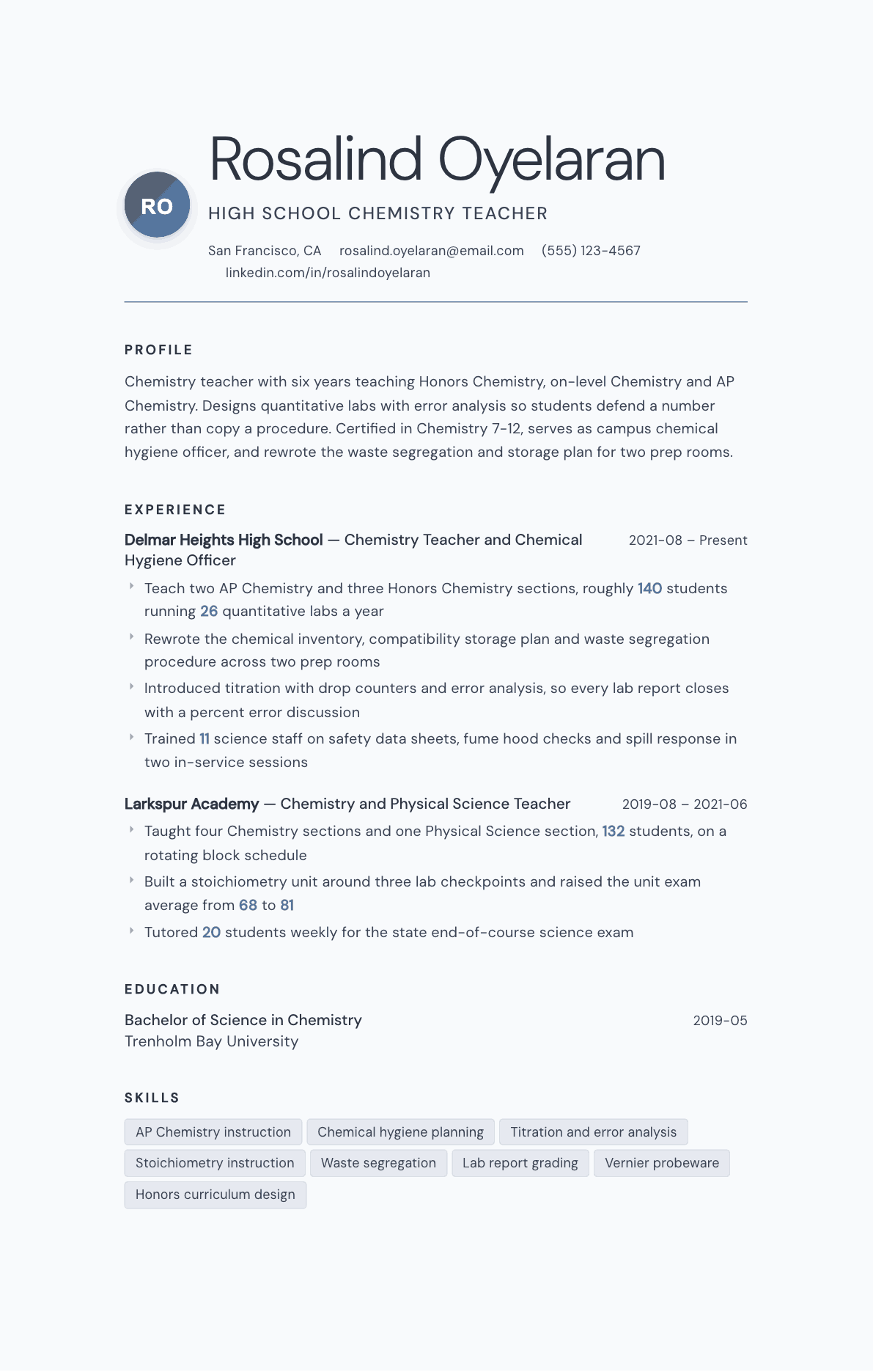
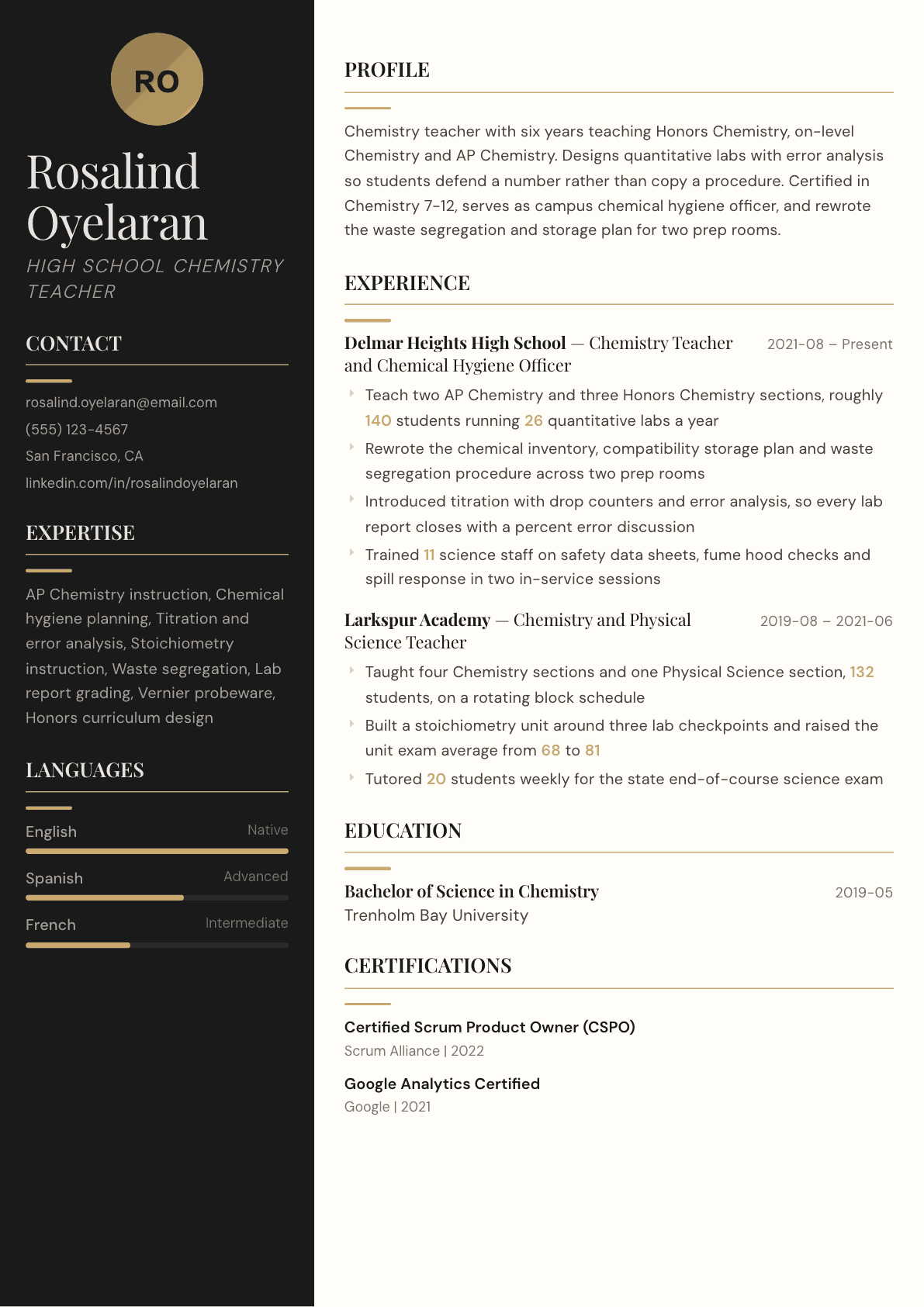
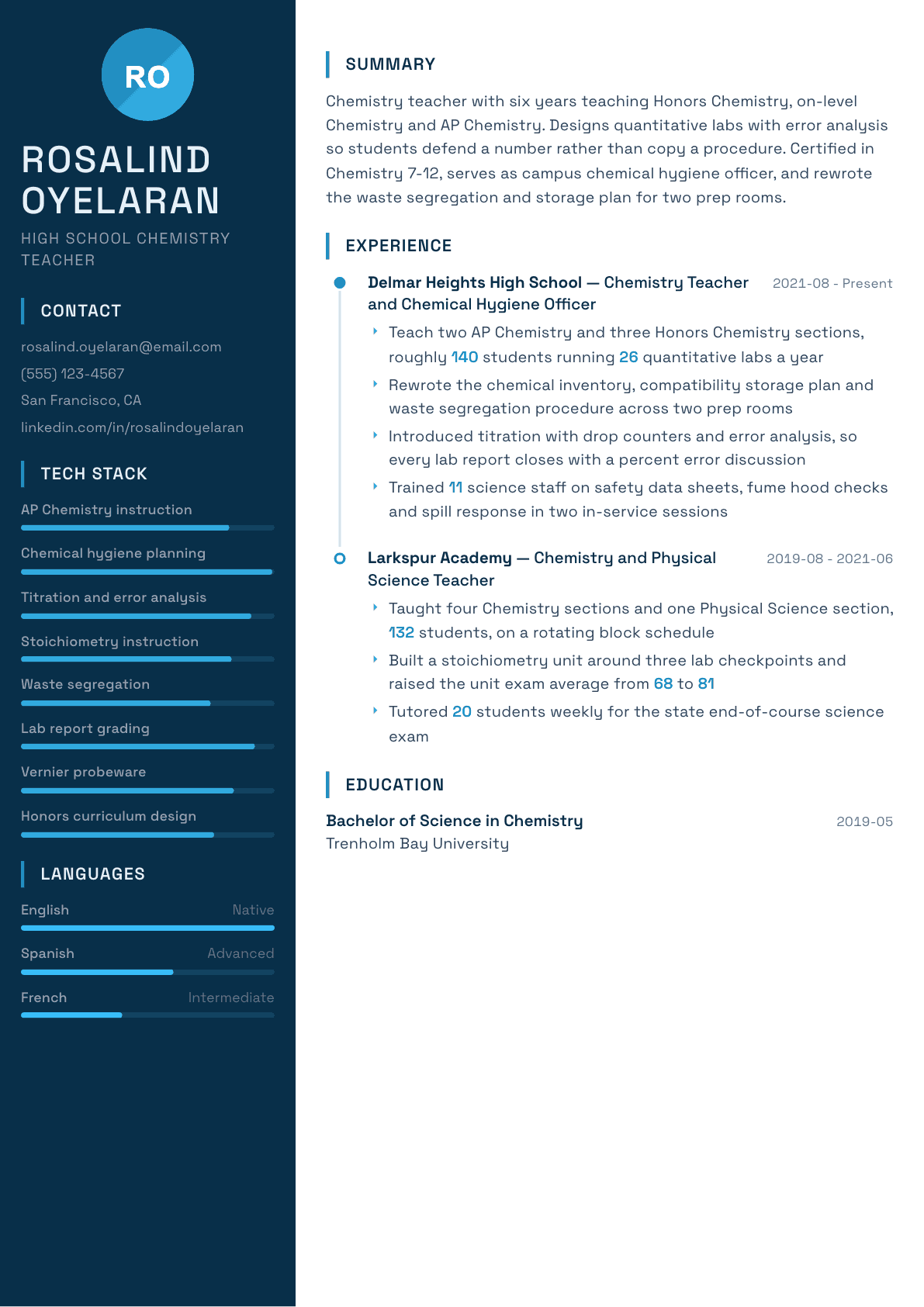
Example Chemistry Teacher summary
Chemistry teacher with six years across AP, Honors and on-level Chemistry, certified 7-12. Runs 26 quantitative labs a year with formal error analysis and serves as campus chemical hygiene officer, rewriting inventory, storage compatibility and waste segregation for two prep rooms. Trained 11 science staff on safety data sheets and spill response. Seeking a chemistry position with an AP section and prep room ownership.
Skills to list on a Chemistry Teacher resume
- AP Chemistry curriculum
- Honors Chemistry instruction
- Stoichiometry instruction
- Titration and volumetric analysis
- Chemical hygiene and storage
- Hazardous waste segregation
- Lab report assessment
- Error and uncertainty analysis
- Vernier probeware
- PhET simulations
- NGSS alignment
- Differentiated instruction
- Tutoring and exam preparation
- Staff safety training
- Classroom management
What actually gets this resume read
- Say which chemistry courses you have taught and at what level, because AP and on-level are separate hiring needs.
- Make chemical safety a visible duty line: inventory, storage compatibility, waste disposal and fume hood checks.
- Describe the quantitative labs you run and how students handle uncertainty, since that separates real chemistry teaching.
- Report AP results as the number of students earning a qualifying score, and name the years covered.
- Note any staff training you led on safety data sheets or spill response, because that is a hiring differentiator.
- List your certification area, grade band and the content exam you passed near the top of the first page.
How to write a chemistry teacher resume
Chemistry positions are hard to fill and easy to fill badly. A principal who loses a chemistry teacher in March is looking at a prep room of reagents nobody else is qualified to touch, an AP roster with an exam date already set, and a state end-of-course test in May. That urgency works in your favor only if your file proves you can walk in and take the room, including the cabinet behind it.
The candidates who get called write about two things most applicants leave out. The first is quantitative rigor: titrations, gravimetric analysis, error and uncertainty, students defending a calculated value. The second is chemical hygiene: inventory, storage compatibility, waste segregation, and who signs for the disposal pickup.
What follows is how a chemistry hiring team reads a resume, what to write in each section, three summaries at different career stages, before and after bullets, and the questions chemistry teachers ask when they are applying mid-year into a room somebody left in a hurry.
Format and the level breakdown a chair needs first
One page under five years, two once you carry AP sections, prep room ownership or curriculum authorship. Reverse chronological, single column, no icons. Directly under the header, break out chemistry by level: AP Chemistry, honors Chemistry, on-level Chemistry, dual credit, and any Physical Science or Physics you can also hold. A department covering three preps needs to see the whole range.
If your degree is in chemistry rather than education, say so plainly and pair it with your certification route. Content depth is an asset here, and hiding the pathway only raises a question.
- Header: name, city and state, contact, certification title with grade band.
- Level breakdown of chemistry courses plus any adjacent science you can cover.
- Then summary, certification, teaching experience, education, chemical hygiene duties, skills.
Summary: levels, lab rigor, and safety ownership
Three lines. Grade band, courses by level, certification, and the quantitative lab work you run. What distinguishes a chemistry summary is the word quantitative: students producing a number, calculating error, and defending the result rather than following a recipe to a color change.
Then one clause on safety ownership. Chemical hygiene officer, prep room manager, or author of the storage and waste plan. That clause turns you from a teacher who can hold the course into a teacher who solves the problem attached to it.
Experience: labs run, calculations taught, results moved
Head each entry with school, title, courses with levels, student load and lab cadence. Then write bullets no other science teacher could write: titration with drop counters and standardization, calorimetry, gravimetric analysis, spectrophotometry with a calibration curve, gas laws with pressure sensors, and stoichiometry taught through lab checkpoints rather than worksheets.
Attach outcomes to named assessments. The state end-of-course science exam, AP qualifying score counts across cycles, or a unit exam average tied to a specific instructional change. Stoichiometry is where most chemistry students fall off, so evidence there carries weight with anyone who has taught the course.
Include error analysis explicitly. A chemistry teacher whose lab reports end with an uncertainty discussion is teaching a different course from one whose reports end with a conclusion sentence, and the chair reading your file knows it.
Chemical hygiene: the duty that comes with the room
Give this its own block. Chemical inventory and safety data sheet upkeep, storage by compatibility group rather than alphabetical order, segregation and labeling of waste streams, disposal pickup coordination, fume hood and eyewash verification, spill kits, and student safety contracts.
If you have served as chemical hygiene officer, rewritten a storage plan, cleared audit findings, or trained staff on spill response, say it with numbers of rooms, findings or people. Those sentences do more work than any statement about your teaching philosophy, because they describe liability a building administrator carries personally.
- Inventory: safety data sheet binder, quantity tracking, expiration and disposal of legacy reagents.
- Storage: compatibility grouping, flammable and acid cabinets, secondary containment.
- Response: spill kits, eyewash and shower checks, incident reporting, staff training sessions.
Skills, keywords and exam preparation work
Mirror the posting once in skills and once in a bullet: laboratory safety, inquiry-based instruction, standards alignment, data analysis, differentiated instruction, and the course names themselves. Add the equipment: probeware brand, spectrophotometers, analytical balances, drop counters, pressure and temperature sensors, and the simulation library you use when glassware is not available.
Tutoring and exam preparation deserve a line. Chemistry carries a state end-of-course test in many places, and a teacher who runs structured review sessions with attendance numbers is offering something the department measures.
Chemistry Teacher resume summary examples
First classroom
Newly certified chemistry teacher, grades 7 to 12, with a chemistry degree and a 16-week placement teaching four on-level Chemistry sections. Ran titration, calorimetry and gas law investigations with probeware and completed chemical hygiene training. Seeking a high school chemistry position with prep room access.
Six years in
Chemistry teacher with six years across AP, honors and on-level Chemistry, running 26 quantitative labs a year with formal error analysis. Serves as campus chemical hygiene officer and rewrote inventory, storage compatibility and waste segregation for two prep rooms. Certified Chemistry 7-12.
Science department lead
Science lead with fifteen years teaching AP and honors Chemistry, and five years supervising seven teachers, three prep rooms and the district chemical hygiene plan. Rebuilt the chemistry scope and sequence around lab checkpoints and trains all new science hires on storage and waste protocols.
Work experience bullets: before and after
Before: Taught chemistry classes and labs.
After: Taught two AP Chemistry and three honors Chemistry sections, about 140 students, running 26 quantitative labs a year.
Level breakdown, student load and lab count let a chair schedule you while reading the line.
Before: Kept the chemical storage organized.
After: Rewrote the chemical inventory, compatibility storage plan and waste segregation procedure across two prep rooms.
Three named deliverables across a stated scope describe liability solved, not tidiness.
Before: Students wrote lab reports.
After: Introduced titration with drop counters and error analysis so every lab report closes with a percent error discussion.
The technique and the required reasoning step show the rigor level of the course you run.
Before: Helped students understand difficult topics.
After: Rebuilt the stoichiometry unit around three lab checkpoints and raised the unit exam average from 68 to 81.
Naming the hardest unit in the course and the structural change makes the growth credible.
Before: Provided training to other teachers.
After: Trained 11 science staff on safety data sheets, fume hood verification and spill response across two in-service sessions.
Headcount, topics and setting turn a vague training claim into documented professional leadership.
Hard skills
- AP Chemistry curriculum
- Honors and on-level Chemistry instruction
- Stoichiometry instruction
- Titration and volumetric analysis
- Calorimetry and thermochemistry labs
- Spectrophotometry and calibration curves
- Error and uncertainty analysis
- Chemical hygiene planning
- Hazardous waste segregation
- Probeware and sensor-based labs
- Simulation-based instruction
- End-of-course exam preparation
Soft skills
- Lab supervision and student safety habits
- Breaking down abstract concepts
- Calm incident response
- Coaching colleagues on safety practice
- Tutoring outside contract hours
- Family communication about grades
Certifications worth listing
- National Board Certification, Science Adolescence and Young Adulthood (National Board for Professional Teaching Standards)
- AP Course Audit Approval, Chemistry (College Board)
- Praxis Chemistry: Content Knowledge (Educational Testing Service)
- Certified Chemical Hygiene Officer (National Registry of Certified Chemists)
Mistakes that cost chemistry teacher candidates the interview
- Leaving chemical hygiene off the file when it is the duty a building administrator worries about most.
- Describing labs as hands-on without naming a single quantitative technique or the calculation students perform.
- Blending AP, honors and on-level chemistry into one line so the reader cannot match you to the vacancy.
- Claiming score improvement with no assessment name, cycle count or instructional change behind it.
- Hiding a chemistry degree behind an alternative certification route instead of pairing the two openly.
- Ignoring the state end-of-course exam and the review structure you run for it.
Chemistry Teacher resume questions
How do I show chemical safety experience on a chemistry teacher resume?
Give it a labeled block with concrete duties: inventory and safety data sheets, compatibility storage, waste segregation and disposal coordination, fume hood and eyewash checks, and any audit findings you cleared or staff you trained.
I have a chemistry degree but an alternative certification. How do I present that?
State the degree, then the certification route and its current status on the same block. Content depth is an advantage in chemistry hiring, and an unexplained pathway raises a question that a two-line explanation answers cleanly.
What lab work should a chemistry teacher list?
The quantitative ones that show equipment competence and calculation: titration and standardization, calorimetry, gravimetric analysis, spectrophotometry with a calibration curve, and gas law work with sensors. Six or eight is enough to establish the range.
How do I write about AP Chemistry results honestly?
Report the number of students earning a qualifying score and the number of exam cycles covered, rather than a single strong year. Include enrollment alongside it so a reader can see whether the score count grew while the roster grew too.
Is it worth applying mid-year to a chemistry vacancy?
Yes. Chemistry openings are among the hardest for districts to cover, and a mid-year applicant who can document safety competence and immediate course readiness is often reviewed within days rather than waiting for a spring hiring cycle.