Skincare Specialist Resume Examples: what gets the call
Write a Skincare Specialist Resume Built on Real Results
By Mustafa Tarabya, founder of CVBooster · Published · Updated
Skincare specialist resume example with treatment keywords and a guide to writing protocols, devices, home care plans and client results.
Sample resumes for a skincare specialist
The same skincare specialist content laid out in three CVBooster templates, so you can see what the finished document looks like before you write a word.
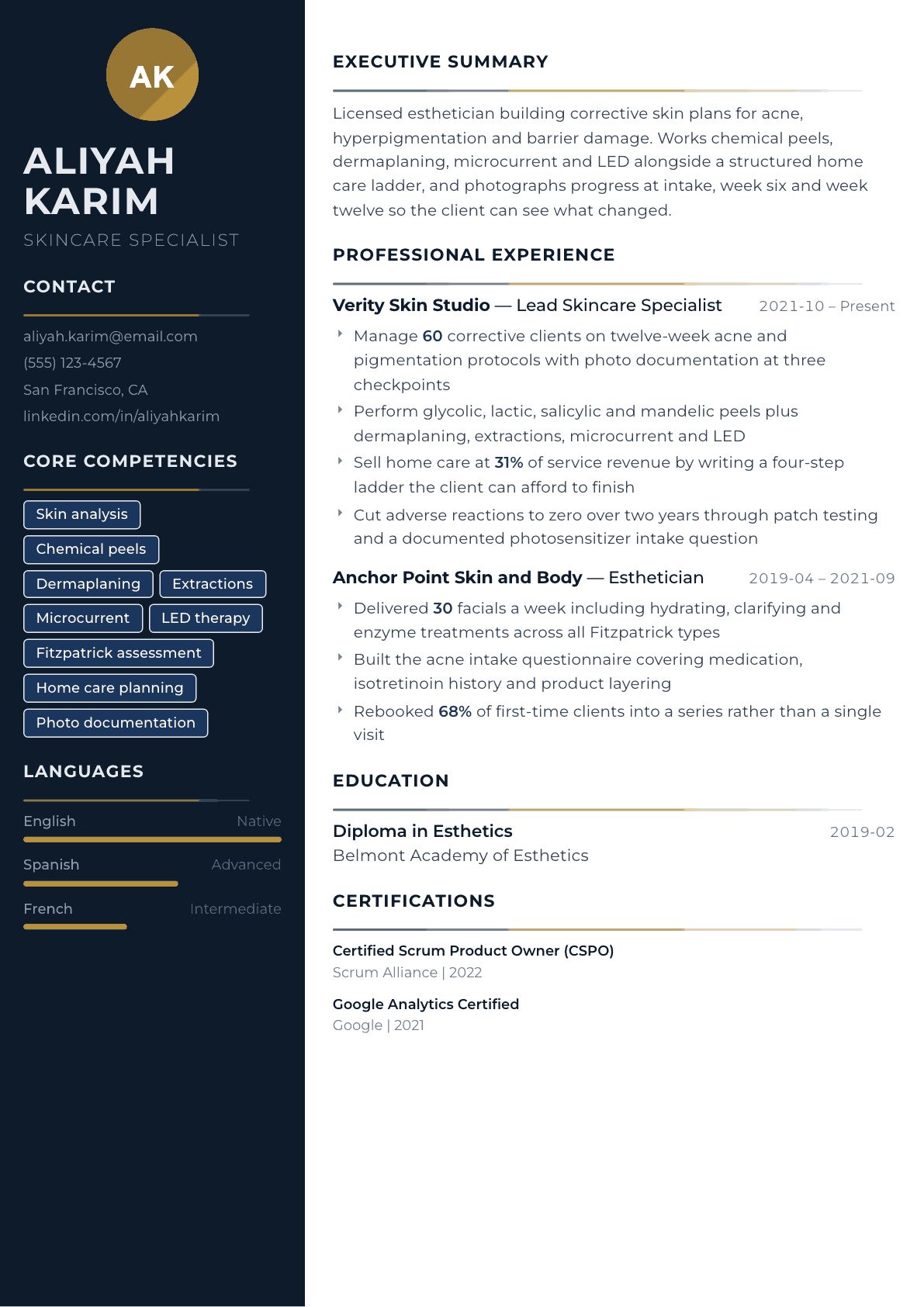
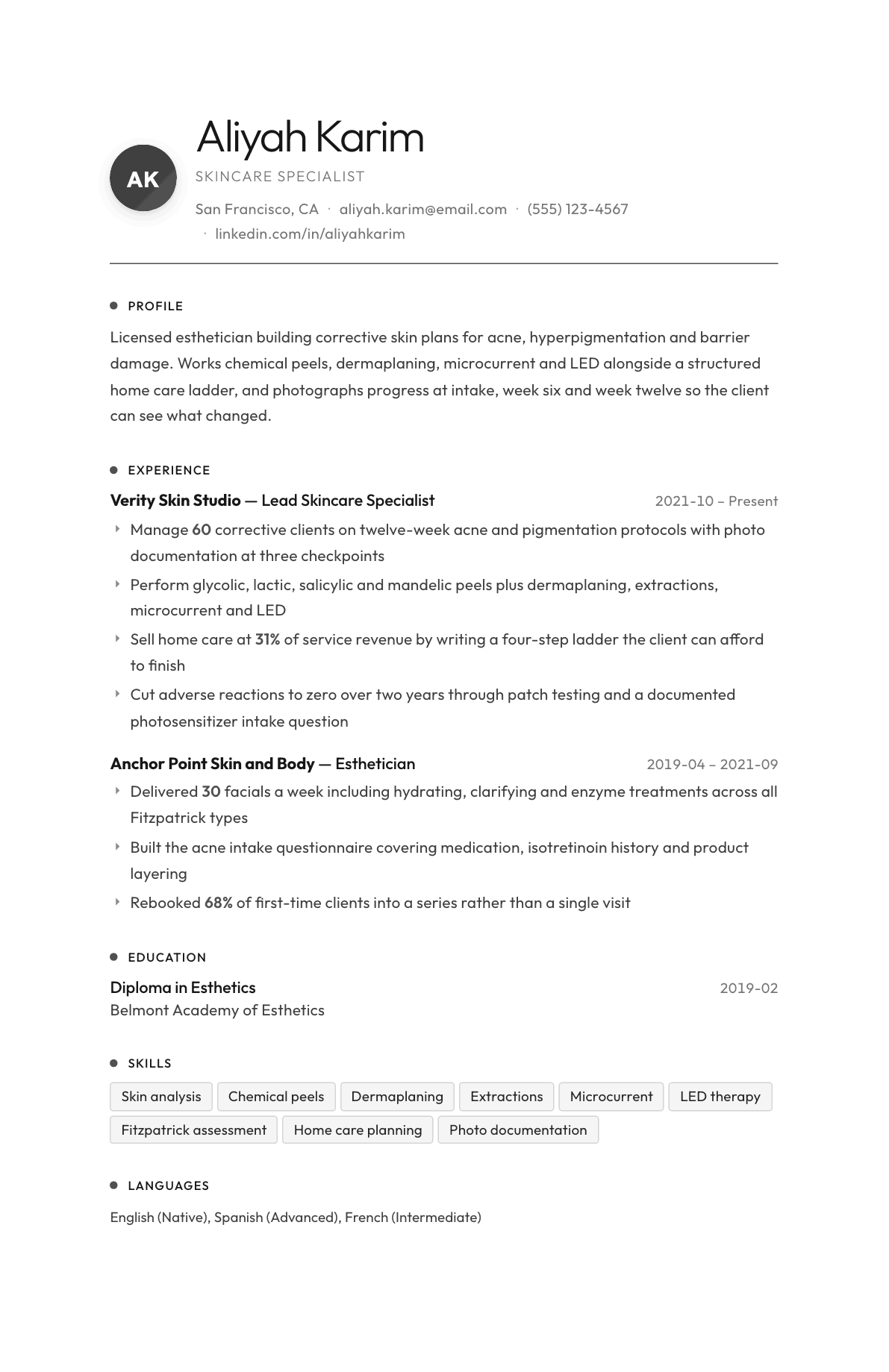
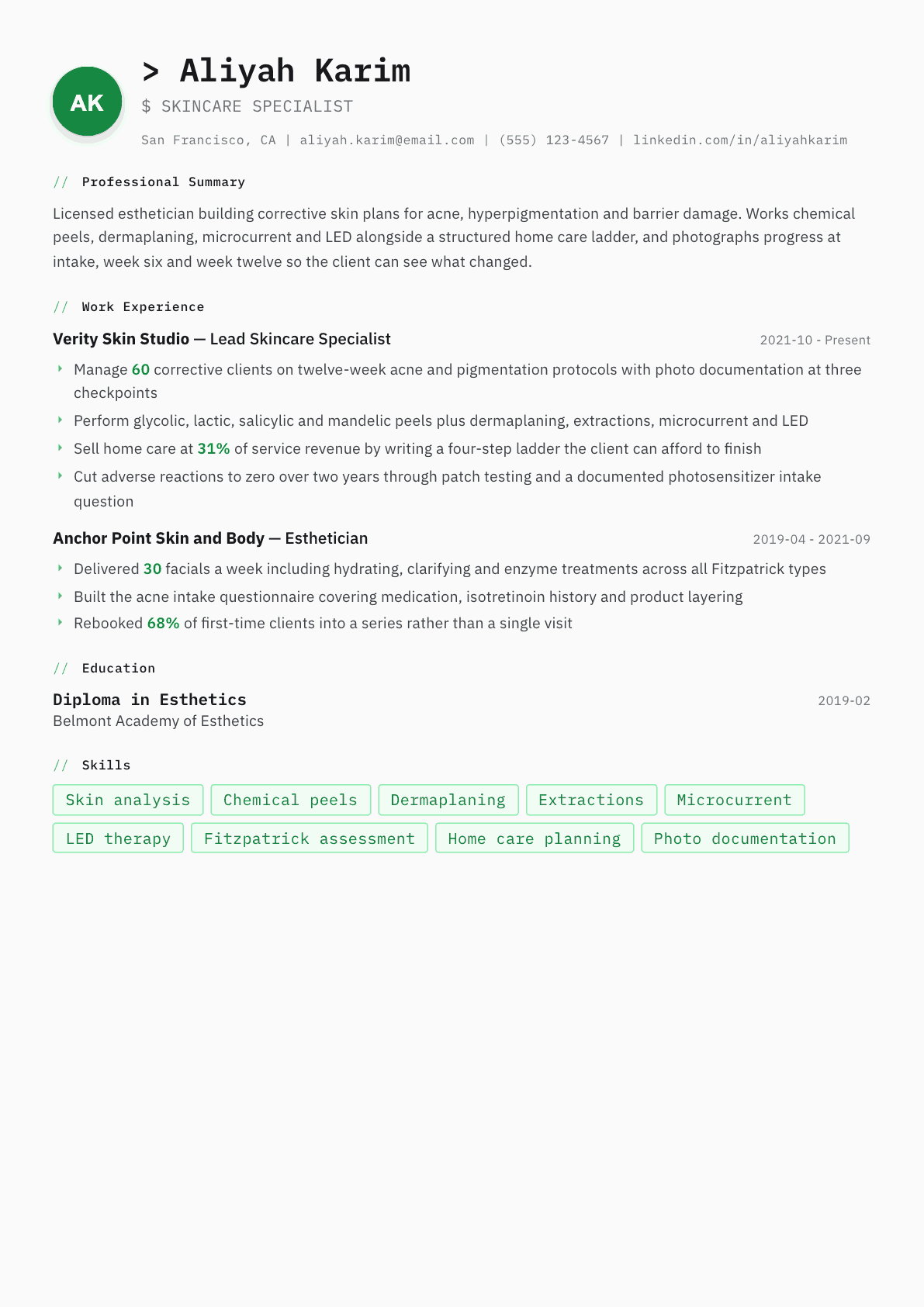
Example Skincare Specialist summary
Licensed esthetician focused on corrective skin work for acne, hyperpigmentation and compromised barriers. Runs glycolic, lactic, salicylic and mandelic peels alongside dermaplaning, extractions, microcurrent and LED, and pairs every series with a home care ladder the client can finish. Documents progress with intake, mid-series and end photos, and screens hard for medication and sun exposure before any acid touches skin. Seeking a lead role in a corrective studio.
Skills to list on a Skincare Specialist resume
- Skin analysis and consultation
- Fitzpatrick typing
- Chemical peel application
- Dermaplaning
- Manual extractions
- Microdermabrasion
- Microcurrent
- LED phototherapy
- Ultrasonic exfoliation
- Acne protocol design
- Hyperpigmentation protocols
- Barrier repair planning
- Home care ladder building
- Progress photo documentation
- Contraindication screening
What actually gets this resume read
- Name your acid families and strengths, because a studio hires on the peels you can run unsupervised.
- List the devices you are trained on by device type, and say who trained you and where.
- Show a protocol arc: intake, series length, checkpoints and the photo documentation you keep.
- Give home care attachment as a share of service revenue, since correction fails without the routine.
- Describe your contraindication questions, including active medication and recent sun or laser exposure.
- Say which Fitzpatrick range you have real hands-on hours with, not just the ones you were taught on.
How to write a skincare specialist resume
There are two kinds of skincare resume, and studios can tell them apart in about eight seconds. One describes relaxing facials with lovely products. The other describes correction: a client with inflammatory acne, a twelve-week plan, an acid choice with a reason behind it, a home routine the client can afford to finish, and photographs at three checkpoints proving what changed.
A studio owner hiring for corrective work wants the second one. She is thinking about series bookings rather than single visits, about home care attachment, and about whether you know enough to say no to a peel when a client walks in tanned or three weeks into a retinoid. Nothing on the page matters more than showing you have a protocol and stick to it.
This guide covers the sections a skin studio or medspa reads and the order it reads them, with summaries for a newly licensed esthetician, a specialist with a corrective book and a lead, five rewritten bullets, and the questions that come up when a relaxation-focused esthetician moves into results work.
Format: one page, license and modality list where they cannot be missed
One page, reverse chronological. The license, the issuing state and the treatments you can run unsupervised go in the top third. A studio owner scanning for a peel-capable esthetician should not have to read your education section to find out whether you are one.
Group devices separately from manual treatments. Peels, dermaplaning and extractions are a different competency from microcurrent, ultrasonic and LED, and studios often hire for one gap or the other. Two short lists read faster than one long one.
- Acid list with strengths: glycolic, lactic, salicylic, mandelic, and any blended solutions you run without supervision.
- Device list with the trainer: microcurrent, LED, ultrasonic, microdermabrasion, and who certified you on each.
- Protocol line: series length, checkpoint intervals and the photo documentation you take at each one.
- Skin type line: the Fitzpatrick range you have genuine hands-on hours with, not the range you were taught on.
Summary: what you correct, with what, over how long
Three lines naming the concerns you treat, the tools you treat them with, the length of a typical series and the way you document results. Acne, hyperpigmentation, barrier damage, rosacea-prone skin and aging concerns are all coached differently, and a studio hires for the ones its book is full of.
If your background is relaxation facials, do not pretend otherwise. Say what you have, name the corrective training you have added, and lead with the treatments you can already run alone. Owners hire eager estheticians constantly, but they resent finding the gap during a client peel.
Experience: protocol, checkpoints, home care
Structure each role around clients on a plan rather than treatments performed. Give the number of corrective clients you carried, the length of the arc, what happened at each checkpoint and how you adjusted when the skin did not respond. That is the part a studio cannot train quickly and therefore pays for.
Home care is half the outcome and it belongs on the page as a number. Attachment as a share of service revenue, plus the way you build the routine, tells an owner you understand that correction happens between appointments. A four-step ladder someone finishes beats an eight-step routine they abandon in week two.
Then the safety half. Contraindication questions about isotretinoin, recent laser or waxing, active cold sores, recent sun exposure and photosensitizing medication. Say what you ask, when you patch test and what you have refused to do. An owner reads a refusal as competence.
Results, photography and rebooking
Corrective work only sells if the client can see it, so photography is a working part of the job. Say when you shoot, under what lighting conditions, and where the images are stored with consent. Consistency matters more than equipment, and an owner will recognize immediately whether you have a real photo standard or a phone in a drawer.
Rebooking follows from that. A specialist who converts first-time clients into a series rather than a single visit changes the economics of a room, so give the conversion figure if you track it, and describe the moment in the appointment where you make the series case.
Keywords a skin studio or medspa filters on
Postings reuse a compact vocabulary: skin analysis, Fitzpatrick, chemical peel, dermaplaning, extractions, microdermabrasion, microcurrent, LED phototherapy, ultrasonic, acne protocol, hyperpigmentation, barrier repair, home care regimen, contraindications, progress photos. Mirror the true ones once in your skills block and once inside a bullet.
Name the product lines you have been trained on and the trainer, because studios stock specific houses and an esthetician who already knows the line saves a training week. Add the booking system too, for the same reason.
Skincare Specialist resume summary examples
Newly licensed
Newly licensed esthetician with 600 program hours and 120 supervised facials across hydrating, clarifying and enzyme treatments. Trained in skin analysis, Fitzpatrick typing and superficial peels, with dermaplaning certification completed. Seeking a first corrective room where a series protocol is already in place.
Corrective book
Skincare specialist managing 60 corrective clients on twelve-week acne and pigmentation protocols with photo documentation at three checkpoints. Runs glycolic, lactic, salicylic and mandelic peels alongside dermaplaning, extractions, microcurrent and LED, and holds home care at 31% of service revenue.
Lead specialist
Lead skincare specialist running a corrective floor and the studio protocol library, training three estheticians on acid selection, endpoint recognition and intake screening. Closed two years with no adverse reactions across a heavy acne and pigmentation caseload, and owns the progress photography standard.
Work experience bullets: before and after
Before: Performed facials and skincare treatments for clients.
After: Managed 60 corrective clients on twelve-week acne and pigmentation protocols, photographing at intake, week six and week twelve and adjusting the acid choice when the skin plateaued.
A caseload on a protocol with checkpoints reads as clinical practice rather than a service list.
Before: Used chemical peels on clients.
After: Ran glycolic, lactic, salicylic and mandelic peels selected by concern and Fitzpatrick type, timing to endpoint rather than to a fixed clock and neutralizing on first sign of frost.
Naming the acids and the endpoint judgment shows technique instead of following a card.
Before: Recommended products for clients to use at home.
After: Sold home care at 31% of service revenue by writing a four-step ladder priced so the client could complete it, then reviewing adherence at every checkpoint appointment.
The number plus the affordability and adherence logic explains why the attachment holds up.
Before: Followed safety procedures during treatments.
After: Screened every intake for isotretinoin history, recent laser or waxing, active cold sores and photosensitizing medication, closing two years with zero adverse reactions.
Listing the actual screening questions and the outcome makes a safety claim verifiable.
Before: Got clients to book more appointments.
After: Converted 68% of first-time clients into a booked series rather than a single visit by mapping the full arc on paper during the consultation.
The conversion rate and the mechanism together change the economics of a treatment room.
Hard skills
- Skin analysis and consultation
- Fitzpatrick typing
- Chemical peel application
- Dermaplaning
- Manual extractions
- Microdermabrasion
- Microcurrent
- LED phototherapy
- Ultrasonic exfoliation
- Acne protocol design
- Hyperpigmentation protocols
- Barrier repair planning
- Home care ladder building
- Progress photo documentation
Soft skills
- Setting expectations about timelines
- Saying no to an unsafe request
- Keeping a client motivated through a purge phase
- Explaining ingredients without jargon
- Discretion about skin history
Certifications worth listing
- National Esthetics Theory and Practical Examinations (National-Interstate Council of State Boards of Cosmetology)
- CIDESCO Diploma (CIDESCO International)
- Bloodborne Pathogens Training (American Red Cross)
Mistakes that cost skincare specialist candidates the interview
- Describing facials by their menu names instead of the concerns they correct and the protocol behind them.
- Listing peels without the acids, the strengths or who trained you, which tells an owner nothing about what you can run alone.
- Leaving out the Fitzpatrick range you have real hours with, when pigment risk is the main safety question in this work.
- Skipping home care attachment, when a routine the client finishes is most of the visible result.
- Showing single treatment photos rather than a documented arc across a series with consistent lighting and consent.
- Claiming device experience from a single demonstration at a trade show rather than supervised hours on a client floor.
Skincare Specialist resume questions
What license do I need to work as a skincare specialist?
An esthetician license in most states, sometimes a cosmetology license instead, with the scope of peels and devices set by state rules. List the license, the issuing state and the renewal month, and describe device work in terms of what you actually performed.
How do I move from relaxation facials into corrective work?
Reorder the page so analysis, extractions and any acid work come first, then name the corrective training you have completed and the models or supervised clients behind it. Be direct about the gap, because owners will find it in your first peel week anyway.
Should I include before and after photos with an application?
Include one short portfolio link rather than attaching images. Make sure the sets show consistent lighting, the same angle, and a healed or mid-series stage rather than immediate post-treatment redness that flatters the work unfairly.
How do I write about a client whose skin did not improve?
Frame it as protocol judgment. A bullet about recognizing a plateau at week six, switching acid families and documenting the change shows more skill than a page of successes, because correction work is mostly adjustment rather than a single correct answer.
Do medspas want different things from a skincare resume?
Yes. A medspa reads for supervision structure, device hours, charting and contraindication discipline, while an independent studio reads for series conversion and retail. Keep two versions and lead each with the half that employer is buying.
Related resume examples
- Esthetician Resume example
- Medical Esthetician Resume example
- Aesthetician Resume example
- Laser Technician Resume example
- Spa Therapist Resume example
- Nail Technician Resume example