Job Description Template: A Structure That Works
By Mustafa Tarabya, founder of CVBooster · Published · Updated
12 min read
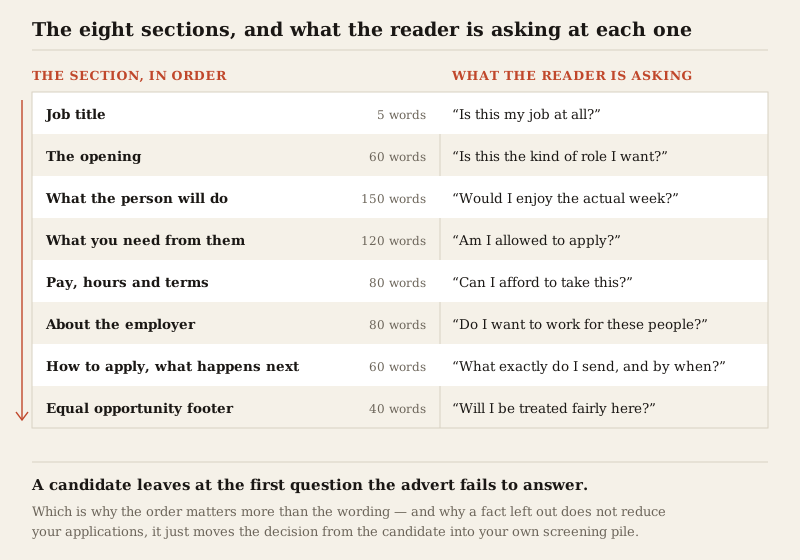
A usable job description has eight sections in a fixed order: title, opening, duties, requirements, pay and terms, about the employer, how to apply, and the legal footer. The template is below with word budgets and, more usefully, the reason each section exists.
This page is written for the person doing the hiring rather than the person applying. If you are a small employer, a founder, or a manager who has been handed a vacancy alongside your actual job, this is the part of hiring that gets the least attention and changes the most, because it runs before every other filter you have.
What should a job description contain?
Eight sections. The word budgets are a guide, and the whole thing should land between five hundred and eight hundred words. Longer than that and the sections at the bottom are read by nobody.
- Job title. The standard industry title, not your internal one. Five words at most.
- The opening. Two or three sentences: what the role exists to do, who it reports to, where it is based, and the shape of the week. Around 60 words.
- What the person will do. Five to eight duties, ordered by how much of the week each one takes. Around 150 words.
- What you need from them. Essential requirements and desirable ones, in two clearly separated lists. Around 120 words.
- Pay, hours and terms. The salary range with the currency and the period, contract type, hours, location and working pattern, holiday, and the headline benefits. Around 80 words.
- About the employer. What you do, how big you are, and one honest, specific thing about working there. Around 80 words.
- How to apply and what happens next. What to send, where, by when, and the shape of the process. Around 60 words.
- The footer. Equal opportunity statement and how to request adjustments to the process. Around 40 words.
Why does a well-written advert get better applicants?
Because the advert is a filter that runs before yours does, and it is the only filter that costs you nothing to operate.
Think about what happens with a vague advert. It does not reduce applications; it increases them, because fewer people can rule themselves out. Every fact you leave out is a decision you have taken away from the candidate and moved into your own screening pile, where you now have to make it by reading resumes. A vague advert is not a shortcut. It is work you have deferred and made more expensive.
The second mechanism matters more. The people you most want are usually already employed, not urgently looking, and reading your advert with mild curiosity on a phone. They are the easiest people in your entire pool to lose. Someone who needs a job will push through a bad advert; someone who is comfortable will not. So a vague advert does not just produce more applications, it skews them towards the candidates with the least choice.
The third is what happens after the hire. An advert is a description of a job that somebody is going to arrive and do. If the week they experience is not the week you described, that gap shows up as a resignation inside the first year, and you pay for the whole search again.
Tip: The salary range is the highest-leverage single line in the advert. Publishing it costs you the applications from people who were never going to accept the number, which is not a cost. Withholding it costs you the candidates who will not spend an evening on an application to find out.
How do you write each section?
The title
Use the title people would search for. Internal titles, brand titles and levelled titles are all invisible outside your building. "Growth Ninja" is not searched by anybody. "Customer Happiness Wizard" is not searched by anybody. If your internal title genuinely differs, put the standard one in the advert and mention the internal one in the body.
Add a seniority word only if you mean it, and add a specialism if it narrows usefully. "Marketing Manager" is broad; "Marketing Manager (Paid Acquisition)" tells the right person to stop and the wrong person to keep scrolling, which are both wins.
The opening
Weak: "We are seeking a highly motivated and dynamic individual to join our fast-paced team in an exciting role with excellent opportunities for growth." Twenty-three words, no information, and it could sit on top of any advert ever written.
Rewritten: "We are hiring a logistics coordinator to run customs declarations in-house for our EU road freight. You would be our second coordinator, working alongside Priya and reporting to our operations manager, from our Rotterdam office three days a week." The reader now knows the job, the team size, the reporting line, and the working pattern, in under forty words.
What the person will do
Order these by the share of the week they take, not by importance. This is the single most useful change most adverts can make, because a list ordered by importance systematically hides the actual job. The strategic responsibility that takes two hours a month goes at the top and the reader never learns that most of the week is chasing paperwork.
Write them as things a person does, in the present tense, with enough specificity that a candidate could imagine a Tuesday. "Manage stakeholder relationships" tells nobody anything. "Speak to around fifteen clients a week, mostly when a shipment is delayed" is a job.
And put in one honest sentence about the least attractive part. Every job has one. Naming it costs you the applicants who would have discovered it in week two and left, and it buys credibility with everyone else, because an advert that admits one thing is believed about the rest.
What you need from them
Two lists, clearly labelled, and be ruthless about which is which. The essential list should contain only things that would genuinely make you reject an otherwise excellent candidate on day one. Most essential lists are two or three times longer than that, and every extra line narrows your pool for no gain.
Be particularly careful with the automatic entries. A degree requirement on a job that does not need one is the most common. So is a years-of-experience number chosen because it sounded right: five years is not a skill, it is a proxy for one, and it is a proxy that excludes people who got there faster and includes people who repeated their first year four times.
Where you can, replace the proxy with the thing itself. Instead of "5+ years in logistics", write "has run customs declarations independently, including when something went wrong at a border". That is checkable in an interview and it describes what you actually need.
Pay, hours and terms
A range with a currency and a period. Contract type. Hours a week. Where the work happens and how many days. Holiday. Two or three benefits that are actually distinctive, not a list of things every employer provides. If pay depends on experience, say what moves someone from the bottom of the range to the top — that sentence does more for your credibility than the range itself.
Some jurisdictions now require pay ranges in adverts and some do not, and the rules change from year to year and city to city. Check what applies where you are advertising rather than assuming, and note that if you advertise across borders you may be subject to more than one rule.
About the employer, and how to apply
Three sentences on the company, and one of them should be specific enough that a competitor could not have written it. Skip the mission statement. "We ship perishables to nine EU markets and we are forty people" tells a candidate more than a paragraph about passion and innovation.
Then be concrete about the process. What to send, where to send it, the closing date, how many stages there are, roughly how long each takes, and when they will hear from you. Publishing the process is unusual enough to be a differentiator, and it costs nothing but the discipline of then following it.
Why write the description before you advertise?
There is a practical reason and, for employers covered by United States federal law, a documentary one. This is not legal advice and it applies only under that framework, but it is specific enough to be worth knowing.
The regulation implementing the Americans with Disabilities Act defines a job's "essential functions" as "the fundamental job duties of the employment position", excluding marginal ones. It then lists the evidence of whether a particular function is essential. Among the items on that list, at 29 CFR 1630.2(n)(3), is "written job descriptions prepared before advertising or interviewing applicants for the job". Once the duties are written, the questions to ask an interviewee guide shows how to turn each requirement into an interview question.
In plain terms: a written description made before you advertise is treated as evidence of what the job actually requires. One written afterwards, to justify a decision already taken, is not the same thing. That is a good enough reason to write the duties list carefully and date it, and it happens to align exactly with what makes a better advert anyway.
The non-legal reason is simpler. Writing the duties in order of time spent forces you to work out what the job is, and a surprising number of vacancies turn out on inspection to be two half-jobs stapled together, or a job that should not be filled at all.
A full example, written out
Everything below is invented as an example. It is around four hundred and fifty words, which is on the short side deliberately.
"Logistics Coordinator (Customs) — Kaaipoort BV, Rotterdam. We are hiring a logistics coordinator to run customs declarations in-house for our EU road freight. You would be our second coordinator, working alongside Priya and reporting to our operations manager, from our Rotterdam office three days a week."
"What the week looks like, roughly in order of time spent: preparing and filing customs declarations for around forty shipments a week; speaking to clients, mostly when a shipment is held; booking and tracking road freight across nine EU markets; chasing carriers when a delivery slips; keeping our declaration records straight for audit; and, about one week in six, covering Priya's lanes while she is away. The least enjoyable part of the job is the paperwork when a load is held at a border, which is slow and can land at four on a Friday. We would rather tell you that now."
"Essential: you have prepared customs declarations independently, including at least once when something went wrong. You are comfortable being the person a client calls when a truck is stuck. You have the right to work in the Netherlands. Desirable: Dutch as well as English; experience with perishables; experience on the carrier side as well as the forwarder side."
"€44,000 to €52,000 a year, depending on how much customs work you have done unsupervised — the top of the range is for someone who could take our German and Polish lanes on their own from month one. Permanent, 38 hours a week, three days in the Rotterdam office and two from home, 25 days holiday plus public holidays, pension, and we pay for the customs qualification if you do not already have it."
"Kaaipoort ships perishables to nine EU markets. We are forty people, we handle our own declarations rather than using a broker, and we publish our delay figures by lane on our website because we would rather compete on that than on price."
"To apply, send a CV and a short note about a shipment that went wrong and what you did, to hiring@example.com by 19 September. Three stages: a twenty-minute call, an hour with the operations manager and Priya, and a short practical exercise on a real declaration. We reply to everybody who applies, within a week of the closing date. Kaaipoort is an equal opportunity employer. If you need any adjustment to the process to take part fairly, tell us in your email and we will arrange it."
What should you cut?
- "Fast-paced", "dynamic", "wear many hats" and "rockstar". These are read as warnings about workload, not as selling points.
- "Other duties as assigned" standing in for the parts of the job you did not want to write down.
- Requirement lists longer than about eight essential items. If everything is essential, nothing has been decided.
- The mission statement, unless the mission is genuinely why someone would take the job.
- Benefits that every employer offers, listed as though they were unusual.
- "Competitive salary". It means the range is below what the reader hoped for, and every reader knows it.
- A photograph of a diverse group of people smiling in a meeting room, in place of any description of the actual team.
The check before you post it
- The title is one that people outside your company would search for.
- The duties are ordered by time spent, and one of them is honest about the worst part.
- The essential list contains only things you would genuinely reject an excellent candidate over.
- There is a salary range with a currency and a period.
- The working pattern is stated as days, not as a word like "hybrid".
- The process is described, including when candidates will hear back — and you have diarised actually doing it.
- Somebody who does the job now has read the advert and agreed it describes their week.
- It is under eight hundred words.
That last check is worth the ten minutes it takes. The person currently doing the job will find the sentence that is no longer true faster than anyone in the room, and an advert that survives their reading is an advert that will survive its first hire.
Related articles
- Bartender Job Descriptions for a Resume: 8 Examples
- Accountancy CV Example: 6 UK Accounts CVs by Career Level
- Accounting Interview Questions and Answers: 7 Full Examples
- Activity Resume Example: 6 Samples for College Applications
More articles
- Job Interview Tips: A Timeline From Preparation to Follow-Up
- Job Offer Letter: What to Check Before Signing
- Job Resume Title: How to Write It, With 12 Examples
Looking for a worked example for your job title? Browse the resume examples by job title.