Entrepreneur Resume Examples: free ATS score and gap list
Turn Your Venture Into an Entrepreneur Resume Hiring Teams Trust
By Mustafa Tarabya, founder of CVBooster · Published · Updated
An entrepreneur resume example that translates founding a company into hireable experience, with sample bullets, keywords and a writing guide.
Sample resumes for a entrepreneur
The same entrepreneur content laid out in three CVBooster templates, so you can see what the finished document looks like before you write a word.
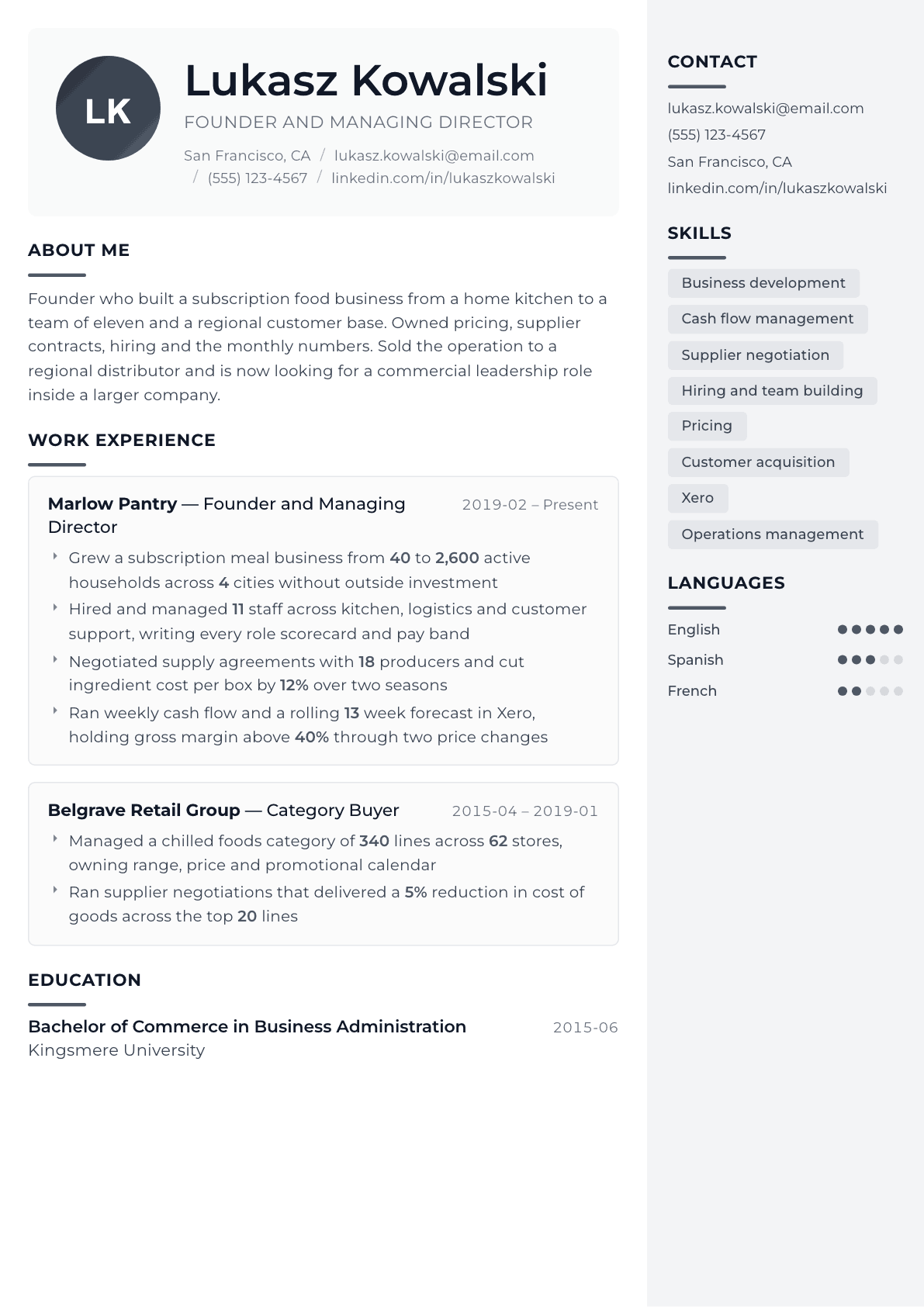
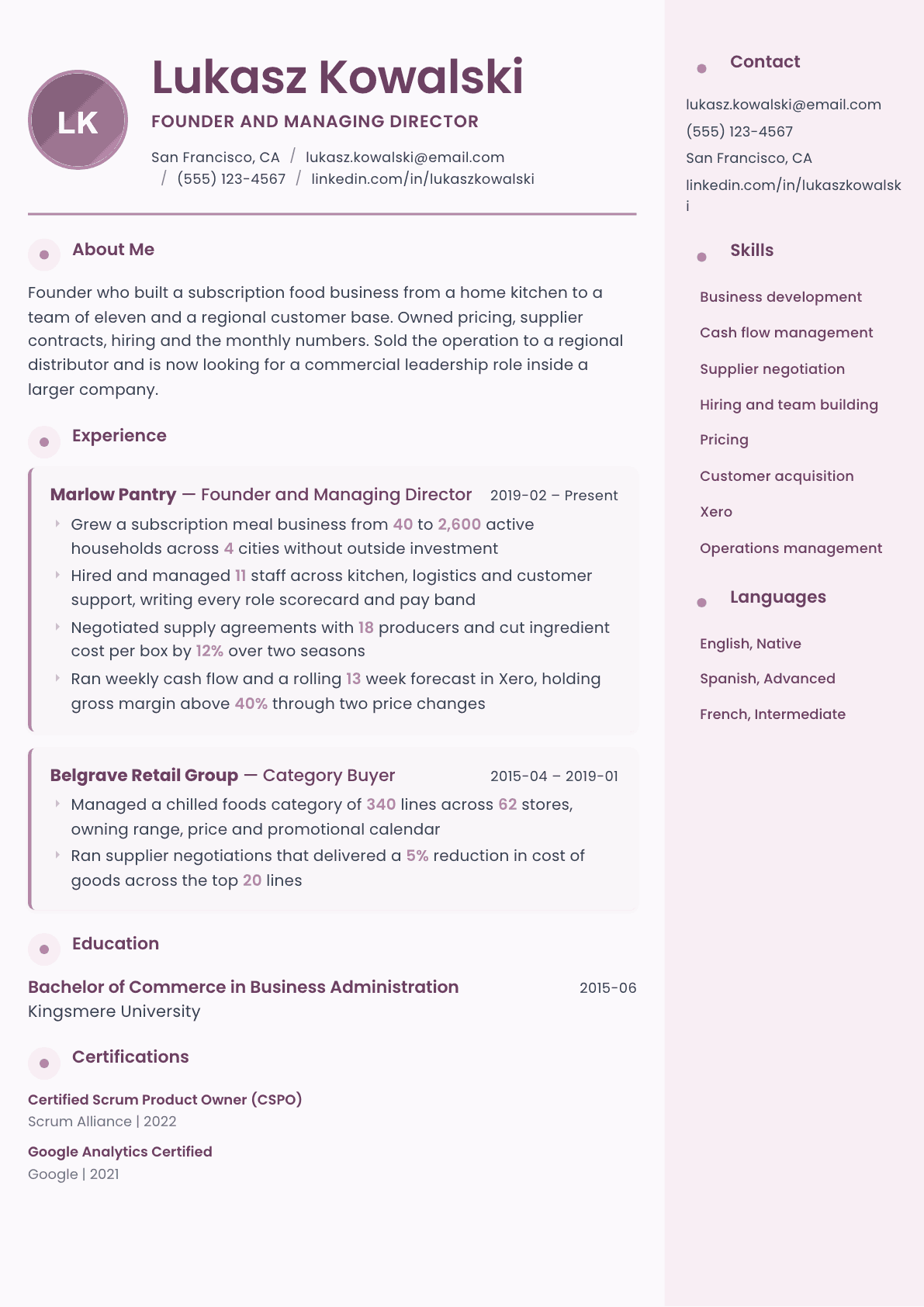
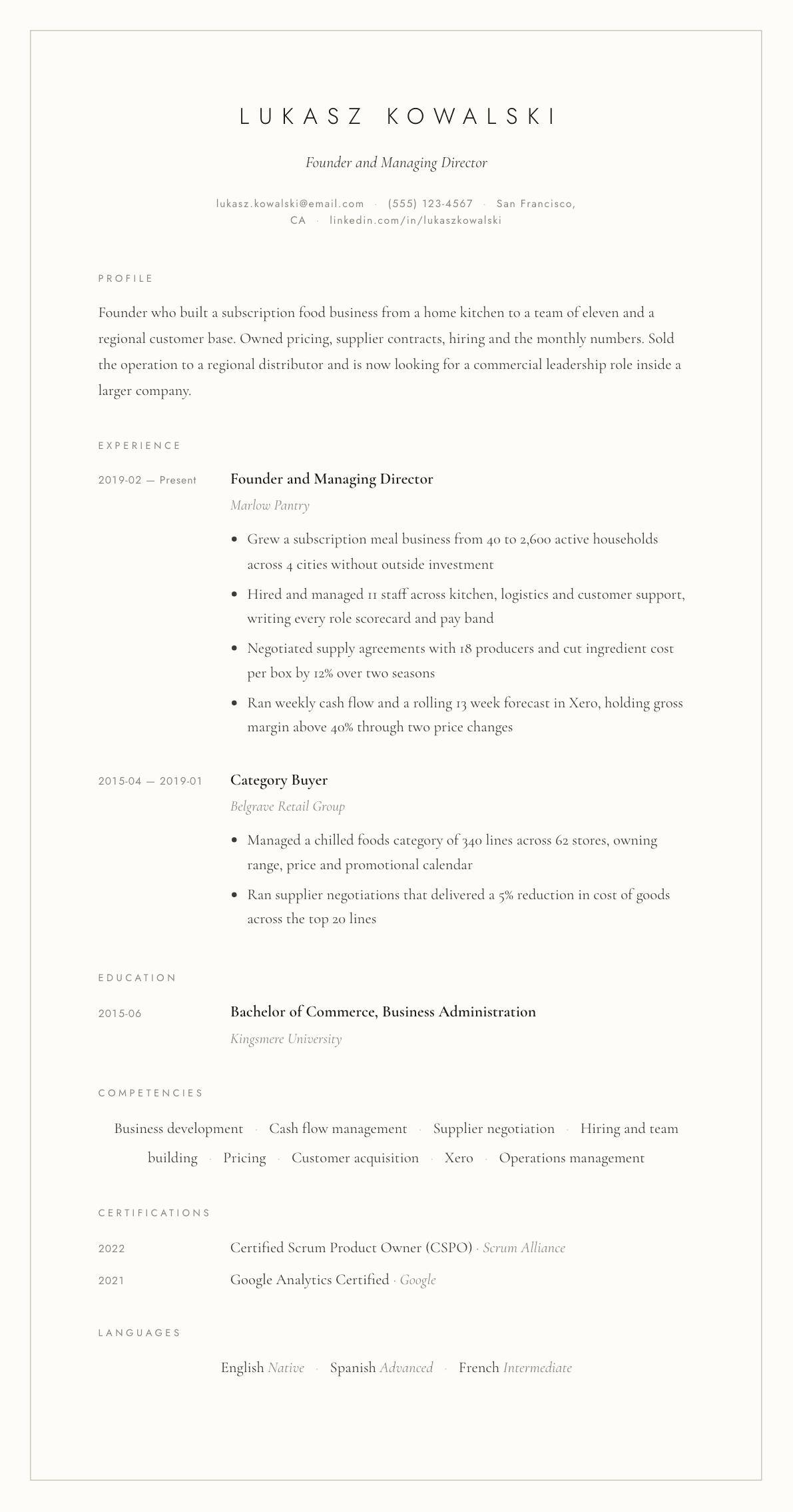
Example Entrepreneur summary
Founder with six years building and running a subscription food business that reached several thousand households and a team of eleven, funded entirely from revenue. Owned pricing, supplier contracts, hiring and the weekly cash position, and held gross margin above forty points through two price changes. Previously a category buyer in grocery retail. Now seeking a commercial leadership role inside an established consumer business.
Skills to list on a Entrepreneur resume
- Business development
- Commercial strategy
- Cash flow management
- Pricing and margin control
- Supplier negotiation
- Hiring and onboarding
- Customer acquisition
- Unit economics
- Operations management
- Financial forecasting
- Brand building
- Contract negotiation
- Xero
- Market research
What actually gets this resume read
- Give your company a one line description under the job title so the reader knows the market, model and size.
- Translate founder work into functions a hiring manager recognizes: commercial, operations, finance, hiring, marketing.
- Report revenue growth, headcount and customer counts as trajectories, since a starting point makes the result readable.
- Explain why the venture ended in a neutral line if it closed, because an unexplained gap invites the worst assumption.
- Keep any pre-founder employment on the page, as it proves you can operate inside somebody else structure too.
- Match the language to the role you want next, whether that is general management, commercial leadership or operations.
How to write a entrepreneur resume
An entrepreneur resume has a translation problem. You did five jobs at once for several years, nobody gave you a title that maps onto a job posting, and the reader has no manager to call. Recruiters are not hostile to founders, but they are cautious, and the caution has two sources: they cannot verify what you claim, and they worry you will leave the moment your next idea arrives.
Both concerns are answerable on the page. Verification improves when you describe the venture the way an outsider would: what it sold, to whom, how many people worked there, and what the numbers did over time. The retention worry shrinks when your summary states plainly what you want next and why an employed role suits that, rather than leaving the reader to invent a story.
This guide covers how to present a venture so it reads as management experience, how to handle a business that closed, which functional language converts founder work into hireable skills, and the questions founders ask when they write a resume for the first time in years.
Format: give the company a description before you describe yourself
Under the company name, add one line that positions it: what it sold, the market, the model and the size. Something like a subscription meal business serving households in four cities, eleven staff, funded from revenue. Without that line, a reader cannot tell whether you ran a side project or a real trading business, and they will assume the smaller of the two.
Use a functional job title alongside founder. Founder and managing director, founder and head of operations, or co-founder and commercial director all tell a screener what you actually did daily. The word founder on its own is a shareholding fact, not a description of work.
- Company line: product, customer, model, headcount, funding source.
- Title: founder plus the function you performed most.
- Dates: continuous, with a clear end and a one clause reason if the business closed.
Trajectory: show the numbers moving, not a snapshot
A single figure means little without a starting point. Customers grown from forty to a few thousand, headcount from two to eleven, revenue from a first trading year to the last one: trajectories prove you built rather than inherited. Where revenue is sensitive, use bands or growth multiples instead of exact figures, which is common practice and does not weaken the claim.
Include the unit economics you managed, because that is the part employers most want to see from a founder. Gross margin held through a price change, cost per acquired customer, repeat purchase rate, or contribution per unit all show that you ran the business on numbers rather than on optimism.
- Customers, revenue and headcount as start point to end point.
- Margin and cost per customer, with the actions that moved them.
- Cash discipline: forecasting horizon, the tool you ran it in, how often you reviewed it.
Translate founder work into the functions a hiring manager buys
Group your bullets by function rather than by chronology, because that is how job postings are written. Commercial covers pricing, selling and partnerships. Operations covers suppliers, logistics, service delivery and quality. Finance covers cash flow, forecasting, tax filings and banking. People covers hiring, pay structure, scheduling and letting people go. Marketing covers acquisition, brand, channels and retention.
Choose the two or three functions closest to the role you want and give them the most space. A founder applying for a commercial manager role should lead with pricing, accounts won and negotiation, and compress the bookkeeping into a single line. The same resume aimed at an operations role should invert that emphasis.
Name the systems you used. Accounting, point of sale, customer relationship and inventory tools appear in postings as hard filters, and a founder who ran the business in named software reads as more employable than one who describes the same work in general terms.
Handling an exit, a closure or an ongoing business
If you sold, say so and give the buyer type and your role through the transition. If the business closed, one neutral clause is enough: the market moved, the funding did not arrive, the partnership ended. Readers respect a clean statement far more than a gap they have to ask about, and every founder in the pile has an outcome of some kind.
If the business still trades while you look for a role, be explicit about the arrangement. Say whether it now runs with a manager, whether it is winding down, or how many hours a week it takes. Ambiguity here is what causes a promising founder application to stall after the first call.
Entrepreneur resume summary examples
First venture, two years
Founder of a two person design services business serving small retail clients, billing project work and retainers. Handled selling, quoting, delivery scheduling and invoicing, and grew from three clients to eighteen over two trading years. Now seeking an account management role where the same client ownership applies at larger scale.
Six years running a company
Founder who built a subscription food business from a home kitchen to eleven staff and several thousand households across four cities, funded entirely from revenue. Owned pricing, supplier contracts, hiring and weekly cash flow, holding gross margin above 40% through two price changes. Targeting a commercial leadership role in consumer goods.
Exited founder
Entrepreneur who founded, scaled and sold a regional logistics business with a fleet of eighteen vehicles and a team of thirty, then stayed through a nine month integration with the acquirer. Built the commercial book, the operating model and the management team. Looking for a general management role with full profit and loss ownership.
Work experience bullets: before and after
Before: Founded and ran my own business.
After: Founded and ran a subscription meal business serving 2,600 households across four cities, with eleven staff across kitchen, logistics and support, funded entirely from trading revenue.
The rewrite converts a claim into a company description a reader can size and compare against a job requirement.
Before: Handled all financial matters.
After: Ran weekly cash flow and a rolling thirteen week forecast in Xero, managed payroll for eleven staff, and filed quarterly returns with an external accountant reviewing the books each quarter.
Naming the cadence, the tool and the filings turns vague ownership into finance experience an employer recognizes.
Before: Negotiated with suppliers.
After: Negotiated supply agreements with 18 producers, moving four core ingredients onto fixed seasonal pricing and reducing cost per box by 12% across two seasons.
It shows the negotiation count, what changed in the contracts and the margin effect that followed.
Before: Hired and managed staff.
After: Wrote role scorecards and pay bands for eight positions, hired eleven staff across three functions, and ran monthly one to ones with two team leads who covered operations when I was selling.
Hiring reads as management when the structure, the process and the delegation are visible.
Before: Grew sales through marketing.
After: Built acquisition through local partnerships and paid social, tracking cost per new subscriber weekly and reallocating budget to the two channels that held payback inside three months.
The strong version shows the channels, the measure and the decision rule behind the growth.
Hard skills
- Profit and loss ownership
- Cash flow forecasting
- Pricing and margin control
- Supplier and contract negotiation
- Customer acquisition
- Unit economics
- Inventory and supply planning
- Payroll and statutory filings
- Sales and account development
- Accounting software such as Xero or QuickBooks
- Market research
- Business planning
Soft skills
- Decision making with incomplete information
- Resilience
- Negotiation
- Hiring judgment
- Prioritization
- Direct communication
Mistakes that cost entrepreneur candidates the interview
- Using founder as the only job title, which describes ownership rather than the work you did every week.
- Leaving the company undescribed so the reader cannot tell a trading business from a side project.
- Giving one impressive number with no starting point, which reads as selective rather than as growth.
- Ignoring a closure and leaving a gap the recruiter has to raise in the first call.
- Listing every function equally instead of leading with the two closest to the job you want.
- Dropping earlier employment, which is the evidence that you can work inside someone else structure.
Entrepreneur resume questions
Will employers take my founder experience seriously?
Many will, provided the venture is described in terms they can size. What loses credibility is vagueness: no headcount, no customers, no revenue direction, no reason it ended. Concrete detail moves a founder application from curiosity to candidate.
How do I explain that my business failed?
One neutral clause in the role entry, such as the business closed when the main supply contract ended. Then keep writing about what you built and learned. Readers are far more concerned by an unexplained gap than by a company that stopped trading.
Should I include revenue figures on an entrepreneur resume?
Use bands or growth multiples rather than exact figures if the numbers are sensitive or the business still trades. Direction and scale are what a reader needs, and a band answers that without publishing your accounts to strangers.
What job title should I use instead of founder?
Pair founder with the function you performed most, such as founder and managing director or founder and head of operations. That gives an applicant tracking system a searchable title and tells a human what your week actually looked like.
How do I convince a hiring manager I will not leave to start something else?
Say what you want next and why, in the summary, in one sentence. Naming the kind of role and the reason you want to operate inside a larger business answers the question before the interviewer has to ask it awkwardly.
Related resume examples
- Startup Founder Resume example
- General Manager Resume example
- Small Business Owner Resume example
- Growth Manager Resume example
- Business Manager Resume example
- Head of Product Resume example