Professional Reference Letter: 8 Samples for Employment
By Mustafa Tarabya, founder of CVBooster · Published · Updated
12 min read
A professional reference letter is a signed statement from someone who worked with a candidate, confirming the role they held, the work they did and how well they did it, so a new employer can trust the resume. The constraint is that every claim must be true and checkable, because the reader can call you, and in some places the law expects references to be accurate. The US Equal Employment Opportunity Commission states that "It is illegal for an employer to give a negative or false employment reference (or refuse to give a reference) because of a person's race, color, religion, sex" or other protected traits. Below are eight reference letter samples for employment, including a letter for a coworker, one for a teaching assistant and a corporate reference letter on company letterhead, checked in October 2026. Written by Mustafa Tarabya, who hired for his own company, read every application himself and now writes CVBooster's guides.
Most reference letters say the candidate is hardworking, a great team player and a pleasure to work with. So does every other letter in the pile, including the one for the person who was let go. A letter that could describe anyone tells the reader nothing.
What every professional reference letter must contain
Every sample below has the same five parts. If you are short on time, write these and nothing else.
- The relationship. Your title, their title, how long you worked together and whether you managed them.
- The role. What they were responsible for, in one or two sentences.
- Specific evidence. Two pieces of work you saw yourself, with a result where you know one.
- A comparison or a clear verdict. How they compare to others in the same role, or a plain recommendation.
- Your contact details. A phone number or email, and an offer to answer questions.
Reference letter from a manager for a former employee
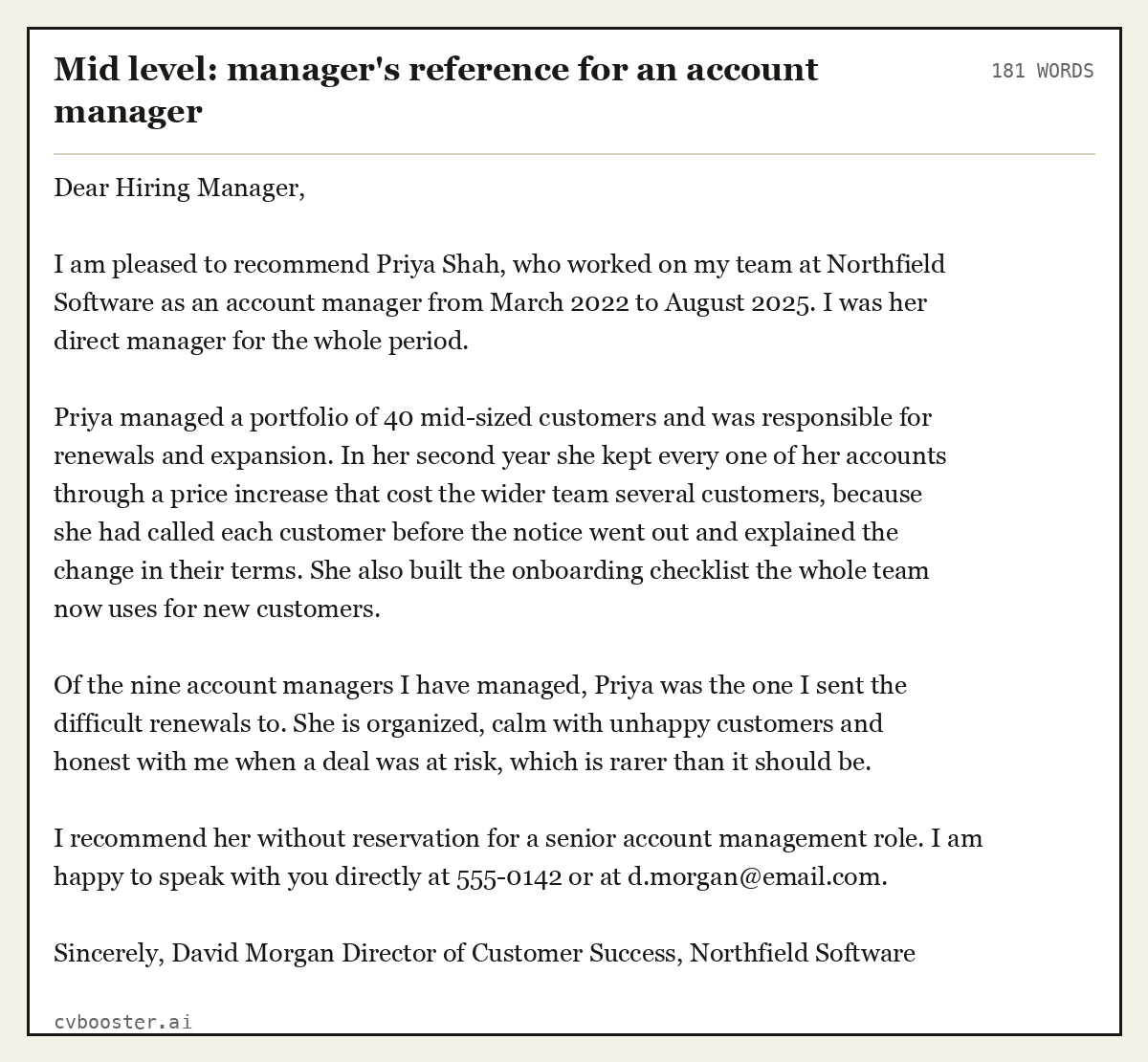
Mid level: manager's reference for an account manager (181 words)
Dear Hiring Manager,
I am pleased to recommend Priya Shah, who worked on my team at Northfield Software as an account manager from March 2022 to August 2025. I was her direct manager for the whole period.
Priya managed a portfolio of 40 mid-sized customers and was responsible for renewals and expansion. In her second year she kept every one of her accounts through a price increase that cost the wider team several customers, because she had called each customer before the notice went out and explained the change in their terms. She also built the onboarding checklist the whole team now uses for new customers.
Of the nine account managers I have managed, Priya was the one I sent the difficult renewals to. She is organized, calm with unhappy customers and honest with me when a deal was at risk, which is rarer than it should be.
I recommend her without reservation for a senior account management role. I am happy to speak with you directly at 555-0142 or at d.morgan@email.com.
Sincerely, David Morgan Director of Customer Success, Northfield Software
How to write a reference letter for a coworker
A peer reference carries less authority than a manager's, so it has to be more specific. Say how you worked together and what you saw day to day. Writing recommendation letters for colleagues is easier with one rule: describe only work you saw yourself, and say plainly that you were a peer, not their manager, so the reader weighs the letter correctly.
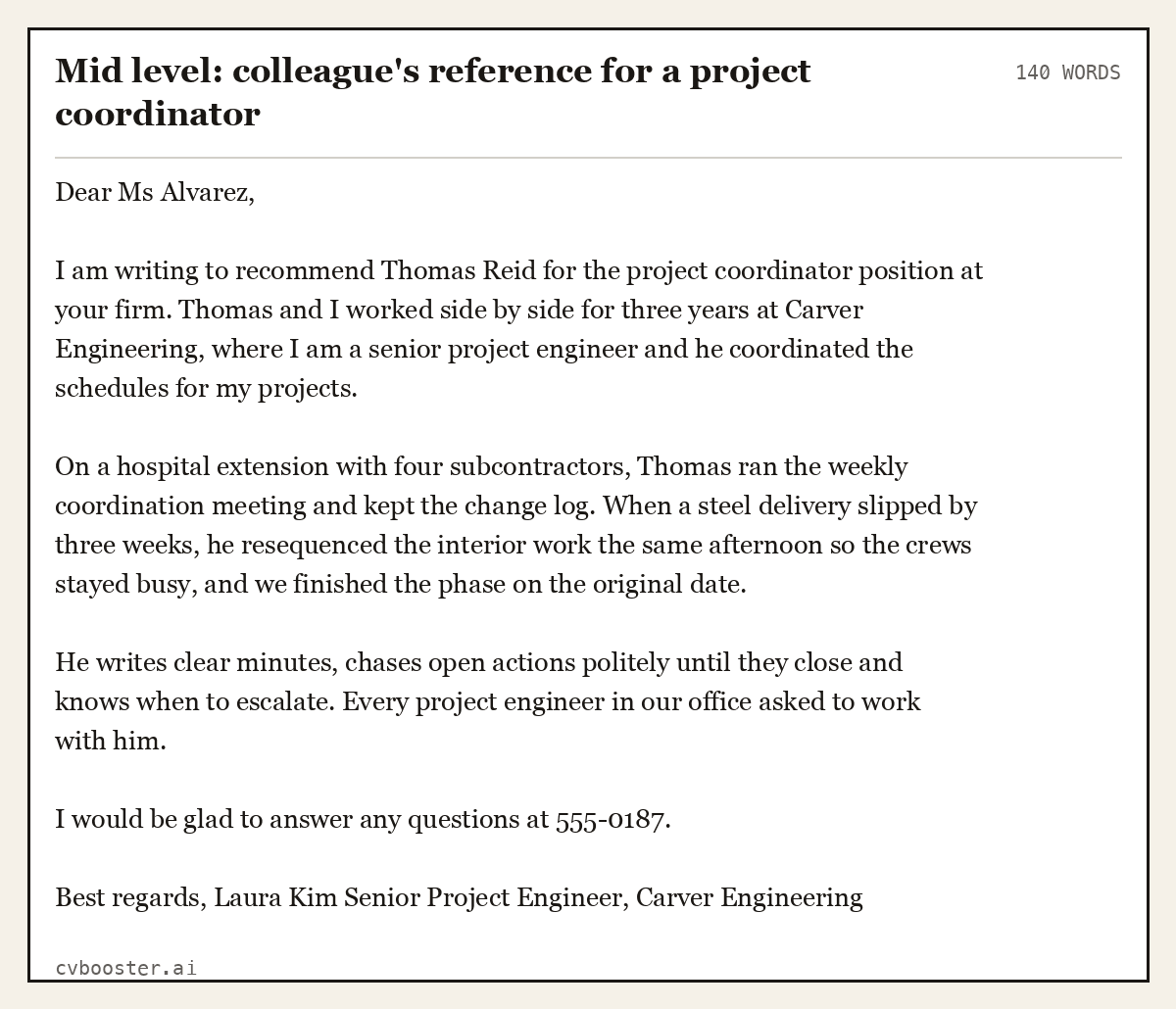
Mid level: colleague's reference for a project coordinator (140 words)
Dear Ms Alvarez,
I am writing to recommend Thomas Reid for the project coordinator position at your firm. Thomas and I worked side by side for three years at Carver Engineering, where I am a senior project engineer and he coordinated the schedules for my projects.
On a hospital extension with four subcontractors, Thomas ran the weekly coordination meeting and kept the change log. When a steel delivery slipped by three weeks, he resequenced the interior work the same afternoon so the crews stayed busy, and we finished the phase on the original date.
He writes clear minutes, chases open actions politely until they close and knows when to escalate. Every project engineer in our office asked to work with him.
I would be glad to answer any questions at 555-0187.
Best regards, Laura Kim Senior Project Engineer, Carver Engineering
Reference letter for an intern or entry level employee
With an intern you have little history, so focus on how they learned, how they took feedback and one task they did well.
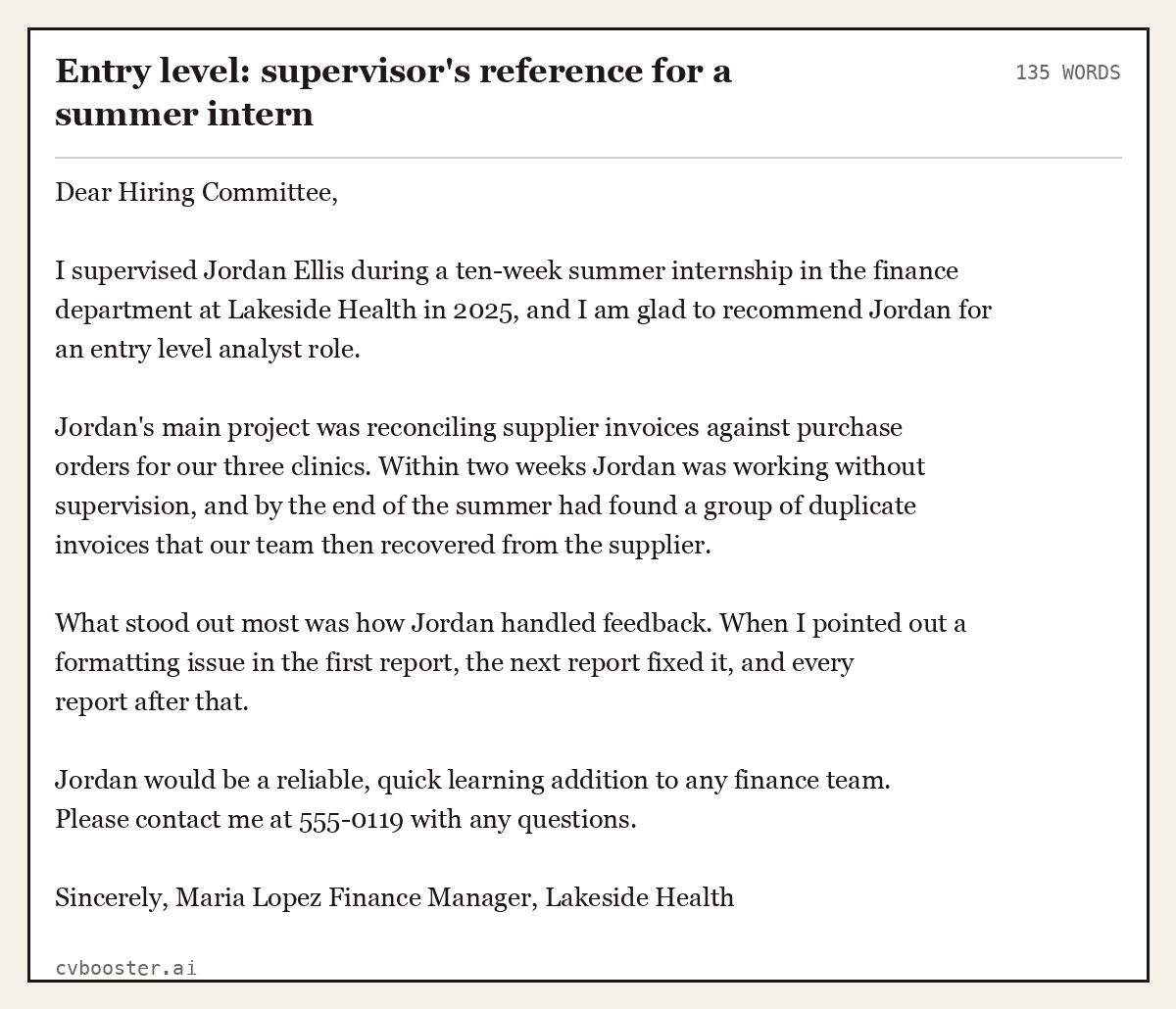
Entry level: supervisor's reference for a summer intern (135 words)
Dear Hiring Committee,
I supervised Jordan Ellis during a ten-week summer internship in the finance department at Lakeside Health in 2025, and I am glad to recommend Jordan for an entry level analyst role.
Jordan's main project was reconciling supplier invoices against purchase orders for our three clinics. Within two weeks Jordan was working without supervision, and by the end of the summer had found a group of duplicate invoices that our team then recovered from the supplier.
What stood out most was how Jordan handled feedback. When I pointed out a formatting issue in the first report, the next report fixed it, and every report after that.
Jordan would be a reliable, quick learning addition to any finance team. Please contact me at 555-0119 with any questions.
Sincerely, Maria Lopez Finance Manager, Lakeside Health
How to write a reference letter for a teacher
A teacher reference is usually written by a principal, a department head or a mentor teacher, and the reader is a principal or hiring panel. They want to know about classroom management, student progress, relationships with families and how the teacher works with colleagues. Name the grade level, the subject and something you observed in the classroom yourself. A teacher applying to a new district may also need the teacher cover letter and teacher resume to tell the same story.
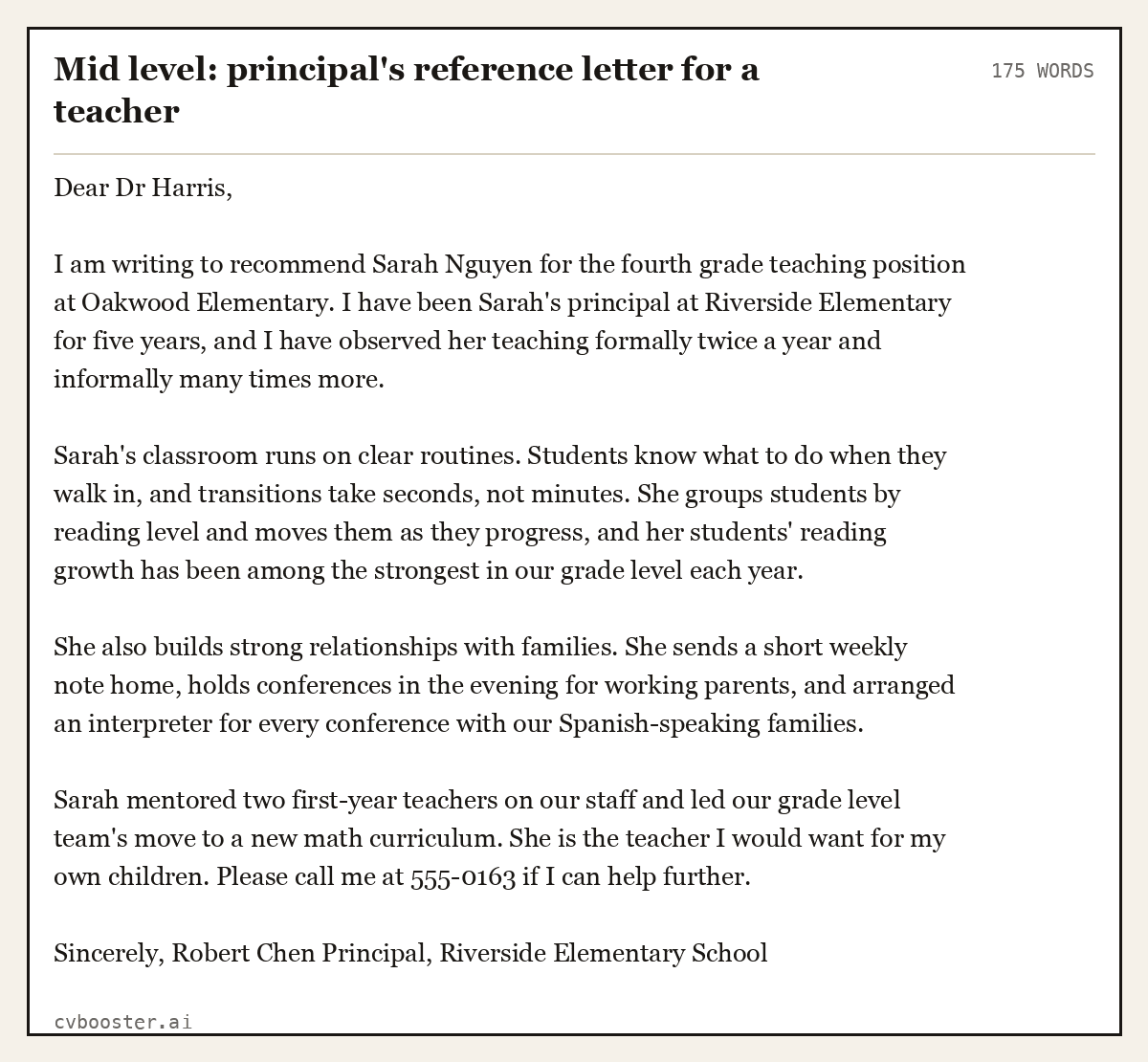
Mid level: principal's reference letter for a teacher (175 words)
Dear Dr Harris,
I am writing to recommend Sarah Nguyen for the fourth grade teaching position at Oakwood Elementary. I have been Sarah's principal at Riverside Elementary for five years, and I have observed her teaching formally twice a year and informally many times more.
Sarah's classroom runs on clear routines. Students know what to do when they walk in, and transitions take seconds, not minutes. She groups students by reading level and moves them as they progress, and her students' reading growth has been among the strongest in our grade level each year.
She also builds strong relationships with families. She sends a short weekly note home, holds conferences in the evening for working parents, and arranged an interpreter for every conference with our Spanish-speaking families.
Sarah mentored two first-year teachers on our staff and led our grade level team's move to a new math curriculum. She is the teacher I would want for my own children. Please call me at 555-0163 if I can help further.
Sincerely, Robert Chen Principal, Riverside Elementary School
Recommendation letter for a teaching assistant
A recommendation letter for a teaching assistant usually comes from the classroom teacher the assistant supported, and the reader is a principal or a school hiring panel. They want to know how the assistant works with individual students, follows the teacher's plans, handles behavior and keeps records. Name the grade, the kind of support (small reading groups, one to one support for a student with an education plan) and one moment you saw yourself. The assistant's own application should match it, so share our teaching assistant cover letter with them.
The full letter, ready to adapt:
Dear Ms Patel,
I am writing to recommend Leah Morgan for the teaching assistant position at Hillcrest Elementary. Leah has worked in my second grade classroom at Maple Grove Elementary for two school years, and I plan her work every day.
Leah runs our small reading groups four mornings a week. She keeps a short note on every child after each session, and those notes are the first thing I read when I plan the next week. One student in her group started the year unable to blend sounds and ended it reading simple chapter books with her.
She is calm with behavior. When a student with a support plan becomes upset, Leah follows the plan exactly, takes him to the quiet corner and brings him back to the lesson without fuss.
Leah is reliable, discreet with student information and liked by children and parents alike. I recommend her without hesitation. Please call me at 555-0148 with any questions.
Sincerely,
Emily Brooks, Second Grade Teacher, Maple Grove Elementary
UK employment reference letter sample
UK employers are not usually required to give a reference, but GOV.UK is clear about the standard when they do: "An employer does not usually have to give a work reference – but if they do, it must be fair and accurate." This sample is written to that standard, with British spelling.
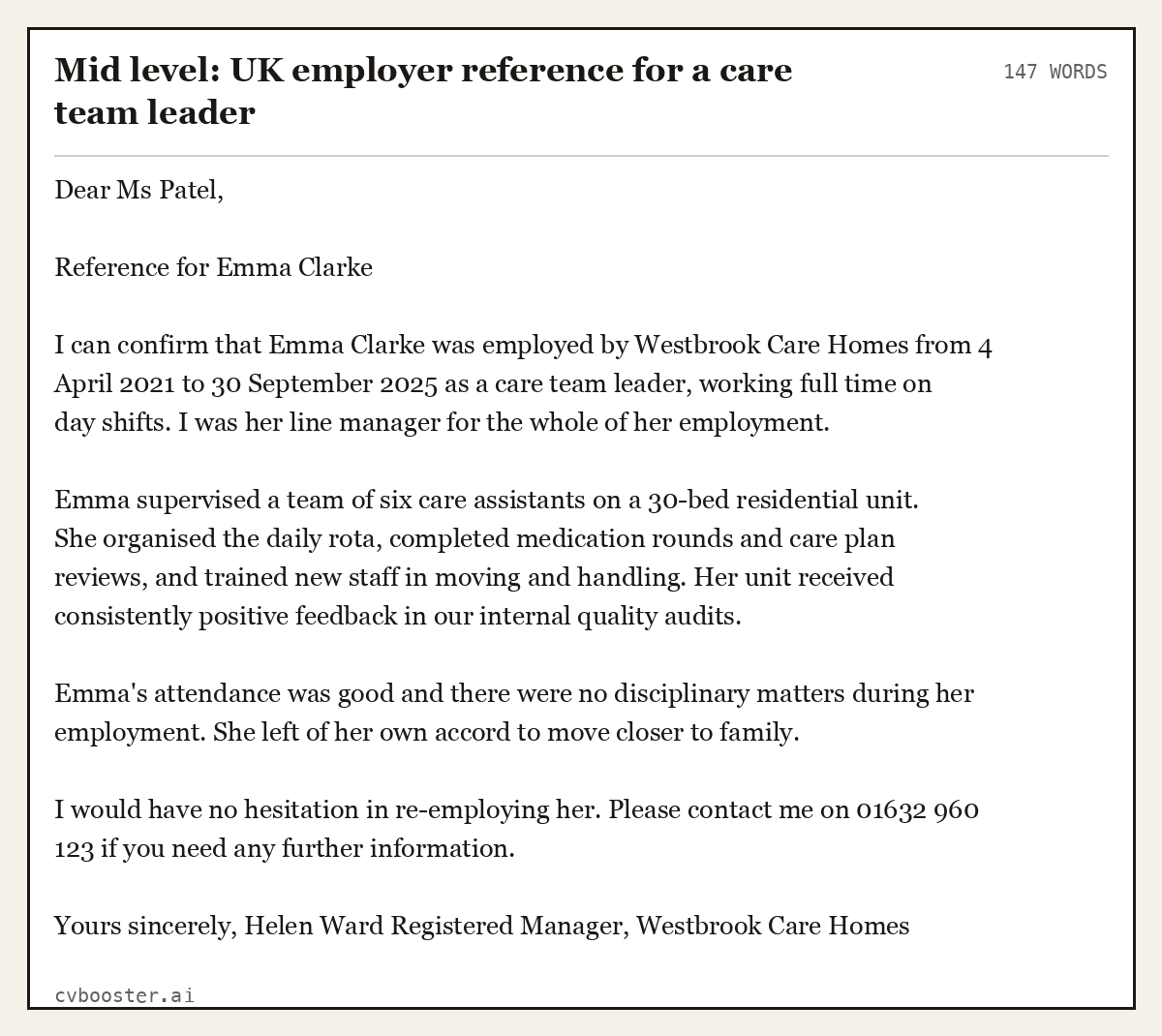
Mid level: UK employer reference for a care team leader (147 words)
Dear Ms Patel,
Reference for Emma Clarke
I can confirm that Emma Clarke was employed by Westbrook Care Homes from 4 April 2021 to 30 September 2025 as a care team leader, working full time on day shifts. I was her line manager for the whole of her employment.
Emma supervised a team of six care assistants on a 30-bed residential unit. She organised the daily rota, completed medication rounds and care plan reviews, and trained new staff in moving and handling. Her unit received consistently positive feedback in our internal quality audits.
Emma's attendance was good and there were no disciplinary matters during her employment. She left of her own accord to move closer to family.
I would have no hesitation in re-employing her. Please contact me on 01632 960 123 if you need any further information.
Yours sincerely, Helen Ward Registered Manager, Westbrook Care Homes
Short reference letter when company policy limits what you can say
Many employers allow only a factual reference that confirms dates and job title. Acas notes that an employer "does not have to give a reference by law" unless it has agreed to in writing or works in certain regulated areas, so a short policy letter is common and is not a bad sign. Check your company's policy before you write anything on letterhead.
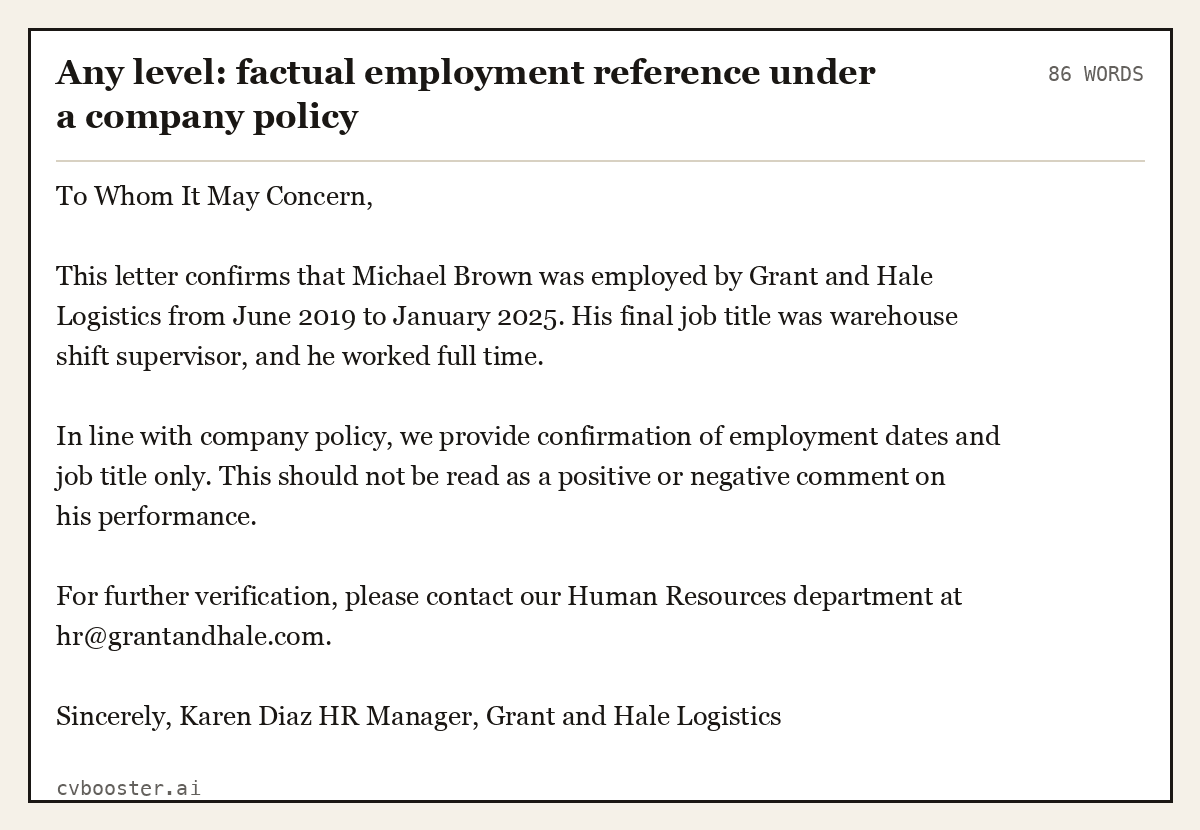
Any level: factual employment reference under a company policy (86 words)
To Whom It May Concern,
This letter confirms that Michael Brown was employed by Grant and Hale Logistics from June 2019 to January 2025. His final job title was warehouse shift supervisor, and he worked full time.
In line with company policy, we provide confirmation of employment dates and job title only. This should not be read as a positive or negative comment on his performance.
For further verification, please contact our Human Resources department at hr@grantandhale.com.
Sincerely, Karen Diaz HR Manager, Grant and Hale Logistics
Corporate reference letter for a business, on company letterhead
A reference letter for business is a reference written by a business, usually the owner of a small company, either for an employee who is leaving or for a contractor or supplier another firm is thinking of hiring. Small businesses rarely have an HR department or a policy template, so the owner writes it personally. That is an advantage: the owner saw the work up close and can say more than a policy letter allows.
Print it on company letterhead, or add the business name, address and phone number at the top, and sign it with your title (owner, managing partner, director). The reader uses the letterhead to check the business is real, and the phone number to call you.
The same five parts apply. For an employee, name the role and two pieces of work. For a supplier or contractor, replace the role with what they delivered to your business, for how long, and whether you would hire them again. Keep it to facts you can stand behind if the reader calls.
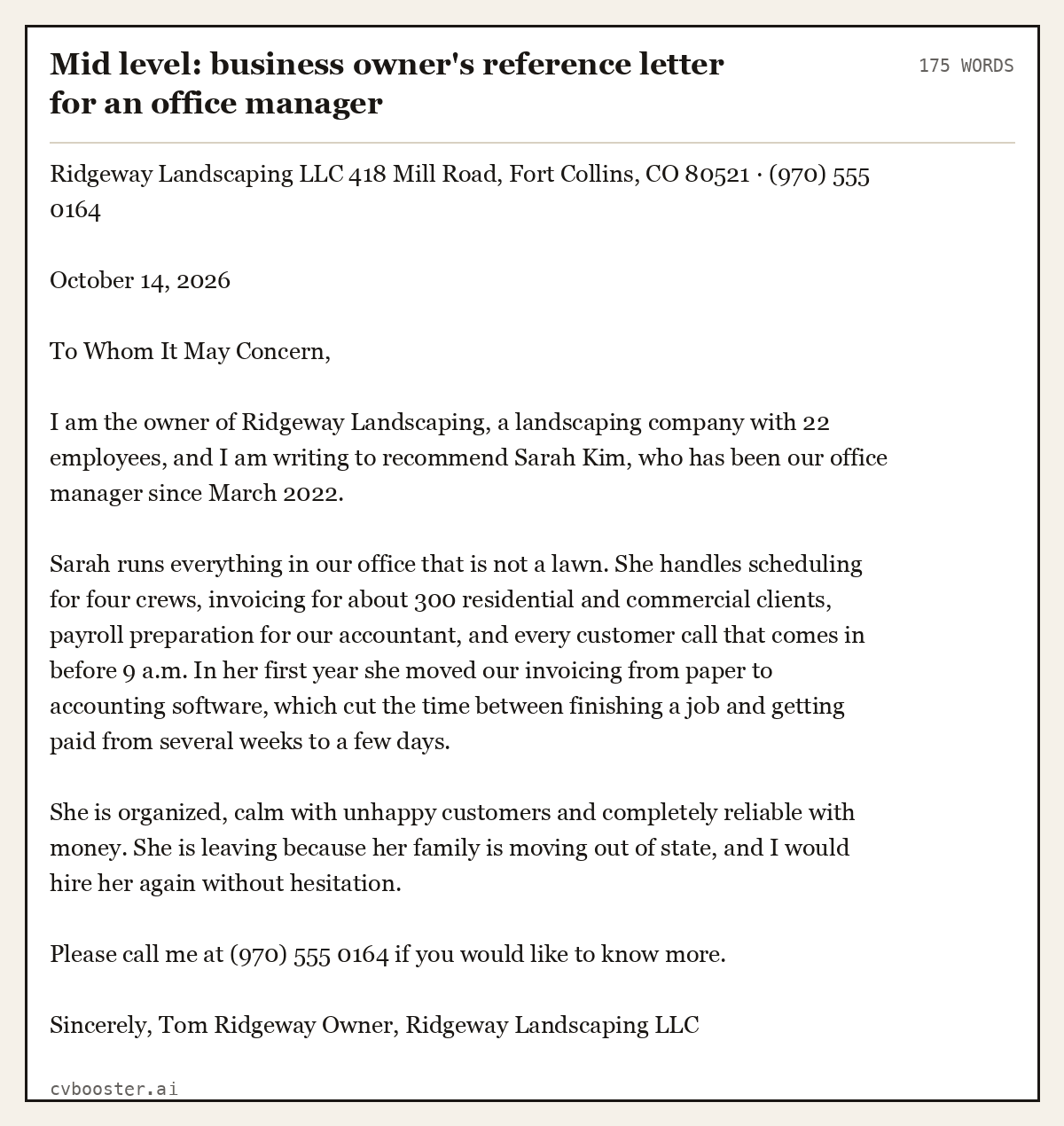
Mid level: business owner's reference letter for an office manager (175 words)
Ridgeway Landscaping LLC 418 Mill Road, Fort Collins, CO 80521 · (970) 555 0164
October 14, 2026
To Whom It May Concern,
I am the owner of Ridgeway Landscaping, a landscaping company with 22 employees, and I am writing to recommend Sarah Kim, who has been our office manager since March 2022.
Sarah runs everything in our office that is not a lawn. She handles scheduling for four crews, invoicing for about 300 residential and commercial clients, payroll preparation for our accountant, and every customer call that comes in before 9 a.m. In her first year she moved our invoicing from paper to accounting software, which cut the time between finishing a job and getting paid from several weeks to a few days.
She is organized, calm with unhappy customers and completely reliable with money. She is leaving because her family is moving out of state, and I would hire her again without hesitation.
Please call me at (970) 555 0164 if you would like to know more.
Sincerely, Tom Ridgeway Owner, Ridgeway Landscaping LLC
When to say no to writing a reference
If you cannot write two specific, true sentences about someone's work, you are not the right person to write their reference. Say so kindly and early: "I don't think I saw enough of your work to write the letter you deserve. Someone who managed you directly will help you more." Declining gives them time to ask someone else, which is kinder than a vague letter that reads as a warning.
If you are the one asking, make it easy to say yes. Send the job posting, your resume and two or three pieces of work you would like the writer to mention, and give them at least a week. Our guide to references on a resume covers who to list and how. If the letter has to be in Spanish, the recommendation letter in Spanish page has five full samples with the formal phrases. Commanders and senior sergeants writing for a board or a veteran can follow the military reference letter samples. For more finished letters, including recommendation letters for school and awards, see our reference letter examples, and for a personal rather than professional reference, the character reference letter guide. The free recommendation letter generator turns a few details into a draft you can edit.
Frequently asked questions
What should a professional reference letter include?
It should include your relationship to the candidate and how long you worked together, their role and responsibilities, two specific examples of their work, a clear recommendation or comparison with others in the same role, and your contact details. Keep it to one page and sign it with your full name and job title.
How long should a reference letter for employment be?
One page, usually three to five short paragraphs and roughly 150 to 250 words. A factual policy letter can be much shorter. Length is less important than specifics: one checkable example of good work is worth more than a full page of general praise.
Can my employer refuse to give me a reference?
In the US and the UK, most employers are not legally required to give a reference, and many limit it to dates and job title by policy. An employer cannot refuse or give a false reference for a discriminatory reason. In the UK, a reference that is given must be fair and accurate.
How do I write a reference letter for a teacher?
State your role, such as principal or department head, and how you observed the teacher. Then describe their classroom management, how their students progressed, how they work with families and colleagues, and any extra responsibilities. Name the grade and subject, give one specific example, and end with a clear recommendation.
What is the difference between a reference letter and a recommendation letter?
In everyday use they mean almost the same thing. A reference letter often confirms employment and general performance and may go to any employer. A recommendation letter is usually written for one specific job, school or award and argues more strongly for the candidate. Both should be specific and true.
How do I write a reference letter for a coworker?
Say that you were a peer, how long you worked together and on what. Then describe two pieces of their work you saw yourself, with the result if you know it, and how they work with others. Close with a clear recommendation and your phone or email. Keep it to one page and stay specific.
Related articles
- Sample MBA Recommendation Letters: 6 Examples That Work
- Nanny Reference Letter: 7 Samples for Parents and Employers
- Recommendation Letter in Spanish: 5 Full Samples to Copy
- Acceptance Resignation Letter: 6 Samples for Employers
More articles
- Job Reference Letter of Recommendation: 11 Full Examples
- References on Resume: 7 Examples and What to Send Instead
- Referral Letter: Six Complete Examples and the Rules
Looking for a worked example for your job title? Browse the resume examples by job title.