VP Operations Resume Examples: free ATS score and gap list
Create a VP Operations Resume That Showcases Scalable Impact
By Mustafa Tarabya, founder of CVBooster · Published · Updated
Build a VP operations resume demonstrating P&L ownership, operational excellence, and leadership of large-scale teams with measurable business outcomes.
Sample resumes for a vp operations
The same vp operations content laid out in three CVBooster templates, so you can see what the finished document looks like before you write a word.
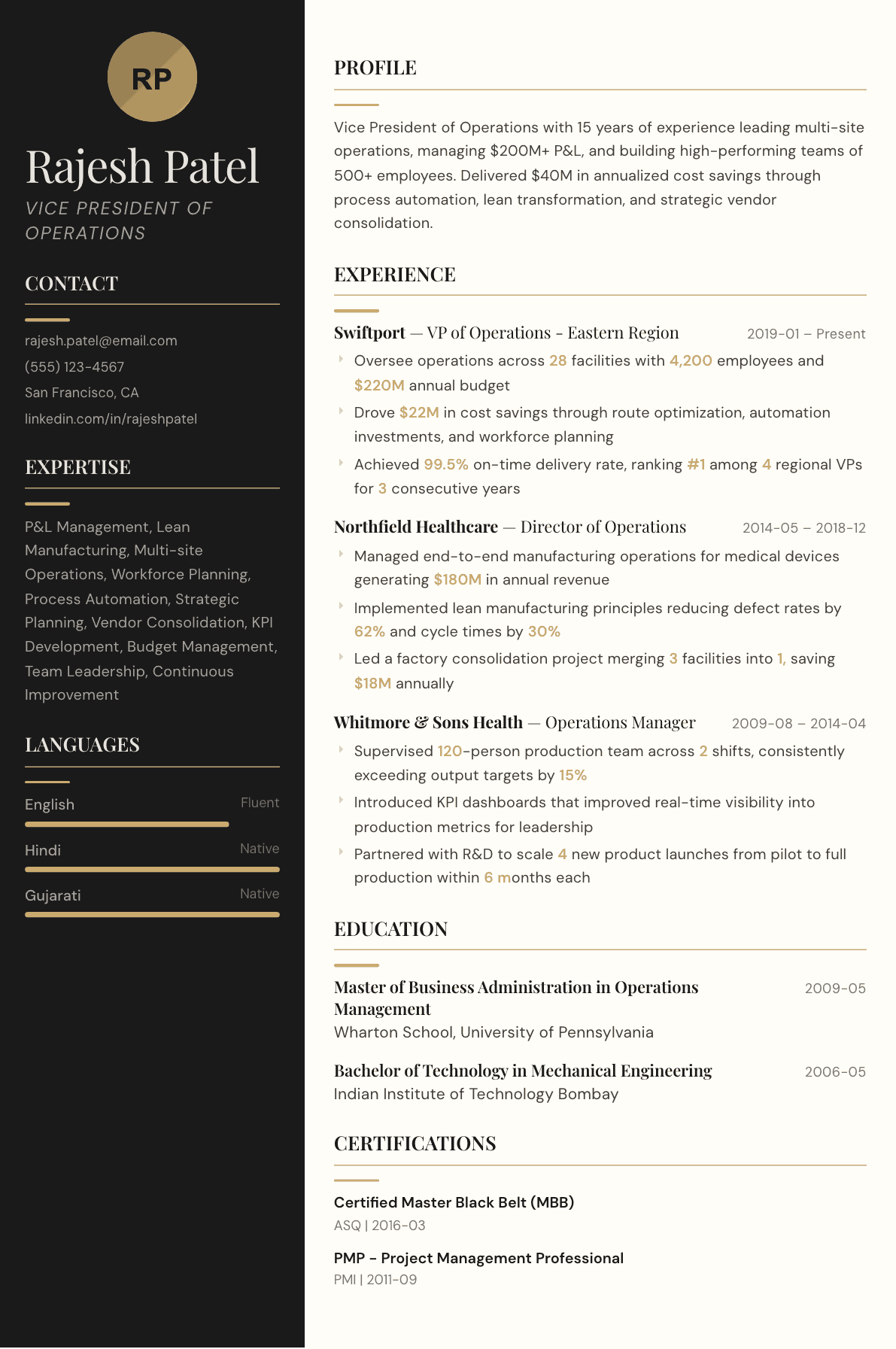
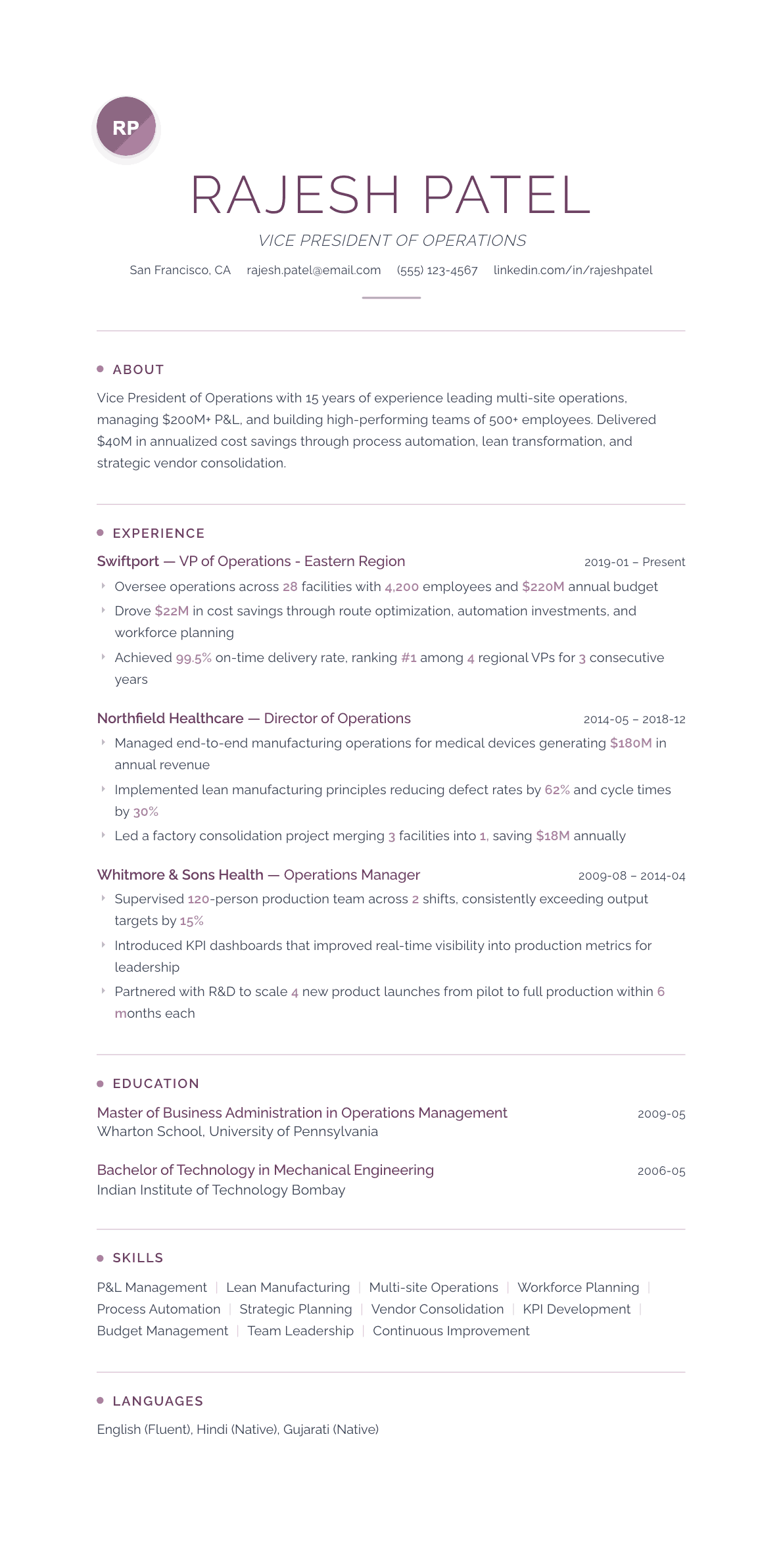
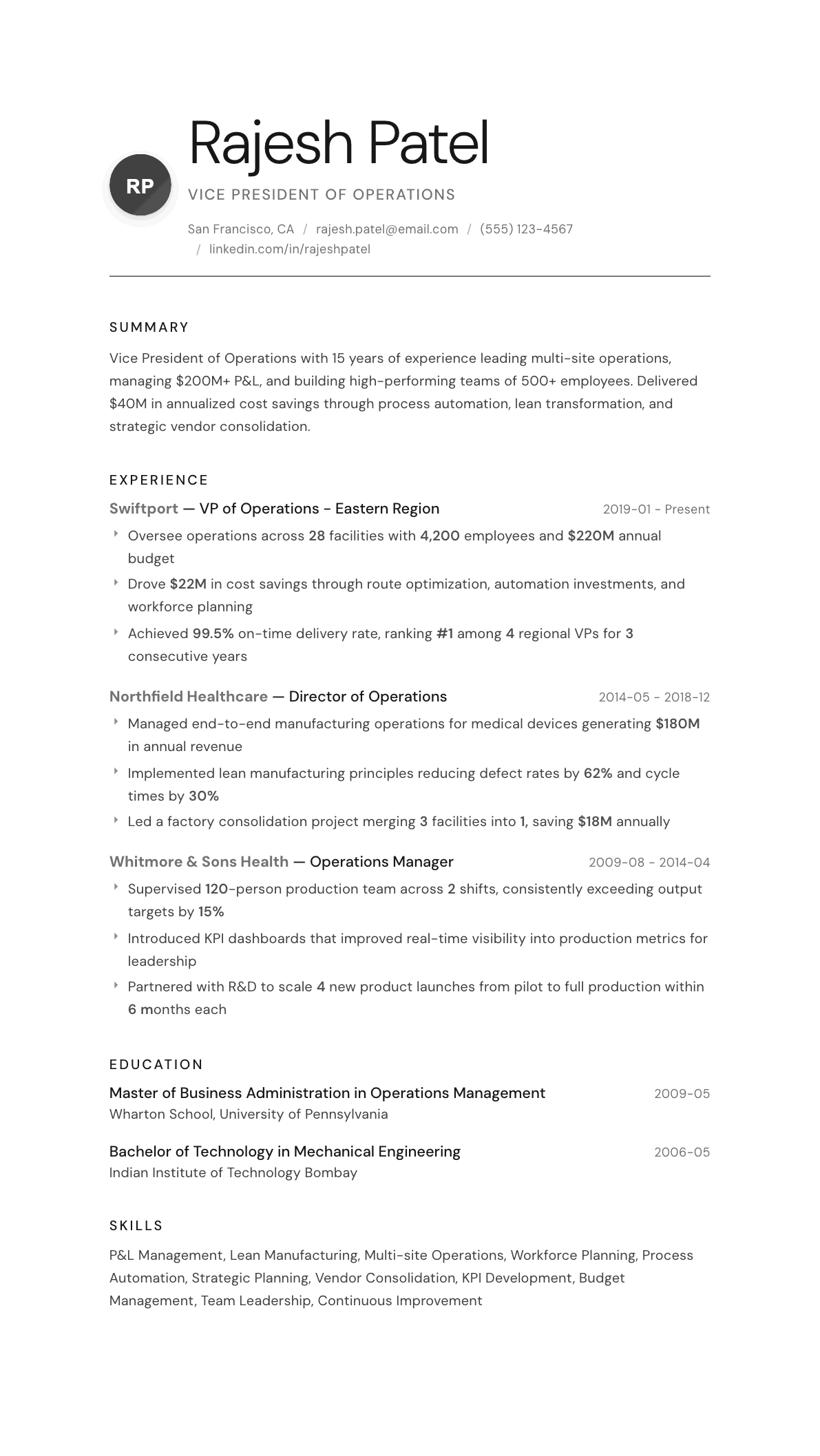
Example VP Operations summary
Vice President of Operations with 15 years of experience scaling multi-site operations, managing $200M+ P&L, and leading teams of 500+. Delivered $40M in annualized cost savings through lean transformation, automation, and vendor consolidation. Seeking a COO or SVP Operations role to drive enterprise-wide operational excellence.
Skills to list on a VP Operations resume
- P&L Management
- Operational Excellence
- Lean Manufacturing
- Six Sigma
- Multi-Site Operations
- Workforce Planning
- Process Automation
- Strategic Planning
- Vendor Management
- Budget Oversight
- Change Management
- Team Leadership
- KPI Development
- Continuous Improvement
What actually gets this resume read
- Lead with P&L scope, headcount, and number of facilities to establish scale immediately.
- Quantify cost savings, efficiency gains, and quality improvements with dollar figures and percentages.
- Show progression from manager to director to VP to demonstrate a clear leadership trajectory.
- Highlight lean, Six Sigma, or other operational excellence methodologies you champion.
- Include both strategic initiatives (consolidations, transformations) and operational KPIs.
- Use an executive-format template that conveys seniority and authority.
How to write a vp operations resume
A vice president of operations resume is read by a CEO, a board member or an executive search partner, and each of them tests one thing on the first page: the size and shape of what you have run. Sites, headcount, budget responsibility, the operating model, and whether the business was scaling, stabilizing or being turned around.
Executive resumes fail when they read like an enlarged manager resume. A long list of process improvements at this level suggests someone who has not yet moved from running work to running an organization, and search partners screen that out quickly.
This guide covers what belongs on an operations executive resume, how to write scope so it is comparable across companies, how to handle profit and loss ownership honestly, three summaries at different stages, before and after bullets, and the questions candidates ask when they step up from director.
Format: two pages, scope line first, achievements second
Two pages, reverse chronological, one column. Under each title give a scope line before any bullets: sites and geography, headcount including contractors, budget responsibility described in scale terms, the functions reporting to you, and who you reported to. A board member cannot compare your last role to the opening without it.
Executive readers skim the first third of page one and then decide. Put the largest and most relevant scope there, and let earlier roles compress to two or three lines each once they are more than a decade back.
- Scope line: functions owned, sites, headcount, budget scale, direct reports, reporting line.
- Order: summary, scope highlights, experience, board or advisory roles, education, certifications.
- Name the operating model: multi-site manufacturing, distribution network, field service, contact center or shared services.
- State the business context: growth, integration after an acquisition, turnaround, or preparing a company for sale.
Summary: the operating problem you are hired to solve
Four or five lines is acceptable at this level. Say what kind of operations you run, at what scale, in which industries, and what you are known for fixing. Executives are hired against a problem: capacity that cannot keep up, cost that has drifted, quality that is failing customers, or an integration that has stalled.
Drop the adjectives. Visionary, results-driven and transformational appear on every executive resume in the pile, and a search partner reads them as padding around the two or three facts she needs.
Experience: organizations built, not projects run
Three or four bullets per role at this level. Each should be an organizational outcome: a network redesigned, a plant brought up, a service model changed, a leadership team rebuilt, a cost structure reset, a safety culture turned around. Projects belong inside those bullets as the method, not as the headline.
Show the people work explicitly. How many leaders reported to you, how many you hired, what you did about the ones who could not scale, and what turnover looked like afterward. Chief executives hire operations leaders for the organization they leave behind as much as for the numbers.
Be precise about profit and loss. Owning a budget, owning cost of goods and owning a full profit and loss statement are different things. Say which one, because the first reference call will establish it anyway.
The numbers an operations executive is judged on
Pick the handful that mattered in your industry and carry them consistently across roles, so a reader can see a trajectory. Mixing a different metric into every job hides whether you improved anything or only changed the definition.
- Service: on-time delivery, fill rate, first-time fix, cycle time, service level attainment.
- Quality: defect rate, scrap, rework, warranty claims, customer complaint rate.
- Cost: cost per unit, cost per order, labor productivity, overtime, network unit economics.
- Safety: recordable incident rate, lost-time injuries, days without a recordable.
- People: span of control, voluntary turnover, internal promotion rate, time to fill critical roles.
Education, credentials and board work
An MBA is common at this level and belongs near the end unless it comes from a program the target company recruits from heavily. Lean and quality credentials still carry weight in manufacturing and distribution. List the belt and the issuing body rather than a training course with no assessment behind it.
Board, advisory and industry association roles deserve a short section when they are real. They signal that you can operate outside your own company, which is part of what separates a vice president from a strong director.
Keywords an executive operations brief repeats
Search briefs and postings repeat a specific set: multi-site operations, profit and loss ownership, operational excellence, capacity planning, continuous improvement, safety performance, vendor consolidation, integration and talent development. Use them once in the summary and once where you prove them, and let the scope lines carry the rest.
VP Operations resume summary examples
Stepping up from director
Operations director moving into an executive seat, with 11 years in medical device manufacturing and responsibility for 2 plants, 340 employees and the site budgets. Led a factory consolidation and a lean program that cut defect rates, and ran the operations half of 4 product launches.
First VP role
Vice president of operations for a regional distribution business: 9 facilities, 1,100 employees and full accountability for the cost structure. Rebuilt the leadership bench, moved on-time delivery into the high 90s, and took the network through a warehouse management system replacement without missing peak season.
Multi-region executive
Operations executive with 18 years across manufacturing and logistics, currently running 28 facilities and 4,200 employees with full profit and loss ownership for a region. Known for turnarounds: 2 underperforming networks stabilized, a post-acquisition integration completed, and a safety record rebuilt from the bottom quartile.
Work experience bullets: before and after
Before: Responsible for operations across multiple sites.
After: Ran 9 distribution facilities and 1,100 employees across 4 states, with 6 site directors reporting in and full accountability for the operating budget.
Counts, geography, reporting structure and the type of accountability make the scope comparable to the opening.
Before: Improved operational efficiency.
After: Reset the labor model across the network by rebuilding shift patterns around the demand curve, taking cost per order down while holding same-day dispatch above 97%.
The mechanism plus a guardrail metric shows a controlled improvement instead of a slogan.
Before: Led lean transformation initiatives.
After: Introduced daily management and standard work at 3 plants, trained 40 supervisors as problem owners, and cut scrap on the highest volume line by a third within 2 quarters.
Naming who was trained and what changed on the floor turns a program name into evidence that it landed.
Before: Built and developed high-performing teams.
After: Rebuilt the site leadership bench: hired 4 plant managers, promoted 3 supervisors into director roles, and brought voluntary turnover among salaried staff down over 2 years.
Hiring, promotion and retention numbers are the only proof of team building a chief executive trusts.
Before: Managed a large budget.
After: Owned a regional profit and loss statement covering freight, labor, facilities and capital, and delivered against plan for 3 consecutive years including 2 years of double-digit volume growth.
Stating exactly what the ownership covered stops a reference call from shrinking the claim later.
Hard skills
- Multi-site operations leadership
- Profit and loss and budget ownership
- Capacity and network planning
- Lean manufacturing and Six Sigma
- Safety program leadership
- Warehouse and distribution operations
- Supplier and vendor consolidation
- Post-merger operational integration
- Capital project approval and execution
- Workforce planning and labor modeling
- Quality management systems
- Operational reporting and dashboard design
- Automation and technology deployment
Soft skills
- Executive communication
- Leader development
- Change leadership
- Decision making on incomplete data
- Labor relations
- Board reporting
Certifications worth listing
- Certified Six Sigma Black Belt (CSSBB) (American Society for Quality)
- Certified Manager of Quality and Organizational Excellence (American Society for Quality)
- Project Management Professional (PMP) (Project Management Institute)
- Certified Supply Chain Professional (CSCP) (Association for Supply Chain Management)
- OSHA 30-Hour General Industry (OSHA Training Institute)
Mistakes that cost vp operations candidates the interview
- Writing a director resume in a larger font: many small process wins and no organizational outcomes.
- Omitting headcount, site count and budget scale, which makes every achievement impossible to size.
- Claiming profit and loss ownership when you owned a cost center. The first reference call corrects it and the correction is expensive.
- Changing metrics between roles, so a reader cannot tell whether performance improved or the definition did.
- Ignoring safety entirely on a manufacturing or distribution resume, where it is among the first questions a board asks.
- Running to three or four pages. Compress everything older than roughly a decade to a title, a company and a line.
VP Operations resume questions
How long should a VP of operations resume be?
Two pages. Executive search partners expect it and read the first page hardest. Give the last two roles most of the space, compress anything older than roughly a decade to a line each, and move education and credentials to the end.
Do I need an MBA to be a VP of operations?
No. Many operations executives come up through plants, distribution centers and field service without one. If you have it, list it at the end. Without it, lean on scope: sites run, people led, and the financial statement you carried.
How do I show profit and loss ownership accurately?
Name what the statement covered and what you actually controlled: revenue, cost of goods, labor, freight, facilities, capital. If you owned costs but not revenue, say so. Precision here reads as executive maturity rather than as a smaller job.
Should an operations executive resume include a highlights block?
A short highlights block above the experience works well when it holds four or five outcomes at the scale you want to be hired at. It fails when it repeats bullets that appear again below, wasting the part of the page that gets read most.
How do I position a turnaround that is still in progress?
Describe the starting condition, what you have changed so far, and the interim results with the horizon attached. Executives respect a candid in-flight story. What they distrust is a finished-sounding claim about a business that is publicly still struggling.
Related resume examples
- COO Resume example
- General Manager Resume example
- Supply Chain Manager Resume example
- Operations Manager Resume example
- Operations Consultant Resume example
- Operations Director Resume example