Middle School Teacher Resume Examples: read this first
Craft a Middle School Teacher Resume for Team Based Schools
By Mustafa Tarabya, founder of CVBooster · Published · Updated
Middle school teacher resume examples with subject and advisory keywords, sample bullets on data and behavior, and a full writing guide.
Sample resumes for a middle school teacher
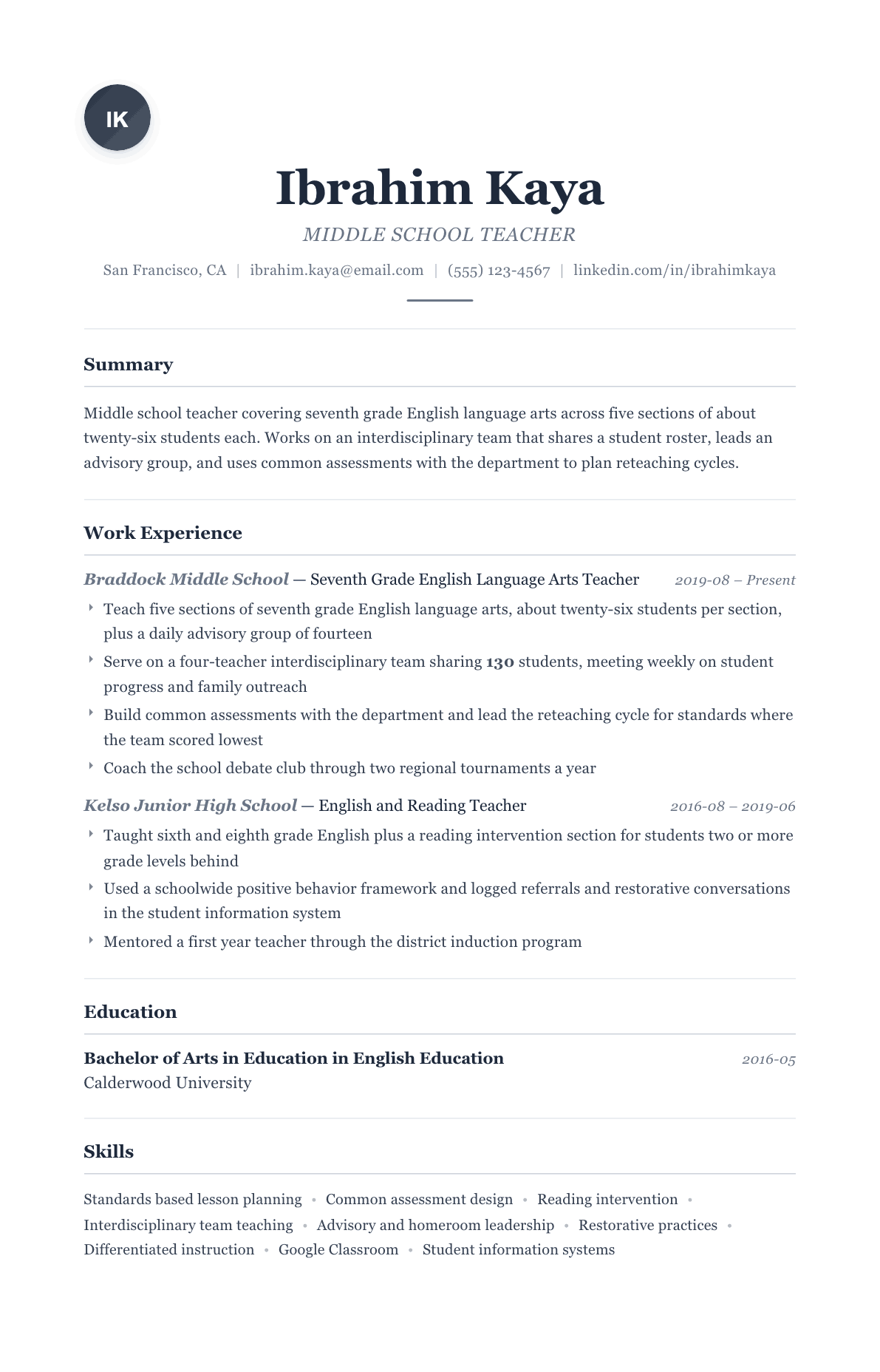
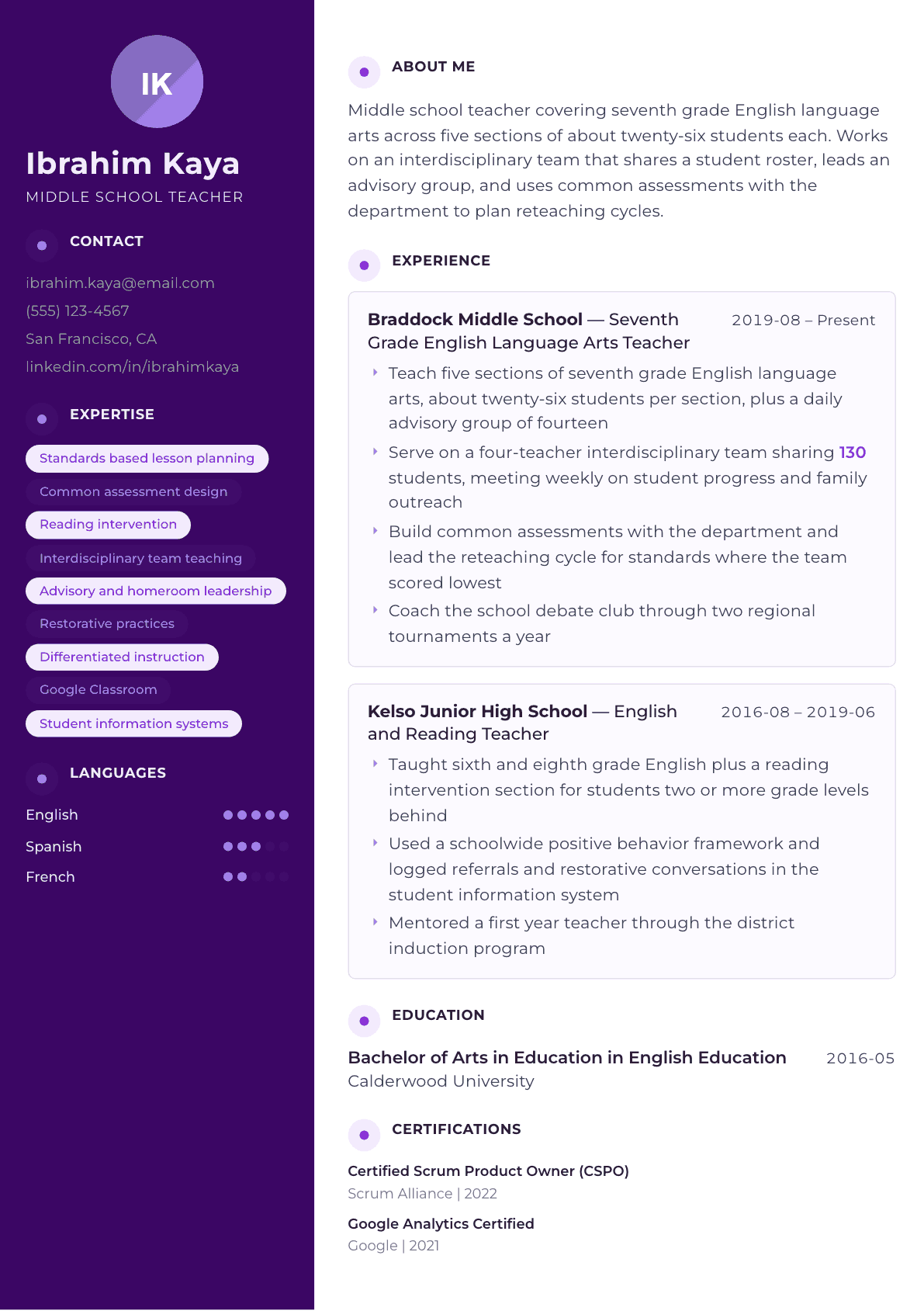
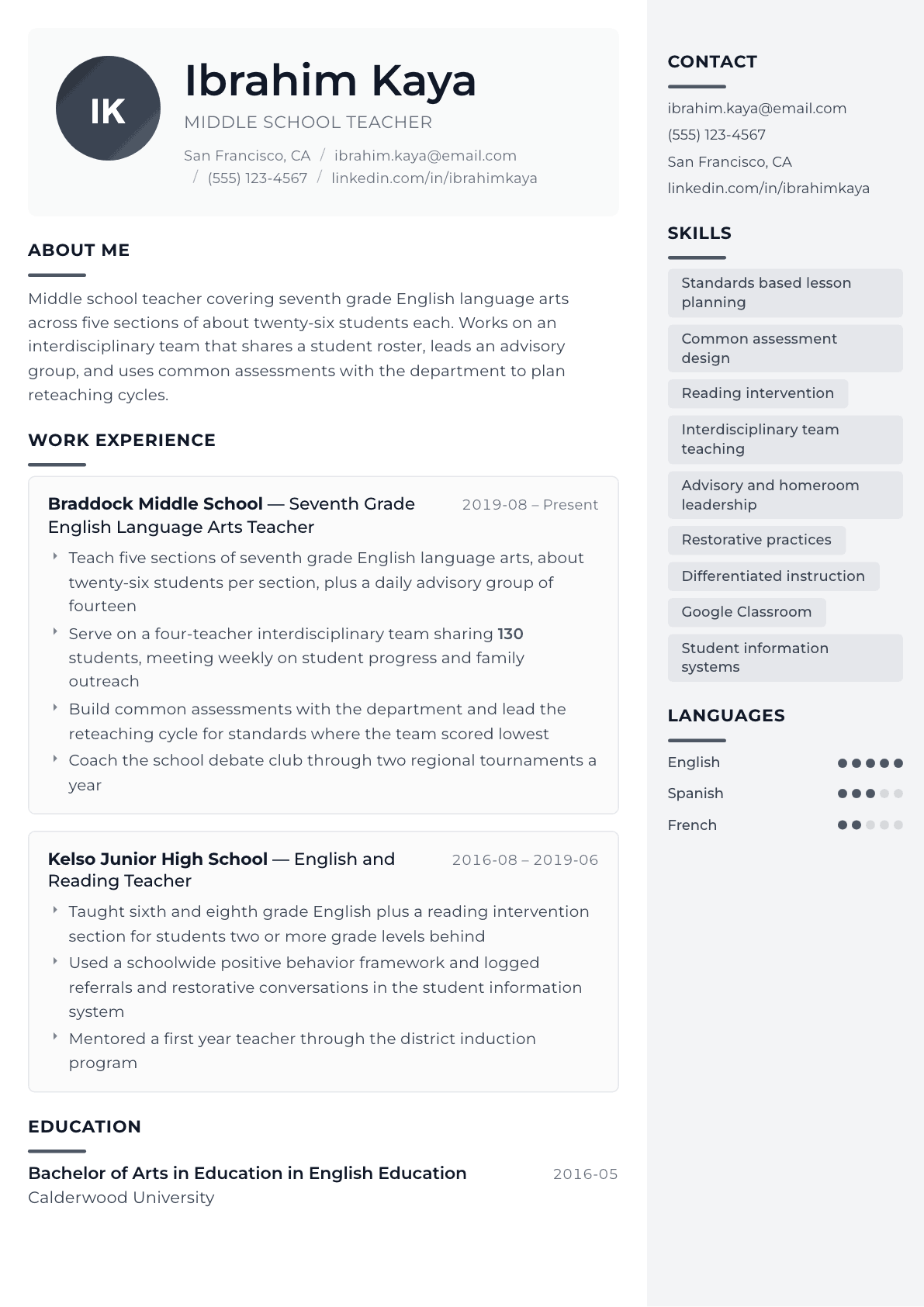
The same middle school teacher content laid out in three CVBooster templates, so you can see what the finished document looks like before you write a word.
Example Middle School Teacher summary
Middle school English language arts teacher with eight years across sixth through eighth grade, currently teaching five sections and an advisory group. Works on a four-teacher interdisciplinary team sharing a student roster, builds common assessments with the department, and leads reteaching cycles from the results. Mentors new teachers through district induction. Seeking a team lead or department chair role.
Skills to list on a Middle School Teacher resume
- Standards based lesson planning
- Common assessment design
- Data driven reteaching
- Reading intervention
- Interdisciplinary team teaching
- Advisory group leadership
- Restorative practices
- Positive behavior interventions and supports
- Differentiated instruction
- Multilingual learner strategies
- Individualized education program implementation
- Google Classroom
- Student information systems
- Family communication
- Club and athletics coaching
What actually gets this resume read
- Say how many sections you teach, the subject, the grade, and the student count per section so a principal can picture your load.
- Name the team structure you worked in, whether that is an interdisciplinary team, a department, or a house model.
- Show adolescent behavior work directly: advisory, restorative conversations, referral patterns and family contact routines.
- Give one example of using assessment data with colleagues rather than alone, because middle schools hire for collaboration.
- List every certification area and grade band, plus any endorsement in reading, special education or multilingual instruction.
- Add coaching, clubs and after school duties, since middle school postings often require a supervision commitment.
How to write a middle school teacher resume
Middle schools hire differently from elementary and secondary schools because the building is organized around teams, not just departments. A principal filling a seventh grade opening is usually filling a slot on a specific team that shares a roster of students, and she is reading your resume to decide whether you will hold up in that structure with thirteen year olds and four colleagues watching.
That means two things have to be visible fast. First, your certification area and grade band, since a middle grades license, a secondary license and an elementary license with a middle grades endorsement are not interchangeable in a district office. Second, evidence that you can handle adolescent behavior without either collapsing or escalating, which is the reason most middle school hires do not survive their first year.
What follows is the section order a middle school principal reads in, three summaries covering a new teacher, an established team member and a team or department lead, before and after bullets from real middle grades practice, and the questions teachers ask when applying at this level.
Format: certification, subject, load
One page early, two once you carry leadership duties. Directly beneath the summary, put certification with the state, the grade band and every endorsement, then a one-line teaching load summary: the subject, the number of sections, the students per section and any additional assignment such as advisory or an intervention block.
A middle school principal is building a master schedule while she reads. Handing her the load in one line makes it easy to imagine you inside it, which is exactly the mental step that leads to an interview.
- Header: name, city and state, phone, email, certification area and grade band.
- Order: summary, certification and endorsements, teaching experience, leadership and extracurricular, education, skills.
- Career changers add a content expertise line connecting prior work to the subject they will teach.
Summary: subject, grades, team structure
Name the subject, the grades taught, the number of sections and the team model you worked inside. Interdisciplinary teams, subject departments and house structures each shape the job, and a principal wants to know which one you already function in.
Add the thing that makes you useful beyond your own classroom. Building common assessments, running an intervention section, leading advisory curriculum or coaching are all concrete. A statement about believing every child can learn is not, because every applicant writes it.
Experience: load, assessment cycle, behavior
Start each position with the school, the grade levels, the subject, the section count and the students per section. Then write bullets across three areas that middle school leaders weigh: what you teach and how you plan it, how you use assessment with colleagues, and how you handle adolescent behavior and family contact.
The assessment bullet should show a cycle rather than a tool. Building common assessments with the department, looking at the results together, and running a reteaching cycle on the standard that came back weakest is a sequence a principal recognizes as real collaborative practice.
The behavior bullet is where middle school resumes usually go vague. Name the framework the school used, describe restorative conversations or a referral pattern you changed, and say how you contacted families before a problem grew. Adolescents test structure, and a principal is hiring for structure that holds without becoming punitive.
Advisory, intervention and inclusion
Advisory is close to universal at this level and rarely written down. Say how many students were in your group, how often it met, what curriculum you delivered and what you tracked, such as grade checks or goal setting conferences.
Reading intervention matters more in middle school than most applicants admit, because students arrive several grade levels apart. If you have taught an intervention section, name the program, the size of the group and how you monitored progress. Co-teaching, inclusion sections and implementation of individualized education programs belong here as well, since a middle school schedule is full of both.
Extracurricular duty and the words the posting uses
Clubs, athletics and duty coverage often decide the hire because the posting was written around a vacancy in both a classroom and a coaching role. List what you have coached or sponsored with the season length and the level, and say honestly what you are willing to take on.
Mirror the posting vocabulary once high on the page and once in a bullet: standards based instruction, common assessments, data teams, differentiation, tiered supports, restorative practices, advisory, family communication and the learning management system the district runs. Use their exact wording.
Middle School Teacher resume summary examples
New to the building
Middle grades certified teacher in English language arts with a full year internship teaching two sections of eighth grade under a mentor, plus a summer literacy program for rising sixth graders. Trained in a schoolwide behavior framework. Seeking a seventh or eighth grade position with team induction support.
Four years on a team
Seventh grade English language arts teacher carrying five sections of about twenty-six students plus a daily advisory group. Works on a four-teacher interdisciplinary team sharing a student roster, builds common assessments with the department, and runs reteaching cycles on the weakest standards.
Team leader
Middle school team leader with nine years across sixth through eighth grade English, chairing weekly team meetings on student progress and family outreach for a shared roster. Coordinates the reading intervention block, mentors teachers through district induction, and coaches the debate club.
Work experience bullets: before and after
Before: Taught English to middle school students.
After: Taught five sections of seventh grade English language arts at about twenty-six students per section, plus a daily advisory group of fourteen students.
Section count and class size describe the actual load a principal is scheduling around.
Before: Worked with other teachers on my team.
After: Served on a four-teacher interdisciplinary team sharing 130 students, meeting weekly to review progress, coordinate assignments and plan family outreach for struggling students.
The team size, the shared roster and the meeting purpose show the structure rather than the sentiment.
Before: Used data to improve instruction.
After: Built common assessments with the department, analyzed the results together, and led a reteaching cycle on the two standards where the grade level scored lowest.
It shows a full assessment cycle run with colleagues, which is what data team language actually means.
Before: Handled discipline issues in my classroom.
After: Applied the schoolwide behavior framework with restorative conversations before referrals, logged each contact in the student information system, and called families the same week a pattern appeared.
A sequence, a system of record and a family contact rhythm prove a method instead of a temperament.
Before: Taught a reading class for struggling students.
After: Taught a reading intervention section for students two or more grade levels behind, using a structured program with fluency probes collected every two weeks to adjust grouping.
The program, the group profile and the monitoring frequency make the intervention verifiable.
Hard skills
- Standards based lesson planning
- Common assessment design
- Data driven reteaching cycles
- Reading intervention instruction
- Interdisciplinary team planning
- Advisory curriculum delivery
- Restorative practices
- Positive behavior interventions and supports
- Co-teaching and inclusion
- Individualized education program implementation
- Learning management systems
- Student information system documentation
Soft skills
- Structure without escalation
- Adolescent rapport
- Collaboration on a shared roster
- Direct family conversations
- Mentoring newer colleagues
- Consistency across five sections
Certifications worth listing
- State Teaching Certificate, Middle Grades (State Department of Education)
- National Board Certification, Early Adolescence (National Board for Professional Teaching Standards)
- Reading Specialist Endorsement (State Department of Education)
- English as a Second Language Endorsement (State Department of Education)
Mistakes that cost middle school teacher candidates the interview
- Omitting the section count and class size, which prevents a principal from placing you in the master schedule.
- Ignoring the team structure when middle schools are built around teams and hire for fit inside one.
- Writing about classroom discipline as a personal quality rather than a framework you applied consistently.
- Leaving advisory off the resume even though nearly every middle school assigns it.
- Presenting assessment work as something you did alone when the posting asks for collaborative data practice.
- Failing to list coaching, clubs or duty coverage when the vacancy was written around an extracurricular need.
Middle School Teacher resume questions
Do I need a middle grades certificate or can I use a secondary one?
It depends entirely on the state, and some districts accept a secondary license for seventh and eighth grade while others require middle grades specifically. Write your exact certification area and grade band on the resume so the human resources office can check it without calling you.
How do I move from elementary to middle school teaching?
Lead with your content depth in the subject you want to teach, add any endorsement you hold or are pursuing, and translate your experience into secondary terms: sections rather than a class, department collaboration rather than grade level, and adolescent behavior rather than primary routines.
What should I say about advisory on a resume?
Give the group size, how often it met, the curriculum you delivered and what you monitored, such as grade checks, goal setting or attendance follow-up. Advisory is where a school builds relationships, and evidence that you ran one well is a genuine differentiator.
Should career changers list their previous industry experience?
Yes, briefly, and only where it feeds the subject. Two lines connecting prior work to the content you will teach adds credibility with students and administrators. Keep the teaching sections dominant so the resume does not read as a career summary with a classroom attached.
How do I write about a difficult class without sounding negative?
Describe the structure you built rather than the students. Name the routine, the reinforcement system, the family contact rhythm and what changed in referral patterns or work completion. That reads as a teacher who solves problems, not one who complains about a roster.