College Student Resume Examples: the lines they read
Launch Your Career with a College Student Resume
By Mustafa Tarabya, founder of CVBooster · Published · Updated
Create a college student resume that highlights your coursework, campus involvement, internships, and transferable skills to land your first role.
Sample resumes for a college student
The same college student content laid out in three CVBooster templates, so you can see what the finished document looks like before you write a word.
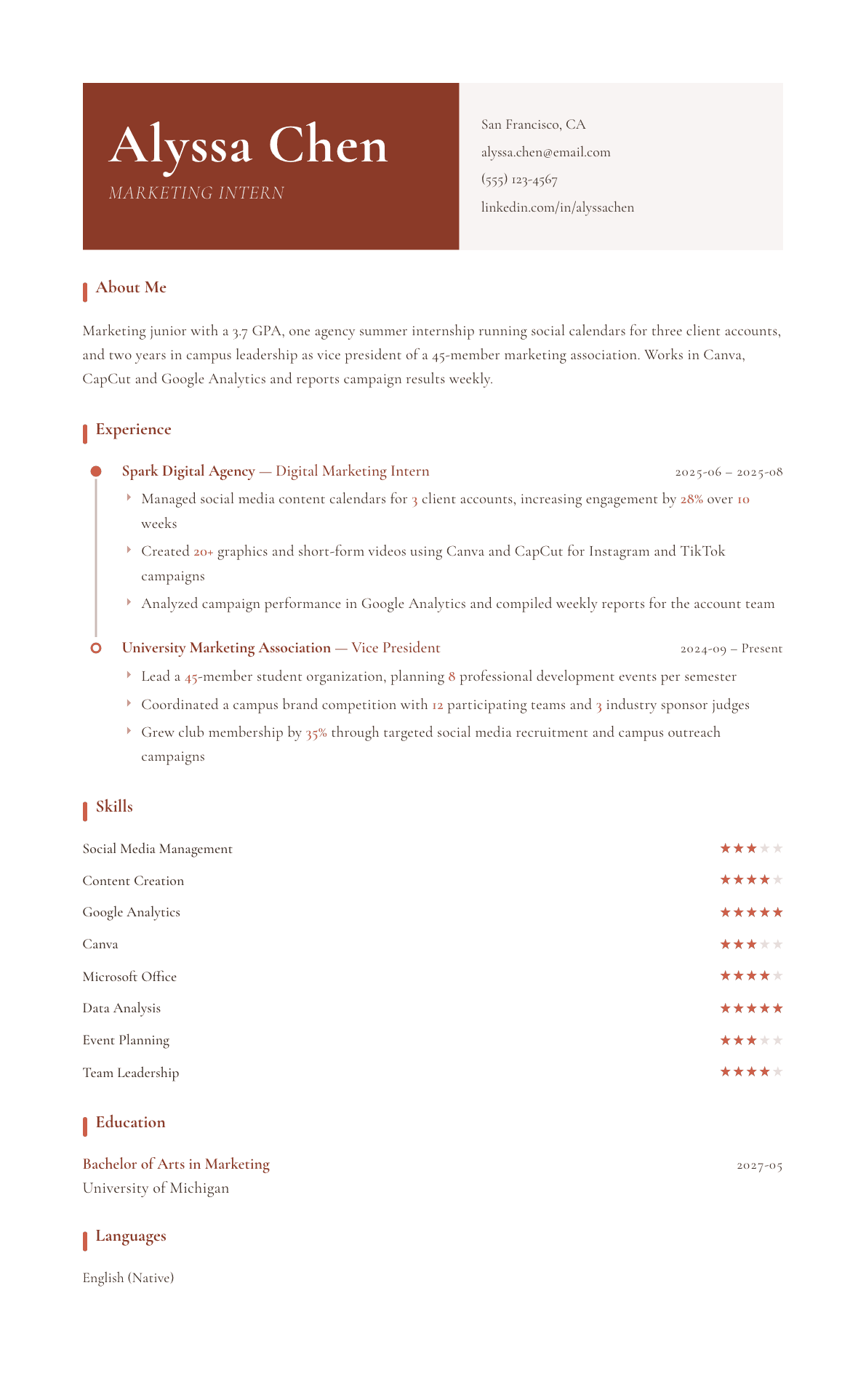
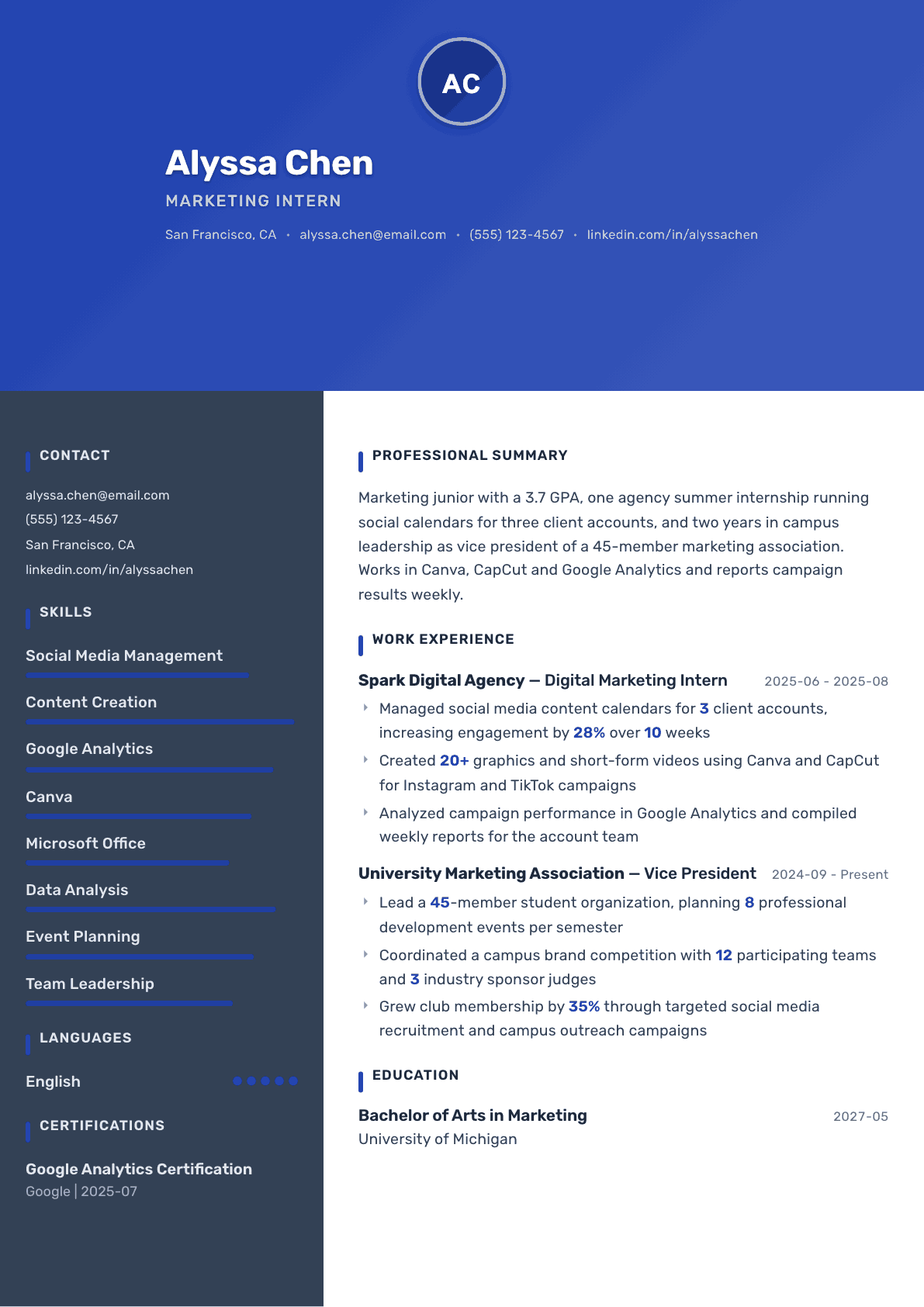
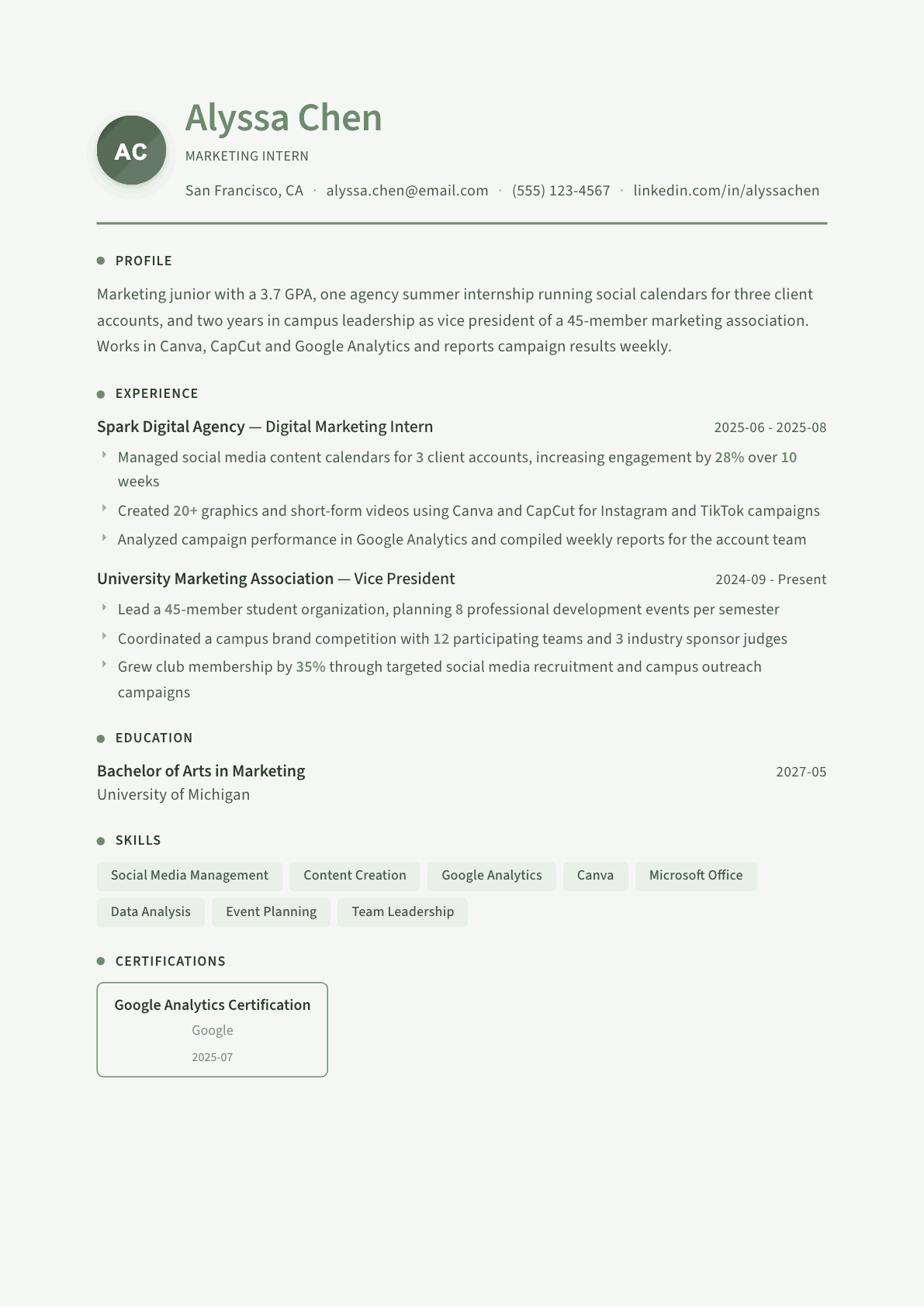
Example College Student summary
Marketing junior, 3.7 GPA, with a completed agency internship where client engagement rose 28% over ten weeks and a vice president role in a 45-member student organization that grew 35% after a social recruitment push. Looking for an entry-level social or content marketing role.
Skills to list on a College Student resume
- Microsoft Office Suite
- Google Workspace
- Social Media Platforms
- Research & Analysis
- Written Communication
- Team Collaboration
- Time Management
- Public Speaking
- Event Coordination
- Problem Solving
What actually gets this resume read
- Lead with education since it is your strongest section -- include GPA if above 3.5, relevant coursework, and honors.
- Treat campus organizations, volunteer work, and class projects as legitimate experience entries.
- Quantify everything possible: event attendance, membership growth, social media metrics, or project outcomes.
- Include relevant certifications like Google Analytics, HubSpot, or Excel to stand out against other students.
How to write a college student resume
A college student resume competes against hundreds of near-identical documents from people with the same major, the same graduation year and the same absence of full-time employment. Campus recruiters know this, which is why they read for the few things that actually separate applicants: what you built, what you were responsible for outside of class, whether you have used the tools the job runs on, and whether your graduation date fits the start date they need to fill.
The document also has to survive an applicant tracking system, because most campus pipelines run through one. That means a single-column layout, a real skills section carrying the software named in the posting, and dates written plainly. A designed two-column resume that looks beautiful on a career fair table can come out of a parser with the education section scrambled.
This guide covers the section order for a student who is still enrolled, how to write coursework and class projects so they read as work, what to do with campus jobs and student organizations, three summaries from a first-year to a graduating senior, before-and-after bullets, and the questions students ask while applying for internships and first roles.
Format: one page, education on top, graduation date visible
One page while you are enrolled, no exceptions. Single column, standard margins, one font, and no headshot. Put education at the top and keep it there until you have a year of relevant full-time work behind you, because your degree and expected graduation date are the two facts a campus recruiter screens on first.
Write the expected graduation as a month and year and say the word expected. Recruiters filter candidates by graduation window for internship cohorts and rotational programs, and an ambiguous date gets a file set aside rather than clarified.
- Header: name, city and state, phone, email, and one link to a portfolio or professional profile if it is real and current.
- Sections in this order: summary, education, experience, projects, leadership and activities, skills.
- Students with a strong project portfolio move projects above experience when the jobs are unrelated to the field.
- Keep dates in a consistent format down the whole page so a parser reads them the same way each time.
Education: degree, dates, grade point average, and coursework worth listing
Give the university, the city, the degree written out, the major and minor, and the expected graduation month. Add the grade point average when it is competitive, along with honors, scholarships and the dean list. Study abroad terms and transfer institutions belong here as short lines rather than separate sections.
Relevant coursework earns a line only when the courses are specific and connected to the role. Six named upper-division courses that map to the posting are useful. A list of twelve including introductory requirements is noise, and a recruiter reads it as padding.
If you are paying your way through school with unrelated work, say so in one line under education. Working twenty hours a week while carrying a full course load is a schedule most hiring managers respect, and it explains an experience section full of restaurant and retail jobs.
Experience: campus jobs, research and internships all belong
Every paid or structured role goes in this section: internships, work-study positions, research assistantships, teaching assistantships, resident advisor roles, campus tour guiding, and off-campus part-time jobs. Format them identically with a title, the organization, the location and the dates.
Write bullets around scope and outcome rather than duties. A student who processed lab samples should say how many and under what protocol. A resident advisor should say how many residents were on the floor and what happened during a crisis call. A campus job in dining services should say the shift volume and whether you trained anyone. The tasks are ordinary; the numbers make them legible.
Unrelated work still earns a place. Recruiters read a semester of consistent retail or food service as proof you can hold a schedule and deal with people, which is more than half of what an internship supervisor worries about.
- Internships: the team, the project, the tools, and what shipped out the door or was handed over at the end.
- Research: the lab, the principal investigator area of study, the technique you ran, and any poster or paper you contributed to.
- Campus employment: hours per week, people served, systems used, and any training or scheduling you owned.
- Off-campus jobs: shift volume, cash or inventory responsibility, and promotions or added duties.
Projects: the section that beats the rest of your class
A projects section is where a student without internships can still win the interview. Include coursework projects, capstone work, hackathon builds, case competition entries, independent research and anything you made outside a syllabus. Give each one a title, a one-line problem statement, the tools used, your specific role if it was a team, and the result.
Say what was hard. A project entry that reads "built a dashboard in Python and Tableau to compare campus dining prices across four vendors, cleaning 3,000 scraped records" is more persuasive than a paragraph of technology names, because it shows the messy part of the work rather than the finished screenshot.
Be exact about team projects. Recruiters ask about them in interviews, and a student who claims the whole build and then cannot explain a component loses the offer at that moment.
Leadership, activities and a skills section that passes the filter
Student organizations, fraternity and sorority offices, club sports, campus media, volunteering and case clubs all belong under leadership and activities, with the position, the years and the scale. A treasurer who managed a chapter budget and a chair who ran a conference for two hundred attendees have both done real management work, and it should read that way.
The skills section is where a tracking system finds its keywords, so build it from the posting. Group it: software and tools, technical or analytical skills, and languages with an honest level. List only what you could be asked about in an interview, because a recruiter who opens a question on a listed tool and hears silence will not open a second one.
College Student resume summary examples
First or second year
Sophomore pursuing a B.S. in Business Analytics with a 3.6 GPA and coursework in statistics and database systems. Works 15 hours a week in campus dining while serving as social media chair for a 60-member student organization. Seeking a first summer internship in marketing analytics.
Junior with an internship
Marketing junior with a completed agency internship managing content calendars for three client accounts and raising engagement 28% over ten weeks. Leads a 45-member student organization and runs its recruitment campaigns. Fluent in Google Analytics, Canva and Meta Ads Manager, graduating in May.
Graduating senior
Graduating senior in Computer Science with two software internships, a capstone building a scheduling tool now used by three campus departments, and two years as a teaching assistant for an introductory programming course serving 120 students each term. Seeking a full-time engineering role starting in July.
Work experience bullets: before and after
Before: Worked at the campus dining hall.
After: Worked 15 hours a week in campus dining through four semesters, running the grill station during peak service for roughly 400 diners and training six new student workers.
Hours across semesters, service volume and training others turn an ordinary campus job into proof of reliability and responsibility.
Before: Did a group project for my marketing class.
After: Led the four-person team on a semester marketing project, running a 120-response survey on campus coffee preferences and presenting the segmentation to a panel of two local business owners.
Naming your role, the sample size and the real audience makes a class project read as work rather than an assignment.
Before: President of a student club.
After: Led a 45-member professional student organization, planning eight events a semester and growing membership 35% through targeted recruitment at orientation and department info sessions.
Membership size, event cadence and the growth mechanism show management rather than a title on a list.
Before: Research assistant in a psychology lab.
After: Ran participant sessions and coded 240 behavioral trials for a working memory study, maintaining the data log and preparing summary tables for a departmental poster session.
The volume and the specific deliverable let a reader judge the work instead of imagining it.
Before: Familiar with Excel and data analysis.
After: Built an Excel model with lookup formulas and pivot tables to track a chapter budget across six events, replacing a shared document that had gone out of balance twice.
A skill demonstrated on a real problem is credible; the same skill claimed in a list is not.
Hard skills
- Microsoft Excel including pivot tables
- Google Workspace
- Data analysis and reporting
- PowerPoint and presentation design
- Google Analytics
- Social media management
- Survey design and data collection
- Canva and basic graphic design
- SQL fundamentals
- Academic research and citation
- Event planning and logistics
- Budget tracking
Soft skills
- Time management across a course load
- Written communication
- Team collaboration
- Public speaking
- Adaptability
- Initiative without supervision
Certifications worth listing
- Google Analytics Certification (Google)
- Google Data Analytics Professional Certificate (Google)
- HubSpot Content Marketing Certification (HubSpot Academy)
- Microsoft Office Specialist: Excel Associate (Certiport)
- Bloomberg Market Concepts (Bloomberg)
- AWS Certified Cloud Practitioner (Amazon Web Services)
- CompTIA A+ (CompTIA)
Mistakes that cost college student candidates the interview
- Leaving the expected graduation month off, which drops the file out of internship cohort filtering.
- Using a two-column design template that a campus tracking system parses out of order.
- Listing every course taken since freshman year instead of the six that match the posting.
- Omitting campus jobs and food service work as if they do not count, when they are the clearest evidence of holding a schedule.
- Claiming a whole team project as your own work and then failing the first interview question about it.
- Writing an objective statement about wanting to grow professionally instead of a summary saying what you can already do.
- Sending one generic resume to every posting when the skills section should change for each employer.
College Student resume questions
Should a college student resume be one page?
Yes, one page for the entire time you are enrolled and for the first year or two after. Recruiters reviewing campus applicants spend very little time on each file, and a second page usually means coursework padding rather than additional substance.
When should I include my GPA on a college resume?
Include it when it is roughly 3.0 or higher, and write the scale. Some finance, consulting and engineering programs screen on it directly and will ask if it is missing. If yours is lower, leave it off and strengthen the projects and experience sections.
Can I list class projects as experience?
Put them in their own projects section rather than in experience, so nothing looks overstated. Give each project the problem, your role, the tools and the outcome, and treat capstone and case competition work with the same detail you would give a job.
Does unrelated part-time work belong on a college resume?
Yes. Retail, food service, warehouse and campus jobs show that you can hold a schedule alongside a course load and deal with people under pressure, which is exactly what an internship supervisor worries about with a first-time hire.
How do I write a resume for an internship in a different major?
Lead the summary with the target field and name the coursework, projects and tools that connect to it. Then reorder your bullets in each entry so the transferable work comes first, and add any certification in the target field to close the credibility gap.