Bus Driver Resume Examples: free ATS score and gap list
Write a Bus Driver Resume That Shows Passenger Safety First
By Mustafa Tarabya, founder of CVBooster · Published · Updated
A bus driver resume example with route and ridership numbers, passenger endorsement detail, accessibility skills, ATS keywords and a writing guide.
Sample resumes for a bus driver
The same bus driver content laid out in three CVBooster templates, so you can see what the finished document looks like before you write a word.
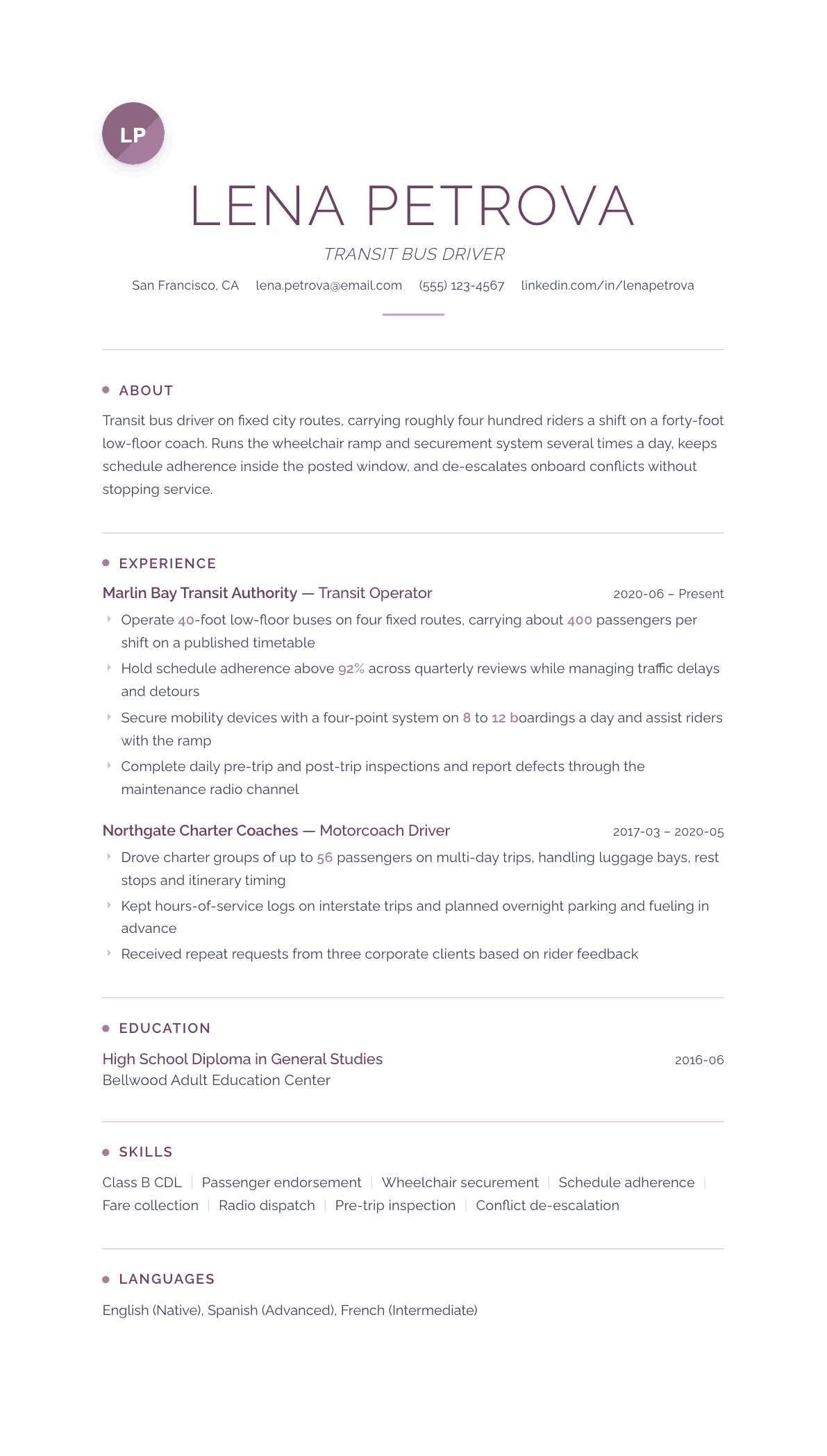
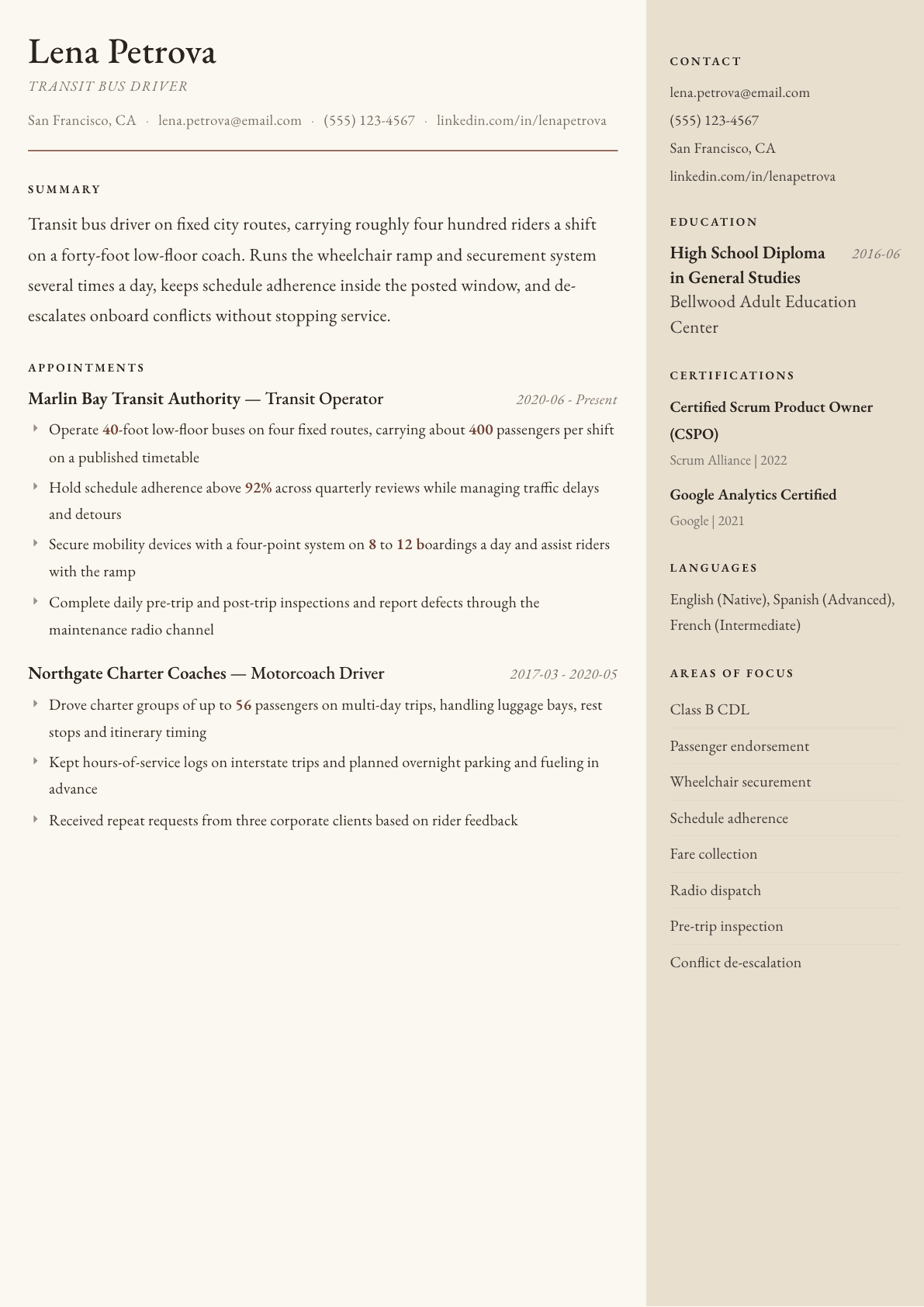
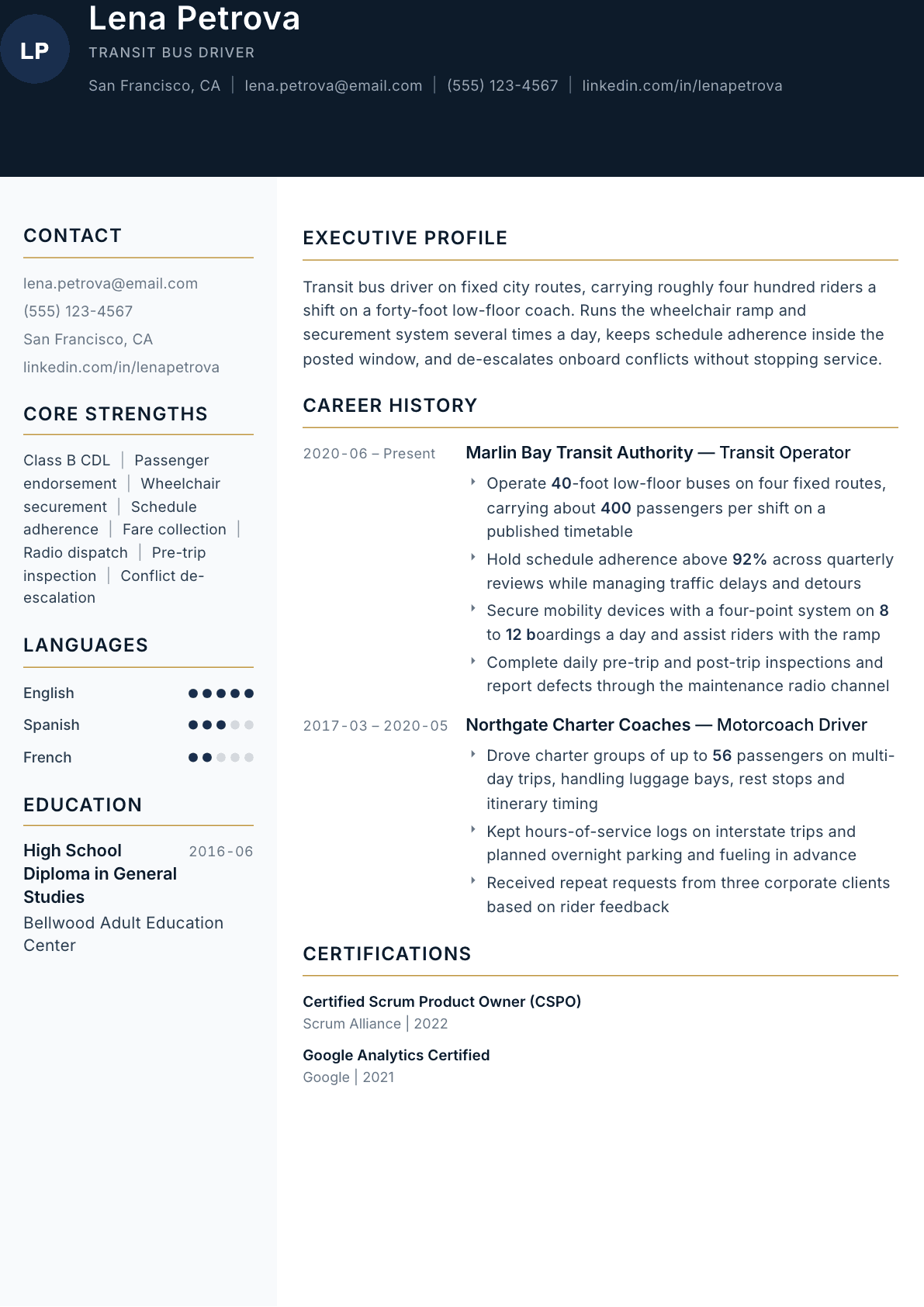
Example Bus Driver summary
Transit bus driver with eight years on fixed city routes and charter coach work, carrying about four hundred riders a shift on a forty-foot low-floor bus. Holds a Class B CDL with passenger endorsement, runs mobility device securement several times daily, and has kept schedule adherence above the agency target for three straight years. Seeking a full-time operator seat with a municipal transit agency.
Skills to list on a Bus Driver resume
- Class B CDL
- Passenger endorsement
- Fixed route operation
- Wheelchair securement
- ADA accessibility
- Fare collection
- Schedule adherence
- Radio communication
- Pre-trip inspection
- Defensive driving
- Conflict de-escalation
- Passenger assistance
- Detour management
- Incident reporting
What actually gets this resume read
- Put the CDL class and passenger endorsement in the header, since transit agencies screen for those two lines first.
- Give ridership numbers and vehicle size, because carrying four hundred riders a shift is a different job from a shuttle run.
- Show accessibility work: ramp deployment, mobility device securement and how you assist riders who need time.
- Include schedule adherence or on-time performance, the number every transit supervisor already tracks for you.
- Describe how you handle disputes onboard, since agencies hire for temperament as much as for driving skill.
- Note your safety record in years and miles, and mention any agency safe-driving award you have received.
How to write a bus driver resume
Driving a bus is a public-facing safety job with a schedule attached. The transit supervisor reading your resume is asking two questions at once: can this person handle a forty-foot vehicle in city traffic without an incident, and can this person stay calm when a rider is angry, confused, intoxicated or in distress. A page that only proves the first half leaves the harder question unanswered.
Transit agencies also hire against records they already keep. Schedule adherence, missed trips, passenger complaints, preventable collisions and safety awards are all measured, so a bus driver resume that cites those categories is speaking the supervisor's own language. Charter and motorcoach work adds trip planning, luggage handling and hours-of-service rules on interstate runs.
This guide covers the credentials that get you screened in, how to write the summary and route bullets around ridership and adherence, the accessibility work that agencies weight heavily, three example summaries, before and after bullets, and the questions drivers ask when moving between transit, charter and shuttle work.
Format: license and endorsement block, then routes
A transit hiring office processes applications in batches, so keep the layout plain and put the qualifying facts in a labeled block under your contact details. The person reading it is confirming you can legally carry passengers before anything else.
One page is normal. Two is fine only if you have a long record across transit, charter and paratransit that genuinely needs the space.
- Credentials: CDL class, passenger endorsement, air brake status, medical certificate, and years of passenger driving.
- Record: preventable collisions, passenger complaints upheld, and any safe-driving award with the awarding agency.
- Then summary, driving experience, safety and accessibility training, skills, education.
Summary: vehicle, ridership and schedule performance
Name the vehicle size, the service type and the daily ridership in the first sentence. Forty-foot low-floor on fixed city routes carrying about four hundred riders a shift is a specific job, and it tells a supervisor that timetable pressure and constant boarding are already familiar to you.
Then give one performance fact the agency measures, such as schedule adherence or years without a preventable collision. Finish with what you are looking for, whether that is a full-time operator seat, a paratransit assignment or charter work, so the application lands on the right desk.
Experience: the route, the riders and the exceptions
For each job give the vehicle, the service type and the route structure: fixed route, express, shuttle, paratransit or charter. Then use bullets to cover ridership volume, timetable performance, accessibility work, fare handling and incident management.
Accessibility deserves at least one bullet of its own. Ramp deployment, kneeling the bus, four-point mobility device securement, stop announcements and assisting riders with low vision are daily work on a transit route and they are also the areas where complaints originate. Show that you do them as routine.
The exception bullet matters as much. Detours around a closed street, a mechanical fault reported by radio, a medical emergency onboard, a fare dispute that stayed calm. Supervisors hire the driver who keeps the service moving without escalating a situation into an incident report.
Safety, training and the record you can prove
List the training programs you have completed by name, such as defensive driving, first aid and cardiopulmonary resuscitation, de-escalation, and any agency operator certification. Transit agencies run their own training and value a candidate who arrives having already absorbed the core material.
Then state the record. Years and miles without a preventable collision, an accident-free award, or a period as a designated trainer are all verifiable through the previous agency, which is what makes them worth the line they occupy.
Skills and vocabulary transit postings repeat
The words that recur across bus operator postings are fixed route, schedule adherence, passenger endorsement, air brakes, pre-trip inspection, fare collection, mobility device securement, accessibility compliance, two-way radio, detour management and incident reporting.
For charter and motorcoach roles, add trip planning, luggage bay handling, passenger manifests, overnight parking and interstate hours of service. The two sectors share a license and very little else, so let the vocabulary reflect the one you are applying to.
Bus Driver resume summary examples
New to passenger driving
Class B driver with a new passenger endorsement and four years in customer-facing retail and security work. Comfortable with pre-trip inspections and defensive driving, trained in first aid, and seeking an operator trainee seat with a municipal agency that provides route training.
Four years on fixed route
Transit bus driver operating 40-foot low-floor coaches on four fixed routes, carrying about 400 riders a shift. Holds schedule adherence above 92% across quarterly reviews, secures mobility devices on 8 to 12 boardings a day, and has driven four years with no preventable collisions.
Operator and trainer
Senior transit operator with twelve years across fixed route, express and paratransit service, spending the last three as a line trainer for new operators. Covers extra board assignments on short notice, holds first aid and de-escalation certification, and has received two agency safe-driving awards.
Work experience bullets: before and after
Before: Drove a city bus on assigned routes.
After: Operated 40-foot low-floor buses on four fixed routes, carrying about 400 passengers per shift against a published timetable with peak-hour headways.
Vehicle type, route count, ridership and the timetable pressure describe the actual working conditions rather than the job title.
Before: Kept to the schedule.
After: Held schedule adherence above 92% across quarterly agency reviews while absorbing construction detours and peak traffic delays.
It cites the metric the agency already tracks and names the conditions that make holding it difficult.
Before: Helped disabled passengers.
After: Deployed the ramp and secured mobility devices with a four-point system on 8 to 12 boardings a day, and gave stop announcements for riders with low vision.
The securement method and boarding count show accessibility as trained routine rather than occasional assistance.
Before: Dealt with difficult passengers.
After: De-escalated fare and seating disputes onboard without stopping service, and reported the two incidents that required supervisor involvement through the radio protocol.
Keeping service moving and knowing when to escalate is the exact judgment a transit supervisor is hiring for.
Before: Checked the bus each day.
After: Completed daily pre-trip and post-trip inspections on brakes, lights, ramp and securement equipment, reporting defects through the maintenance radio channel before pull-out.
Naming the components, including the accessibility equipment, shows an inspection that covers what passengers depend on.
Hard skills
- Class B commercial driving
- Passenger endorsement operations
- Fixed route and express service
- Air brake systems
- Wheelchair ramp and lift operation
- Four-point mobility device securement
- Fare collection and pass validation
- Two-way radio communication
- Pre-trip and post-trip inspection
- Detour and service disruption handling
- Incident and accident reporting
- Schedule and headway management
Soft skills
- Composure with the public
- De-escalation instinct
- Punctuality and attendance
- Patience with boarding delays
- Situational awareness
Certifications worth listing
- Commercial Driver's License, Class B (State driver licensing agency)
- Passenger Endorsement (P) (State driver licensing agency)
- First Aid and CPR (American Red Cross)
- Medical Examiner's Certificate (FMCSA National Registry of Certified Medical Examiners)
Mistakes that cost bus driver candidates the interview
- Leaving the passenger endorsement out of the header. Without it an application cannot progress, so it belongs in the first four lines of the page.
- Describing the route without ridership. Four hundred boardings a shift and forty on a suburban shuttle are different jobs with different pressure.
- Treating accessibility as an afterthought. Ramp and securement work is daily, safety critical, and a frequent source of complaints, so it earns a bullet.
- Ignoring schedule adherence. Agencies measure it continuously, and a candidate who cites it is speaking the language of the person doing the hiring.
- Saying you are good with people with no example. A de-escalated dispute or an assisted rider proves the trait that an adjective only asserts.
- Mixing charter and transit vocabulary on one page. Choose the sector you are applying to and let the terminology match it.
Bus Driver resume questions
Do I need a commercial license to drive a bus?
Yes for most passenger buses, along with a passenger endorsement, and agencies often require an air brake qualification too. Some small shuttle vehicles fall below the threshold. State your class, endorsement and air brake status so the recruiter can match you to the vehicle.
How do I become a bus driver with no passenger experience?
Most transit agencies train operators from other driving or customer service backgrounds. Lead with any commercial driving, security, retail or care work, then emphasize your record and availability for split shifts, which is what new operators are usually asked to cover first.
What is the difference between a transit and a motorcoach resume?
Transit is about ridership volume, headways, fare handling and accessibility on repeated short trips. Motorcoach is about trip planning, group management, luggage bays and hours of service on long runs. The license overlaps, the daily skills do not, so write for one.
Should I list passenger complaints on my resume?
Never list individual complaints, but do cite a clean record if you have one, such as years with no upheld complaints. Agencies verify this with your previous employer, so an accurate claim strengthens the page and an exaggerated one undoes it.
Does paratransit experience help a fixed route application?
It helps considerably. Paratransit drivers handle securement, passenger assistance and unpredictable timing every day, which are the skills that cause new fixed route operators the most trouble. Give the vehicle type, rider counts and the securement equipment you used.
Related resume examples
- School Bus Driver Resume example
- CDL Driver Resume example
- Chauffeur Resume example
- Transportation Coordinator Resume example
- Tow Truck Driver Resume example
- Taxi Driver Resume example