Team Leader Resume Examples: free ATS score and gap list
Craft a Team Leader Resume That Shows Real People Leadership
By Mustafa Tarabya, founder of CVBooster · Published · Updated
Team leader resume example with sample experience bullets, leadership keywords, a skills list and a guide to writing each section well.
Sample resumes for a team leader
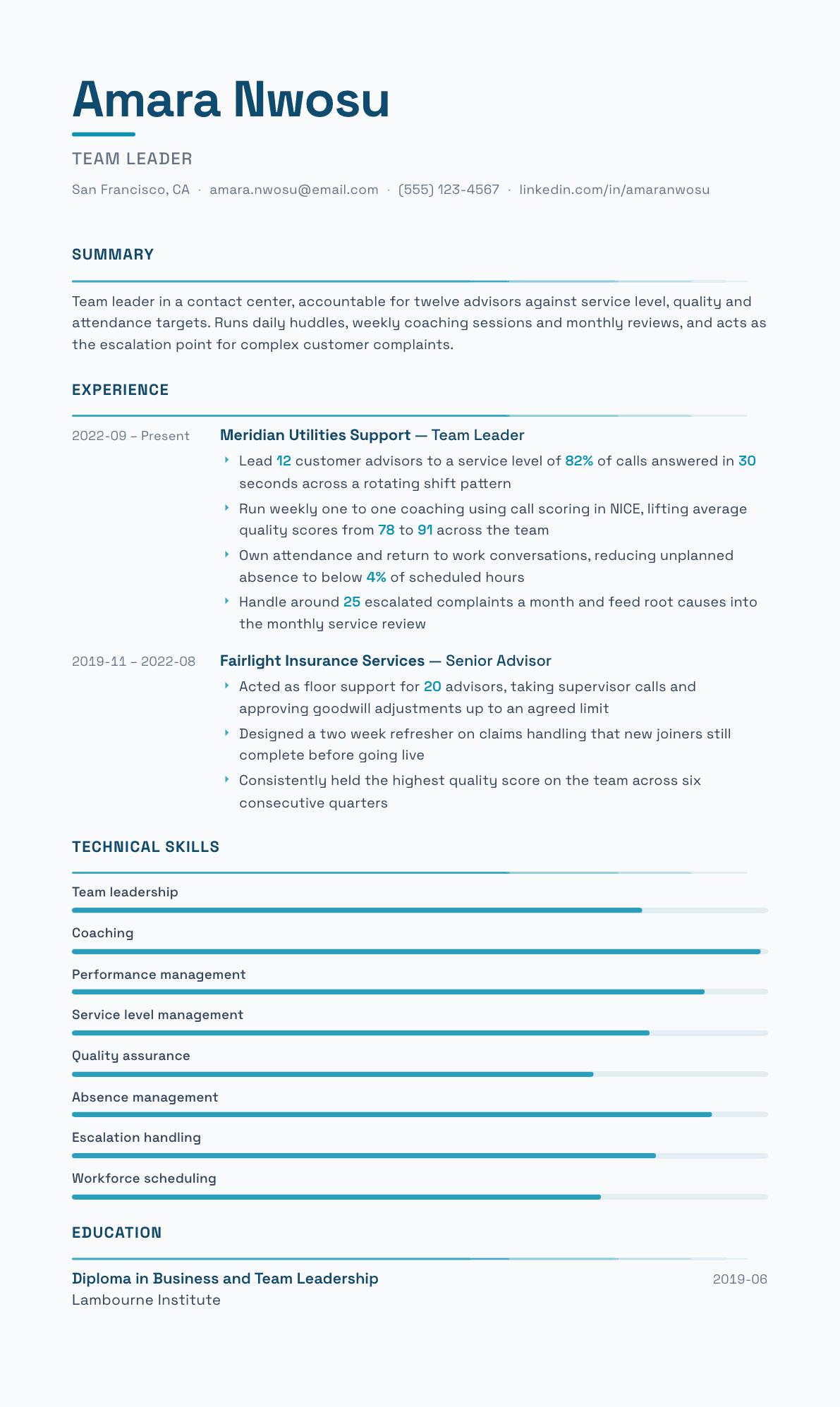
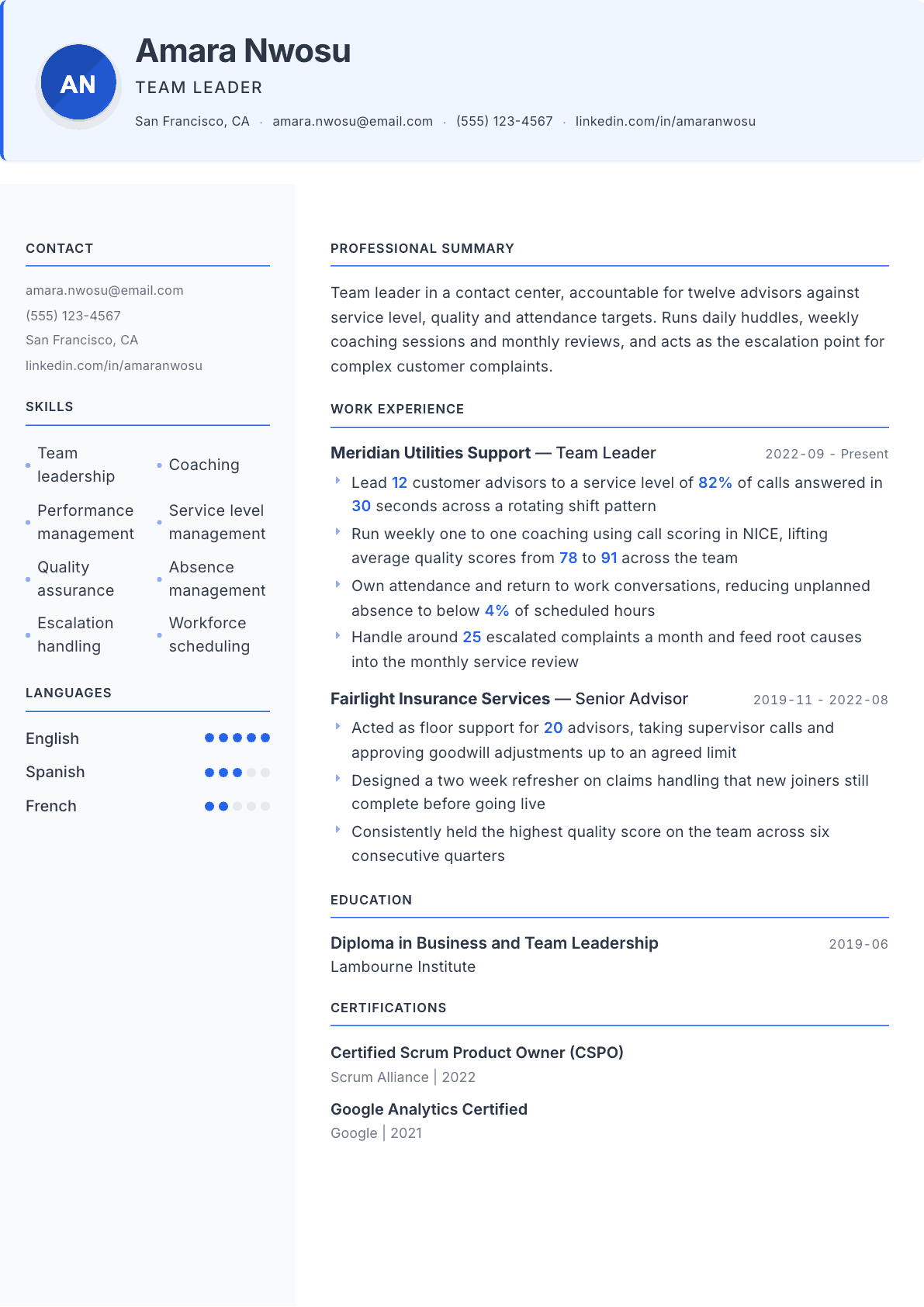
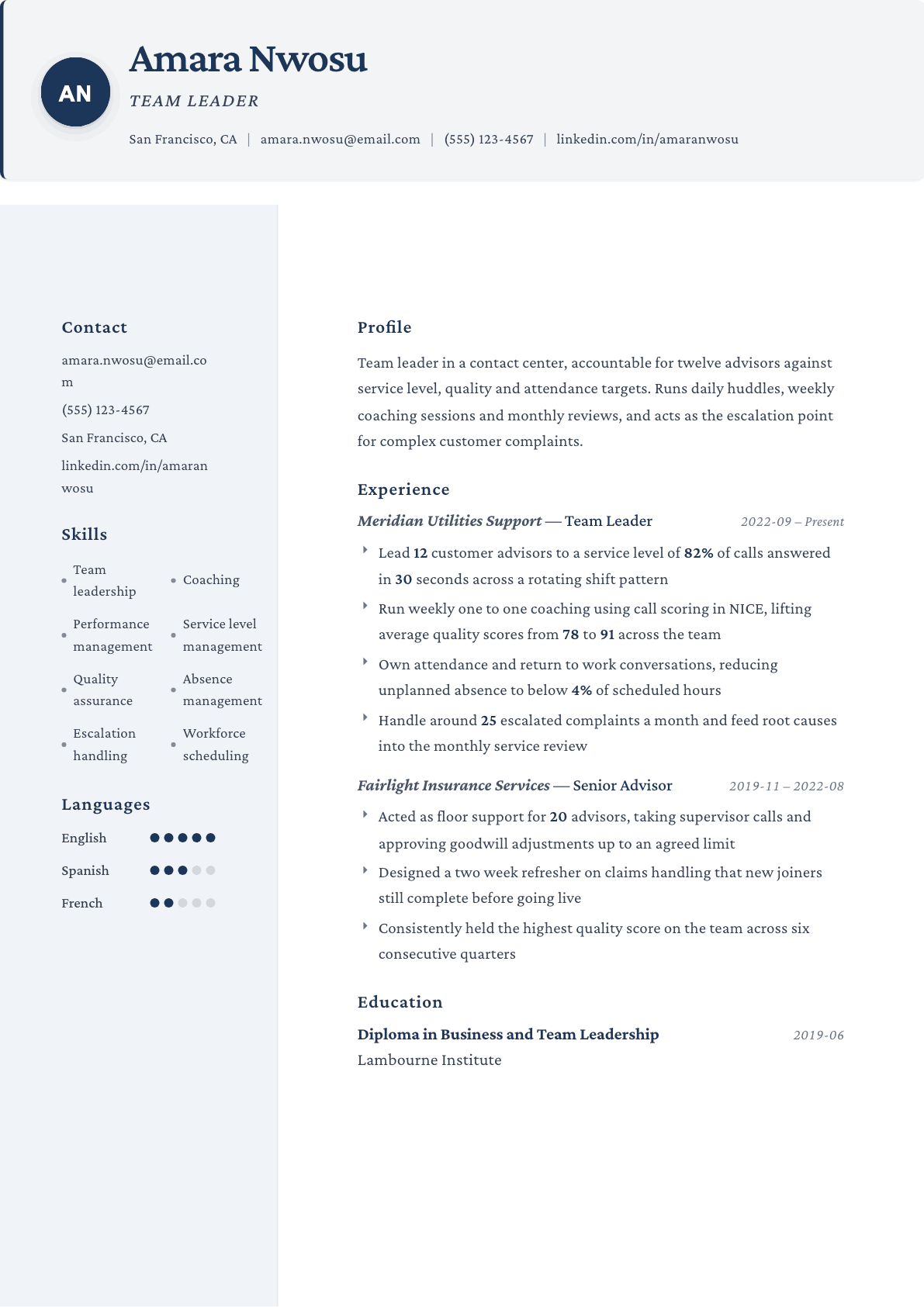
The same team leader content laid out in three CVBooster templates, so you can see what the finished document looks like before you write a word.
Example Team Leader summary
Team leader with three years running a twelve person contact center team against service level, quality and attendance targets. Coaches through call scoring and weekly one to ones, lifted average quality scores by more than ten points, and owns escalated complaints end to end. Comfortable with formal people processes including return to work interviews and performance improvement plans.
Skills to list on a Team Leader resume
- Team leadership
- One to one coaching
- Performance management
- Service level management
- Quality monitoring
- Absence and attendance management
- Rota and shift planning
- Escalation handling
- Root cause analysis
- Onboarding and induction
- KPI reporting
- Conflict resolution
- Continuous improvement
- Workforce management tools
What actually gets this resume read
- Say how many people report to you and whether that includes formal responsibility for reviews, absence and discipline.
- Name the targets you are held to, such as service level, quality score, utilization, output per hour or safety incidents.
- Show the coaching mechanism, not just the word coaching: call scoring, side by side observation, weekly one to ones.
- Include how you handled an underperformer, because interviewers ask about it and few resumes mention it at all.
- Add one bullet on something you improved for the whole team, such as a rota change, a checklist or a handover routine.
- Avoid listing generic leadership adjectives and let the numbers under each job carry the leadership claim instead.
How to write a team leader resume
Team leader is the first rung where the work is other people. A screener reading your resume wants to know three things quickly: how many people you led, what targets you were held to, and how you moved a person who was missing them. Most team leader resumes answer the first and skip the other two.
The gap shows up in interviews. A candidate who writes led a team of twelve and motivated staff to achieve targets has nothing to say when asked what happened with the advisor who kept failing quality. A candidate who wrote about call scoring, weekly one to ones and a documented improvement plan has an answer ready, and the resume already told the reader it was coming.
This guide walks through the sections in the order a hiring manager reads them, with example summaries for a first time leader, an established leader and a senior one, before and after bullets drawn from real team leader work, and the questions leaders ask when they move between sectors.
Format: one page, targets visible under every job
One page unless you have led teams for more than seven years or across several sites. Reverse-chronological, single column, and no icons in the experience section, because contact center and operations employers frequently run a basic parser before a human ever opens the file.
Under each employer, add a scope line before the bullets: team size, shift pattern, and the headline target. A reader who sees twelve advisors on a rotating shift against a service level target already knows more than three vague bullets would tell them.
- Header: name, city and state, phone, email, and the title Team Leader.
- Sections in this order: summary, leadership highlights, experience, education, certifications.
- Scope line per job: reports, shift pattern, primary target, and who you reported to.
Summary: reports, targets, and the coaching mechanism
Three lines. Number of direct reports, the environment, the targets you own, and the specific way you coach. The coaching mechanism is the part that separates you from every other applicant, because it is the only sentence that describes how you actually lead rather than that you do.
If you carry formal people responsibility, say so here. Absence and return to work conversations, probation reviews and performance improvement plans are the duties that decide whether an employer sees you as a supervisor or a genuine first line manager.
Experience: the target, the method, the movement
Write each significant bullet as a small three part story. The target you were held to, the method you applied, and the movement you produced. Lifted average quality scores from a starting point to a higher one through weekly call scoring is a complete thought. Improved team quality is a fragment.
Cover the targets your sector actually uses. Contact centers run on service level, average handling time, quality score, adherence and attendance. Production teams run on output per hour, scrap rate, safety incidents and downtime. Sales teams run on conversion, pipeline and revenue per head. Field teams run on jobs completed, first time fix and travel time. Use the ones you were measured on and the numbers will read as lived rather than borrowed.
Include the difficult work. An underperformance case you took through a documented process, an absence pattern you addressed, a grievance you handled at first line. These are the bullets hiring managers stop on, because they show a leader who does the unpleasant half of the job.
- Give one bullet per target you owned, each with a movement or a sustained level.
- Name the coaching artifact: scorecards, side by side observations, one to one records, development plans.
- Include at least one bullet on formal people process, since that is what promotion panels probe.
Skills: leadership capabilities, not leadership adjectives
Fill the block with things you can be asked to demonstrate: performance management, absence management, rota planning, quality monitoring, root cause analysis, onboarding, escalation handling, continuous improvement. Passionate, motivational and hands on can all be deleted with no loss.
Add the workforce tools you used. Scheduling and quality platforms vary by employer, so naming the ones you know, such as a workforce management system or a call quality platform, tells the reader how much system training you will need. It also matches a phrase in the posting more often than a generic skill does.
Keywords and how to tailor between sectors
Team leader postings are written from templates that repeat the same phrases: people management, coaching and development, performance management, service level agreement, key performance indicators, escalation, absence management, continuous improvement. Mirror the exact wording of the posting once in the highlights block and once inside a bullet.
Moving sector is normal for team leaders and the resume should make the transfer explicit. Keep the leadership mechanics identical, swap the metric names, and add one line in the summary naming the target sector so the reader is not left doing the translation for you.
Team Leader resume summary examples
First leadership role
Senior advisor stepping into team leadership after two years as floor support for twenty advisors, taking supervisor calls and approving goodwill adjustments. Designed a two week claims refresher now used for every new joiner. Held the highest quality score on the team across six consecutive quarters.
Three years leading
Team leader for twelve contact center advisors on a rotating shift, accountable for service level, quality and attendance. Coaches through weekly call scoring and one to ones, lifting average quality from 78 to 91, and holds unplanned absence below 4% of scheduled hours.
Senior team leader
Senior team leader with two teams and twenty-six reports, plus responsibility for developing three aspiring leaders. Owns escalated complaints, chairs the monthly service review, and cut repeat contacts by feeding complaint root causes into process change with the operations manager.
Work experience bullets: before and after
Before: Led a team of 12 and motivated them to hit targets.
After: Led twelve advisors to a service level of 82% of calls answered within thirty seconds across a rotating shift pattern, including weekend and evening cover.
The named target with its threshold replaces motivation language that no reader can verify or picture.
Before: Coached staff to improve their performance.
After: Ran weekly one to one coaching using call scoring in the quality platform, lifting team average quality from 78 to 91 over three quarters.
The mechanism and the movement together show how the improvement happened, which is what an interviewer asks next.
Before: Managed absence and attendance.
After: Owned attendance including return to work conversations and trigger reviews, reducing unplanned absence to under 4% of scheduled hours across the team.
Naming the formal conversations proves genuine people responsibility rather than a spreadsheet of sick days.
Before: Dealt with customer complaints and escalations.
After: Handled around twenty-five escalated complaints a month to resolution and fed recurring root causes into the monthly service review with the operations manager.
Volume plus the feedback loop shows the leader fixed causes instead of only absorbing angry calls.
Before: Helped new starters settle into the team.
After: Ran the induction for six new joiners, pairing each with a buddy for two weeks and reviewing progress at thirty, sixty and ninety days.
A described onboarding structure with checkpoints is a repeatable process rather than a friendly gesture.
Hard skills
- Performance management
- One to one coaching and call scoring
- Quality monitoring
- Service level and KPI management
- Absence and attendance management
- Rota and shift planning
- Escalation and complaint handling
- Root cause analysis
- Onboarding and induction design
- Workforce management systems
- Continuous improvement methods
- Team reporting and MI
Soft skills
- Difficult conversations
- Fair and consistent decisions
- Motivating through a bad week
- Active listening
- Delegation
- Conflict resolution
Certifications worth listing
- Certified Manager (CM) (Institute of Certified Professional Managers)
- Certified Six Sigma Green Belt (CSSGB) (American Society for Quality)
- Certified Professional in Talent Development (CPTD) (Association for Talent Development)
- Certified Associate in Project Management (CAPM) (Project Management Institute)
Mistakes that cost team leader candidates the interview
- Stating the team size and nothing else, so the reader learns the scale but never the accountability.
- Filling the skills block with adjectives such as motivational and approachable that cannot be tested.
- Skipping the underperformance work, which is the first thing an interview panel asks a team leader about.
- Reporting only good news, when a leader who explains a target they missed and what changed reads as credible.
- Using metric names from the old sector without translating them for the employer you are applying to.
- Claiming to coach without naming a single artifact such as a scorecard, an observation or a development plan.
Team Leader resume questions
How many people do I need to have led to call myself a team leader?
The title comes from the responsibility, not the headcount. If you set priorities, review performance and are the escalation point for a group, you led a team. State the number plainly and let the accountability carry the claim.
What if my team leader role had no formal authority?
Say so accurately and evidence what you did hold: allocating work, reviewing quality, coaching, and covering the manager. Describing informal leadership honestly reads better than implying disciplinary authority you never had and cannot discuss.
Should I include team results I did not personally deliver?
Include them as team results and make your contribution explicit. Led the team that reduced handling time is fair. Reduced handling time on its own invites a question you will have to walk back during the interview.
How do I move from team leader to operations manager?
Add scope beyond your own team: a project across teams, budget or headcount input, deputizing for the manager, or leading other leaders. Those three or four bullets are what a promotion panel uses to justify the step.
Do I put my individual performance on a team leader resume?
Only briefly and only for a first leadership role, where a strong individual record explains the promotion. Once you have led for a year, the team results and the coaching evidence should take that space instead.
Related resume examples
- Operations Manager Resume example
- Customer Service Supervisor Resume example
- Shift Manager Resume example
- Sales Team Leader Resume example
- Operations Analyst Resume example
- Business Manager Resume example