Nurse Manager Interview Questions With 8 Full Sample Answers
By Mustafa Tarabya, founder of CVBooster · Published · Updated
10 min read
Nurse manager interview questions test whether you can run a unit through other people: staffing it, paying for it, keeping it safe and keeping the nurses from leaving. The constraint is that clinical excellence is assumed, so every answer has to show a decision you made as a leader, with the unit, the numbers and the result. O*NET, the US Department of Labor's occupation database, lists Nurse Manager among the titles of medical and health services managers, and one task it names is to "Establish work schedules and assignments for staff, according to workload, space, and equipment availability." Below are eight nursing manager interview questions with full sample answers, each tagged for a first-time manager or an experienced one, plus what the panel scores. Written by Mustafa Tarabya, who hired for his own company, read every application himself and now writes CVBooster's guides.
You have been the charge nurse everyone calls when the night goes sideways. Now a panel of a director, an HR partner and two staff nurses asks how you would handle a budget variance. Nobody on the floor ever asked you that. It is still the question that decides the job.
1. Why do you want to move into nurse management?
This opens most nurse manager interviews. The panel is screening out candidates who want the title or an escape from the bedside. Give a reason rooted in the unit, and show you know what the job costs.
First-time manager: why nurse management (128 words)
I have been a charge nurse on a 28 bed medical surgical unit for four years, and the shifts I am proudest of are not the ones where I took the hardest patient. They are the nights I rearranged assignments so a new graduate was not drowning, or got a float nurse moved before the admission wave hit. I have started to care more about how the whole unit runs than about my own assignment.
I also know what I would be giving up. Less patient contact, more meetings, being the person staff are frustrated with when the schedule does not work. I have talked to our manager about it in detail, and I still want it, because I think I can keep good nurses on this unit.
What the panel scores in a nurse manager answer
Most panels include staff nurses, and they listen for one thing: would this person have my back and still hold me to the standard. Directors listen for money and safety. Four habits score with both:
- Name the unit. Bed count, specialty, number of staff, and whether you had 24 hour accountability.
- Show the decision. What you chose, what you weighed, and who you involved.
- Give the number. Turnover, overtime hours, falls, a survey score, a budget line, with the time frame.
- Close the loop. What you changed afterward and how you checked it held.
Use the STAR shape (situation, task, action, result) and keep each answer near two minutes. Our STAR interview questions guide shows the format, and the ED nurse interview questions page covers the clinical questions you may still get.
2. How do you handle staffing shortages?
This is the question staff nurses on the panel care about most. They want to hear that you plan ahead, use every legitimate lever, and do not quietly make them work short every week.
Experienced manager: staffing shortages (152 words)
Situation: on my 32 bed telemetry unit we lost five nurses in one quarter, two to retirement and three to a new hospital nearby, and we were covering with overtime.
Task: I needed safe staffing within the budget without burning out the people who stayed.
Action: I worked with our staffing office to book four travel contracts for thirteen weeks as a bridge, and posted the open positions the same week. I offered self-scheduling for the next two schedule periods so people could plan their extra shifts instead of being called. I also cross-trained three nurses from our step-down unit so we could share float coverage.
Result: overtime hours fell by about a third over the next two pay periods, all five positions were filled within four months, and we released the travelers early. I now review vacancies against the schedule every two weeks so we see the gap before it opens.
3. How do you manage a unit budget?
Directors ask this to find out whether you understand that the unit is a cost center you are accountable for. A first-time manager does not need to have owned a budget, but must show they understand the lines.
First-time manager: managing a budget (129 words)
I have not owned a full budget yet, but I have worked on the parts that drive it. Most of a nursing unit budget is labor, so the biggest levers are productive hours per patient day, overtime and agency use. As a charge nurse I sent staff home on low census days under our policy and tracked how many hours we saved each month for our manager.
As a manager, I would meet with finance in my first month to understand the unit's targets and variances, review the payroll report every pay period, and explain variances before anyone asks. For supplies I would look at the top ten items by cost and check par levels with the staff who use them, because they usually know where the waste is.
4. Tell us about a conflict between two staff members you resolved
This tests whether you address conflict early and fairly, rather than letting it spread through the unit. Pick a real one, and keep both people's dignity in the telling.
Experienced manager: conflict between staff (133 words)
Situation: two experienced nurses on my unit stopped speaking after a disagreement over a patient handoff, and it was affecting report and the newer staff who worked with both.
Task: I needed to stop it before it became a team problem, without taking sides on the old incident.
Action: I met each of them privately first and listened. Then I met them together, set ground rules, and kept the conversation on the handoff process, not on who was right. We agreed they would use our structured bedside handoff tool every time, and I asked both to help me teach it to the newer nurses.
Result: within a month report was back to normal, and one of them asked to become a preceptor. I followed up with each of them at their next one-on-one.
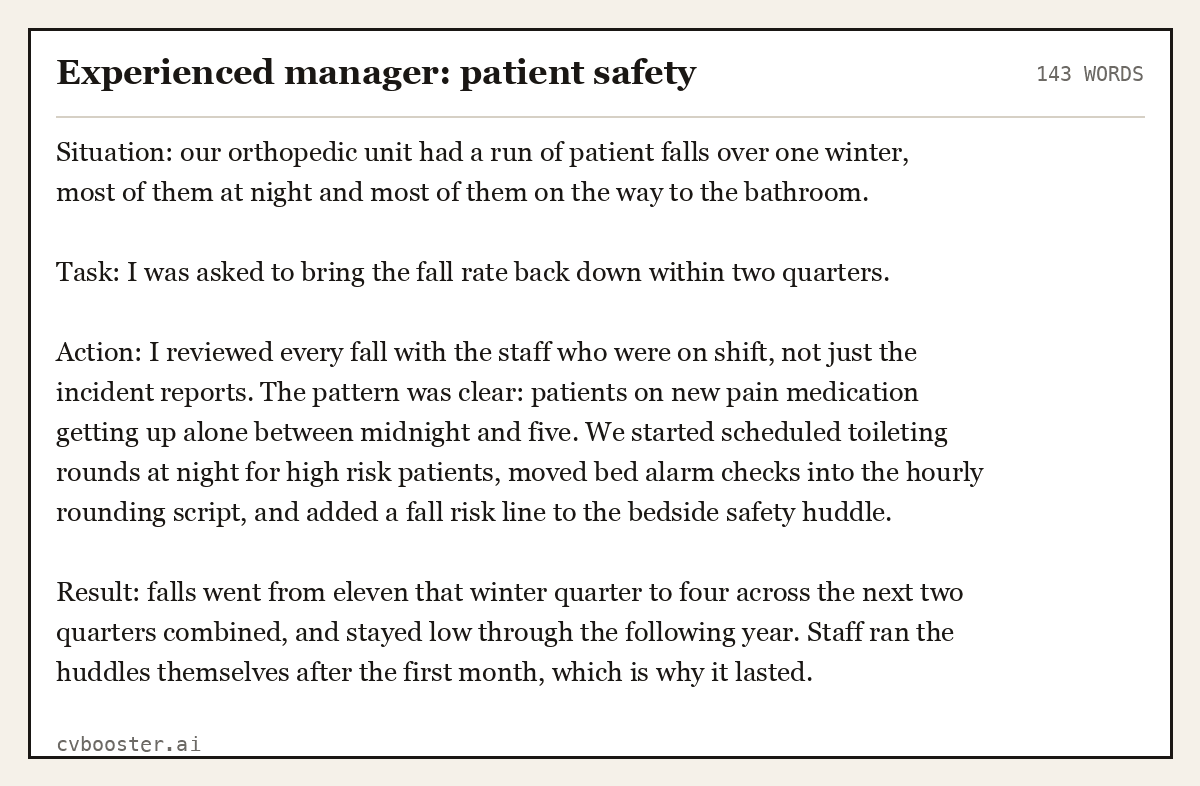
5. How do you improve patient safety on your unit?
Panels want a specific safety problem, the data that showed it, and the change you led. The AHRQ TeamSTEPPS program describes itself as "an evidence-based set of teamwork tools, aimed at optimizing patient outcomes by improving communication and teamwork skills among healthcare teams." Naming a recognized framework like that shows you do not invent safety work from scratch.
Experienced manager: patient safety (143 words)
Situation: our orthopedic unit had a run of patient falls over one winter, most of them at night and most of them on the way to the bathroom.
Task: I was asked to bring the fall rate back down within two quarters.
Action: I reviewed every fall with the staff who were on shift, not just the incident reports. The pattern was clear: patients on new pain medication getting up alone between midnight and five. We started scheduled toileting rounds at night for high risk patients, moved bed alarm checks into the hourly rounding script, and added a fall risk line to the bedside safety huddle.
Result: falls went from eleven that winter quarter to four across the next two quarters combined, and stayed low through the following year. Staff ran the huddles themselves after the first month, which is why it lasted.
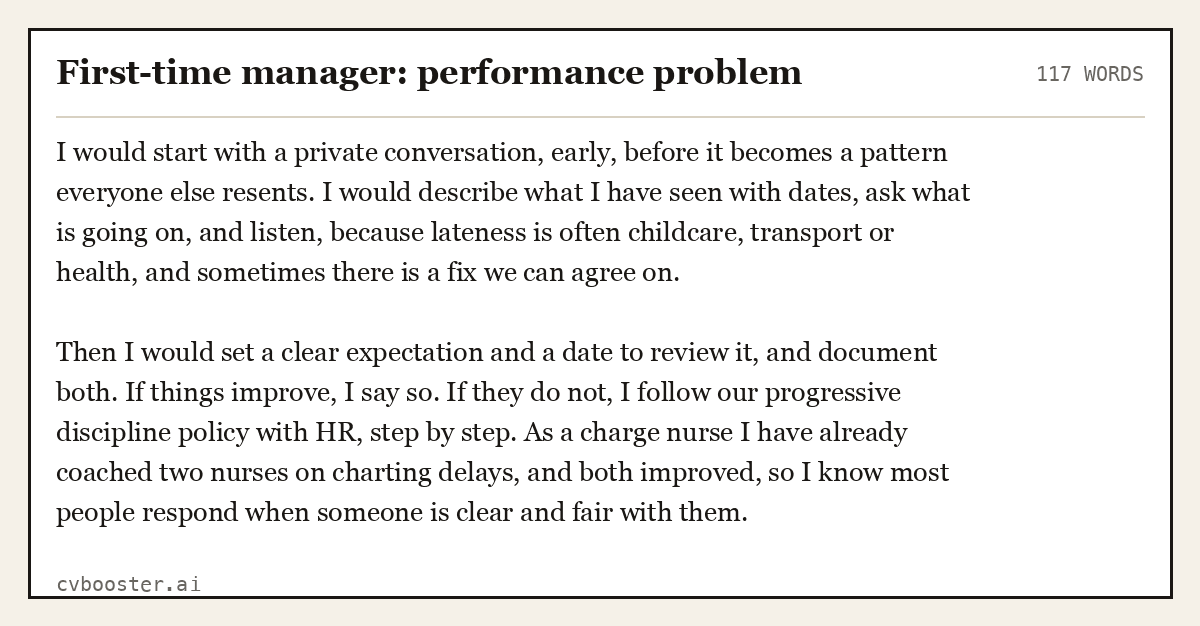
6. How would you handle a nurse who is consistently late or underperforming?
This tests whether you hold people accountable while supporting them. Show the steps, the documentation and the human conversation.
First-time manager: performance problem (117 words)
I would start with a private conversation, early, before it becomes a pattern everyone else resents. I would describe what I have seen with dates, ask what is going on, and listen, because lateness is often childcare, transport or health, and sometimes there is a fix we can agree on.
Then I would set a clear expectation and a date to review it, and document both. If things improve, I say so. If they do not, I follow our progressive discipline policy with HR, step by step. As a charge nurse I have already coached two nurses on charting delays, and both improved, so I know most people respond when someone is clear and fair with them.
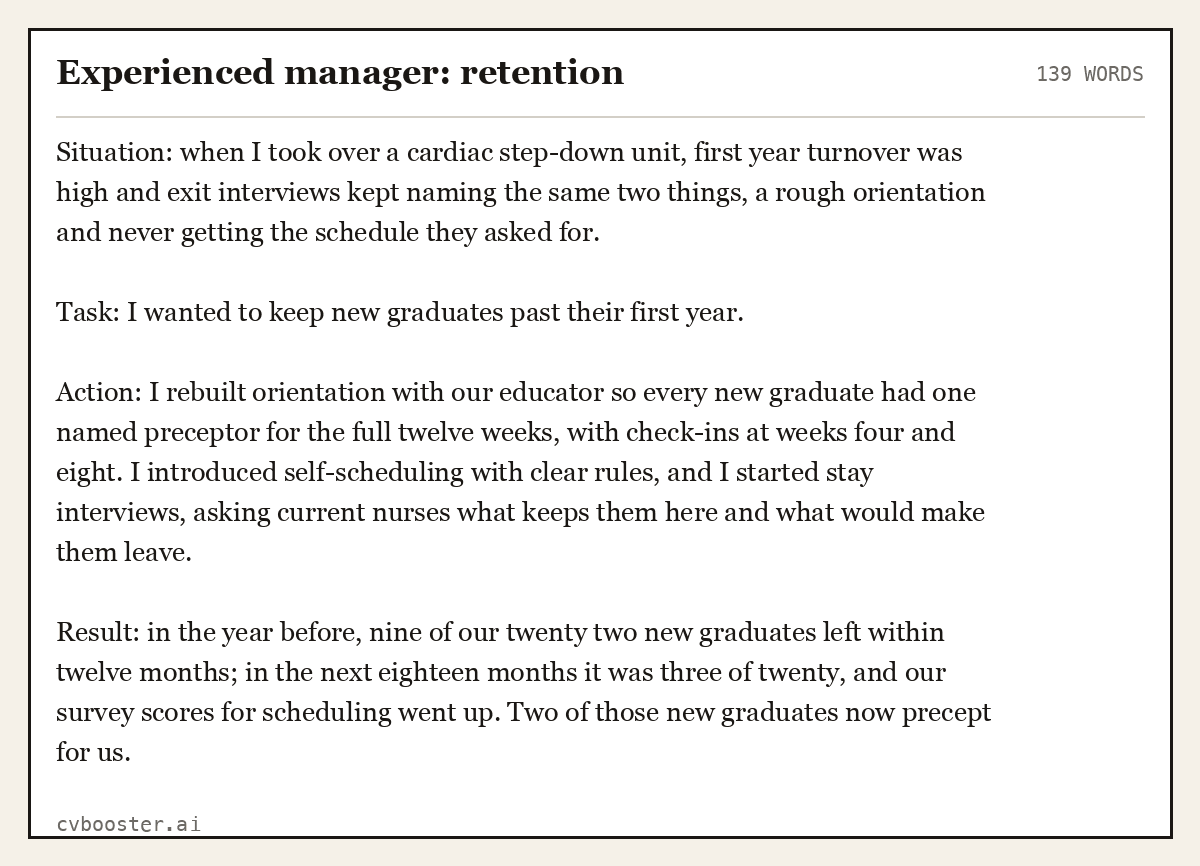
7. How do you keep good nurses from leaving?
Retention is the question behind the question for most directors. Show what you have done, not what you believe.
Experienced manager: retention (139 words)
Situation: when I took over a cardiac step-down unit, first year turnover was high and exit interviews kept naming the same two things, a rough orientation and never getting the schedule they asked for.
Task: I wanted to keep new graduates past their first year.
Action: I rebuilt orientation with our educator so every new graduate had one named preceptor for the full twelve weeks, with check-ins at weeks four and eight. I introduced self-scheduling with clear rules, and I started stay interviews, asking current nurses what keeps them here and what would make them leave.
Result: in the year before, nine of our twenty two new graduates left within twelve months; in the next eighteen months it was three of twenty, and our survey scores for scheduling went up. Two of those new graduates now precept for us.
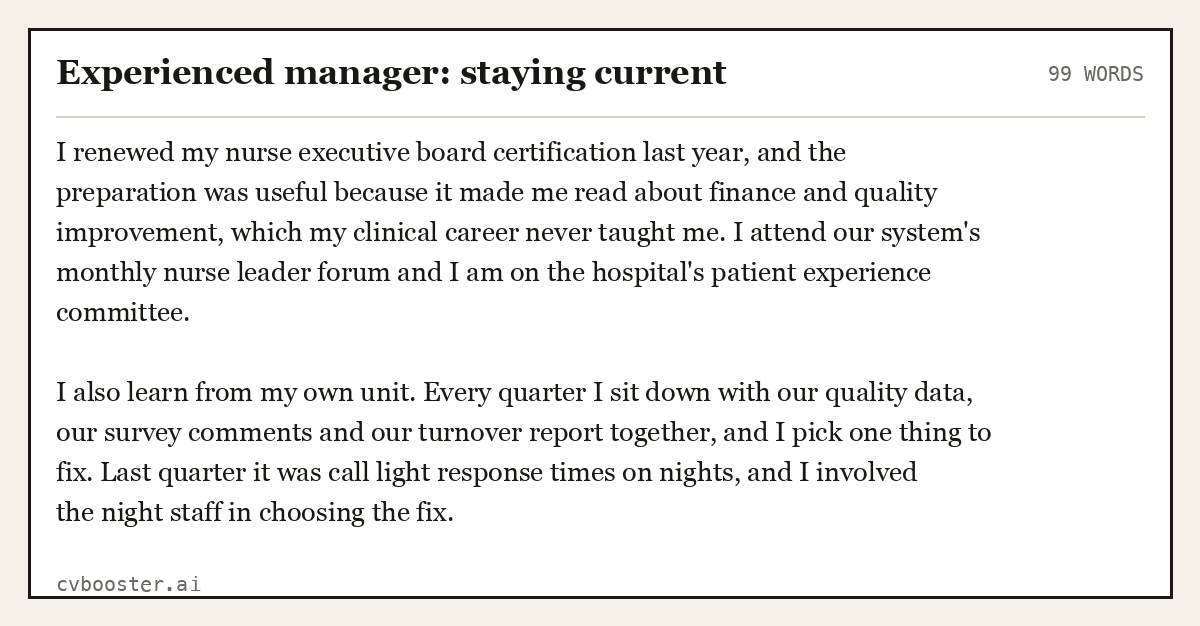
8. How do you stay current as a nurse leader?
Panels want to see that you treat leadership as a skill you build, not a promotion you received. Certification is the easiest proof. The ANCC Nurse Executive certification is aimed at nurses who are "accountable for a single group of nurses and/or non-nursing staff and focus, in part, on daily operations, staffing, staff development, and individual and group performance." That description is close to the nurse manager job itself.
Experienced manager: staying current (99 words)
I renewed my nurse executive board certification last year, and the preparation was useful because it made me read about finance and quality improvement, which my clinical career never taught me. I attend our system's monthly nurse leader forum and I am on the hospital's patient experience committee.
I also learn from my own unit. Every quarter I sit down with our quality data, our survey comments and our turnover report together, and I pick one thing to fix. Last quarter it was call light response times on nights, and I involved the night staff in choosing the fix.
Questions to ask the panel
End with two or three questions that show you are already thinking like the manager of that unit:
- What are the unit's current vacancy and turnover numbers, and what has been tried?
- How much authority will I have over hiring, scheduling and the unit budget?
- What does the director expect from a new manager in the first ninety days?
- How are staff nurses involved in decisions such as scheduling and practice changes?
Before the interview, make sure your resume tells the same story as your answers, and read our questions to ask in an interview guide for more closing questions. The nurse manager resume guide shows how to put unit size, staffing and quality results on one page.
Frequently asked questions
What questions are asked in a nurse manager interview?
Expect questions on why you want to lead, staffing shortages, budgets, conflict between staff, patient safety, performance problems, retention and how you stay current. Staff nurses on the panel focus on fairness and support, while directors focus on money, safety and results. Prepare one real example for each area.
How do I prepare for a nursing manager interview as a first-time manager?
List your leadership moments as a charge nurse, preceptor or committee member, and turn each into a STAR answer with the unit and a number. Learn the basics of a unit budget, read the hospital's quality data if it is public, and prepare honest answers about what you have not done yet.
What is the hardest nurse manager interview question?
For most candidates it is the budget question, because few bedside nurses have owned one. Answer it by naming the levers you know, such as productive hours, overtime and agency use, and by explaining how you would learn the rest from finance in your first month.
What should I bring to a nurse manager interview?
Bring copies of your resume, your license and certification details, and a short list of results you can talk about, such as turnover, overtime or a safety improvement with the time frame. Some panels also welcome a ninety day plan, so prepare one page you can leave behind if asked.
How long is a nurse manager interview?
Many hospitals run more than one round: a screening call with HR, a panel interview with the director and staff nurses, and sometimes a meeting with the chief nursing officer. Ask the recruiter for the format in advance so you can prepare examples for each audience.
Related articles
- Case Manager Interview Questions: 7 Answers That Score
- Creative Interview Questions With 6 Sample Answers
- ED Nurse Interview Questions With 9 Full Sample Answers
- Female Job Interview Attire: Six UK Outfits by Job Type
More articles
- Nurse Practitioner Interview Questions With 9 Full Answers
- Nursery Teacher Interview Questions: 7 Model Answers
- Example of a Nursing CV: 7 UK Nurse CVs, Student to Band 7
Looking for a worked example for your job title? Browse the resume examples by job title.