Transcriptionist Resume Examples: the lines they read
A Transcriptionist Resume That Proves Your Ear and Turnaround
By Mustafa Tarabya, founder of CVBooster · Published · Updated
Transcriptionist resume example with audio hour bullets, style guide and software keywords, plus a section by section writing guide.
Sample resumes for a transcriptionist
The same transcriptionist content laid out in three CVBooster templates, so you can see what the finished document looks like before you write a word.
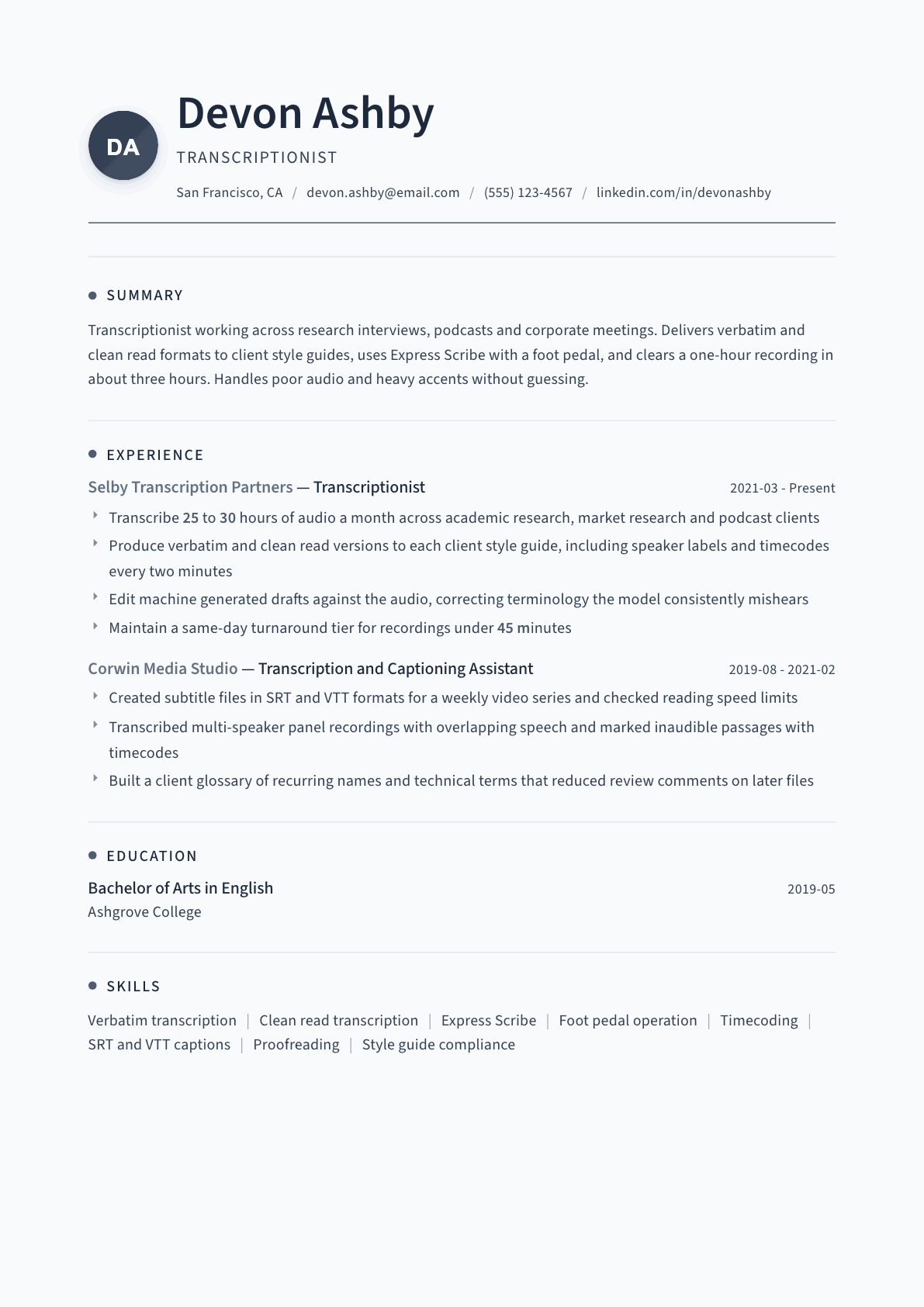
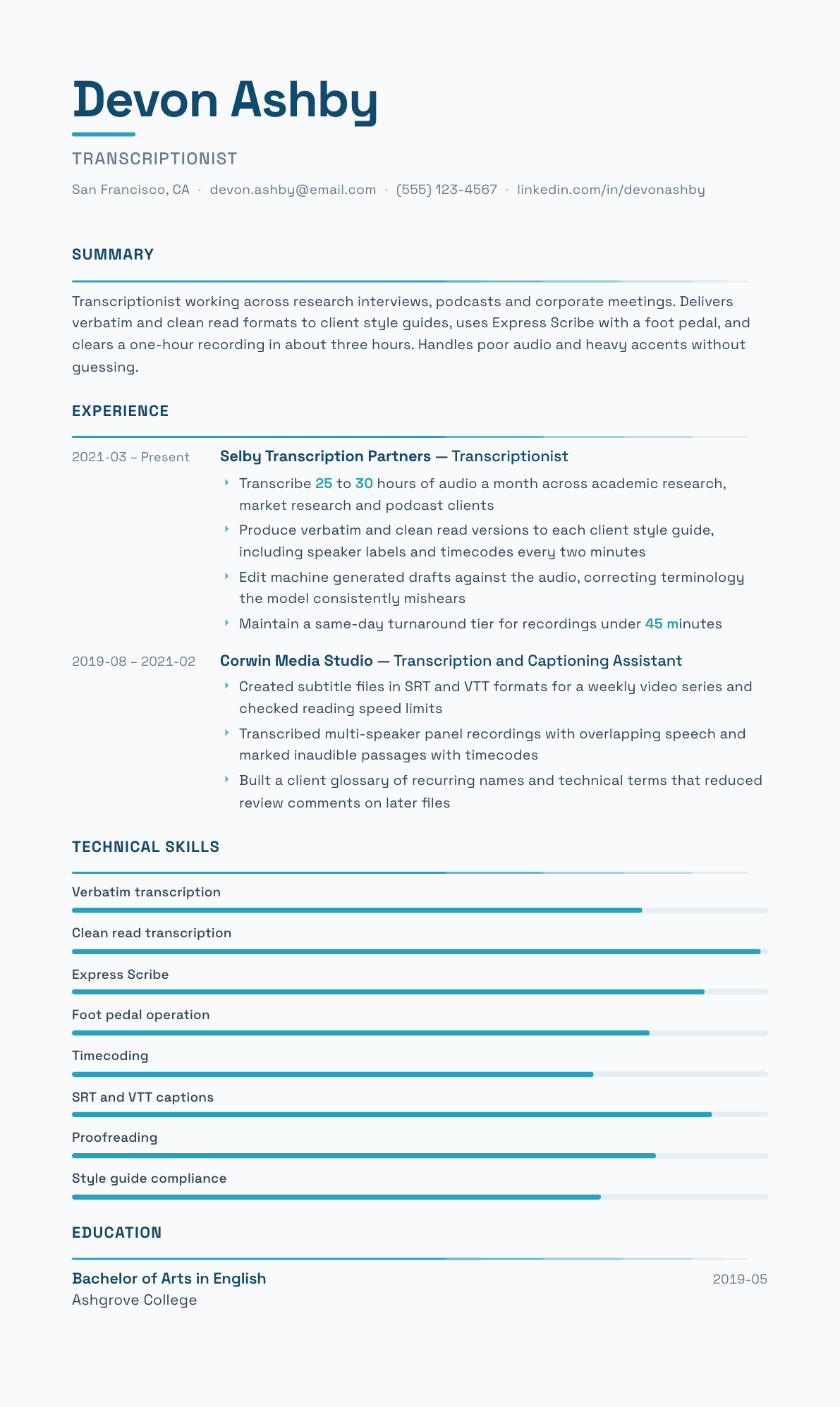
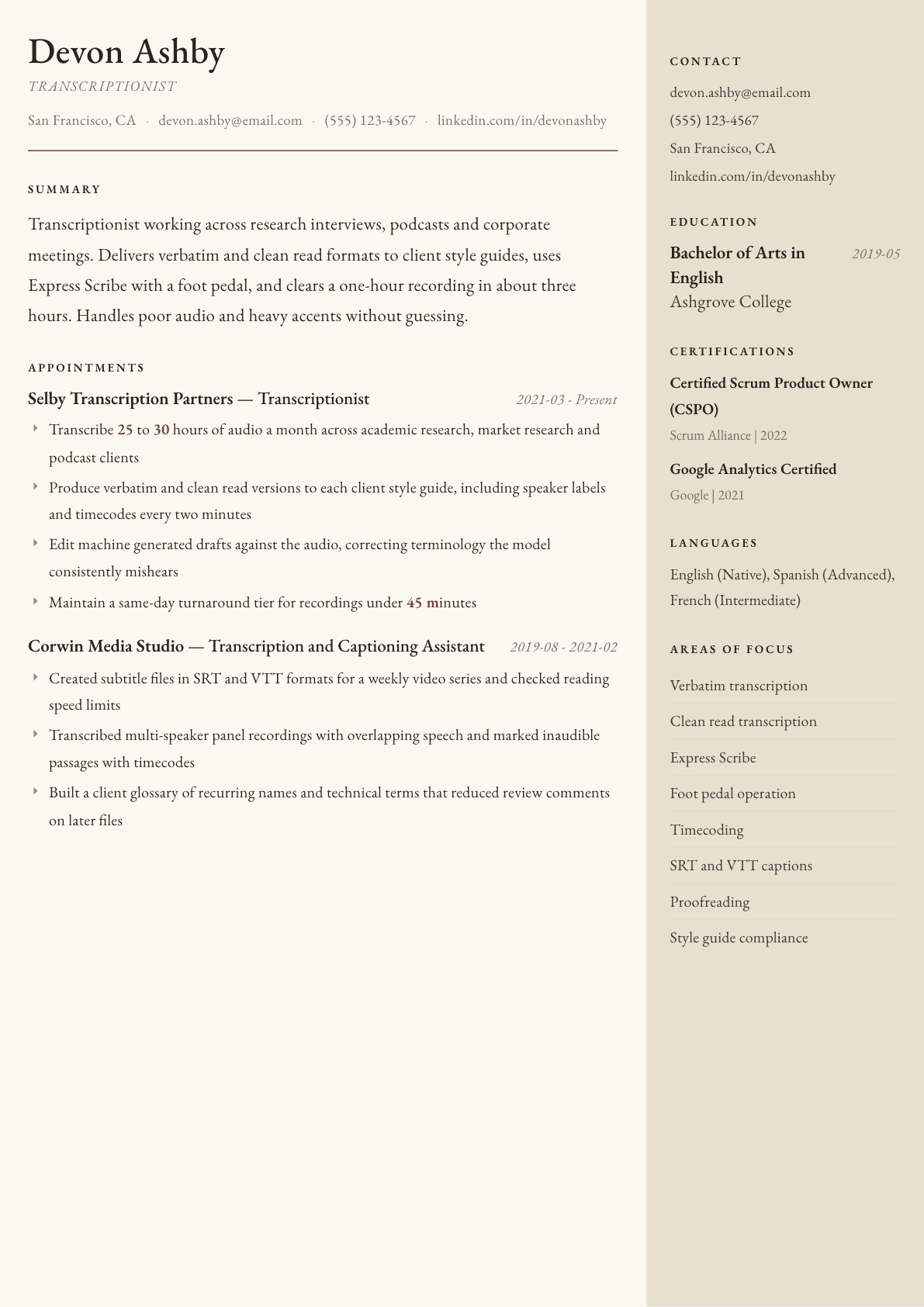
Example Transcriptionist summary
Transcriptionist with six years across research, media and corporate audio. Delivers verbatim and clean read files to client style guides with speaker labels and timecodes, and holds a same-day tier for shorter recordings. Works in Express Scribe with a foot pedal and edits machine drafts against the original audio. Seeking steady contract work with clients who send difficult multi-speaker recordings.
Skills to list on a Transcriptionist resume
- Verbatim transcription
- Clean read transcription
- Intelligent verbatim
- Express Scribe
- Foot pedal operation
- Timecoding
- Speaker identification
- SRT and VTT captions
- Audio cleanup review
- Proofreading
- Style guide compliance
- Glossary building
- Confidential audio handling
- Fast typing
What actually gets this resume read
- Give audio hours per month rather than file counts, because that is the unit transcription managers plan capacity in.
- State your turnaround tiers, since a client hires on how fast a one-hour recording comes back as much as on accuracy.
- Name the formats you deliver: verbatim, clean read, intelligent verbatim, SRT captions, timecoded speaker labels.
- List your tools by name, including Express Scribe, oTranscribe, a foot pedal model, and any captioning software.
- Say how you handle difficult audio: overlapping speakers, background noise, accents, and how you mark inaudible passages.
- Mention subject areas you know well, because medical, legal and technical vocabulary is what separates two applicants.
How to write a transcriptionist resume
Transcription work is bought in audio hours, not documents, and a resume that counts files instead of hours tells a transcription manager nothing about your capacity. The person hiring you is planning a month of client audio against a roster, so the first thing they want is how many hours you deliver and how fast a one-hour recording comes back.
The second thing is format discipline. Verbatim, intelligent verbatim and clean read are different products, and a client style guide will specify speaker labels, timecode intervals, how to mark crosstalk and what to do with an inaudible passage. Transcription managers have all been burned by someone who ignored the guide, so proving you work to one is worth more than proving you type quickly.
This guide covers how to state capacity and turnaround, how to describe difficult audio without sounding like you avoid it, how to present editing of machine generated drafts as skilled work, and which tools and subject areas to name.
Format: one page, capacity stated like a service
Write the resume the way a client would read a service description. One page, single column, with a capacity block near the top: audio hours per month, your turnaround tiers, the formats you deliver and the file types you return. Freelance transcription is bought on those four facts.
If you work for agencies as well as direct clients, group them clearly. A list of a dozen platform names looks scattered, while two headings for agency work and direct clients, each with the audio types and the years, reads as a career.
- Capacity block: hours a month, turnaround tiers, output formats, delivery file types.
- Section order: summary, capacity, experience, tools, subject areas, education.
- State whether you take rush work and how a rush job is priced in time, not money.
Summary: audio type, formats, turnaround
Name the audio you work with first, because research interviews, podcasts, corporate meetings, focus groups and lectures each present a different difficulty. Then the formats you deliver, then your turnaround tier for a short recording. Close with the thing clients keep you for, such as handling multi-speaker recordings without guessing.
Avoid opening with fast and accurate typist. Speed matters less in transcription than judgment about what you cannot hear, and the summary is the place to signal that you mark an inaudible passage with a timecode rather than inventing a plausible word.
Capacity and turnaround: the numbers a manager plans with
Give audio hours per month rather than a word count, and add your working ratio, meaning how long you take per hour of audio. A clean single-speaker recording might take three hours to finish while a four-person panel with crosstalk takes considerably longer, so say which ratio applies to which audio.
Then set out your turnaround tiers plainly: same day for recordings under a certain length, next day for standard work, and a stated limit on how much you accept at once. Clients choose a transcriptionist on the promise they can plan around, and a resume with tiers reads as a professional service rather than an availability guess.
Formats, style guides and difficult audio
List the output formats by their industry names: verbatim with false starts and fillers retained, intelligent verbatim with them removed, clean read edited for readability, and captions delivered as SRT or VTT files with reading speed limits respected. Add speaker labeling conventions and your timecode interval, since those are the first items on most style guides.
Describe how you handle hard audio: overlapping speakers, background noise, low quality phone recordings and unfamiliar accents. Say what you do at the limit, which is to mark the passage inaudible with a timecode and, where the client allows, flag a best guess in brackets. That single sentence tells a manager you will not quietly invent content.
Mention glossary building. A client glossary of recurring names, product terms and technical vocabulary reduces review comments across a project and is one of the few things a transcriptionist can do that visibly saves the client time.
Tools, editing machine drafts, and confidentiality
Name your tools: a playback application such as Express Scribe or a comparable transcription editor, your foot pedal, your headphones, your word processor and any captioning software you use. Tools signal a working setup rather than a laptop and good intentions.
Treat editing of machine generated drafts as its own skill and give it its own bullets. The work is checking the draft against the audio, correcting the terminology the model consistently mishears, restoring speaker attribution and repairing punctuation that changes meaning. Much of the available work is now this, and a resume that only offers typing from scratch reads as narrower than it needs to.
Close with confidentiality. Research interviews, corporate meetings and legal recordings all carry restrictions, so state that you work under confidentiality agreements, keep audio in a controlled location and delete files on the agreed schedule.
Transcriptionist resume summary examples
Starting out
English graduate producing clean read transcripts of research interviews and podcasts, delivering around 10 hours of audio a month with a two-day turnaround. Works in a transcription editor with a foot pedal and follows client style guides for speaker labels and timecodes. Seeking regular contract transcription work.
Three years freelance
Transcriptionist delivering 25 to 30 hours of audio a month across academic research, market research and podcast clients. Produces verbatim and clean read versions to each client style guide with speaker labels and timecodes every two minutes, and holds a same-day tier for recordings under 45 minutes.
Established contractor
Transcriptionist and captioning contractor with seven years across research, media and corporate audio, handling multi-speaker panels with overlapping speech. Edits machine generated drafts against the original recording, delivers SRT and VTT caption files to reading speed limits, and builds client glossaries that cut review comments.
Work experience bullets: before and after
Before: Transcribed audio files for clients.
After: Transcribed 25 to 30 hours of audio a month across academic research, market research and podcast clients, working to each client style guide.
Audio hours are the unit transcription managers plan capacity in, and the client mix shows the range of difficulty handled.
Before: Delivered work quickly.
After: Maintained a same-day turnaround tier for recordings under 45 minutes and a next-day tier for standard work up to two hours.
Stated tiers are a promise a client can plan around, while quickly is a claim nobody can schedule against.
Before: Transcribed difficult recordings.
After: Transcribed multi-speaker panel recordings with overlapping speech, marking inaudible passages with timecodes rather than guessing at unclear words.
The handling rule at the limit of the audio is what proves professional judgment to anyone who has reviewed transcripts.
Before: Edited automatic transcripts.
After: Edited machine generated drafts against the source audio, correcting technical terminology the model consistently mishears and restoring speaker attribution.
Naming what actually goes wrong in a machine draft shows the editing work is skilled rather than a light proofread.
Before: Made subtitles for videos.
After: Created subtitle files in SRT and VTT formats for a weekly video series, checking reading speed limits and line breaks before delivery.
Caption formats and reading speed are the technical checks that separate captioning from plain transcription.
Hard skills
- Verbatim transcription
- Intelligent verbatim
- Clean read transcription
- Speaker identification and labeling
- Timecoding
- SRT and VTT caption files
- Machine draft editing
- Express Scribe
- Foot pedal operation
- Style guide compliance
- Glossary building
- Proofreading and punctuation for meaning
- Confidential audio handling
Soft skills
- Concentrated listening
- Patience with poor audio
- Refusing to guess
- Meeting a promised delivery time
- Taking style corrections cleanly
- Managing several client deadlines
Certifications worth listing
- Certified Realtime Captioner (CRC) (National Court Reporters Association)
Mistakes that cost transcriptionist candidates the interview
- Counting files or word totals instead of audio hours, which is the only capacity unit a transcription manager plans with.
- Promising fast turnaround with no tiers, so a client cannot tell whether a two-hour recording comes back tomorrow or next week.
- Listing verbatim and clean read as if they were the same product, which signals you have not worked to a client style guide.
- Avoiding any mention of difficult audio, when handling crosstalk and accents is the reason a client pays a person.
- Leaving machine draft editing off the resume, which narrows you out of a large share of available work.
- Naming clients who expected confidentiality instead of describing the sector and the audio type.
Transcriptionist resume questions
How do I show transcription experience without naming clients?
Describe the sector and the audio type: academic research interviews, market research focus groups, corporate board meetings or a weekly podcast. Give the monthly hours and the formats delivered, which tells a hiring manager everything useful while respecting the confidentiality terms you signed.
What working ratio should I put on my resume?
Give the ratio honestly and split it by difficulty: a clean single-speaker recording finished in about three hours per audio hour, with more time for multi-speaker or poor quality audio. An inflated ratio is discovered on the first job and costs you the client.
Is transcription experience still worth listing now that software does a first pass?
Yes, because the paid work has shifted toward editing those drafts against the audio, and that requires the same ear plus knowledge of what the model gets wrong. Frame your experience as audio accuracy and format discipline rather than typing speed alone.
Should I list subject areas I know well?
Always. Medical, legal, academic and technical vocabulary is what separates two applicants with the same speed, because unfamiliar terminology is where transcripts go wrong. Name the fields you have real hours in and leave out the ones you have only touched once.
What equipment belongs on a transcriptionist resume?
The playback software, the foot pedal, closed back headphones and any captioning tool you use, plus your usual word processor. It reads as a working setup rather than a hobby, and clients who send difficult audio specifically look for a pedal and proper headphones.
Related resume examples
- Virtual Assistant Resume example
- Administrative Assistant Resume example
- Medical Transcriptionist Resume example
- Editorial Assistant Resume example
- Data Entry Specialist Resume example
- Data Entry Clerk Resume example